Unacademy Business Model And How It Makes Money in India’s EdTech Market

Unacademy is one of India’s largest edtech platforms, built around competitive exam preparation and online learning. It started as a YouTube channel and grew into a multi-hundred-million-dollar company with millions of learners across the country.
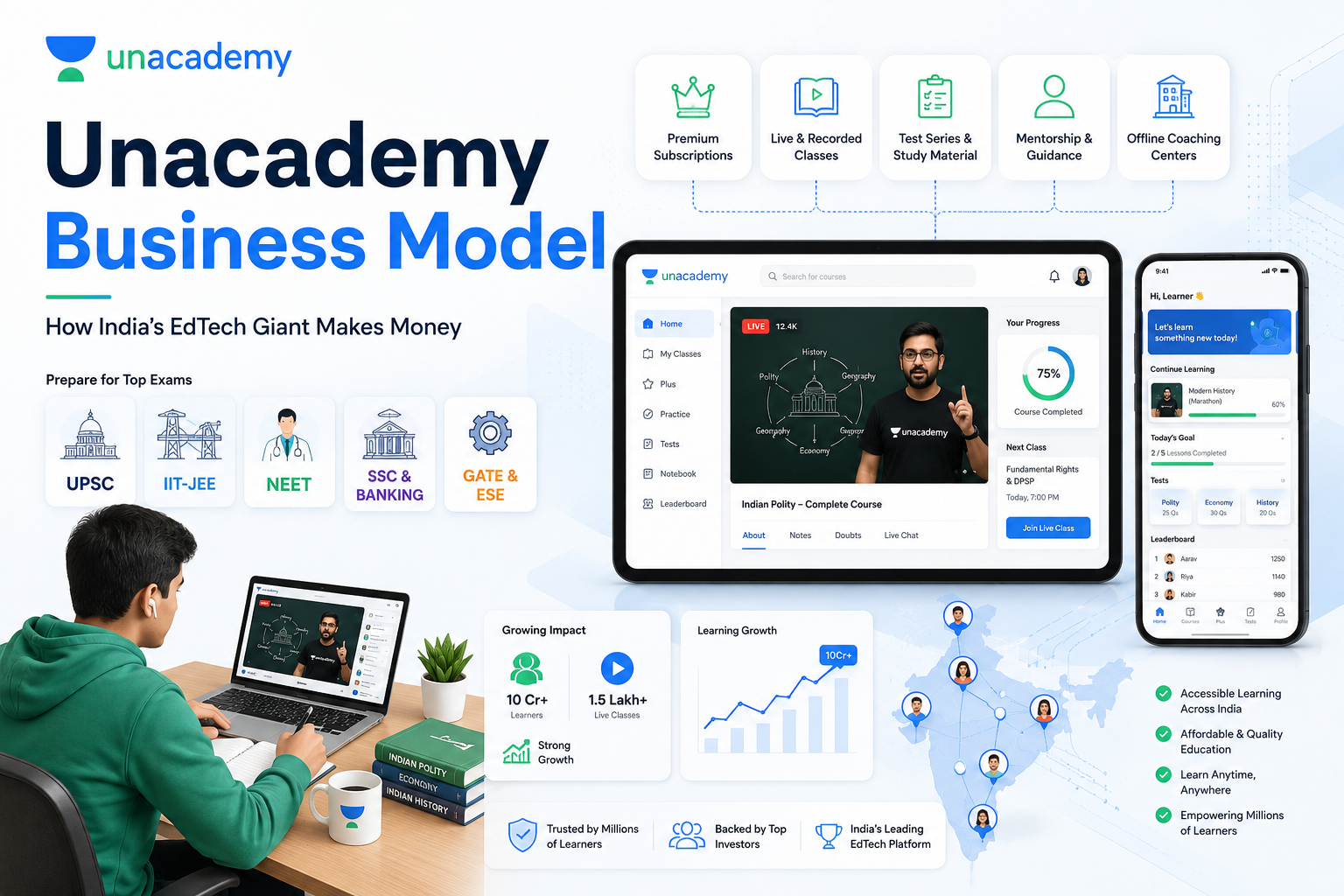
Unacademy earns money primarily through subscriptions, offline coaching centers, premium mentorship programs, and test series products. Its business model combines a creator marketplace with a subscription-based access layer.
What Is Unacademy?
Unacademy is an Indian online education platform that offers courses for competitive exams, academic subjects, and skill development.
Founded in 2015 by Gaurav Munjal, Roman Saini, and Hemesh Singh, Unacademy began as a free YouTube channel where Roman Saini, a former IAS officer, shared UPSC preparation content. The channel gained massive traction because quality exam prep content was hard to find for free online.
By 2016, it had evolved into a full platform. By 2021, it reached unicorn status with a valuation of over $3.4 billion.
Who uses Unacademy:
- Students preparing for UPSC, IIT-JEE, NEET, SSC, Banking, GATE, and CA exams
- Learners in tier-2 and tier-3 cities who cannot access top coaching institutes
- Working professionals looking for skill-based or language learning content
The platform operates across Hindi, English, and multiple regional languages, making it accessible to a wide demographic.
How Does Unacademy Work?
Unacademy connects students with educators through live classes, recorded video content, mock tests, and structured learning programs.
The Student Side
Students download the app or access the web platform and browse courses by exam category. Free content is available to everyone. Premium content sits behind a subscription paywall.
Once subscribed, students get access to:
- Live interactive classes with top educators
- Recorded lectures available on demand
- Structured study plans for specific exams
- Mock tests and practice papers
- PDF notes and study materials
- Doubt-clearing sessions
The mobile app is the primary touchpoint for most users. It includes gamified progress tracking, reminders, and AI-based content recommendations based on your learning history.
The Educator Side
Educators apply to join the platform. Once accepted, they create and deliver courses. Unacademy handles the platform infrastructure, payments, and student acquisition.
Educators earn through a revenue-sharing model. Top educators, called “Star Educators,” get additional benefits like branding support, higher payouts, and visibility on the platform.
Many educators have built massive personal followings through Unacademy, which functions almost like a creator economy platform within the edtech space.
The Technology Layer
Unacademy uses AI to recommend courses, personalize learning paths, and surface the right content at the right time. The platform tracks test performance, watch time, and completion rates to adjust recommendations.
Mobile-first design is central to the experience. Over 90% of users access the platform through smartphones, so the app is optimized for low-bandwidth environments common in smaller Indian cities.
Unacademy Business Model Explained
Unacademy follows a hybrid model that combines an edtech marketplace with a subscription access layer and an expanding offline presence.
At its core, the platform works in three layers:
Marketplace Layer: Educators create content, students consume it, and Unacademy takes a revenue share from subscriptions and paid courses.
Subscription Layer: Students pay monthly or annual fees to access premium content across multiple subjects and educators. This creates predictable recurring revenue.
Hybrid Coaching Layer: Unacademy has expanded into physical offline centers under the Unacademy Centres brand, targeting students who prefer in-person instruction for high-stakes exams.
This combination allows Unacademy to serve multiple audience segments simultaneously, from students in rural India who need affordable online access to students in major cities who want structured physical coaching.
How Unacademy Makes Money
Unacademy earns through subscriptions, offline coaching centers, mentorship programs, test series, and brand partnerships.
Subscription Revenue
Subscriptions are the primary income source for Unacademy. The platform offers two main tiers:
Unacademy Plus: The standard premium plan that gives access to all live and recorded courses in a specific exam category. Pricing varies by exam and duration. Monthly plans are available, but most students opt for longer commitments at discounted rates.
Unacademy Iconic: A higher-tier plan that includes everything in Plus along with personalized mentorship, doubt-clearing sessions, and dedicated support. This is priced significantly higher and targets serious aspirants with the budget for intensive preparation.
Subscription revenue benefits from high predictability. Once a student subscribes for 6 or 12 months, the revenue is locked in, which helps with financial planning and content investment.
Offline Coaching Centers
Unacademy Centres are physical coaching locations set up in major cities. These centers operate similarly to traditional coaching institutes, with scheduled classes, faculty, and a structured curriculum.
This move was strategic. A large portion of Indian exam aspirants still prefer physical classrooms for discipline and peer interaction. By entering this space, Unacademy captures a segment that purely online platforms cannot reach.
Offline centers generate revenue through enrollment fees and bundled online-offline packages. They also serve as a brand-building tool in local markets.
Premium Mentorship Programs
Beyond standard subscriptions, Unacademy sells mentorship programs where students work directly with top educators or rank holders.
These programs include:
- Personalized study plans
- One-on-one doubt sessions
- Interview preparation for exams like UPSC
- Performance tracking and feedback
Mentorship programs are priced at a premium and target students who are making a serious multi-year investment in exam preparation. The ticket size is significantly higher than standard subscriptions.
Test Series and Study Materials
Unacademy sells standalone test series for students who may not need a full subscription but want structured practice.
Products include:
- Full-length mock exams modeled after actual competitive exams
- Subject-wise practice paper sets
- Previous year question paper compilations
- Premium PDF notes created by top educators
These products attract students at different budget levels and serve as an entry point for upselling to full subscriptions.
Brand Partnerships and Sponsorships
Unacademy partners with companies for sponsored content, co-branded programs, and advertising within the platform ecosystem.
This includes:
- Corporate sponsorships of free content and live events
- Co-branded scholarship programs
- Advertising on the Unacademy YouTube channels, which collectively have tens of millions of subscribers
This revenue stream is smaller than subscriptions but growing, particularly as Unacademy’s brand recognition has increased.
Unacademy Revenue Streams Breakdown
Subscription-based revenue contributes the largest share of Unacademy’s income, followed by offline centers and premium programs.
| Revenue Stream | Description | Importance |
|---|---|---|
| Plus Subscription | Premium access to live and recorded courses | High |
| Iconic Subscription | All-in-one premium with mentorship | High |
| Offline Centers | Physical coaching enrollment fees | Growing |
| Mentorship Programs | Personalized exam guidance | Medium |
| Test Series | Standalone mock exams and practice papers | Medium |
| Brand Partnerships | Sponsorships and co-branded content | Low to Medium |
Unacademy Cost Structure
Unacademy spends heavily on educator payouts, marketing, technology infrastructure, and offline operations.
Major expense categories:
- Educator Payments: Top educators receive guaranteed salaries or high revenue shares. Some star educators reportedly earn crores annually. This is a significant fixed cost.
- Marketing and Customer Acquisition: Unacademy has historically spent aggressively on ads, celebrity endorsements, and IPL sponsorships. This drove growth but also contributed to high cash burn.
- App Development and Technology: Maintaining a platform that serves millions of concurrent users requires constant investment in engineering, servers, and AI infrastructure.
- Offline Center Operations: Running physical coaching centers involves rent, faculty salaries, utilities, and administrative staff, adding to operational complexity.
- Acquisitions: Unacademy has acquired multiple companies including Relevel, CodeChef, and PrepLadder. Integration costs and acquisition premiums add to the expense base.
- Employee Salaries: The company employs a large workforce across product, operations, and support functions.
The cost structure is top-heavy, which is why Unacademy has been focused on reducing burn rate and improving unit economics in recent years.
Unacademy Growth Strategy
Unacademy scaled rapidly through free content funnels, celebrity educator branding, and aggressive acquisition of niche platforms.
Free YouTube Funnel
Unacademy’s YouTube channels were a core growth engine. By distributing free high-quality content on YouTube, the platform built trust and awareness with millions of students before asking them to pay for a subscription.
This free-to-paid conversion model is similar to what many SaaS companies use, applied to education.
Celebrity Educator Strategy
Unacademy invested heavily in recruiting well-known educators with large existing audiences. These educators brought their followers to the platform, reducing paid customer acquisition costs.
Educators became brand ambassadors. Their names and faces appeared in advertising campaigns, creating a personality-driven brand identity that resonated with students.
Regional Language Expansion
By offering content in Hindi and regional languages, Unacademy tapped into markets that English-only platforms ignored. This was critical for penetrating tier-2 and tier-3 cities where the majority of competitive exam aspirants live.
Acquisitions
Unacademy used funding to acquire complementary platforms:
- PrepLadder for medical entrance preparation
- CodeChef for competitive programming
- Relevel for job placement and skill assessment
- Mastree for K-12 learning
Each acquisition added a new category and user base without building from scratch.
Offline Expansion
The move into physical coaching centers allowed Unacademy to compete directly with legacy players like Allen and Aakash. It also created a hybrid product that combined online content access with in-person instruction.
Why Unacademy Became Popular in India
Affordable competitive exam preparation delivered through mobile made Unacademy accessible to millions of students who previously had limited options.
Key reasons for growth:
- Price advantage: A yearly Unacademy Plus subscription costs a fraction of what Kota coaching institutes charge. For families in smaller cities, this price difference is decisive.
- Geographic access: Students in cities without top coaching centers could now access the same quality content from their phones.
- Live and interactive classes: Unlike pre-recorded video platforms, Unacademy offered live classes where students could ask questions in real time.
- Mobile-first design: With India’s cheap mobile data, a well-optimized mobile app became a major advantage.
- Strong educator community: Reputable educators on the platform built trust with students, making Unacademy a credible alternative to established institutes.
Challenges in Unacademy’s Business Model
High competition, heavy marketing spend, and the difficulty of scaling offline operations are the core challenges Unacademy faces.
Competition from Physics Wallah: Physics Wallah disrupted the market with extremely low prices. Its ability to deliver competitive exam content at a fraction of Unacademy’s pricing put pressure on subscriber growth and retention.
BYJU’S and the edtech slowdown: The broader edtech sector saw declining growth post-pandemic as students returned to physical schools and coaching centers. This affected all major platforms including Unacademy.
High customer acquisition costs: Aggressive marketing through IPL, television, and digital ads built brand awareness but at a high cost per subscriber. Improving this ratio is a core operational challenge.
Retention issues: Students subscribe for a specific exam cycle. If they pass or give up, they churn. Building long-term repeat revenue requires constant new student acquisition.
Offline complexity: Running physical centers adds real estate costs, local hiring challenges, and operational overhead that a purely digital business does not face.
Unacademy vs Traditional Coaching Institutes
Unacademy offers scalability and affordability while traditional coaching institutes provide structure and in-person discipline.
| Factor | Unacademy | Traditional Coaching |
|---|---|---|
| Accessibility | Nationwide, any device | Location dependent |
| Pricing | Significantly lower | Expensive |
| Schedule Flexibility | High, on-demand content | Fixed class schedules |
| Learning Mode | Online and hybrid | Primarily offline |
| Scalability | Millions of students | Limited by classroom size |
| Interaction | Live chat and Q and A | Face-to-face |
| Track Record | Growing | Decades of results |
For students in metro cities with access to top institutes, traditional coaching still holds appeal. For everyone else, Unacademy’s model is more practical.
Competitors of Unacademy
Unacademy operates in a competitive market with several well-funded and growing rivals.
BYJU’S: The largest edtech company in India by funding and brand recognition. Focuses on K-12 and test prep with a heavy sales-led model.
Physics Wallah: Fastest-growing competitor. Known for aggressive pricing and high-quality faculty. Became a unicorn in 2022 and directly targets Unacademy’s core market.
Vedantu: Live online tutoring platform focused on K-12 and competitive exams. Known for its WAVE platform and structured classroom experience.
Testbook: Focused specifically on government job exams like SSC, Railway, and Banking. Has strong traction in this specific category.
Adda247: Another competitive exam-focused platform with a strong presence in banking and government job preparation.
Each competitor has carved out a positioning, making differentiation critical for Unacademy.
Is Unacademy Profitable?
Unacademy has prioritized growth and market share over profitability and is actively working to reduce losses and move toward sustainable operations.
Unacademy has raised over $860 million in funding from investors including SoftBank, Tiger Global, Sequoia India, and Facebook. This capital funded aggressive expansion, marketing, and acquisitions.
However, the company has reported significant losses. Like most edtech companies, it operated with high burn during the growth phase. Post-2022, the company shifted focus toward cost optimization, including layoffs across multiple rounds.
Efforts toward profitability:
- Reducing marketing spend
- Cutting underperforming business units
- Focusing on higher-margin subscription products
- Rationalizing offline expansion
Unacademy has not publicly reported reaching profitability, but management has indicated a path toward sustainable unit economics. The company continues to operate with investor backing while working to reduce its cost base.
Lessons Startups Can Learn From Unacademy
Unacademy demonstrates how a creator-led, community-driven education platform can scale rapidly when it solves a high-stakes real-world problem.
Build audience before monetizing: Unacademy’s YouTube presence built massive trust before the subscription model launched. The free funnel reduced initial friction and accelerated growth.
Focus on niche demand: Competitive exam preparation is a high-urgency, high-spending category. Students invest significant money and time because the stakes are high. Focusing here rather than general education allowed Unacademy to monetize effectively.
Treat educators as creators: By giving educators a platform to build their personal brand, Unacademy turned content creation into a competitive advantage and a retention tool.
Mobile-first is non-negotiable in India: Designing for mobile and low-bandwidth conditions allowed Unacademy to serve markets that desktop-first platforms missed entirely.
Hybrid expansion adds reach: Moving into offline centers was counterintuitive for a digital company but strategically smart. It addressed a segment of the market that pure online platforms were losing.
Future of Unacademy
Unacademy is likely to focus on profitability, AI-driven personalization, offline growth, and expansion into new educational categories.
AI personalization: As AI tools become more capable, Unacademy can use them to build adaptive learning paths that adjust based on individual student performance. This could improve outcomes and retention.
Offline center growth: Physical coaching remains a large market in India. Expanding Unacademy Centres strategically in high-demand cities could open significant revenue.
Regional market deepening: Demand for vernacular-language content continues to grow. Doubling down on regional language courses could open new subscriber segments.
Skill-based learning: Beyond competitive exams, India’s workforce needs upskilling in technology, finance, and business. Unacademy’s Relevel acquisition pointed toward this direction.
International opportunities: Indian diaspora populations and neighboring markets with similar exam-driven education cultures could be long-term expansion targets.
Wrapping Up on Unacademy Business Model
Unacademy built a scalable edtech business by solving a problem that millions of Indian students face: accessing quality competitive exam preparation without relocating to Kota or spending lakhs at coaching institutes.
Its revenue model is built on subscriptions as the foundation, with offline coaching, mentorship, and test series as supporting layers. The cost structure is heavy, but the company is actively working to improve its efficiency.
The long-term sustainability of Unacademy depends on its ability to retain subscribers, reduce acquisition costs, and grow revenue from higher-margin products like mentorship and offline centers. The competition from Physics Wallah makes pricing strategy critical.
What Unacademy got right was timing, distribution, and creator strategy. What it now needs to prove is that the business can operate profitably at scale. Given the scale of India’s exam preparation market and Unacademy’s brand recognition, the opportunity remains large.
FAQs
Unacademy uses a hybrid edtech marketplace and subscription model. Educators create and deliver courses, students pay subscription fees for premium access, and Unacademy takes a revenue share. It also operates offline coaching centers and sells standalone test series products.
Unacademy makes money through Unacademy Plus and Iconic subscriptions, offline coaching center enrollments, premium mentorship programs, standalone test series, and brand partnerships and sponsorships.
Unacademy is not yet publicly confirmed as profitable. The company has reported losses over multiple years and has been working to reduce burn through cost-cutting, layoffs, and focusing on higher-margin products. It continues to operate with significant investor backing.
Unacademy’s main competitors include Physics Wallah, BYJU’S, Vedantu, Testbook, and Adda247. Physics Wallah is currently its most aggressive competitor in the competitive exam prep space.
Unacademy succeeded by offering affordable competitive exam preparation through mobile, distributing free content on YouTube to build trust, and recruiting well-known educators who brought existing student audiences to the platform.
Yes. Unacademy operates physical coaching centers under the Unacademy Centres brand in multiple Indian cities. These centers offer structured in-person classes for competitive exams alongside access to the online platform.
Unacademy Plus is the core premium subscription tier. It gives subscribers access to all live and recorded courses within a chosen exam category. Pricing varies by exam type and subscription duration, with discounts for longer commitments.
Unacademy was founded by Gaurav Munjal, Roman Saini, and Hemesh Singh. Roman Saini, a former IAS officer, originally created the YouTube channel that became Unacademy. Gaurav Munjal serves as the CEO.
Discover more from Business Model Hub
Subscribe to get the latest posts sent to your email.