Sonder Business Model How It Makes Money Without Owning Most of Its Properties

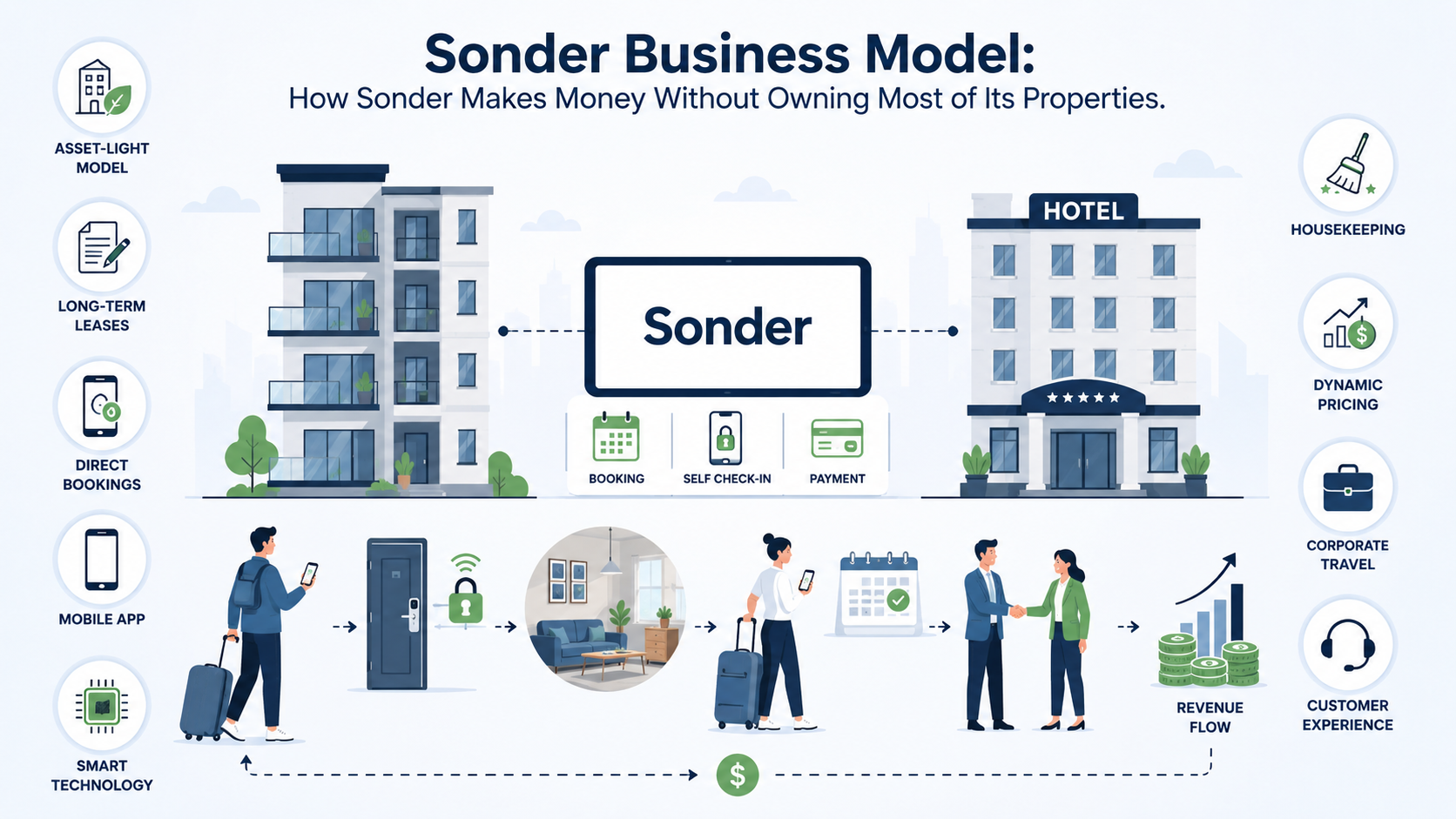
Sonder was a technology-driven hospitality company that offered apartment-style accommodations with hotel-like consistency. It leased properties, furnished them to brand standards, and managed operations through a digital platform.
Sonder operated on a lease arbitrage model. It signed long-term leases on apartment buildings, renovated and furnished units, and rented them short-term to travelers at higher nightly rates than the long-term lease costs.
Sonder generated revenue primarily through room bookings, extended stay rentals, corporate travel accommodations, premium pricing during peak demand, and additional guest services like late checkout and parking.
Unlike traditional hotels, Sonder didn’t own most of its properties. Unlike Airbnb, Sonder controlled the entire guest experience because it managed operations directly rather than being a peer-to-peer marketplace.
Sonder’s asset-light strategy promised rapid scaling with lower capital requirements. However, the fixed costs of long-term leases proved unsustainable when occupancy fluctuated, leading to the company’s collapse in 2025.
Introduction
Sonder emerged as one of the most discussed hospitality startups of the past decade. The company promised to revolutionize urban accommodation by combining apartment-style living with hotel-grade consistency. Its tech-enabled approach and asset-light business model attracted significant investor attention.
The shift toward tech-enabled hospitality gained momentum as travelers sought alternatives to traditional hotels. Sonder positioned itself at the intersection of this trend, offering digital check-in, consistent design standards, and apartment amenities. This article examines Sonder’s business model, revenue streams, and the lessons from its rise and fall.
What Is Sonder?
Company Overview
Sonder Holdings Inc. was a technology-driven hospitality company headquartered in the United States. The company operated a hybrid model between traditional hotels and short-term apartment rentals. It managed furnished units in urban centers that were bookable through its digital platform and major online travel agencies.
Founding Story
Francis Davidson and a group of university students founded Sonder in 2014. They were frustrated with the inconsistency of short-term stays. Their idea was straightforward: combine the reliability of hotels with the space and design of vacation rentals under one brand.
Mission and Vision
Sonder aimed to transform the global hospitality industry through a digitally centered, design-oriented, and competitively priced accommodation offering. The company wanted to create a consistent guest experience that stood apart from the heterogeneous quality of private short-term rentals while remaining more flexible and tech-savvy than traditional hotels.
Global Presence
At its peak, Sonder operated in more than 40 cities across 10 countries. The company had approximately 9,900 hotel rooms and furnished apartments available across 41 cities in nine countries by late 2024. Sonder properties could be found in destinations including San Diego, New Orleans, London, Barcelona, Dubai, and New York.
Target Customers
Sonder’s primary customer segments included business travelers, remote workers, digital nomads, families, vacation travelers, long-stay guests, and corporate clients. The company particularly attracted digital nomads and business guests who wanted hotel-like amenities in a home-style space. Many Sonder guests stayed longer than the average short-term rental guest, often booking for work trips or extended visits.
Sonder at a Glance
| Category | Details |
|---|---|
| Founded | 2014 |
| Founders | Francis Davidson and university classmates |
| Headquarters | United States |
| Industry | Hospitality / Short-term Rentals |
| Business Type | Technology-enabled Hospitality Operator |
| Revenue Model | Accommodation bookings and ancillary services |
| Customers | Business travelers, remote workers, families, corporate clients |
| Operating Countries | United States, Canada, United Kingdom, France, Spain, UAE, and others |
The Sonder Business Model Explained
Asset-Light Hospitality Model
Sonder pursued an asset-light strategy. Instead of buying properties, the company leased buildings from owners. This approach required less capital for expansion compared to traditional hotel chains that construct or purchase their own real estate.
Long-Term Leasing Instead of Ownership
Sonder signed long-term leases on apartment buildings or large sections of them. The company committed to fixed periodic fees per unit, often with negotiated rent escalations. This practice set Sonder apart from most hotel companies, which license their brands to property investors to stay asset-light.
Technology-Driven Operations
Technology sat at the core of Sonder’s operations. The company used a mobile-first approach with digital check-in, keyless entry, and app-based guest support. Sonder branded itself as a technology company, though it operated in the capital-intensive hospitality sector.
Centralized Management
Sonder managed all properties centrally. This included marketing, housekeeping, maintenance, pricing, and guest communications. The centralized approach aimed to deliver consistent quality across all locations.
Standardized Guest Experience
Every Sonder unit featured modern furnishings, high-speed Wi-Fi, professional cleaning, and hotel-like amenities. Guests knew what to expect regardless of the city. This consistency represented Sonder’s key differentiator from the variable quality found on peer-to-peer platforms.
How Sonder Works (Step-by-Step)
Step 1: Finds High-Potential Buildings
Sonder identified buildings in urban markets with strong travel demand. The company targeted properties in business hubs, tourism centers, and cities with growing remote work populations.
Step 2: Signs Long-Term Lease Agreements
The company entered into master lease agreements with building owners. These fixed leases required Sonder to pay rent regardless of occupancy levels. The leases often spanned multiple years and covered entire buildings or large blocks of units.
Step 3: Designs and Furnishes Every Unit
Sonder renovated and furnished each unit to its brand standards. The company invested significant capital in interior design, furniture, appliances, and smart home technology. This standardization created the consistent experience Sonder promised guests.
Step 4: Lists Properties on Its Platform and OTAs
Sonder listed properties through its own website and app, as well as third-party online travel agencies. Three OTAs represented approximately 28%, 18%, and 11% of revenues in mid-2025. Major booking platforms included Expedia, Booking.com, and others.
Step 5: Guests Book Digitally
Guests booked stays through Sonder.com, the Sonder app, or online travel agencies. In April 2025, Sonder began integrating with Marriott’s booking systems, with Marriott channels fully replacing Sonder’s direct booking functionality by July 2025.
Step 6: Automated Check-In
Check-in operated entirely through the Sonder app. Guests received door codes digitally and accessed their units without meeting staff. This contactless process reduced staffing costs but required reliable technology.
Step 7: Digital Guest Support
Sonder provided guest support through the app and digital channels. While the company advertised 24/7 support, actual hospitality operations still required human staff for lockouts, maintenance issues, and other problems.
Step 8: Cleaning and Turnover Management
Professional cleaning teams prepared units between guests. Sonder managed these operations centrally, aiming to ensure consistent cleanliness standards across all properties.
Value Proposition
For Travelers
Hotel-quality consistency represented Sonder’s primary value to travelers. Every property followed the same design and service standards. Guests enjoyed apartment-style living with more space, kitchens, and in-unit laundry compared to hotel rooms. Self check-in eliminated front desk wait times. The digital-first experience appealed to tech-savvy travelers. Competitive pricing often undercut traditional hotels in the same markets.
For Property Owners
Guaranteed lease income attracted property owners to Sonder. The company paid fixed rents regardless of occupancy. Professional property management removed the burden of finding individual tenants. Better occupancy rates than traditional long-term rentals made Sonder an attractive partner. Long-term partnerships provided stability for property owners.
Customer Segments
Business travelers valued Sonder’s apartment-style accommodations for extended work trips. Remote workers appreciated the reliable Wi-Fi and comfortable workspaces. Digital nomads favored the consistency across different cities. Families preferred the extra space and kitchen facilities. Vacation travelers sought the modern design and convenient locations. Long-stay guests benefited from competitive weekly and monthly rates. Corporate clients used Sonder for employee relocation and project team accommodations.
Revenue Streams
Room Bookings
Room bookings generated Sonder’s primary revenue. Guests paid nightly rates for accommodations. Revenue came from direct bookings through Sonder’s platforms and indirect bookings through online travel agencies.
Extended Stay Rentals
Weekly and monthly stays represented a significant revenue source. Extended stays often provided more stable occupancy than nightly rentals. Sonder targeted remote workers and business travelers who needed accommodations for weeks at a time.
Corporate Travel
Business accommodation partnerships generated steady revenue. Corporate clients booked blocks of rooms for employees. These relationships provided predictable income and higher occupancy during weekdays.
Premium Room Pricing
Dynamic pricing algorithms increased rates during peak demand. Sonder adjusted prices based on occupancy, local events, and seasonal patterns. Higher pricing during high-demand periods maximized revenue per available room.
Additional Guest Services
Late checkout fees, parking charges, room upgrades, and other add-ons contributed ancillary revenue. These services provided incremental income without significant additional costs.
Cost Structure
Long-term lease payments represented Sonder’s largest fixed cost. The company remained obligated to pay rent even when occupancy dropped. Property furnishing required significant upfront capital for each new location. Technology development costs included the mobile app, booking platform, and operational systems. Housekeeping and maintenance expenses scaled with occupancy but required staffing regardless. Customer support costs included digital channels and human staff for complex issues. Marketing expenses covered SEO, performance advertising, and brand building. Staff salaries included management, operations, and corporate personnel. Insurance and utilities added ongoing operational costs.
Key Resources
The technology platform formed the backbone of Sonder’s operations. The mobile app enabled guest booking, check-in, and support. The property portfolio represented Sonder’s inventory of bookable units. Brand reputation attracted guests seeking consistent quality. The operations team managed day-to-day property functions. Guest data informed pricing and marketing decisions. Design expertise created the standardized aesthetic that distinguished Sonder from competitors.
Key Partners
Real estate developers provided properties for Sonder to lease. Property owners entered into master lease agreements. Cleaning partners maintained units between guests. Maintenance companies handled repairs and upkeep. Payment providers processed guest transactions. Online travel agencies distributed Sonder inventory to a broader audience. Technology vendors supplied the software and hardware powering Sonder’s operations.
Marketing Strategy
Search engine optimization drove organic traffic to Sonder’s booking platforms. Performance marketing targeted travelers searching for accommodations in Sonder cities. The mobile app served as a direct booking channel. Email marketing engaged past guests with promotions and new property announcements. Referral programs encouraged existing guests to recommend Sonder to others. Social media showcased property design and guest experiences. Content marketing built brand awareness through travel and lifestyle articles. Online travel agencies expanded Sonder’s reach to new customers. Customer reviews built trust and social proof. Corporate partnerships generated business travel bookings.
Technology Behind Sonder
Contactless check-in eliminated front desk staffing requirements. Smart locks provided keyless entry through mobile devices. Dynamic pricing algorithms adjusted rates based on real-time demand. Property management software coordinated operations across locations. Revenue management systems optimized pricing for maximum profitability. AI-powered customer support handled common guest inquiries. Data analytics informed decisions about pricing, marketing, and property selection.
Why Sonder Doesn’t Need to Own Hotels
Asset-Light Strategy
Sonder avoided the capital requirements of property ownership. Leasing instead of buying allowed faster expansion with less upfront investment. The company could scale without traditional real estate financing.
Lower Capital Requirements
Each new property required less capital than purchasing a building. Sonder invested in furnishings and technology rather than real estate. This model appealed to investors seeking rapid growth.
Faster Expansion
The lease model enabled Sonder to enter new cities quickly. The company could open properties as soon as leases were signed and units furnished. Traditional hotels face longer development timelines.
Better Scalability
Asset-light operations scaled more easily than asset-heavy models. Sonder could add properties without managing a real estate portfolio. The centralized technology platform supported growth across markets.
Higher Operational Flexibility
Sonder could exit underperforming markets when leases expired. Property ownership would have required selling assets. The lease model provided more flexibility to optimize the portfolio.
Competitive Advantages
Consistent brand experience distinguished Sonder from variable-quality alternatives. Technology-first operations reduced staffing costs and enabled digital guest experiences. The apartment-hotel hybrid appealed to travelers wanting space and amenities. Lower operating costs than traditional hotels enabled competitive pricing. Global scalability attracted investor interest and enabled rapid expansion. The direct booking ecosystem reduced dependence on third-party platforms.
Challenges in Sonder’s Business Model
Lease Obligations During Low Demand
Fixed lease payments continued regardless of occupancy. When travel demand dropped, Sonder still owed rent. This obligation created financial pressure during economic downturns or seasonal slumps.
High Furnishing Costs
Each new property required significant investment in furniture and design. These upfront costs needed to be recovered through bookings. Rapid expansion required substantial capital for furnishings.
Economic Downturns
Recessions and travel restrictions reduced demand for accommodations. Sonder’s fixed costs made the company vulnerable to economic cycles. The COVID-19 pandemic demonstrated this vulnerability clearly.
Hotel Competition
Traditional hotel chains competed for the same business and leisure travelers. Hotels offered loyalty programs and established brand recognition. Sonder needed to differentiate itself while competing on price and amenities.
Regulatory Risks
Cities regulated short-term rentals through zoning laws, occupancy taxes, and licensing requirements. Sonder faced compliance costs and restrictions in some markets. Regulatory changes could limit operations or increase costs.
Occupancy Fluctuations
Seasonal variations and local events affected occupancy rates. Sonder needed to maintain high occupancy to cover fixed lease costs. Empty units still incurred rent expenses.
Profitability Pressure
Sonder struggled to achieve sustainable profitability. The company reported adjusted EBITDA losses even as revenues grew. Cost control remained an ongoing challenge.
Sonder vs Traditional Hotels
| Feature | Sonder | Traditional Hotels |
|---|---|---|
| Property Ownership | Leased properties | Owned or managed properties |
| Check-In | Digital, contactless | Front desk, staffed |
| Room Style | Apartment-style with kitchen | Standard hotel rooms |
| Technology | App-first, digital operations | Varies, often less tech-focused |
| Staffing | Minimal on-site staff | Full hotel staff |
| Scalability | Asset-light, faster expansion | Asset-heavy, slower expansion |
Sonder vs Airbnb
| Feature | Sonder | Airbnb |
|---|---|---|
| Inventory Control | Fully managed, owned/leased | Peer-to-peer marketplace |
| Brand Consistency | Standardized across properties | Varies by host |
| Guest Experience | Hotel-like, predictable | Varies by listing |
| Property Management | In-house operations | Host-managed |
| Pricing | Centralized, dynamic | Host-set |
SWOT Analysis
Strengths
Sonder’s asset-light model enabled rapid scaling with less capital. The technology-first approach reduced operational costs. Brand consistency attracted travelers seeking predictable quality. Apartment-style accommodations appealed to modern travelers. Digital check-in and support created a frictionless guest experience.
Weaknesses
Fixed lease obligations created financial vulnerability. The company struggled to achieve profitability. Operations required significant management attention. High furnishing costs consumed capital. Regulatory risks limited expansion in some markets.
Opportunities
The growing remote work trend increased demand for extended stays. Corporate travel partnerships offered stable revenue. New city expansion could tap underserved markets. Smarter pricing algorithms could optimize revenue. Direct bookings could reduce OTA commission costs.
Threats
Competition from hotels and other short-term rental operators intensified. Economic downturns reduced travel demand. Regulatory crackdowns could limit operations. Rising lease costs squeezed margins. The Marriott partnership’s failure demonstrated risk of strategic dependence.
Lessons Entrepreneurs Can Learn from Sonder
Build an asset-light business where possible to reduce capital requirements and enable faster scaling. Sonder’s lease model allowed rapid expansion without property purchases.
Use technology to reduce operational costs and create efficient guest experiences. Sonder’s digital approach reduced staffing requirements and enabled contactless stays.
Standardize customer experience to build brand trust and loyalty. Sonder’s consistent quality attracted repeat guests who knew what to expect.
Focus on scalability from day one with systems that support growth. Sonder built a centralized platform that could expand to new cities quickly.
Leverage partnerships instead of ownership to access resources without capital investment. Sonder worked with real estate owners, cleaning companies, and technology vendors rather than building everything in-house.
Use data to optimize pricing and occupancy through dynamic algorithms. Sonder adjusted rates based on demand, local events, and seasonal patterns.
Balance rapid growth with sustainable profitability. Sonder’s expansion outpaced its ability to generate positive cash flow, ultimately leading to the company’s collapse.
Future of Sonder
Sonder’s future ended in November 2025 when the company filed for Chapter 7 bankruptcy liquidation. The company announced it would wind down operations immediately, leaving guests and employees scrambling. Several factors contributed to the collapse.
The lease arbitrage model proved economically destructive across real estate cycles. Long-term fixed obligations could not be sustained when occupancy fluctuated or costs increased. Sonder’s fixed lease payments remained due regardless of room rates or demand.
The Marriott partnership failed to provide the lifeline Sonder needed. Marriott terminated the licensing agreement in November 2025 due to Sonder’s default. The partnership, announced with fanfare in 2024, had been intended to expand Sonder’s booking channels and improve liquidity.
Liquidity constraints made Sonder unable to cover obligations. The company had only $27 million in cash by mid-2025. Financial reporting issues and litigation eroded investor confidence. The company’s stock delisted as losses mounted.
Sonder’s collapse offers cautionary lessons about applying Silicon Valley ambition to traditional real estate businesses. Calling a hospitality company a tech company does not eliminate the operational realities of managing physical properties. Scale does not automatically fix structural economic problems.
Wrapping Up
Sonder combined technology, hospitality, and an asset-light strategy to create a unique accommodation offering. The company’s revenue model depended on room bookings, extended stays, corporate travel, and ancillary services. Competitive advantages included brand consistency, technology-driven operations, and the apartment-hotel hybrid concept.
However, the lease arbitrage model carried significant risks. Fixed lease obligations remained due regardless of occupancy. Sonder needed to maintain high occupancy to cover costs. Economic downturns, competition, and regulatory challenges created ongoing vulnerability.
The company’s collapse in 2025 demonstrated that scale alone does not ensure profitability. The Marriott partnership, intended as a lifeline, ultimately failed to address Sonder’s structural financial challenges. The bankruptcy left guests displaced, employees jobless, and property owners with unpaid rent.
Entrepreneurs can learn important lessons from Sonder’s story. Building an asset-light business reduces capital requirements but introduces other risks. Technology can reduce operational costs but does not eliminate the need for sound economics. Standardizing customer experience builds brand loyalty but requires consistent execution. Rapid growth must be balanced with sustainable profitability.
The hospitality industry continues to evolve. Travelers still want apartment-style accommodations with hotel-quality consistency. However, the economic model must work before technology and branding can deliver success. Sonder’s rise and fall offers a valuable case study for founders and hospitality entrepreneurs seeking to innovate in this competitive sector.
FAQs
Sonder operated a lease arbitrage model. The company signed long-term leases on apartment buildings and subleased units to travelers at higher rates. This asset-light approach required less capital than property ownership but carried fixed lease obligations.
No. Sonder leased the majority of its properties from building owners. The company invested in furnishings and renovations but did not purchase real estate. This asset-light strategy enabled faster expansion but created vulnerability to fixed costs.
Sonder generated revenue primarily through room bookings. Additional revenue came from extended stay rentals, corporate travel accommodations, premium pricing during peak demand, and ancillary services like late checkout and parking.
No. Airbnb is a peer-to-peer marketplace connecting hosts with guests. Sonder managed its own properties directly. Sonder controlled the entire guest experience, while Airbnb hosts manage their own listings independently.
Sonder competed with traditional hotels, other apartment-style operators like Kasa and AvantStay, and vacation rental platforms like Airbnb and Vrbo. The company faced competition for both business and leisure travelers.
Sonder did not own most of its properties. Instead, it leased buildings and operated them through its brand and technology platform. Asset-light models require less capital for growth but carry different risks than property ownership.
Sonder was not consistently profitable. The company reported adjusted EBITDA losses throughout its public period. Operating costs, including lease payments and property furnishing, consistently exceeded revenue.
Sonder did not own its properties, unlike most hotel chains. It used apartment-style units instead of traditional hotel rooms. The technology-first approach emphasized self-service and digital guest experiences over traditional hotel staffing.
Discover more from Business Model Hub
Subscribe to get the latest posts sent to your email.