Etsy Business Model and How It Makes Money From Handmade and Creative Products

Etsy runs a marketplace business model that connects independent creators with buyers looking for handmade, personalized, and vintage products. Etsy earns revenue through listing fees, transaction commissions, advertising, subscriptions, and payment processing.
What Is Etsy?
Etsy is an online marketplace built around handmade goods, custom products, craft supplies, and vintage items. It launched in 2005 and was founded by Rob Kalin, Chris Maguire, and Haim Schoppik in Brooklyn, New York.
The platform was built on one core idea: give independent creators a place to sell their work without competing against mass-produced products on general marketplaces like Amazon or eBay.
Today, Etsy operates globally with millions of active sellers and buyers. It supports a mobile-first shopping experience and hosts categories ranging from jewelry and clothing to home decor, digital downloads, and craft supplies.
Key facts about Etsy:
- Founded in 2005
- Headquartered in Brooklyn, New York
- Publicly traded on NASDAQ (ETSY)
- Over 90 million active buyers globally
- Millions of sellers across 200+ countries
Etsy is not just a marketplace. It is a creator economy platform that gives small businesses and independent artists access to a global customer base without requiring a standalone e-commerce store.
How Etsy Works
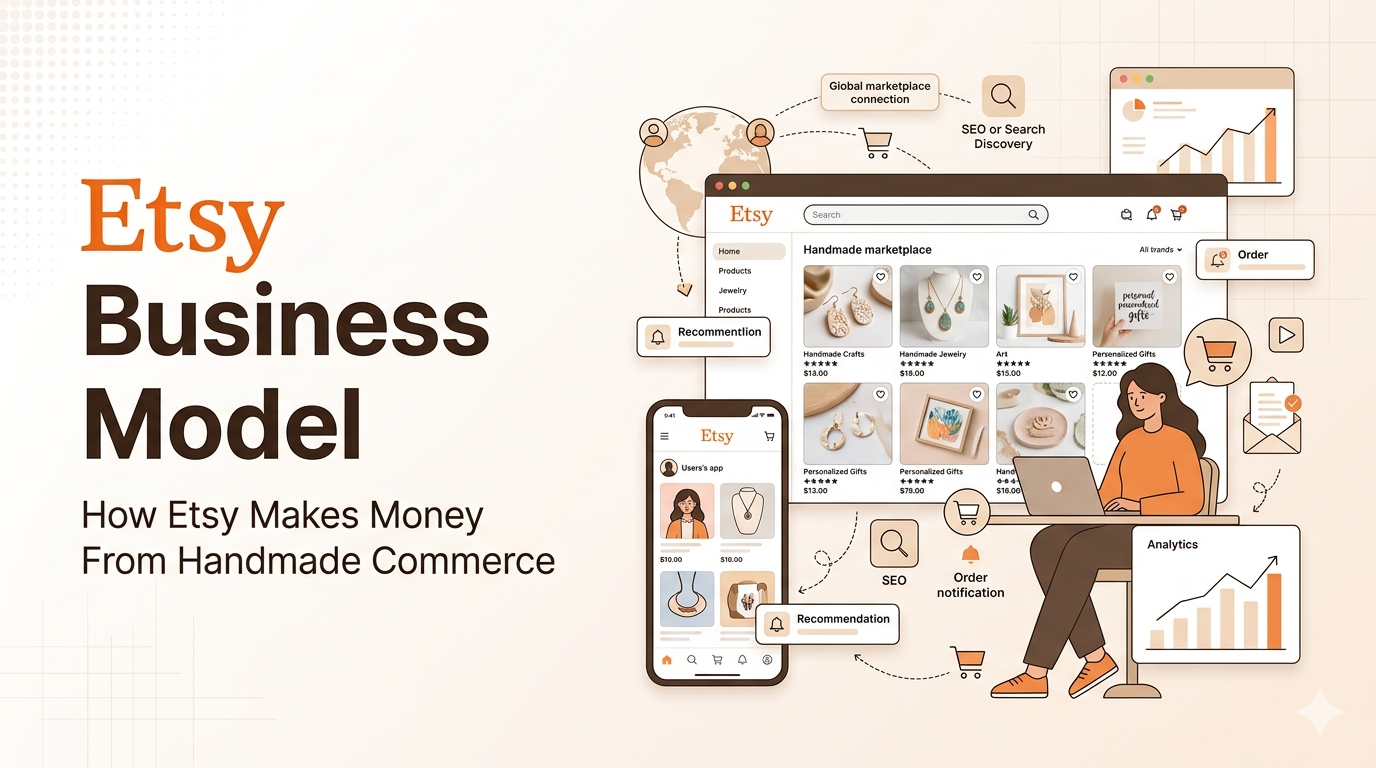
Etsy allows sellers to build digital storefronts while buyers discover unique products through search, recommendations, and personalized shopping experiences.
Seller Workflow
Sellers sign up, create a shop, and list products with photos, descriptions, and pricing. Each listing requires a small fee. Sellers handle their own inventory, production, and shipping. Etsy provides the platform, traffic, and payment infrastructure.
Steps for sellers:
- Create an Etsy account and open a shop
- Upload product listings with optimized descriptions
- Set pricing and shipping options
- Manage orders through the Etsy dashboard
- Handle fulfillment and customer communication
Buyer Workflow
Buyers search for products using keywords, browse curated recommendations, or explore trending categories. Etsy’s algorithm surfaces relevant listings based on search intent, seller reputation, and listing quality.
Steps for buyers:
- Search or browse products on Etsy
- Filter by price, location, and customization options
- Purchase through Etsy Payments
- Leave reviews after receiving orders
Marketplace Infrastructure
Etsy provides the full transaction layer. This includes Etsy Payments for secure checkout, a messaging system between buyers and sellers, a review and rating system for trust, and support for personalized and custom orders.
Etsy Business Model Explained
Etsy follows a two-sided marketplace business model where creators sell directly to buyers while Etsy provides the infrastructure and monetization layer.
Etsy does not manufacture or hold inventory. It acts as the middleman that connects supply and demand, earns a cut from every transaction, and sells additional tools and visibility to sellers.
Two-Sided Marketplace
Etsy’s model depends on two groups: sellers and buyers. The platform only works when both sides are active and engaged.
- Sellers bring product supply, variety, and creativity
- Buyers bring demand, spending, and transaction volume
- Etsy provides the platform, trust layer, and monetization tools
Network effects drive this model. More sellers mean more product variety. More variety attracts more buyers. More buyers mean more sales for sellers. The cycle reinforces itself.
Creator Economy Platform
Etsy positions itself as a platform for independent businesses, not a retailer. Sellers are individual creators, small studios, and craft businesses. This creator-first structure gives Etsy a differentiated identity compared to general marketplaces.
Asset-Light Structure
Etsy owns no inventory and operates no warehouses. This keeps overhead low and allows the platform to scale without the logistical costs that traditional retailers face. Revenue scales with transaction volume, not physical assets.
Etsy Business Model Canvas
The Etsy Business Model Canvas breaks down how Etsy creates, delivers, and captures value across its marketplace ecosystem.
| Business Model Canvas Block | Etsy Example |
|---|---|
| Key Partners | Sellers, payment gateways, shipping carriers |
| Key Activities | Marketplace operations, seller onboarding, ad management |
| Key Resources | Platform, brand, search algorithm, seller network |
| Value Proposition | Handmade marketplace for buyers and creators |
| Customer Relationships | Reviews, personalization, direct messaging |
| Channels | Website, mobile app, SEO, email, social media |
| Customer Segments | Handmade buyers, gift shoppers, small creators |
| Cost Structure | Infrastructure, marketing, payment processing |
| Revenue Streams | Listing fees, transaction fees, ads, subscriptions |
Key Partners
Etsy relies on several external partners to keep the platform running smoothly.
- Independent sellers who create and supply all products
- Payment providers that power Etsy Payments
- Shipping carriers like USPS, FedEx, and UPS for label services
- Advertising networks for offsite ad placements
- Technology infrastructure providers for cloud and hosting
Key Activities
Running a marketplace requires consistent operational focus across several areas.
- Managing the marketplace platform and search
- Onboarding and supporting sellers
- Processing payments and handling disputes
- Running the Etsy Ads system
- Improving search relevance and buyer experience
Key Resources
Etsy’s most valuable assets are not physical.
- The marketplace platform itself
- Brand reputation in the handmade and creative space
- The seller network and product catalog
- Proprietary search algorithm
- User data for personalization and recommendations
Value Propositions
For buyers:
- Access to unique, handmade, and custom products
- Personalized shopping for gifts and special occasions
- Vintage items unavailable in mainstream retail
- Direct connection with the maker behind the product
For sellers:
- Instant access to a global buyer audience
- No need to build a standalone e-commerce store
- Built-in search traffic and discovery tools
- Marketing and advertising options through Etsy Ads
Customer Relationships
Etsy builds trust between strangers through its review system, seller transparency, and direct messaging. Buyers can see seller ratings, read past customer feedback, and communicate directly with sellers before purchasing.
Channels
Etsy reaches buyers through multiple touchpoints.
- Website and mobile app for direct shopping
- SEO for organic search traffic from Google
- Email marketing for promotions and recommendations
- Pinterest as a major visual discovery driver
- Social media for brand visibility and seller promotion
Customer Segments
- Buyers looking for handmade or personalized products
- Gift shoppers who want something unique
- Vintage collectors
- Small creators and independent craft businesses
- Wholesale craft supply buyers
Cost Structure
- Platform infrastructure and technology development
- Marketing and customer acquisition
- Employee salaries and operations
- Payment processing costs
- Customer support
How Etsy Makes Money
Etsy monetizes seller activity and marketplace transactions through multiple recurring revenue streams.
Listing Fees
Every product a seller lists on Etsy costs $0.20 per listing. Listings expire after four months and automatically renew at the same $0.20 fee unless the seller deactivates them.
This creates a low-friction entry point for sellers while generating consistent, predictable revenue for Etsy regardless of whether a sale happens.
Transaction Fees
When a sale occurs, Etsy charges sellers a transaction fee of 6.5% of the total order value. This includes the item price plus any shipping and gift wrapping charges the buyer pays.
Transaction fees are Etsy’s largest revenue source. As seller volume and average order values grow, this line item scales directly.
Payment Processing Fees
Etsy operates its own payment system called Etsy Payments. Sellers who use it pay an additional processing fee that varies by country. In the US, this is typically around 3% plus $0.25 per transaction.
Etsy Payments is the default and in most markets the required payment method, which ensures Etsy captures this fee on nearly every transaction.
Etsy Ads
Sellers can pay for promoted listings within Etsy’s search results. These sponsored placements appear above organic results and are sold through a cost-per-click model.
Etsy also runs an offsite ads program where it promotes seller listings on external platforms like Google, Facebook, and Instagram. Sellers who make a sale through an offsite ad are charged a fee of 12% to 15% of that order value. Sellers who make over $10,000 annually on Etsy are automatically enrolled in this program.
Etsy Plus
Etsy Plus is a subscription plan for sellers priced at $10 per month. It includes:
- Listing credits and Etsy Ads credits
- Advanced shop customization options
- Restock request alerts for out-of-stock items
- Discounts on business tools and custom web addresses
Shipping Labels
Etsy offers discounted shipping labels through partnerships with USPS, FedEx, and Canada Post. Sellers purchase labels directly through Etsy, and Etsy earns a margin on each label sale.
Currency Conversion Fees
When buyers or sellers conduct transactions across different currencies, Etsy charges a currency conversion fee of around 2.5%. This applies to international transactions and adds another passive revenue stream as Etsy grows globally.
Etsy Marketplace Flywheel
More sellers create more products, attracting more buyers, which increases transactions and fuels further platform growth.
This is Etsy’s core growth loop:
- More independent creators join Etsy
- Product variety and catalog depth increase
- Buyers find more relevant and unique products
- Buyer engagement and purchase frequency rise
- Seller earnings grow, attracting more sellers
- The cycle repeats at a larger scale
The flywheel is self-reinforcing. Etsy’s job is to remove friction at every step, improve search relevance, and maintain trust between buyers and sellers.
Why Etsy Became Successful
Niche Positioning
Etsy did not try to compete with Amazon on price or selection. It carved out a specific niche: handmade, vintage, and custom. That positioning gave it a clear identity and attracted buyers who were not looking for the cheapest option but for something meaningful.
Emotional Commerce
Buying on Etsy carries a different emotional weight than buying from a retailer. Shoppers feel a personal connection to the maker. This emotional layer creates loyalty, repeat purchases, and word-of-mouth growth that paid advertising cannot replicate.
SEO-Based Product Discovery
Etsy built strong organic search visibility over time. Individual product listings rank on Google for long-tail search terms. This gives Etsy essentially free top-of-funnel traffic from buyers who are already in purchase mode.
Strong Creator Community
Sellers are Etsy’s biggest advocates. Many promote their Etsy shops across social media, driving external traffic back to the platform. Etsy benefits from seller-generated marketing without paying for it directly.
Mobile Commerce Growth
Etsy invested early in its mobile app. A large portion of Etsy’s traffic and purchases now happen on mobile devices. The app experience supports personalized feeds, saved items, and messaging, keeping buyers engaged between purchases.
Etsy vs Amazon Handmade vs eBay
| Feature | Etsy | Amazon Handmade | eBay |
|---|---|---|---|
| Marketplace Type | Handmade-focused | Handmade section of Amazon | General marketplace |
| Buyer Intent | Personalized, unique shopping | Amazon convenience | Auctions and deals |
| Seller Identity | Independent creators | Verified artisans only | Mixed seller base |
| Brand Positioning | Creative marketplace | Amazon ecosystem | General commerce |
| Fee Structure | Listing plus transaction fees | Referral fee, no listing fee | Insertion and final value fees |
| Trust Signals | Seller reviews and profiles | Amazon ratings | Seller ratings and feedback |
| Personalization | High | Low to moderate | Low |
Key differences:
- Etsy is the only platform built exclusively around creative and handmade commerce
- Amazon Handmade benefits from Amazon’s traffic but lacks Etsy’s handmade identity
- eBay skews toward resale, auctions, and used goods rather than new handmade products
- Sellers on Etsy build branded storefronts; eBay and Amazon listings are more commoditized
Etsy Marketing Strategy
SEO and Long-Tail Keywords
Etsy’s organic growth depends heavily on search engine optimization. Product listings are indexed by Google, and Etsy invests in making its platform easy for search engines to crawl. Sellers are encouraged to write keyword-rich titles and descriptions, which feeds Etsy’s overall SEO footprint.
Pinterest and Visual Discovery
Pinterest sends significant referral traffic to Etsy. Because both platforms are visually driven and attract buyers in discovery mode, they pair naturally. Sellers often share their listings to Pinterest boards, and Etsy’s product images are frequently repinned.
Social Commerce
Etsy supports sellers in promoting their shops on Instagram, Facebook, and TikTok. Many independent creators have built large followings that drive direct traffic to their Etsy storefronts. Etsy benefits from this without running its own influencer campaigns.
Seasonal Shopping Campaigns
Etsy runs major campaigns around holidays, gifting seasons, and occasions like Valentine’s Day, Mother’s Day, and Christmas. These campaigns drive spikes in buyer traffic and are supported by email marketing, paid ads, and curated gift guides on the platform.
Personalized Email Marketing
Etsy uses purchase history and browsing behavior to send personalized product recommendations via email. These campaigns remind buyers of saved items, alert them to price drops, and surface new listings from shops they have purchased from before.
Challenges in Etsy’s Business Model
Marketplace Saturation
As more sellers join, standing out becomes harder. Popular categories like jewelry, prints, and candles are highly competitive. New sellers often struggle to gain visibility without paying for Etsy Ads.
Fake Handmade Products
One of Etsy’s ongoing problems is sellers listing mass-produced or dropshipped products as handmade. This undermines the platform’s core value proposition and frustrates genuine creators and buyers alike.
Seller Fee Complaints
Etsy has raised fees multiple times. The transaction fee increase from 5% to 6.5% in 2022 prompted a seller strike. Fee sensitivity is high among independent creators with thin margins, and any future increases risk seller attrition.
Competition From Amazon
Amazon Handmade offers lower fees and access to Amazon’s massive buyer base. For sellers who prioritize volume over brand identity, Amazon is an increasingly viable alternative.
Platform Dependency Risks
Sellers who rely entirely on Etsy for revenue are vulnerable to algorithm changes, fee increases, and policy shifts. This dependency creates tension between Etsy’s business interests and seller sustainability.
SWOT Analysis of Etsy
| Internal | External | |
|---|---|---|
| Positive | Strengths | Opportunities |
| Strong brand in handmade niche | AI personalization tools | |
| Asset-light business model | Global market expansion | |
| Large, loyal seller community | Sustainable shopping trends | |
| SEO-driven organic traffic | Social commerce growth | |
| Negative | Weaknesses | Threats |
| Seller fee sensitivity | Amazon Handmade competition | |
| Fake handmade product problem | Economic downturns reducing discretionary spend | |
| Platform dependency for sellers | Marketplace saturation | |
| Limited enterprise tools | Copycats and niche competitors |
Lessons Entrepreneurs Can Learn From Etsy
Build a Community-Driven Marketplace
Etsy’s sellers are not just revenue sources. They are brand ambassadors, content creators, and community members. Building a marketplace where supply-side participants feel invested in the platform’s success is a significant competitive moat.
Focus on Niche Positioning
Etsy succeeded by refusing to be everything to everyone. Defining a clear niche, owning it completely, and building every product decision around it creates a durable brand identity that generalist competitors cannot easily replicate.
Create Emotional Brand Value
Products on Etsy carry stories. The handmade identity creates an emotional premium that justifies higher prices and drives repeat purchases. Entrepreneurs should think about how their platform or product creates meaning beyond the transaction.
Use Marketplace Network Effects
Two-sided marketplace businesses become more valuable as both sides grow. Entrepreneurs building platforms should focus on reducing friction for both supply and demand simultaneously, not just one side.
Enable Small Businesses
Etsy’s growth is tied to the success of its sellers. Platforms that genuinely help their participants succeed tend to build loyalty that is difficult for competitors to break. Seller success equals platform success.
Future of Etsy
Etsy’s future growth may depend on AI personalization, global expansion, creator tools, and trust preservation in handmade commerce.
AI-Driven Recommendations
Etsy is investing in machine learning to improve search relevance and product recommendations. Better personalization means buyers find what they want faster, increasing purchase rates and time on platform.
Sustainable Shopping
Consumer interest in sustainable, locally made, and ethically produced goods continues to rise. Etsy’s handmade positioning naturally aligns with this trend and could attract a new generation of conscious shoppers.
Creator-First Commerce
As the creator economy grows, more individuals are building independent businesses. Etsy has an opportunity to expand its seller tools, analytics, and financial services to capture a larger share of creator-driven commerce.
Personalized Gifting Economy
Gift shopping is one of Etsy’s strongest use cases. As personalized and experiential gifts become more popular, Etsy is well positioned to be the go-to destination for meaningful gift purchases across all major occasions.
Social Commerce Integrations
Shopping through social media platforms is growing fast. Etsy’s ability to integrate with Instagram, TikTok Shop, and Pinterest shopping features could expand its reach significantly beyond its existing user base.
Final Verdict
Etsy built a durable business model by owning a clear niche and turning that niche into a full creator economy platform. Its revenue model is diversified across listing fees, transaction commissions, advertising, subscriptions, and payments, which reduces dependence on any single stream.
The asset-light structure keeps margins healthy. The two-sided marketplace model creates compounding network effects. And the emotional connection buyers feel with handmade products drives loyalty that generic marketplaces cannot replicate.
Challenges around seller fees, marketplace saturation, and competition from Amazon are real. But Etsy’s brand identity in the handmade and creative space gives it a defensible position that will be difficult to displace.
Long-term, Etsy’s competitive advantage comes down to community trust, niche authority, and the emotional value of buying something made by a real person. That is not something a general marketplace can manufacture.
FAQs
Etsy operates a two-sided marketplace connecting independent sellers with buyers. It earns revenue through listing fees, transaction fees, payment processing, advertising, and subscriptions.
Etsy makes money through a $0.20 listing fee per product, a 6.5% transaction fee on each sale, payment processing fees, Etsy Ads revenue, Etsy Plus subscriptions, shipping label sales, and currency conversion fees.
The Etsy Business Model Canvas maps out its key partners, activities, resources, value propositions, customer relationships, channels, segments, cost structure, and revenue streams as a two-sided marketplace platform.
Etsy’s main competitors include Amazon Handmade, eBay, Shopify (as an alternative selling platform), and niche marketplaces like Redbubble and Society6.
Etsy succeeded through clear niche positioning in handmade goods, strong SEO-driven traffic, a loyal seller community, emotional brand value, and a scalable asset-light business model.
No. Etsy owns no inventory. It is a platform-first marketplace where all products are owned and fulfilled by independent sellers.
Etsy focuses exclusively on handmade, vintage, and personalized products from independent creators. Amazon prioritizes scale, speed, and price across all product categories. Etsy sells emotional value; Amazon sells convenience.
Yes. Etsy has been profitable and generates strong cash flow through its diversified revenue model. However, profitability has fluctuated with changes in seller activity, marketing spend, and macroeconomic conditions affecting discretionary spending.
Discover more from Business Model Hub
Subscribe to get the latest posts sent to your email.