
Udacity is an online learning platform that focuses on technology education. The platform specializes in artificial intelligence, programming, cloud computing, cybersecurity, and career-oriented training programs. Unlike traditional universities, Udacity offers flexible, project-based programs that help learners build practical skills faster than conventional education paths .
Founded in 2011 by Sebastian Thrun, a Stanford professor and former Google VP who worked on Google’s self-driving car project, Udacity emerged from the massive open online course movement . Thrun co-taught one of the first MOOCs with over 160,000 students enrolled, which inspired the creation of Udacity as a platform dedicated to technology education at scale.
The company is headquartered in Mountain View, California. In March 2024, Accenture acquired Udacity and integrated it into its LearnVantage division, positioning the platform as a workforce-development tool for enterprise upskilling engagements . This acquisition has allowed Udacity to expand its reach and offer accredited degree programs under $5,000, including an MBA focused on AI product leadership .
Udacity targets several customer segments including individual learners, working professionals, career changers, enterprises, governments, and universities. The platform has a global presence and serves learners across multiple countries. The company currently operates with a headcount between 1,001 and 5,000 employees and has raised $235 million in total funding .
What Is Udacity’s Business Model?
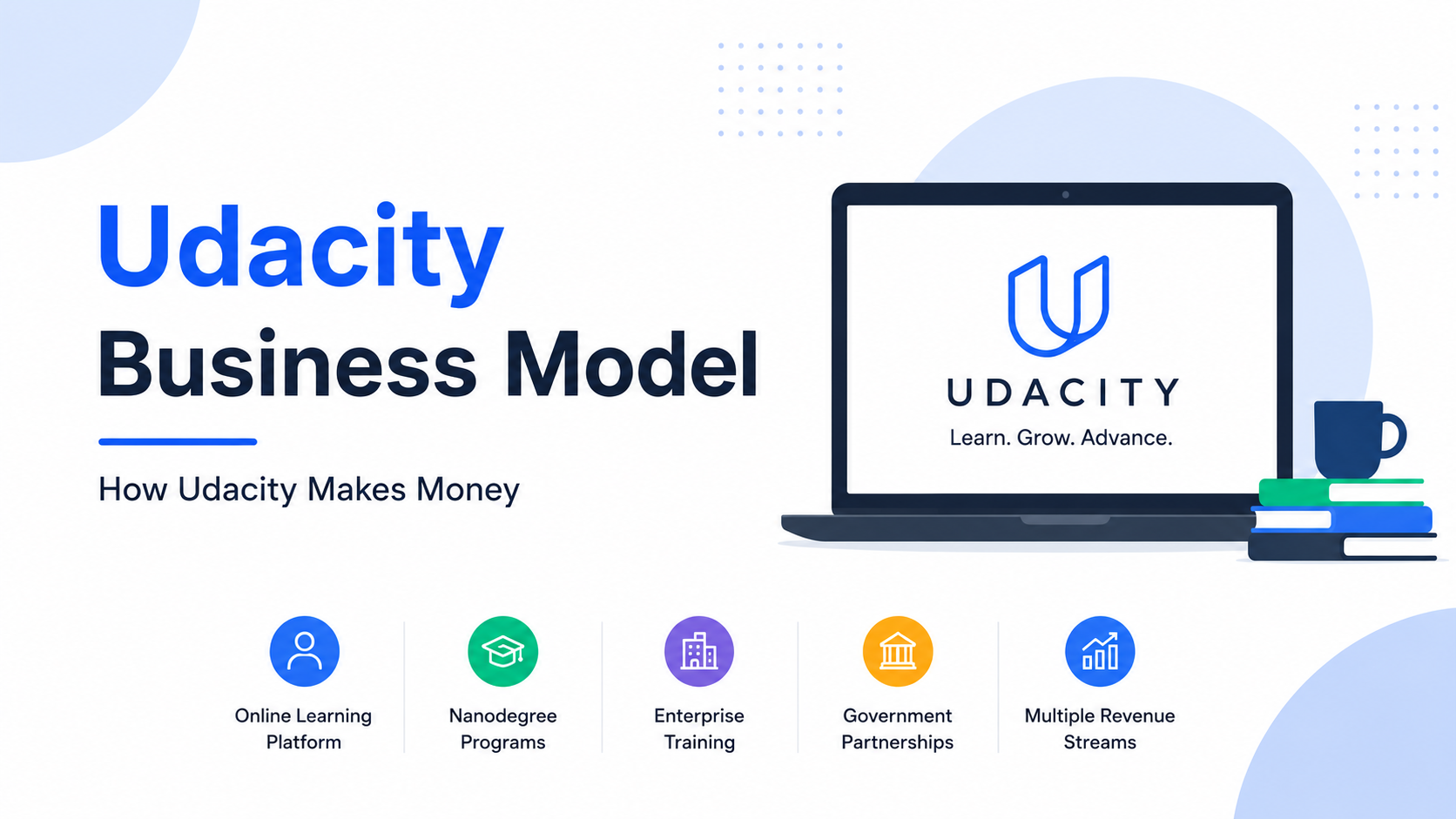
Udacity follows a hybrid B2C and B2B subscription-based business model. The company generates revenue by selling Nanodegree programs to individual learners, providing enterprise workforce training to businesses, offering government upskilling initiatives, delivering certification preparation courses, and leveraging technology partnerships .
The business model has evolved significantly since the company’s founding. While Udacity started as a consumer-focused platform, the enterprise segment has become increasingly important, mirroring trends seen across the edtech industry where B2B revenue often outpaces consumer revenue .
How Does Udacity Work?
Step 1: Users Join the Platform
The user journey begins with account creation on Udacity’s website or mobile app. New users can complete a skill assessment to help the platform recommend appropriate courses based on their current knowledge level and career goals. This personalized approach helps learners find the right starting point for their education journey.
Step 2: Learners Choose Programs
Udacity offers multiple learning options including free courses, paid Nanodegree programs, and professional certificates. The free courses provide introductory content that allows learners to sample the platform’s teaching style and content quality before committing to a paid program. The Nanodegree programs represent the core product offering and focus on specific career paths in technology.
Step 3: Learning Experience
The learning experience combines video lessons with hands-on coding exercises and real-world projects. Learners receive AI-powered assistance through the platform and can access mentor support when they get stuck . The project-based approach is central to Udacity’s value proposition, as learners build a portfolio of substantial projects rather than just watching videos .
Step 4: Career Support
Career services are a key component of the Nanodegree experience. These services include resume review, LinkedIn profile optimization, interview preparation, and portfolio project development. The career support helps learners present their new skills effectively to potential employers and navigate the job search process .
Value Proposition
For Learners
Individual learners benefit from industry-focused skills that directly align with employer needs. The project-based learning approach ensures learners build practical experience rather than just theoretical knowledge. Flexible schedules accommodate working professionals who need to balance education with existing commitments. Career services help learners transition into new roles, and recognized certifications provide credentials that signal competency to employers .
For Businesses
Companies use Udacity for employee upskilling and workforce transformation. The platform offers custom learning paths tailored to organizational needs, analytics dashboards that track employee progress, and leadership training programs. The enterprise solution helps companies address skill gaps and prepare their workforce for emerging technologies .
For Governments
Governments partner with Udacity to support national digital transformation and workforce development initiatives. These public-private partnerships enable large-scale education programs that help citizens acquire in-demand technology skills and support economic growth through a more skilled workforce .
How Udacity Makes Money
Nanodegree Program Fees
The Nanodegree program fees represent Udacity’s primary revenue stream. These premium learning paths focus on career-specific skills and include project reviews, mentor support, and career services. Monthly subscriptions typically range from $249 to $399 depending on the program, with some specialized programs priced higher .
Popular Nanodegree categories include programming and development, artificial intelligence and machine learning, data science and data engineering, cloud computing, cybersecurity, and product management . Learners can choose between a pay-as-you-go monthly subscription or an all-access upfront payment option that often includes a discount for committing to the estimated completion time .
Enterprise Training
Udacity for Business provides corporate learning solutions for employee development. Companies use the platform for leadership training, AI adoption programs, and technical upskilling. The enterprise segment operates through annual contracts and per-seat pricing models, with enterprise licenses providing a recurring revenue stream .
The enterprise offering has become increasingly important as organizations invest in workforce development. According to Udacity’s own research, companies see significant returns on investment, including a 35% increase in productivity, two times faster time to competency than traditional training, and 90% skill attainment achieved by learners .
Government Upskilling Programs
Government partnerships represent another revenue stream for Udacity. These programs support national digital initiatives and workforce modernization efforts through public-private partnerships. Governments use Udacity’s platform to deliver large-scale education programs that help citizens acquire in-demand technology skills. Examples include workforce development initiatives in various countries, though specific country examples are not detailed in available sources .
Professional Certification Preparation
Udacity offers preparation courses for professional certifications in cloud computing, AI, cybersecurity, and programming. These certification preparation programs help learners pass industry-recognized exams that validate their skills to employers. The courses cover the knowledge areas tested in certification exams and include practice questions and hands-on exercises.
Technology Partnerships
Technology partnerships with companies like Google, Amazon Web Services, IBM, Mercedes-Benz, AT&T, and NVIDIA generate revenue through co-developed courses and sponsored content . These partnerships allow Udacity to develop curriculum content that reflects actual industry requirements. Partners benefit from having a trained workforce that can use their technologies effectively, while Udacity gains access to industry expertise and credibility.
The partnership model extends beyond curriculum development to include customer training, where companies partner with Udacity to create specialized workforce training on their solutions . Partners can also resell Udacity’s learning programs, driving additional revenue for both parties.
Customized Learning Solutions
Customized learning solutions provide revenue through private cohorts, tailored curriculum development, learning management system integration, and consulting services. Organizations with specific training needs can work with Udacity to develop custom programs that address their unique requirements. These solutions typically involve larger contracts and higher price points than standard Nanodegree programs.
AI Learning Products
AI-powered learning products represent an emerging revenue stream for Udacity. These products include AI tutors that provide personalized assistance, adaptive recommendations that adjust learning paths based on performance, and AI-powered coding assistants that help learners write better code . As AI continues to transform education, these products are expected to play a larger role in Udacity’s revenue mix.
Udacity Business Model Canvas
Customer Segments
Udacity serves diverse customer segments including students seeking career entry, working professionals looking to upskill, career changers transitioning to technology roles, enterprises needing workforce training, governments supporting national workforce development, and universities seeking to supplement their curricula.
Value Propositions
The key value propositions include job-ready skills that prepare learners for employment, flexible learning schedules that accommodate working professionals, industry projects that build practical experience, career services that support job placement, and AI-enhanced education that personalizes the learning experience .
Channels
Udacity reaches customers through its website, mobile app, enterprise sales team, government partnerships, and marketing campaigns. The enterprise sales team focuses on corporate clients, while marketing campaigns target individual learners through various digital channels.
Customer Relationships
Customer relationships are maintained through self-service access, mentor support, AI tutoring, community forums, and career coaching. The combination of automated and human support helps learners stay engaged and make progress toward their goals.
Revenue Streams
The primary revenue streams include Nanodegree subscriptions, enterprise contracts, government projects, certification courses, technology partnerships, and custom training solutions. This diversified revenue model reduces dependence on any single source of income.
Key Resources
Key resources include the learning platform, course content, industry instructors, AI technology, and the enterprise sales team. The learning platform provides the infrastructure for content delivery and learner engagement, while industry instructors bring real-world expertise to the curriculum.
Key Activities
Key activities include course development, platform maintenance, AI innovation, marketing, customer support, and partnership management. Course development involves creating new Nanodegree programs and updating existing ones to reflect industry changes.
Key Partners
Key partners include technology companies, cloud providers, employers, governments, and universities. These partners contribute to curriculum development, provide hiring pipelines, and support the platform’s credibility.
Cost Structure
Major costs include content creation, instructor payments, platform development, marketing, AI infrastructure, and employee salaries. Content creation involves producing video lessons and developing project briefs and review criteria.
Who Are Udacity’s Customers?
Individual Learners
Individual learners form the consumer segment of Udacity’s customer base. This group includes software developers seeking to learn new technologies, AI professionals wanting to deepen their expertise, data scientists pursuing advanced skills, and career changers transitioning into technology roles .
Enterprises
Enterprises use Udacity to upskill their workforce and address talent gaps. The enterprise customer base includes technology companies, financial services firms, healthcare organizations, and businesses across various industries. These customers value the platform’s ability to deliver measurable business results, including increased productivity and faster time to competency .
Governments
Governments partner with Udacity to support national workforce development initiatives. These customers focus on digital transformation, national upskilling, and large-scale education programs that benefit citizens and support economic growth.
Universities
Universities use Udacity to supplement their curricula with practical, industry-focused courses. These partnerships allow universities to offer students access to technology training that complements their academic programs.
Competitive Advantages
Udacity’s competitive advantages stem from several factors. The platform maintains strong industry partnerships with major technology companies, ensuring its curriculum reflects real-world employer needs . The career-focused curriculum distinguishes Udacity from more academic platforms, while the project-based learning approach ensures learners build practical skills .
Mentor support provides personalized guidance that cheaper platforms cannot offer . Enterprise expertise allows Udacity to serve corporate clients effectively, and AI integration enhances the learning experience through personalization and adaptive recommendations .
SWOT Analysis
Strengths
Udacity’s strengths include strong industry partnerships with major technology companies, a career-focused curriculum that prepares learners for specific roles, project-based learning that builds practical skills, mentor support that provides personalized guidance, and enterprise expertise that serves corporate clients effectively .
Weaknesses
The platform faces challenges including high pricing compared to competitors, which can deter price-sensitive learners . The video-heavy format may not suit all learning styles , and the time-boxed subscription model creates pressure to complete programs quickly. Limited free content reduces the platform’s accessibility compared to competitors with more extensive free offerings.
Opportunities
Opportunities include AI-first education that leverages the platform’s early investment in AI technology , corporate learning expansion as more companies invest in workforce development, global workforce training in emerging markets, new certifications in growing technology fields, and enterprise AI adoption training programs.
Threats
Threats include increasing competition from platforms like Coursera, edX, and Udemy . AI potentially disrupting education delivery models , high customer acquisition costs, challenging course completion rates, pricing pressure from cheaper alternatives, and market saturation in online education.
Udacity vs Competitors
When compared to competitors, Udacity occupies a specific position in the online education market. Coursera offers university courses and professional certificates with a subscription model, while Udemy provides cheap one-off courses through a marketplace model. edX delivers university-style courses with free audit options.
Udacity distinguishes itself through its project-based Nanodegree programs with human project review . The platform offers stronger career support than most competitors, including resume review, LinkedIn optimization, and interview preparation . The enterprise training capabilities are more developed than many competitors, and the AI learning features are more advanced .
The platform’s focus on career outcomes rather than academic credentials creates a different value proposition from university-oriented competitors . While Udacity costs more than platforms like Udemy, the additional features and support justify the premium for learners seeking career advancement.
Challenges Facing Udacity
Increasing Competition
The online education market has become increasingly crowded with platforms competing for learners. Coursera, edX, Udemy, and newer entrants like Scrimba all target similar customer segments . This competition puts pressure on pricing and requires continuous innovation to maintain differentiation.
AI Disrupting Education
AI technology has the potential to disrupt traditional education delivery. Self-taught developers using AI coding assistants may bypass formal training programs . AI-powered learning experiences on competitor platforms also threaten Udacity’s differentiation.
Customer Acquisition Costs
Acquiring new customers is expensive in the competitive online education market. Marketing costs represent a significant expense, and the high cost of acquisition must be justified by customer lifetime value.
Course Completion Rates
Course completion remains a challenge across the online education industry. Many learners enroll in courses but do not complete them, affecting customer satisfaction and reducing the likelihood of repeat purchases.
Pricing Pressure
Competition from cheaper alternatives creates pricing pressure. Platforms like Udemy offer courses for $10 to $20, making Udacity’s $249 to $399 per month seem expensive by comparison .
Market Saturation
The online education market may be approaching saturation, with many potential learners already enrolled in courses on various platforms. This saturation makes it harder to acquire new customers and grow the user base.
Future Growth Strategy
AI-First Education
Udacity’s future growth strategy involves doubling down on AI-first education. The platform plans to expand its AI-powered learning experiences, including AI tutors, personalized learning paths, adaptive recommendations, and AI-powered coding assistants . These AI-enhanced features are expected to play a larger role in the company’s future growth.
Corporate Learning Expansion
Corporate learning represents a significant growth opportunity for Udacity. The enterprise segment has already become a major revenue driver, and the platform plans to expand its corporate offerings. The Accenture acquisition has positioned Udacity as a workforce-development tool for enterprise upskilling engagements .
Global Workforce Training
Global workforce training initiatives offer growth opportunities in emerging markets. As countries invest in digital transformation and workforce development, Udacity can partner with governments and enterprises to deliver large-scale training programs.
New Certifications
New certifications in emerging technology fields will attract learners seeking to validate their skills. The platform’s accreditation capabilities, including the recently launched MBA program under $5,000, expand the credential options available to learners .
Enterprise AI Adoption
Training for enterprise AI adoption represents a specific growth opportunity. As companies adopt AI technologies, they need to train their workforce on AI tools and processes. Udacity’s AI expertise positions the platform well to serve this need .
Key Takeaways
Udacity primarily earns through subscriptions and enterprise training. The hybrid B2C and B2B business model provides diversified revenue streams that reduce dependence on any single source of income. The core Nanodegree program fees generate revenue from individual learners, while enterprise workforce training has become a major revenue driver .
Project-based, career-focused learning differentiates Udacity from many competitors. The platform’s emphasis on hands-on projects with human expert review provides a meaningful improvement over passive content consumption . The career services component, including resume review and interview preparation, adds value that cheaper platforms do not offer .
AI-powered learning experiences are expected to play a larger role in Udacity’s future growth. The platform’s investment in AI technology positions it well for the evolving education landscape . The Accenture acquisition has provided resources and integration opportunities that support future expansion .
For learners serious about career advancement in technology fields, Udacity remains one of the strongest options. The platform’s Nanodegree programs go deeper than most MOOCs, offer real projects reviewed by mentors, and provide a clear roadmap to job-ready skills . While the cost is higher than some alternatives, the return on investment can be substantial for learners who successfully transition to higher-paying roles .
Frequently Asked Questions
Is Udacity free?
Udacity offers some free courses that allow learners to sample the platform’s teaching style and content. However, the full Nanodegree programs and most professional certificates require paid subscriptions. The free tier is limited compared to some competitors.
How does Udacity make money?
Udacity makes money through Nanodegree program subscriptions, enterprise training contracts, government upskilling programs, professional certification preparation courses, technology partnerships, and customized learning solutions.
What is a Udacity Nanodegree?
A Nanodegree is a structured, skills-focused program designed to prepare learners for specific careers in technology. These programs combine video lessons, hands-on projects, mentor support, and career services. Nanodegrees typically take 3 to 6 months to complete with part-time study .
Is Udacity profitable?
Udacity’s profitability is not publicly disclosed since it is a privately held company owned by Accenture. The financial decisions are overseen by executive leadership led by CEO Kai Roemmelt in conjunction with the board of directors .
Who owns Udacity?
Accenture acquired Udacity in March 2024 for an undisclosed sum. The company is now part of Accenture LearnVantage, the consulting firm’s workforce-development division .
Who are Udacity’s biggest competitors?
Udacity competes with Coursera, edX, Udemy, Scrimba, Codecademy, Pluralsight, and Educative. Each platform has different strengths, with Udacity positioned for career-focused, project-based learning .
Is Udacity better than Coursera?
Whether Udacity is better than Coursera depends on your learning goals. Udacity offers more project-based, career-focused programs with human project review. Coursera provides university courses and professional certificates with academic credentials. Udacity is stronger for hands-on technical skills, while Coursera is stronger for academic credentials .
Does Udacity offer certificates?
Yes, Udacity offers certificates upon completion of Nanodegree programs and professional certification preparation courses. These certificates can be added to LinkedIn profiles and shared with employers .
Can businesses use Udacity for employee training?
Yes, Udacity for Business provides corporate learning solutions including employee upskilling, custom learning paths, analytics dashboards, and workforce transformation programs .
Is Udacity worth paying for in 2026?
Udacity is worth paying for if you want a focused, project-heavy Nanodegree in a career-relevant field like AI, data science, or cloud computing, you can afford the subscription, and you value human project reviews and career support. It is not worth it if you are just starting out, learning your first language, or watching your budget .
Discover more from Business Model Hub
Subscribe to get the latest posts sent to your email.