Priceline Business Model And How It Makes Money in the Online Travel Industry

Priceline is a leading online travel agency (OTA) that connects travelers with hotels, airlines, car rental companies, and other travel suppliers through its digital platform. Founded in 1997 and now part of Booking Holdings, Priceline helps consumers find and book travel services at competitive prices.
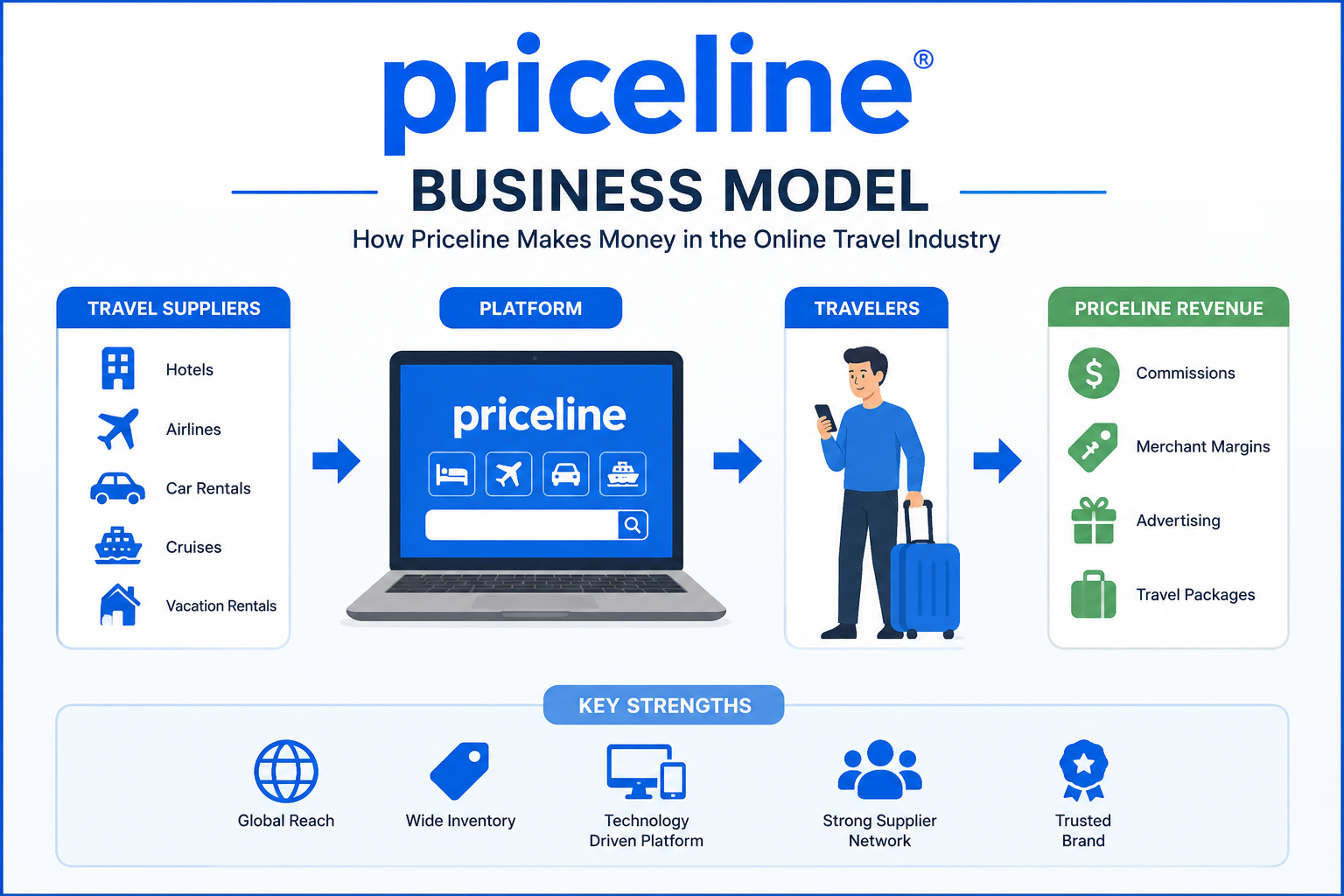
Priceline operates as an asset-light, two-sided marketplace. Travel suppliers list their inventory on the platform, travelers search and book through Priceline’s website or mobile app, and Priceline earns revenue primarily through commissions on bookings and merchant margins.
Priceline generates revenue through multiple streams: hotel booking commissions (agency model), merchant model margins on prepaid bookings, airline ticket commissions, car rental bookings, vacation rental revenue, cruise commissions, travel packages, and advertising.
Priceline’s success stems from leveraging technology, a massive supplier network, and scalable digital operations rather than owning travel assets, creating a powerful network effect that benefits both travelers and suppliers.
Brief Overview of Priceline
Priceline has become a household name in the online travel industry since its founding in 1997 by entrepreneur Jay Walker. The company pioneered a revolutionary concept in e-commerce known as a “demand collection system,” which flipped traditional travel booking on its head by allowing consumers to name their own price for travel services . This innovative approach, combined with strategic acquisitions and technological advancement, has positioned Priceline as one of the largest online travel agencies in the world.
Why Priceline Became One of the Largest Online Travel Agencies (OTAs)
Priceline’s journey from a novel startup to a travel industry giant is remarkable. The company made a bold move in 2007 by becoming the first OTA to eliminate flight booking fees, a decision that nearly tripled its flight business in just a few months . This aggressive strategy, coupled with memorable marketing campaigns featuring William Shatner as the “Priceline Negotiator,” helped the brand capture significant market share in the United States.
The company’s trajectory changed dramatically when it acquired Booking.com in 2005, merging it with Active Hotels to create what would become the world’s largest accommodation booking platform . Today, Priceline operates as a key brand within Booking Holdings, which also includes Booking.com, Agoda, KAYAK, Rentalcars.com, and OpenTable . The parent company rebranded from Priceline Group to Booking Holdings in 2018 to reflect its global portfolio and the dominance of the Booking.com brand internationally .
Why Understanding Its Business Model Matters
For entrepreneurs, investors, and travel industry professionals, understanding Priceline’s business model offers valuable insights into marketplace dynamics, revenue diversification, and technology-driven growth. Priceline demonstrates how an asset-light company can build massive scale through network effects, strategic partnerships, and continuous innovation. Its evolution from a “Name Your Own Price” pioneer to a full-service OTA with AI-powered capabilities shows how successful companies adapt their business models to changing consumer expectations and technological advances .
What Is Priceline?
Company Overview and History
Priceline was founded in 1997 by Jay Walker, who envisioned a system where consumers could name their price for travel services. The concept was based on a “demand collection system,” where buyers advertised their willingness to pay a certain amount, and sellers could choose to accept or reject those offers . This innovative approach earned Priceline a patent and created a new category of e-commerce known as C2B (consumer-to-business) commerce .
The company went public in 1999 during the dot-com boom, but like many internet companies of that era, it faced significant challenges when the bubble burst. In 2001, with the company’s future uncertain, a consortium led by Hong Kong billionaire Li Ka-shing invested in Priceline, providing the capital needed for restructuring and survival . This investment proved pivotal, allowing the company to refocus on its core travel services and begin its expansion strategy.
Parent Company: Booking Holdings
Priceline now operates as part of Booking Holdings, the world’s largest online travel company by sales . The parent company was formerly known as The Priceline Group until the 2018 rebranding to Booking Holdings, which better reflected the global importance of the Booking.com brand .
With over 24,000 employees and annual sales of approximately $186 billion , Booking Holdings serves travelers in more than 220 countries and territories through its portfolio of brands:
Booking.com: The company’s largest brand, specializing in global accommodation bookings
Priceline: The flagship U.S. brand offering flights, hotels, car rentals, and vacation packages
Agoda: Focused on the Asian market with strong accommodation inventory
KAYAK: A travel metasearch engine comparing prices across providers
OpenTable: Restaurant reservation platform
Rentalcars.com: Car rental booking service
Global Presence
While Priceline.com maintains strong brand recognition in the United States, its parent company’s global footprint is massive. Booking Holdings operates in 166 countries with offices in more than 300 locations worldwide . The company supports 43 languages and processes over 100 payment methods in more than 50 currencies . The European market accounts for approximately 71% of the company’s European market share as of 2025, demonstrating its dominant position in key regions .
Core Travel Services
Priceline offers a comprehensive range of travel services through its platform:
- Hotels and accommodations: Over 1.2 million properties in 166 countries
- Flights: Domestic and international airline tickets
- Car rentals: Vehicles from major rental companies
- Vacation rentals: Alternative accommodations including apartments and homes
- Cruises: Bookings with major cruise lines
- Travel packages: Bundled hotel and flight deals
- Travel insurance: Protection for trips and bookings
Priceline Business Model Overview
Business Model at a Glance
Priceline operates as a platform-based marketplace that connects travelers with travel suppliers. The company’s core business model is asset-light, meaning it owns no hotels, airlines, or rental car fleets. Instead, it facilitates transactions between buyers and sellers, earning revenue through commissions and service fees.
Platform-Based Marketplace
At its heart, Priceline is a two-sided marketplace. On one side, travel suppliers list their inventory including hotel rooms, flight seats, and rental cars. On the other side, consumers search for and book travel services. This model creates powerful network effects as more suppliers attract more travelers, and more travelers attract more suppliers .
Asset-Light Business Model
Priceline’s asset-light approach offers significant advantages:
Low capital requirements: No need to invest in hotels, aircraft, or other physical assets
High scalability: Adding new suppliers and customers is relatively low cost
Flexibility: Can expand into new markets and service categories more easily
Higher margins: Avoids the operational costs associated with owning travel assets
Two-Sided Marketplace
The two-sided marketplace structure benefits both participants:
For travelers: Access to a wide inventory of travel options at competitive prices, with the ability to compare options and find deals
For suppliers: Exposure to a global customer base, increased occupancy rates, and access to Priceline’s marketing and distribution channels
Revenue Flow Diagram
The revenue flow in Priceline’s business model follows a straightforward path:
- Traveler books through Priceline’s platform
- Payment is processed through Priceline’s system
- Priceline remits payment to the supplier minus commission or margin
- Priceline recognizes revenue from the transaction
How Priceline Works
Step 1: Travel Suppliers Join Priceline
Hotels
Hotels partner with Priceline to gain access to the platform’s enormous customer base. Suppliers can list their properties through Priceline’s partner solutions, negotiating commission rates and inventory availability. The platform offers both traditional commission-based listings and merchant model arrangements .
Airlines
Airlines work with Priceline to sell seats through the platform. While airline commissions have decreased significantly over the years, Priceline maintains partnerships with major carriers to offer comprehensive flight options .
Car Rental Companies
Rental car companies list their vehicle inventory through Priceline’s platform, paying commissions on bookings generated through the site.
Vacation Rentals
Priceline offers alternative accommodations including vacation rentals and apartments, expanding beyond traditional hotels to compete with platforms like Airbnb .
Cruise Providers
Major cruise lines partner with Priceline to sell cruise packages, with commissions earned on each booking.
Step 2: Customers Search for Travel
Travelers can access Priceline through its website (priceline.com) or mobile app, both of which offer intuitive search interfaces for finding hotels, flights, car rentals, and vacation packages. The platform provides detailed property information, guest reviews, ratings, photos, and maps to help consumers make informed decisions . Users can filter search results by price, location, star rating, amenities, and other preferences.
Step 3: Booking and Payment
The reservation process involves travelers selecting their desired travel services, providing traveler information, and completing the booking. Priceline offers several payment models:
- Standard booking: Travelers pay the listed price for their selected service
- Priceline Express Deals: Pre-negotiated rates with discounts of up to 60%, with hotel name revealed after booking
- Name Your Own Price: Travelers bid on hotel rooms or flights, specifying what they’re willing to pay
Step 4: Supplier Fulfills the Service
Once a booking is confirmed, the responsibility transfers to the travel supplier. Hotels provide the room, airlines operate the flight, and car rental companies deliver the vehicle. Priceline’s role as an intermediary ends when the booking is confirmed, though the platform provides customer support for issues that may arise.
Step 5: Priceline Earns Revenue
Priceline earns revenue at the point of booking through:
- Commissions: Percentage of the booking value (typically 14-15% for hotels)
- Merchant margins: Difference between wholesale rate paid to supplier and retail price charged to traveler
- Service fees: Charges applied to certain bookings for value-added services
- Advertising: Sponsored placements and partner promotions
Priceline Revenue Model
Hotel Booking Commissions
Agency Model
In the agency model, Priceline acts as an agent for the hotel. Travelers book at the hotel’s listed rate, and Priceline earns a commission from the hotel for facilitating the booking. This is the most common arrangement and aligns Priceline’s interests with the hotel’s desire to maximize revenue per available room .
Commission Percentages
Hotel commissions typically range from 14% to 15% of the booking value, though rates can vary based on the supplier’s negotiating power, booking volume, and market conditions . For independent hotels, commission rates are negotiable, and suppliers can choose which room types and inventory to make available through the platform .
Why Hotels Partner with Priceline
Hotels partner with Priceline for several compelling reasons:
- Global customer reach: Access to millions of travelers worldwide
- Increased occupancy: Fill rooms that might otherwise remain empty
- Marketing exposure: Benefit from Priceline’s marketing investments
- Revenue optimization: Access to last-minute demand and price-sensitive travelers
Merchant Model
Wholesale Hotel Rates
In the merchant model, Priceline purchases hotel rooms at wholesale rates from hotels. The platform then resells these rooms to consumers at retail prices, earning the difference between the wholesale cost and the retail price . This model requires Priceline to take inventory risk, as unsold rooms represent a cost.
Retail Pricing and Profit Margin
The profit margin in the merchant model is the spread between the wholesale rate and the retail price. This can be more profitable than commission-based bookings but requires sophisticated revenue management to optimize pricing and minimize unsold inventory. Priceline’s “Name Your Own Price” feature originally operated on this model, with the company seeking to match consumer bids with supplier inventory at a profitable margin .
Airline Ticket Commissions
Airline Partnerships
Priceline partners with major airlines to sell tickets through its platform. While airline commissions have been largely eliminated in many cases, Priceline earns revenue through service fees charged on certain bookings and merchant model arrangements where it resells tickets .
Service Fees
In 2007, Priceline made the strategic decision to eliminate flight booking fees, becoming the first OTA to do so. This move dramatically increased flight booking volume and put pressure on competitors like Expedia and Travelocity. Today, Priceline largely keeps fees off airline tickets except where value-added services justify them .
Car Rental Bookings
Car rental companies pay Priceline commissions on bookings generated through the platform. The commission structure varies by supplier, destination, and booking type, with standard rates typically applied to the rental value. Priceline connects travelers with major rental brands, offering a wide selection of vehicles and competitive pricing.
Vacation Rental Revenue
Priceline has expanded into vacation rentals, listing apartments, homes, and other alternative accommodations alongside traditional hotels . Revenue is earned through commission-based bookings and merchant model arrangements, with the platform benefiting from the growing consumer demand for alternative accommodations.
Cruise Booking Revenue
Cruise bookings generate commissions for Priceline, typically based on the total booking value. Cruise lines partner with Priceline to reach travelers planning cruise vacations, and the platform provides a convenient booking interface for researching and reserving cruise packages.
Travel Packages
Priceline offers bundled flight + hotel packages that create higher average booking values. Package bookings often provide better value to travelers and higher revenue per transaction for Priceline. Connected transactions where customers book more than one travel vertical grew significantly, representing a growing percentage of total transactions .
Priceline VIP Program
The VIP Program is Priceline’s loyalty initiative designed to encourage repeat bookings and customer retention. Members earn points on bookings, access exclusive deals, and enjoy VIP treatment at partner properties. The program helps Priceline reduce customer acquisition costs by increasing lifetime customer value and provides a foundation for personalized offers and recommendations .
Advertising Revenue
Sponsored Placements
Hotels and other travel suppliers can pay for prominent placement in search results and on the platform . These sponsored placements help suppliers stand out in the competitive marketplace and generate additional revenue for Priceline.
Partner Promotions
Priceline earns revenue from promotional campaigns run on behalf of travel suppliers, including featured deals, seasonal promotions, and special offers highlighted to users. The affiliate program also allows partners to earn commissions, with rates ranging from 3% to 7% depending on the product category .
Priceline Value Proposition
For Travelers
Competitive Prices and Price Comparison
Priceline’s vast inventory and marketplace model allow travelers to compare prices across multiple suppliers, finding the best deals for their needs. The platform’s proprietary technology optimizes search results to surface the most competitive options .
Large Inventory
With over 1.2 million accommodations in 166 countries, Priceline offers travelers extensive choice . This breadth of inventory spans budget properties, luxury hotels, vacation rentals, and everything in between.
Last-Minute Deals
Priceline’s “Express Deals” and “Name Your Own Price” features cater to flexible travelers seeking last-minute bargains. These tools help fill empty rooms and empty seats while providing travelers with significant savings .
Loyalty Rewards
The Priceline VIP Program rewards repeat customers with points, exclusive deals, and enhanced benefits, creating a compelling reason for travelers to return to the platform for future bookings .
For Travel Suppliers
Global Customer Reach
Suppliers gain access to millions of travelers who use Priceline’s platform, expanding their customer base far beyond what they could achieve through their own marketing efforts .
Increased Occupancy
Priceline helps hotels fill rooms that might otherwise remain empty, particularly during off-peak periods. The platform’s last-minute deals and name-your-own-price feature effectively monetize unsold inventory .
Marketing Exposure
Priceline invests heavily in marketing and brand building, benefiting suppliers whose properties appear on the platform. Suppliers can also participate in sponsored placements and promotional campaigns.
Revenue Optimization
Through dynamic pricing tools, supplier integrations, and access to price-sensitive customer segments, Priceline helps suppliers maximize their revenue potential from each booking.
Priceline Customer Segments
Leisure Travelers: The largest segment, booking vacations and personal travel
Families: Traveling with children and seeking family-friendly accommodations
Business Travelers: Booking for work trips, conferences, and corporate travel
Budget-Conscious Travelers: Price-sensitive customers seeking the best deals
International Tourists: Travelers from outside the United States seeking domestic bookings
Last-Minute Bookers: Flexible travelers seeking bargains through Priceline’s deal features
Priceline Cost Structure
Technology Infrastructure: Maintaining the platform, cloud hosting, and IT systems
Cloud Hosting: Running the website and mobile app at global scale
Employee Salaries: Including 24,000+ employees across the organization
Marketing and Advertising: Extensive campaigns across digital and traditional channels
Customer Support: 24/7 support for travelers and suppliers
Payment Processing: Fees for processing payments in multiple currencies
Fraud Prevention: Systems to detect and prevent fraudulent bookings
Partner Management: Relationship management with hoteliers, airlines, and other suppliers
Priceline Marketing Strategy
SEO
Priceline invests heavily in search engine optimization through destination landing pages, hotel-specific pages, and comprehensive travel guides that attract organic search traffic .
Paid Advertising
The platform uses Google Ads, display advertising, and retargeting campaigns to reach travelers at various stages of the booking journey .
Email Marketing
Personalized offers, price alerts, and destination recommendations keep travelers engaged and drive repeat bookings.
Mobile App Marketing
App-exclusive discounts and push notifications encourage mobile bookings, which represent a growing portion of travel transactions .
Affiliate Marketing
The Priceline Partner Network allows travel blogs, comparison websites, and other partners to earn commissions by referring bookings .
Social Media Marketing
Travel inspiration, seasonal campaigns, and user-generated content build brand awareness and engagement.
Priceline Business Model Canvas
| Building Block | Details |
|---|---|
| Customer Segments | Travelers, businesses, international tourists, budget-conscious travelers |
| Value Proposition | Affordable travel booking, large inventory, competitive prices, last-minute deals |
| Channels | Website, mobile app, affiliates, partner integrations |
| Customer Relationships | Self-service, loyalty program (VIP), customer support |
| Revenue Streams | Commissions, merchant margins, advertising, travel packages |
| Key Resources | Brand, technology, supplier network, customer data |
| Key Activities | Platform management, marketing, booking processing, supplier relations |
| Key Partners | Hotels, airlines, car rentals, vacation rentals, payment providers |
| Cost Structure | Marketing, technology, operations, customer support |
Why Priceline’s Business Model Is Successful
Strong Network Effects: More suppliers attract more travelers, and more travelers attract more suppliers, creating a virtuous cycle
Massive Supplier Inventory: Extensive inventory across multiple travel verticals provides travelers with unmatched choice
Global Brand Recognition: Strong brand awareness in the U.S. market provides a competitive advantage
Parent Company Ecosystem: Booking Holdings provides global scale, shared resources, and best practices
Scalable Platform: Technology-first approach enables expansion without proportional cost increases
High Repeat Bookings: Loyalty programs and personalized experiences encourage customer retention
Data-Driven Pricing: Sophisticated algorithms optimize pricing and inventory management
Competitive Advantages
Asset-Light Model: No ownership of physical assets means lower capital requirements and operational risk
Global Partnerships: Deep relationships with travel suppliers worldwide
Established Customer Trust: Decades of operation and millions of satisfied customers
Strong Mobile Presence: User-friendly mobile app with exclusive features
Wide Travel Inventory: Comprehensive coverage across hotels, flights, cars, cruises, and vacation rentals
Challenges Facing Priceline
High Customer Acquisition Costs: Marketing to attract new customers is expensive
Competition from OTAs: Intense competition from Expedia Group and other platforms
Direct Hotel Bookings: Hotels increasingly promoting direct bookings to avoid commission
Airline Direct Sales: Airlines incentivizing direct bookings through loyalty programs
Economic Downturns: Travel demand is sensitive to economic conditions
Regulatory Changes: Potential regulations affecting booking fees and data privacy
Priceline vs Competitors
| Feature | Priceline | Expedia Group | Airbnb | Trip.com Group |
|---|---|---|---|---|
| Primary Focus | OTA | OTA | Vacation Rentals | OTA |
| Revenue Model | Commission + Merchant | Commission | Service Fees | Commission |
| Hotels | Yes | Yes | Limited | Yes |
| Flights | Yes | Yes | No | Yes |
| Car Rentals | Yes | Yes | No | Yes |
SWOT Analysis
Strengths
- Strong brand recognition in the U.S. market
- Asset-light business model with high scalability
- Extensive supplier network
- Technology-driven platform with AI capabilities
- Part of Booking Holdings ecosystem
Weaknesses
- Limited global brand recognition compared to Booking.com
- Dependence on supplier relationships
- Competition from direct bookings
Opportunities
- AI-powered travel planning and personalization
- Expansion in emerging markets
- Sustainable tourism initiatives
- Growth in alternative accommodations
Threats
- Intense competition from OTAs and direct channels
- Regulatory changes affecting booking platforms
- Economic downturns impacting travel demand
- Changing consumer preferences
Lessons Entrepreneurs Can Learn from Priceline
Build an Asset-Light Business: Priceline’s success demonstrates the power of owning the marketplace rather than the assets
Create Marketplace Network Effects: Two-sided platforms can create powerful competitive moats
Diversify Revenue Streams: Multiple revenue sources reduce risk and increase profitability
Focus on Customer Convenience: User experience, mobile accessibility, and ease of booking drive growth
Use Technology to Improve Pricing: Data-driven pricing and personalization enhance value
Encourage Repeat Customers Through Loyalty: VIP programs and personalization increase lifetime value
Future of Priceline
AI-Powered Travel Recommendations: Priceline’s Penny AI assistant represents the future of travel planning, using agentic AI to handle everything from shopping to cancellations . Penny can understand complex trip requests, evaluate real-time pricing, and allow travelers to book without leaving the conversation.
Dynamic Pricing: Advanced algorithms will continue to optimize pricing and inventory management
Personalized Travel Planning: AI will enable increasingly tailored recommendations based on traveler preferences and behavior
Sustainable Tourism Initiatives: Growing focus on sustainable travel options and carbon offset programs
Expansion in Emerging Markets: Continued growth in Asia and other developing markets
Conclusion
Priceline’s business model represents a masterclass in building a digital marketplace that creates value for both travelers and suppliers. By connecting millions of travelers with a vast inventory of travel services, Priceline has established itself as a leading player in the online travel industry without owning the physical assets that make travel possible.
The company’s primary revenue streams of commissions, merchant margins, advertising, and travel packages have proven resilient and adaptable. Priceline’s early move to eliminate flight booking fees demonstrated its willingness to disrupt its own revenue model for strategic advantage, while continuous investment in technology including AI-powered features like Penny ensures the platform remains competitive in an evolving market .
The key lesson from Priceline’s success is that technology, supplier networks, and scalable digital operations can build a formidable business without the burden of owning physical assets. As the online travel industry continues to evolve, Priceline’s asset-light marketplace model, combined with its parent company’s global reach and technological capabilities, positions it well for continued success in helping travelers experience the world.
Frequently Asked Questions (FAQs)
What is Priceline’s business model?
Priceline operates as an asset-light, two-sided marketplace connecting travelers with hotels, airlines, and other travel suppliers. Revenue comes primarily from commissions and merchant margins.
How does Priceline make money?
Through hotel booking commissions, merchant model margins, airline ticket fees, car rental commissions, cruise bookings, travel packages, and advertising .
Does Priceline own hotels?
No, Priceline does not own hotels. It operates as an asset-light platform, connecting travelers with hotel partners.
Is Priceline profitable?
Yes, Priceline is highly profitable. The parent company Booking Holdings had 2025 sales of approximately $186 billion and reported revenue of $23.74 billion .
Who owns Priceline?
Priceline is owned by Booking Holdings (formerly The Priceline Group), which also owns Booking.com, Agoda, KAYAK, and OpenTable .
Why do hotels list on Priceline?
For global customer reach, increased occupancy, marketing exposure, and revenue optimization opportunities .
What industries does Priceline operate in?
Travel and tourism, including accommodations, flights, car rentals, cruises, vacation rentals, and travel packages .
How is Priceline different from Expedia?
Both are OTAs, but they have different brand positioning, features (Priceline’s Name Your Own Price and Express Deals), and operating within Booking Holdings versus Expedia Group’s portfolio.
Does Priceline charge booking fees?
Priceline eliminated booking fees on flights in 2007 and largely keeps fees off airline tickets except where value-added services justify them .
What is Priceline VIP?
The loyalty program rewarding repeat customers with points, exclusive deals, and enhanced benefits .
Discover more from Business Model Hub
Subscribe to get the latest posts sent to your email.