HungerStation Business Model: How HungerStation Makes Money in Saudi Arabia

HungerStation is a Saudi-based online food delivery platform that connects customers with restaurants, grocery stores, pharmacies, bakeries, flower shops, and other local retailers through its mobile app and website. It has become one of the Kingdom’s leading food delivery platforms by focusing on local market needs and building a strong merchant network.
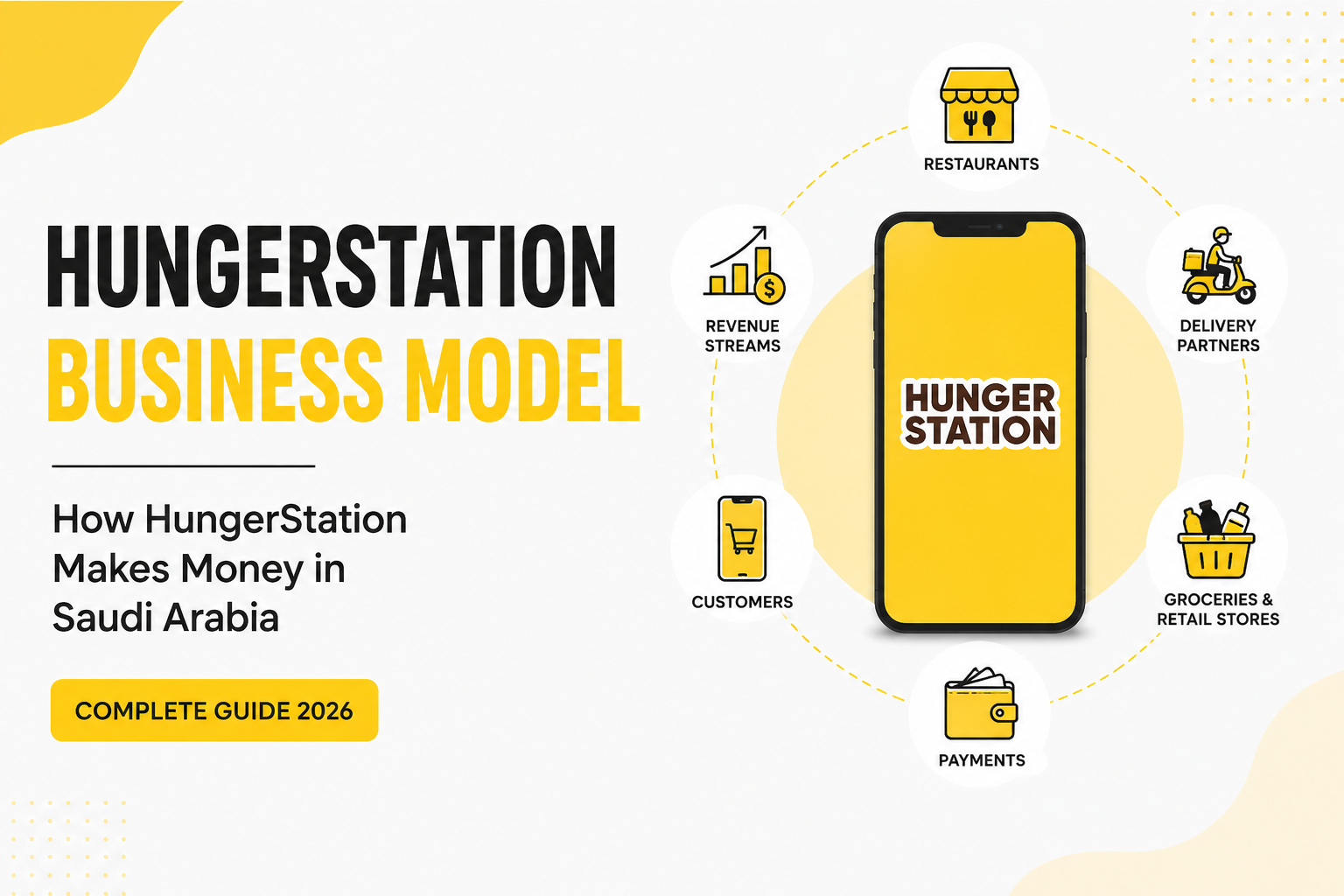
HungerStation earns revenue through delivery fees, restaurant commissions, subscriptions, advertising, and grocery and retail deliveries.
In this blog, we will explore the company overview, its history, the complete business model explained step by step, revenue streams, competitive advantages, and the future outlook.
What Is HungerStation?
Quick Answer: HungerStation is a Saudi-based multi-category delivery marketplace that enables customers to order meals, groceries, medicines, flowers, and more through an app.
Company Overview
- Founded year: 2012
- Headquarters: Riyadh, Saudi Arabia
- Founders: Ebrahim Al-Jassim and Hossein Bukhamseen
- Parent company: Delivery Hero (acquired in 2023)
- Countries served: Primarily Saudi Arabia, with operations in UAE and Bahrain
- Cities covered: Over 102 cities across Saudi Arabia
- Partners: More than 55,000 restaurants, stores, and merchants
- Delivery partners: Thousands of riders across the Kingdom
- App availability: iOS and Android via official app stores
HungerStation is the first Saudi food delivery app in the region. It has grown from a simple restaurant ordering platform into a comprehensive local commerce ecosystem.
History of HungerStation
HungerStation was launched in March 2012, way ahead of the digital boom in Saudi Arabia. The tech sector was still emerging, but the founders took a bet on the growing demand for online convenience.
Early Growth
The company focused on building trust with the local ecosystem. They connected with partners ranging from local favorites to international chains. In 2021, they collaborated with Deliverect to reduce operational errors and speed up order preparation and delivery times.
Expansion and Milestones
HungerStation expanded across Saudi Arabia and eventually into UAE and Bahrain. The company was profitable in 2022, a significant achievement given that their parent company Delivery Hero as a group was not yet profitable at that time. This demonstrated the benefit of sustainable growth and reduced reliance on external capital.
Major Acquisition
In 2023, Delivery Hero acquired HungerStation for approximately $803 million. The acquisition unified Delivery Hero’s command in the KSA market while leveraging HungerStation’s strong local brand and operational capabilities.
Current Market Position
Today, HungerStation holds approximately 18% of the MENA food delivery app MAU market share through 2024. Together with Jahez, these two platforms control 65% of the Saudi food aggregator market. The food delivery market in Saudi Arabia is valued at approximately USD 19 billion as of 2024.
HungerStation Business Model Explained
Quick Answer: HungerStation operates a multi-sided marketplace connecting customers, merchants, and delivery partners while generating revenue from every successful transaction.
Marketplace Platform
At its core, the HungerStation business model is a commission-based platform-enabled aggregation model. The platform brings supply (restaurants and stores) and demand (customers) together on a single digital marketplace. They facilitate every aspect of the transaction.
Demand Generation
The platform attracts millions of users through marketing campaigns, referral programs, coupons, and app store visibility. A notable example is the “Social Feed” campaign, which used AI-powered image recognition to let users order food they saw on social media. This campaign onboarded 100,000 new users in a single month and increased average order value by 12%.
Merchant Onboarding
HungerStation provides easy onboarding for merchants. They offer digital menu management tools, business dashboards with analytics, and promotional tools. The company has invested heavily in the HRewards loyalty program, which has helped over 50,000 vendors gain new customers and increase order volumes across 100+ Saudi cities.
Order Management
The platform processes orders in real-time. Order management includes routing orders to restaurants, syncing menus, managing real-time availability, and payment processing.
Logistics
HungerStation handles last-mile logistics through a network of delivery partners. They use route optimization, GPS tracking, and real-time order tracking to ensure efficient delivery.
Payments
The platform supports multiple payment methods including cash on delivery and card payments. They process payments from customers and settle with restaurant partners.
Customer Retention
HungerStation uses loyalty programs, personalized recommendations, promotions, ratings, and customer support to retain users. The HRewards program alone has accounted for more than 9 million orders purchased using loyalty points in the last 12 months.
How HungerStation Works
The platform follows a six-step process for every order:
Step 1: Customer Opens the App
The customer sets their location and browses nearby restaurants and stores. The app uses smart filters and search to find the best options.
Step 2: Select Restaurant or Store
The customer compares prices, views ratings, and chooses items from the menu. The app offers variety across cuisines including pizza, shawarma, burgers, Indian curries, Japanese specialties, and authentic Arabic dishes.
Step 3: Place Order
The customer adds items to the cart, selects a payment method (card or cash), and applies coupons or promo codes. Delivery time can be scheduled for convenience.
Step 4: Restaurant Accepts Order
The restaurant receives the order via a tablet or panel. They confirm availability and prep time. Food preparation begins after confirmation.
Step 5: Delivery Partner Picks Up
A rider receives a job request, navigates to the restaurant, and picks up the order. The customer can track their order step by step until it arrives.
Step 6: Customer Receives Order
The order is delivered to the customer. The customer can rate the experience, leave feedback, add tips, and reorder favorites easily.
HungerStation Business Model Canvas
Customer Segments
- Individual consumers
- Families
- Office workers
- Restaurants
- Grocery stores
- Pharmacies
- Delivery partners
Value Propositions
For customers:
- Fast delivery with real-time tracking
- Large selection across 55,000+ partners
- Convenience of ordering from anywhere
- Discounts and promotional offers
For merchants:
- Access to more customers
- Delivery infrastructure and logistics
- Marketing exposure and visibility
- Analytics and business insights
For delivery partners:
- Flexible income opportunities
- High order volume
- Commission-based earnings
Channels
- Mobile app (primary channel)
- Website
- Push notifications
- Email marketing
- SMS communications
- Social media platforms
Customer Relationships
- Loyalty programs (HRewards and HungerStation Plus)
- 24/7 customer support
- Ratings and reviews system
- Personalized recommendations
- Promotions and special offers
Revenue Streams
- Restaurant commissions
- Delivery fees
- Subscription plans
- In-app advertising and sponsored listings
- Grocery and multi-category delivery partnerships
Key Resources
- Mobile application
- Delivery network
- Merchant partnerships
- Technology platform
- Customer data
- Brand recognition
Key Activities
- Order processing
- Logistics management
- Marketing and promotion
- Technology development
- Customer support
- Merchant acquisition
Key Partners
- Restaurants
- Grocery chains (including Lulu Market)
- Pharmacies
- Payment providers
- Delivery partners
- Cloud infrastructure providers
Cost Structure
- Delivery operations and rider payments
- Employee salaries
- Marketing and user acquisition
- Technology and cloud infrastructure
- Customer support operations
- Payment processing fees
- Office and administrative expenses
How HungerStation Makes Money
Restaurant Commission
Restaurant commission is the primary revenue stream for HungerStation. The platform charges restaurants a percentage of the total order value for every order placed through the app.
Commission rates in Saudi Arabia typically range from 25% to 35% of the order value. The exact percentage depends on several factors:
- Restaurant size and brand
- Exclusivity agreements
- Whether the restaurant uses HungerStation’s delivery fleet
- Category and average order value
Why restaurants accept it: Restaurants gain access to a large customer base, delivery infrastructure, and marketing exposure. For a typical SAR 50 order at a 30% commission rate, HungerStation earns SAR 15 from the restaurant.
Delivery Fees
Customers pay delivery fees based on distance and demand in their area. Delivery fees in Saudi Arabia typically range from SAR 5 to SAR 15 per order. Factors that affect delivery fees include:
- Distance between the restaurant and delivery address
- Time of day
- Demand and rider availability
- Weather conditions
Delivery fees help the company cover logistics and courier expenses.
Subscription Plans
HungerStation offers a premium membership program called HungerStation Pro (formerly HPlus). Subscribers pay a recurring fee to receive benefits like free delivery and special discounts.
The subscription is priced at approximately SAR 29 per month with annual plans available at a discount. The strategic benefits include:
- Subscribers order more frequently
- Higher loyalty and lower churn rates
- More commission revenue through increased order volume
HungerStation Plus offers unlimited free delivery from over 35,000 restaurants, stores, and pharmacies.
Sponsored Listings and Advertising
Restaurants can pay HungerStation for premium placement in the app. Advertising options include:
- Sponsored listings in search results
- Banner ads on the home screen and category pages
- Promotional features in trending or recommended sections
- Push notification ads
This is a rapidly growing revenue stream as more restaurants compete for visibility in an increasingly crowded marketplace.
Grocery Delivery
HungerStation partners with local grocery stores and supermarkets to offer grocery delivery. The platform now offers 20-minute grocery delivery via HMarket. Grocery delivery represents a high-growth revenue stream as customers increasingly order daily essentials online.
Pharmacy Delivery
The platform partners with pharmacies to deliver medicines and daily care essentials. This category is growing due to healthcare convenience needs and increasing demand for home delivery of medical supplies.
Convenience Store Deliveries
HungerStation delivers snacks, daily essentials, and household products from convenience stores. This expands the platform’s reach beyond food into everyday household needs.
Service Fees
HungerStation charges a small service fee on each order, typically SAR 1 to 3. This covers the technology and platform costs associated with processing transactions. While small per order, service fees scale with volume and contribute a steady revenue stream.
Merchant Services
The platform offers marketing tools, analytics dashboards, and promotional campaigns to help merchants grow their business. These services help restaurants optimize their menu, pricing, and visibility on the platform.
HungerStation Revenue Model Summary
| Revenue Source | How It Works | Paid By |
|---|---|---|
| Restaurant Commissions | Percentage of each order (25-35%) | Restaurants |
| Delivery Fees | Distance and demand-based fees | Customers |
| Subscription Plans | Monthly recurring fee for perks | Customers |
| In-App Advertising | Sponsored listings and banners | Restaurants/Brands |
| Grocery Delivery | Margin on retail items | Customers |
| Pharmacy Delivery | Delivery fees on medical items | Customers |
| Service Fees | Flat fee per order | Customers |
| Merchant Services | Marketing and analytics tools | Restaurants |
HungerStation Value Chain
The value chain follows this flow:
Customer → Platform → Merchant → Delivery Partner → Payment → Customer Support → Repeat Orders
Stages Explained
Customer: The customer discovers the app, creates an account, and places orders.
Platform: HungerStation processes the order, manages payments, and coordinates logistics.
Merchant: Restaurants and stores prepare the products and hand over to riders.
Delivery Partner: Riders pick up and deliver orders to customers.
Payment: Payment is processed and settled between all parties.
Customer Support: Issues are resolved, and feedback is collected.
Repeat Orders: Loyalty programs and promotions encourage repeat purchases.
HungerStation Customer Acquisition Strategy
Referral Programs: Customers earn rewards for referring friends and family.
Coupon Campaigns: First-time users receive discounts and promotional offers. New users can get a full year of free delivery from over 35,000 restaurants and stores upon signup.
Influencer Marketing: HungerStation collaborates with influencers to reach tech-savvy audiences.
Social Media: The platform uses Instagram and other channels to engage users. The “Social Feed” campaign allowed users to DM food posts to HungerStation’s Instagram account and order the identified dish.
Partnerships: Collaborations with banks, telecom providers, and other brands to reach new customers.
Mobile App Optimization: The app is user-friendly and optimized for smartphone usage patterns in Saudi Arabia.
Push Notifications: Targeted messages about deals, new restaurants, and order updates.
Merchant Growth Strategy
Easy Onboarding: Simple sign-up process for new restaurants and stores.
Digital Menu Management: Tools to update menus, prices, and availability.
Business Dashboard: Analytics to track sales, customer behavior, and performance.
Promotions: Restaurants can run promotional campaigns and special offers.
Analytics: Data-driven insights to optimize operations and marketing.
HRewards Program: The loyalty program has driven commercial growth for over 50,000 vendors and partners, helping them expand reach and gain new customers.
Technology Behind HungerStation
AI Recommendations: The platform uses AI to help users find dishes they might enjoy. In 2023, HungerStation introduced a “Subconscious Order” feature that used AI and data to help users find their cravings faster. The launch generated 2.5 million impressions and 6,000 new customers per day.
Route Optimization: Algorithms optimize delivery routes to reduce time and cost.
GPS Tracking: Real-time tracking of orders and riders.
Payment Integration: Multiple payment methods including cash and cards.
Real-Time Order Tracking: Customers can track their orders step by step.
Data Analytics: Insights for merchants and platform optimization.
Cloud Infrastructure: Scalable infrastructure to handle millions of orders.
Competitive Advantages
Strong Saudi Market Presence: Founded in Saudi Arabia, HungerStation has deep local knowledge and cultural understanding. The app offers culturally preferred payment methods like cash on delivery and tailored services for local tastes.
Large Merchant Network: Over 55,000 restaurants and stores across 102+ cities.
Multiple Retail Categories: Beyond food, the platform offers groceries, pharmacies, flowers, and gifts.
Fast Delivery: Quick delivery times, including 20-minute grocery delivery.
Brand Recognition: Strong brand awareness as the first Saudi food delivery app in the region.
Local Expertise: Understanding of Saudi consumer behavior and preferences.
Sustainable Growth: HungerStation was profitable in 2022 while many competitors were still unprofitable.
SWOT Analysis
Strengths
- First-mover advantage in Saudi Arabia
- Strong brand recognition and trust
- Large merchant network of 55,000+ partners
- Profitable business model
- Parent company backing (Delivery Hero)
- Diversified revenue streams
- Technology innovation (AI, route optimization)
Weaknesses
- Customer support issues reported by some users
- Reliance on delivery partners for logistics
- Commission rates can strain small restaurant margins
Opportunities
- Quick commerce and 20-minute delivery expansion
- Grocery and retail category growth
- AI-powered personalization
- Autonomous delivery
- Dark stores and cloud kitchens
- Sustainability initiatives
Threats
- Intense competition from Jahez, Talabat, Careem Food, and others
- Rising delivery costs
- Driver retention challenges
- Regulatory changes
- Customer loyalty in a competitive market
Competitors of HungerStation
| Company | Main Market | Business Model | Strength |
|---|---|---|---|
| Jahez | Saudi Arabia | Marketplace | Local leadership, strong GMV growth |
| Talabat | Middle East | Marketplace | Regional expansion, Delivery Hero portfolio |
| Careem Food | Middle East | Super app | Ecosystem integration |
| Deliveroo | Selected markets | Premium delivery | Fast logistics |
| Uber Eats | Global | Marketplace | Large user base |
| Keeta | Saudi Arabia | Marketplace | Aggressive discounting and tech-enabled order flows |
HungerStation and Jahez together hold 65% market share in Saudi Arabia. Talabat commands 25% MAU market share in MENA through 2024, while HungerStation holds 18%.
Challenges Facing HungerStation
Rising Delivery Costs: Logistics and rider payments are significant expenses. The platform must balance affordability with operational sustainability.
Driver Retention: Keeping delivery partners motivated and on the platform is a constant challenge. Rider compensation structures include salary plus commission per order.
Competitive Pricing: Competitors like Keeta use aggressive discounting (up to 50%) to gain traction. This pressures HungerStation to offer competitive deals.
Merchant Commissions: High commission rates can strain merchant relationships. Some small restaurants struggle with the 25-35% commission fees.
Customer Loyalty: With multiple platforms available, retaining users requires continuous value delivery.
Regulatory Changes: Changes in labor laws, delivery regulations, or e-commerce policies could impact operations.
Future of HungerStation
AI-Powered Logistics: Continued investment in AI for route optimization, demand forecasting, and personalization.
Autonomous Delivery: Exploring autonomous delivery vehicles and drones for last-mile logistics.
Quick Commerce: Expansion of 20-minute delivery for groceries and essentials.
Grocery Expansion: Growing the HMarket and grocery delivery segments to capture more daily spending.
Dark Stores: Investment in dark stores and cloud kitchens to improve delivery speed and inventory management.
Sustainability Initiatives: Environmental sustainability programs to align with Vision 2030 goals.
Personalized Shopping: Deeper AI integration for personalized recommendations and targeted promotions.
Regional Expansion: Growth into new cities and possibly new countries.
Key Takeaways
- Business Model: HungerStation operates a multi-sided marketplace platform connecting customers, restaurants, and delivery partners.
- Revenue Sources: The company generates income through restaurant commissions (25-35%), delivery fees, subscription plans, advertising, and multi-category delivery partnerships.
- Growth Strategy: Customer acquisition through referrals, coupons, and social media campaigns; merchant growth through easy onboarding, analytics, and loyalty programs.
- Competitive Advantages: Strong local presence, large merchant network, diversified categories, and sustainable profitability.
- Future Outlook: AI-powered logistics, quick commerce, grocery expansion, and sustainability initiatives will drive future growth.
Wrapping Up
HungerStation has evolved from a food delivery app into a comprehensive local commerce platform. Its marketplace model, diversified revenue streams, strong merchant ecosystem, and technology-driven logistics have helped it maintain a leading position in Saudi Arabia’s on-demand delivery market.
The company continues to expand into groceries, pharmacies, and other retail categories. With AI-powered logistics, quick commerce, and sustainability initiatives on the horizon, HungerStation is well-positioned to continue growing in the Kingdom’s rapidly evolving digital economy.
The platform’s ability to build trust with the local ecosystem, innovate with technology, and maintain sustainable profitability sets it apart from competitors. As Saudi Arabia’s Vision 2030 continues to drive digital transformation, HungerStation stands as a key player in the nation’s e-commerce and delivery landscape.
Frequently Asked Questions
What is HungerStation?
HungerStation is a Saudi-based online food delivery platform founded in 2012 that connects customers with restaurants, grocery stores, pharmacies, and other retailers through a mobile app and website.
How does HungerStation make money?
HungerStation makes money through restaurant commissions, delivery fees, subscription plans, in-app advertising, grocery delivery, and service fees.
Does HungerStation own restaurants?
No, HungerStation does not own restaurants. It operates as a marketplace connecting customers with partner merchants.
Does HungerStation employ delivery drivers?
HungerStation uses a network of delivery partners and riders. Driver compensation includes salary plus per-order commissions.
Is HungerStation profitable?
Yes, HungerStation was profitable in 2022, even before its acquisition by Delivery Hero.
Who owns HungerStation?
HungerStation is owned by Delivery Hero, which acquired the company in 2023 for approximately $803 million.
What countries does HungerStation operate in?
HungerStation primarily operates in Saudi Arabia, with additional operations in UAE and Bahrain.
What services does HungerStation offer?
HungerStation offers food delivery, grocery delivery, pharmacy delivery, flowers and gifts delivery, and convenience store deliveries.
How much commission does HungerStation charge restaurants?
HungerStation commission rates in Saudi Arabia typically range from 25% to 35% of the order value.
Who are HungerStation’s biggest competitors?
HungerStation’s biggest competitors include Jahez, Talabat, Careem Food, and Keeta in the Saudi market.
Is HungerStation only for food delivery?
No, HungerStation has expanded beyond food delivery into groceries, pharmacies, flowers, gifts, and convenience store items.
What is HungerStation’s business model?
HungerStation operates a commission-based, platform-enabled aggregation model that connects customers, merchants, and delivery partners while generating revenue from every transaction.
Discover more from Business Model Hub
Subscribe to get the latest posts sent to your email.