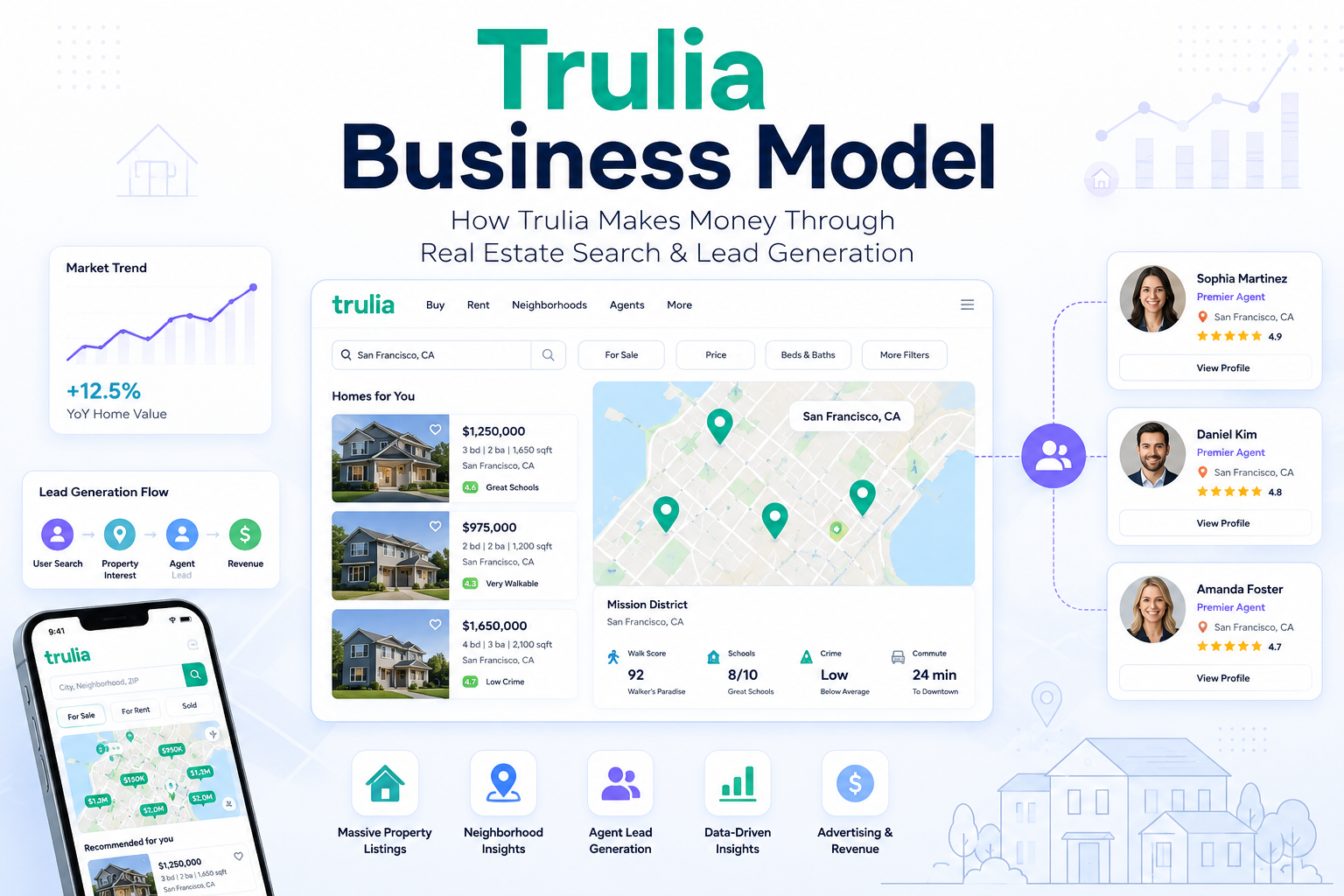

Trulia is one of the most recognized names in online real estate. It helps millions of users search for homes, rental properties, and neighborhood insights all in one place.
What made Trulia stand out early on was its focus on lifestyle data, not just listings. Most platforms showed you the house. Trulia showed you the neighborhood, the schools, the commute, and the crime rates too.
In 2015, Zillow Group acquired Trulia for roughly $2.5 billion, cementing its place as a major force in proptech. Even under Zillow’s umbrella, Trulia continues to operate as a separate consumer-facing product with its own brand identity and user base.
Its revenue model is built around advertising, agent lead generation, and premium listing placement a structure that became a blueprint for modern real estate platforms.
What Is Trulia?
Trulia is an online real estate marketplace that helps users search for homes, rentals, neighborhoods, and local property insights.
Founded in 2005 by Pete Flint and Sami Inkinen, Trulia was built on a simple idea: home searching should be more than just browsing listings. It should help people understand where they’re moving, not just what they’re buying.
The platform grew quickly by aggregating MLS data, public records, and community-generated content into one searchable interface. By the time Zillow acquired it, Trulia had tens of millions of monthly visitors and a strong brand in the consumer real estate space.
Core products and services include:
- Homes for sale search
- Rental property listings
- Neighborhood guides with local data
- Agent finder tools
- Mortgage calculators and affordability tools
Trulia’s role in the proptech ecosystem is that of a consumer aggregator and advertising marketplace. It sits between buyers, renters, and the agents who serve them — monetizing that connection through data-driven advertising.
How Trulia Works
Trulia connects buyers, renters, sellers, and real estate agents through listings, neighborhood data, and advertising systems.
The platform operates as a multi-sided marketplace. On one side, you have consumers searching for homes or rentals. On the other side, you have real estate agents and property managers who want to reach those consumers. Trulia earns money by facilitating that connection.
Property Listings Marketplace
Trulia aggregates millions of property listings from MLS feeds, brokerages, and direct submissions. Users can filter by price, size, location, property type, and more.
The map-based search interface was one of Trulia’s early differentiators. Instead of scrolling through a list, users could visually explore neighborhoods and see available properties overlaid on a map.
Homes for sale and rental listings are both available, making Trulia useful for people at different stages of the housing journey — whether they’re renting now and planning to buy later, or actively shopping for a home.
Neighborhood Intelligence
This is where Trulia genuinely separates itself from basic listing sites.
Every property listing on Trulia includes a neighborhood profile. That profile pulls together data on:
- Crime rates — mapped visually by category
- School ratings — nearby public and private schools with performance scores
- Commute times — estimated drive or transit time to major employment centers
- Lifestyle reviews — community-submitted descriptions of what it’s like to live there
This data layer answers the question buyers actually care about: “Is this a good place to live?” Not just “Is this a good house?”
Agent Lead Generation
When a buyer clicks “Contact Agent” or submits an inquiry on a listing, that action becomes a lead. Trulia routes that lead to an agent — in many cases, a Premier Agent who has paid for visibility in that ZIP code.
The lead generation system is the backbone of Trulia’s revenue model. Agents pay to be positioned in front of high-intent users at the exact moment those users are considering a property.
Mobile App Ecosystem
Trulia invested early in mobile. Its app supports location-based property search, meaning it can surface listings near wherever you currently are.
Push notifications alert users to new listings, price changes, and open houses. The mobile experience is designed to keep users engaged throughout the home search process — which can last months for many buyers.
Trulia Business Model Explained
Trulia operates mainly on a marketplace, advertising, and lead-generation business model.
It doesn’t earn money from the transactions themselves. There’s no commission involved when a buyer purchases a home through Trulia. Instead, Trulia monetizes the attention and intent of its users by selling access to that audience to real estate professionals.
Marketplace Model
Trulia is a classic two-sided marketplace. It creates value for consumers by giving them free access to listings and neighborhood data. It creates value for agents by giving them access to a large pool of motivated home searchers.
The platform’s job is to grow both sides simultaneously. More listings attract more buyers. More buyers attract more agents willing to advertise.
Advertising Model
Real estate agents, mortgage lenders, insurance companies, and home service providers all pay to advertise on Trulia. These ads appear across search results, listing pages, and neighborhood guides.
The advertising model works because Trulia’s audience is highly qualified. Someone searching for a three-bedroom home in a specific ZIP code is a very specific type of consumer — one that advertisers are willing to pay a premium to reach.
Lead Generation Model
Trulia’s lead generation product allows agents to purchase leads by ZIP code. When a user inquires about a property in a ZIP code where an agent has bought coverage, that inquiry goes to the agent.
This is a performance-adjacent model. Agents aren’t guaranteed sales, but they’re guaranteed contact with people who are actively looking. The closer to a transaction decision a user is, the more valuable that lead becomes.
Data Platform Model
Trulia’s neighborhood data isn’t just a consumer feature — it’s a competitive moat. The platform has accumulated years of user behavior, search patterns, and neighborhood preference data that informs both its product development and its advertising targeting.
This data allows Trulia to serve more relevant ads, improve lead quality, and develop insights that keep users coming back for more than just listing browsing.
Trulia Business Model Canvas
Trulia’s Business Model Canvas shows how the platform creates value through real estate listings, neighborhood data, advertising, and agent lead generation.
Key Partners
- Real estate agents and brokerages
- Multiple Listing Services (MLS databases)
- Property management companies
- Mortgage providers and lenders
- Display advertising partners
Key Activities
- Managing and updating property listings
- Maintaining search and recommendation algorithms
- Generating and routing agent leads
- Producing neighborhood data and insights
- Mobile app development and optimization
Key Resources
- Real estate listing data
- User traffic and behavioral data
- Brand recognition
- Mapping and analytics technology
- Mobile applications
Value Propositions
For buyers and renters:
- Free access to comprehensive property listings
- Neighborhood insights that go beyond the listing
- Transparent local data to support better decisions
For agents:
- Access to high-intent buyer leads
- ZIP-code-level advertising targeting
- Increased visibility on a high-traffic platform
Customer Relationships
Trulia operates mostly on a self-service model. Users search on their own. Agents manage their own advertising accounts. Automated systems handle lead routing and email alerts.
Personalization layers — like saved searches and recommended listings — add a sense of customized service without requiring human intervention.
Channels
- Trulia website (desktop search)
- Mobile app (iOS and Android)
- Organic SEO traffic
- Email alerts and newsletters
- Paid digital advertising
Customer Segments
- Active home buyers
- Renters looking for apartments or houses
- Real estate agents seeking leads
- Property management companies
- Mortgage and insurance advertisers
Cost Structure
- Technology infrastructure and hosting
- Data licensing and MLS integrations
- Marketing and user acquisition
- Engineering and product team salaries
- Platform maintenance and compliance
Revenue Streams
- Premier Agent advertising subscriptions
- Featured and promoted listings
- Rental advertising products
- Display advertising from non-agent brands
- Partnership and referral revenue
How Trulia Makes Money
Trulia earns revenue mainly through advertising subscriptions, agent lead generation, and premium listing visibility.
Premier Agent Advertising
This is Trulia’s primary revenue driver. The Premier Agent program lets licensed real estate agents pay for prominent placement across listing pages in specific ZIP codes.
When a buyer views a listing in a ZIP code where an agent is a Premier Agent, that agent’s profile, photo, and contact information appear front and center. The buyer sees them as the recommended contact, even if they’re not the listing agent.
Agents pay monthly fees for this exposure. The cost varies by market — high-demand ZIP codes in competitive cities cost significantly more than rural areas with lower search volume.
Featured Property Listings
Sellers or agents can pay to have their listings promoted above standard organic results. Featured listings get more prominent placement on search results pages and additional exposure within the platform.
This drives more views, more inquiries, and faster responses — making it an attractive add-on for agents with motivated sellers.
Rental Advertising Revenue
Trulia operates a rental marketplace alongside its home-for-sale listings. Property managers and landlords can pay to promote their rental listings, getting featured placement ahead of non-paying entries.
The rental market is a consistent revenue stream because rental activity doesn’t slow down the way home purchases do when interest rates rise. Renters are always in the market.
Display Advertising
Trulia sells display ad space to companies that want to reach home buyers and renters:
- Mortgage lenders targeting buyers calculating affordability
- Homeowners insurance companies reaching buyers close to closing
- Home improvement and service brands targeting recent movers
- Moving companies reaching users who’ve recently gone under contract
These advertisers value Trulia’s audience because the purchase intent is built into the platform’s context.
Partnership Revenue
Trulia generates additional revenue through strategic partnerships — particularly in the mortgage and home services space. Referral arrangements with lenders and service providers contribute to the overall revenue mix, especially as users move deeper into the buying process.
Trulia Value Proposition
Trulia simplifies home discovery by combining listings with local lifestyle and neighborhood intelligence.
For buyers: The value is clarity. Trulia doesn’t just show you houses — it shows you whether a neighborhood fits your life. School quality, safety, walkability, and commute time are all part of the picture.
For renters: Trulia makes it easy to compare rental options based on both price and lifestyle factors. A renter can filter by commute time to work and see crime data before ever scheduling a showing.
For agents: Trulia delivers leads at scale. Rather than cold-calling or spending on broad advertising, agents can pay to be visible exactly when and where buyers are actively looking. That’s a fundamentally more efficient use of marketing dollars.
Trulia Marketing Strategy
SEO Strategy
Trulia built much of its traffic on search engine optimization. It created thousands of neighborhood-level landing pages targeting hyperlocal queries like “homes for sale in [neighborhood name]” or “apartments near [landmark].”
This long-tail SEO approach meant Trulia could capture search demand from buyers and renters who weren’t even sure what they were looking for yet — just starting to explore a city or neighborhood.
Local SEO is a major traffic driver for real estate platforms, and Trulia invested heavily in building content depth at the city, neighborhood, and ZIP-code level.
Content Marketing
Trulia produced guides, market trend reports, and neighborhood spotlights that served both consumers and search engines. Content about buying your first home, understanding mortgage options, or evaluating school districts built trust with users early in their decision process.
This content also positioned Trulia as an authority — not just a listing aggregator — which supported both SEO rankings and brand recall.
Mobile Growth Strategy
Trulia prioritized its mobile app as a growth channel. Location-based features, push notifications for price drops, and a smooth map-based search experience made the app a regular tool for buyers in active search mode.
Mobile engagement is critical in real estate because buyers often browse listings casually over weeks or months. An app that keeps users coming back increases the likelihood they’ll submit an inquiry — and generate a lead — through the platform.
Brand Positioning
Trulia positioned itself as the lifestyle-first real estate platform. Where Zillow led with data and valuations (the Zestimate), Trulia led with neighborhood experience and community insight.
This differentiation made Trulia appealing to buyers who weren’t just looking for a transaction — they were looking for a place to build a life.
Trulia vs Zillow
Trulia focuses more on neighborhood and lifestyle discovery, while Zillow focuses heavily on property data and home valuation tools.
| Feature | Trulia | Zillow |
|---|---|---|
| Core Focus | Neighborhood and lifestyle insights | Home valuation and property data |
| Business Model | Advertising and lead generation | Advertising, leads, and mortgage origination |
| User Experience | Lifestyle-centric search | Data and valuation-centric search |
| Signature Feature | Neighborhood crime and school maps | Zestimate home value tool |
| Parent Company | Zillow Group | Zillow Group |
| Rental Platform | Yes | Yes |
| iBuying History | No | Zillow Offers (now discontinued) |
Both platforms now operate under the same corporate parent, so their listing databases are largely shared. The differences are mostly in user experience emphasis and how each brand presents itself to consumers.
SWOT Analysis of Trulia
Strengths
- Rich neighborhood data that competitors don’t match in depth
- Strong brand recognition in the consumer real estate space
- High user intent — people searching on Trulia are actively considering a move
- Backing and resources of Zillow Group
- Established mobile app with a loyal user base
Weaknesses
- Heavy reliance on advertising revenue makes performance sensitive to housing market cycles
- Limited differentiation from Zillow in an era where both share the same listing data
- Lead quality can vary significantly by market and agent follow-up
- No direct role in the transaction itself limits monetization depth
Opportunities
- AI-powered property matching based on user behavior
- Predictive analytics for market timing and pricing
- Smart home integration and virtual tour expansion
- Deeper partnerships with mortgage and title services
- Hyperlocal content and micro-neighborhood intelligence
Threats
- Declining housing market activity directly reduces advertising spend
- Competitors like Redfin (which offers buyer rebates) and Realtor.com
- Disintermediation risk as brokerages build their own digital tools
- Regulatory changes around data privacy and MLS access
- Rising customer acquisition costs as digital advertising becomes more competitive
Why Trulia Became Successful
Several factors drove Trulia’s rise in a crowded market.
Early proptech innovation. Trulia entered the market when most real estate search was still fragmented across broker websites and classifieds. It aggregated listings and added neighborhood context before that was standard.
Map-based search interface. The visual map interface changed how people searched for homes. Instead of address-by-address browsing, users could see an entire neighborhood at once and understand spatial relationships between properties and amenities.
Trust-focused product design. By including crime data, school ratings, and community reviews, Trulia built consumer trust. It felt transparent — like a platform looking out for the buyer’s interests, not just trying to sell them something.
Mobile-first adoption. Trulia moved aggressively to mobile at the right time. As smartphone usage exploded, Trulia’s app gave it a direct channel to users throughout the day, not just when they were sitting at a desktop.
Challenges in Trulia’s Business Model
Housing market dependence. When the housing market slows — as it did dramatically when interest rates spiked — advertising spend from agents drops. Trulia’s revenue is not insulated from macroeconomic housing cycles.
Lead quality concerns. Not all leads are equal. Agents sometimes report inconsistent lead quality — users who submitted an inquiry but weren’t actually close to making a decision. This creates friction in the agent-platform relationship.
Customer acquisition costs. As more platforms compete for the same audience, the cost of acquiring new users through paid channels has increased. Trulia relies heavily on SEO to keep acquisition costs manageable.
Intense platform competition. Realtor.com, Redfin, Homes.com, and Apartments.com all compete for overlapping user segments. Each platform has to continuously invest in product and content to maintain relevance.
Future of Trulia
The next phase of Trulia’s evolution will likely be shaped by several emerging trends.
AI-driven property matching. Rather than relying on users to set their own filters, AI can infer what a buyer actually wants based on their search behavior and surface more relevant listings proactively.
Predictive analytics. Helping buyers understand when to buy, where prices are heading, and which neighborhoods are appreciating fastest adds real value beyond what static listings provide.
Virtual property tours. As 3D tour technology improves, Trulia could integrate immersive property walkthroughs directly into listings — reducing the need for physical showings early in the process.
Hyperlocal market intelligence. Going deeper on neighborhood data — foot traffic trends, new business openings, infrastructure investments — could give Trulia a stronger data moat and more reasons for buyers to return to the platform throughout their search.
Lessons Startups Can Learn From Trulia
Solve a real user problem. Trulia didn’t just replicate listing data — it answered the questions buyers were actually asking. That problem-solution fit drove organic adoption.
Build network effects deliberately. More listings attracted more buyers, which attracted more agents, which brought more listings. Trulia invested in growing both sides of the marketplace simultaneously.
Use data as a competitive moat. Neighborhood data, user behavior insights, and search trends all compound over time. The longer Trulia operated, the harder that data was for newcomers to replicate.
Prioritize mobile experience. Real estate search is a mobile behavior. Trulia’s early investment in app quality paid off as mobile usage overtook desktop.
Build trust into the product. Transparent data — even data that might dissuade a buyer from a particular area — builds long-term credibility. Users who trust a platform keep coming back to it.
Wrapping Up on Trulia’s Business Model
Trulia built a scalable, data-driven real estate platform by focusing on what buyers actually needed — not just listings, but context.
Its monetization model is straightforward: give consumers free access to valuable information, then charge the professionals who want to reach those consumers. That advertising and lead-generation approach has proven durable across multiple housing cycles.
The acquisition by Zillow Group gave Trulia the resources to compete at scale, even as it maintained its separate brand identity and neighborhood-focused positioning.
For proptech founders and business strategists, Trulia’s growth story is a clear example of how layering data intelligence on top of a marketplace creates compounding value — for users, for advertisers, and for the platform itself.
FAQs
Trulia operates on an advertising and lead-generation model. It offers free search tools to consumers and charges real estate agents, property managers, and advertisers for visibility and access to its user base.
Trulia earns revenue through Premier Agent advertising subscriptions, featured listing promotions, rental advertising, display ads from mortgage and insurance brands, and strategic partnership revenue.
Yes. Zillow Group acquired Trulia in 2015 for approximately $2.5 billion. Trulia continues to operate as a separate consumer brand under Zillow Group’s ownership.
Yes, Trulia is free for home buyers and renters. The platform generates revenue from agents and advertisers, not from consumers.
Trulia’s Premier Agent program gives agents paid visibility in specific ZIP codes, routing buyer inquiries to them as leads. It allows agents to build brand presence and generate contacts with high-intent buyers.
Trulia emphasizes neighborhood lifestyle data — crime maps, school ratings, commute times, and community reviews. Zillow emphasizes property valuation through its Zestimate tool. Both are now owned by the same parent company but maintain distinct user experiences.
Yes. Property managers and landlords can pay to promote rental listings on Trulia, generating featured placement revenue separate from the home-sale advertising business.
Premier Agent advertising, featured property listings, rental advertising, display advertising from financial and home service brands, and partnership referral revenue.
Discover more from Business Model Hub
Subscribe to get the latest posts sent to your email.