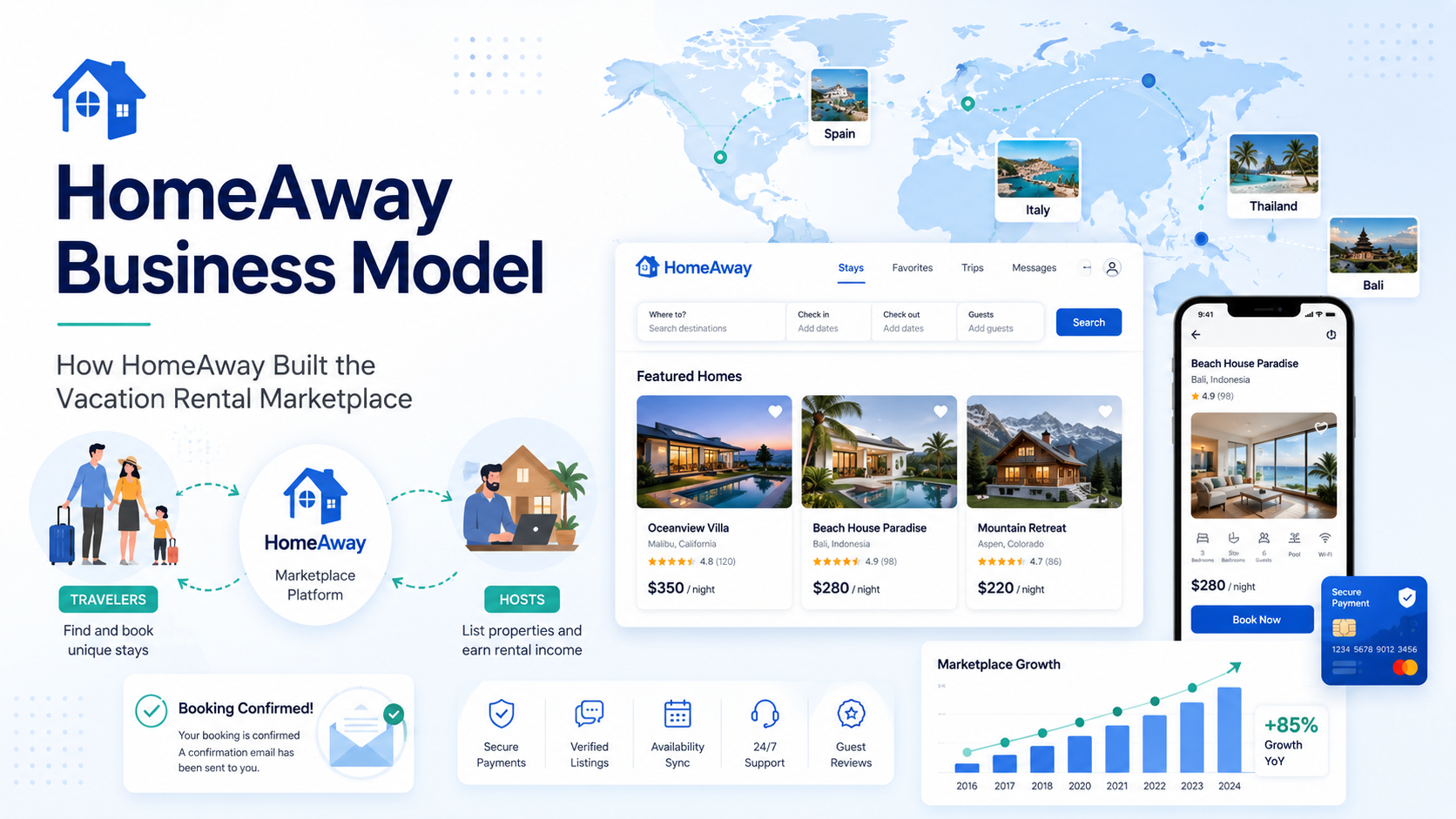
HomeAway Business Model And How It Built the Vacation Rental Marketplace Industry

HomeAway was one of the most influential travel-tech platforms ever built. Long before “vacation rental” became a mainstream category, HomeAway was quietly connecting property owners with travelers looking for something better than a standard hotel room.
The platform grew into a billion-dollar marketplace, got acquired by Expedia, and helped lay the foundation for the entire short-term rental industry we know today.
This breakdown covers exactly how HomeAway worked, how it made money, how it stacked up against Airbnb, and what startups can learn from its model.
What Is HomeAway?
HomeAway was an online vacation rental marketplace that connected travelers directly with property owners renting out their homes, cabins, condos, and beach houses. Instead of booking a hotel room, travelers could rent an entire property — ideal for families, groups, and anyone wanting more space and privacy.
HomeAway Overview
HomeAway was founded in 2005 in Austin, Texas, by Brian Sharples and Carl Shepherd. The founders saw a fragmented vacation rental market — thousands of individual property owners listing homes on scattered, niche websites — and decided to consolidate everything into one centralized platform.
The timing was right. Broadband internet was mainstream, online booking was growing fast, and travelers were increasingly comfortable making reservations without picking up a phone.
Within its first few years, HomeAway acquired several competing rental sites including VRBO (Vacation Rentals by Owner), VacationRentals.com, and multiple international platforms. That acquisition strategy gave HomeAway scale fast.
How HomeAway Worked
The mechanics were straightforward:
- Property owners created listings with photos, descriptions, pricing, and availability calendars
- Travelers searched by destination, dates, group size, and amenities
- The platform connected both sides, handled inquiries, and eventually processed payments directly
Early on, HomeAway was more of a classified listing site than a full booking engine. Hosts paid to be listed, travelers found them, and the actual transaction often happened off-platform. That changed significantly over time — more on that below.
HomeAway Business Model Explained
HomeAway operated a two-sided marketplace model, monetizing both property owners and travelers while keeping its own inventory costs at zero.
Two-Sided Marketplace Structure
A two-sided marketplace needs two distinct user groups who each get value from the platform. HomeAway had:
- Supply side: Property owners and professional property managers who needed visibility and bookings
- Demand side: Travelers searching for affordable, spacious, home-like accommodations
- Platform layer: HomeAway sitting in the middle, facilitating discovery, trust, and transactions
The key insight is that neither side would show up without the other. Hosts need travelers. Travelers need listings. HomeAway’s job was to grow both simultaneously.
Core Marketplace Flywheel
HomeAway’s growth engine worked like this:
- More listings gave travelers more options
- More travelers meant more bookings for hosts
- More bookings generated more reviews
- More reviews built trust and attracted new users on both sides
- The cycle repeated and compounded
This is a classic marketplace flywheel. Once it spins fast enough, it becomes very hard for competitors to break in — because they’d need to build both sides of the market from scratch.
Platform Economics
HomeAway owned no properties. It didn’t need to hire housekeepers, buy furniture, or maintain buildings. Its costs were primarily technology, marketing, and customer support.
That asset-light structure meant HomeAway could scale globally without the capital requirements of a traditional hospitality business. Every new listing added to the platform was essentially free inventory.
HomeAway Business Model Canvas
HomeAway’s business model canvas focused on marketplace scalability, trust systems, and vacation rental monetization.
Key Partners
- Property owners and individual hosts
- Professional property management companies
- Payment processors
- Insurance providers
- Travel affiliate networks
- Channel management software providers (for syncing calendars across platforms)
Key Activities
- Platform and product development
- Listing quality management
- Search and recommendation optimization
- Performance marketing and SEO
- Customer support and dispute resolution
- Fraud prevention and trust verification
Key Resources
- The marketplace platform itself
- HomeAway and VRBO brand recognition
- Traveler and host databases
- Proprietary booking and search technology
- Accumulated reviews and trust signals
Value Propositions
For Travelers:
- Entire homes instead of cramped hotel rooms
- Better value for groups and families
- Local, authentic travel experiences
- More flexible check-in, kitchens, living spaces
For Hosts:
- A global audience of travelers without individual marketing effort
- Tools to manage listings, pricing, and calendars
- Booking infrastructure and payment processing
- Credibility through a trusted platform brand
Customer Relationships
HomeAway was primarily self-service. Travelers searched, compared, and booked without needing a sales rep. Hosts managed their own listings through dashboards.
Automated systems handled booking confirmations, payment reminders, and review requests. Customer support stepped in for disputes, refund requests, and trust issues.
Channels
- Website (primary traffic driver)
- Mobile app
- Organic SEO through destination content
- Google Ads and paid search
- Email marketing campaigns
- Travel affiliate and partnership programs
Customer Segments
- Travelers: Families, large groups, beach vacation seekers, ski trip planners, anyone needing more than one hotel room
- Hosts: Individual property owners, real estate investors, professional vacation rental managers
Cost Structure
- Technology infrastructure and platform maintenance
- Marketing and customer acquisition
- Customer support operations
- Payment processing fees
- Fraud and risk management
Revenue Streams
- Annual listing subscription fees (from hosts)
- Per-booking commissions
- Traveler service fees
- Featured listing and advertising placements
- Ancillary services like travel insurance
How HomeAway Made Money
HomeAway earned money through listing subscriptions, commissions, traveler service fees, and advertising — and the mix shifted significantly over time.
Subscription Listing Model
In its early years, HomeAway’s primary revenue source was annual subscription fees charged to property owners. Hosts paid a flat annual fee — typically ranging from a few hundred dollars upward depending on listing tier — to have their property visible on the platform.
This was simple and predictable. HomeAway collected revenue upfront regardless of how many bookings a host actually received. It aligned well with hosts who had high occupancy rates but created friction with owners who weren’t sure the platform would deliver results.
Transaction Commission Model
As the platform matured and moved toward full online booking, HomeAway added a commission-based model on top of subscriptions. When a booking was completed through the platform, HomeAway took a percentage cut of the transaction.
This shift was partly driven by competitive pressure from Airbnb, which ran a pure commission model from day one. Online booking also gave HomeAway more data, more control over the guest experience, and better fraud protection.
Traveler Service Fees
In addition to charging hosts, HomeAway introduced booking service fees charged directly to travelers. These were typically a percentage of the total rental cost, added at checkout.
This move was controversial among guests who felt the fees reduced the value advantage of vacation rentals over hotels. But it significantly increased revenue per transaction and became a meaningful revenue line.
Advertising Monetization
HomeAway offered paid placement options for hosts who wanted more visibility in search results. Featured listings, sponsored placements, and premium listing tiers allowed property owners to pay for better positioning — similar to how advertising works on Amazon or Google.
This created an additional revenue layer that didn’t depend on bookings at all.
Additional Revenue Sources
- Travel insurance: HomeAway offered damage protection and travel insurance products, earning commission on policy sales
- Payment solutions: Processing fees on transactions run through the platform’s payment system
- Software integrations: Tools and integrations for professional property managers who needed more advanced features
Evolution of HomeAway’s Business Model
HomeAway didn’t stay static. The business model went through several distinct phases:
Phase one — Classified listings: Hosts paid to be listed. Travelers found them and contacted them directly. No online booking, no payment processing through the platform. Simple but limited.
Phase two — Booking integration: HomeAway added online booking functionality, allowing travelers to complete reservations without leaving the platform. This dramatically improved conversion rates and user experience.
Phase three — Commission layering: The platform added per-booking fees on top of subscriptions, moving toward a hybrid revenue model that captured more value from each transaction.
Phase four — Mobile and algorithm optimization: As mobile usage surged, HomeAway invested heavily in its app, mobile booking experience, and personalized search recommendations.
Phase five — Post-acquisition integration: After Expedia acquired HomeAway in 2015, the brand was gradually integrated into the broader Expedia ecosystem, eventually becoming part of Vrbo — the current brand identity the platform operates under today.
HomeAway vs Airbnb Business Model
HomeAway focused mainly on whole vacation properties while Airbnb expanded into broader short-term accommodation experiences.
Marketplace Positioning Comparison
| Factor | HomeAway | Airbnb |
|---|---|---|
| Core inventory | Entire vacation homes | Shared rooms + entire homes |
| Revenue model | Subscription + commissions | Pure transaction commissions |
| Main audience | Families and groups | Broad traveler demographic |
| Brand identity | Vacation rental marketplace | Local living experiences |
| Listing style | Professional/managed properties | Individual hosts, personal touch |
| Urban presence | Weaker | Stronger |
| International scale | Strong through acquisitions | Organic global expansion |
Why Airbnb Grew Faster
Airbnb launched in 2008 — three years after HomeAway — and eventually overtook it in cultural relevance and brand recognition. Several factors drove that:
Better mobile experience. Airbnb built a mobile-first product from early on. The app was clean, visual, and easy to use. HomeAway’s mobile experience lagged for years.
Community branding. Airbnb leaned hard into the “belong anywhere” narrative. It wasn’t just a booking site — it was positioned as a way to travel like a local. That story resonated globally in a way HomeAway’s more transactional messaging didn’t.
Urban market penetration. Airbnb dominated urban short-term rentals — city apartments, spare rooms, downtown condos. HomeAway’s inventory skewed toward traditional vacation destinations like beach towns and mountain resorts. Urban travelers largely went to Airbnb.
Pure commission model. Airbnb never charged hosts annual subscriptions. Hosts paid nothing unless they got a booking. That lower barrier to entry attracted a much larger and more diverse host base.
Faster international scaling. Airbnb expanded internationally through organic growth and aggressive marketing. HomeAway went international through acquisitions, which delivered scale but also created fragmented brand identities across markets.
Expedia Acquisition of HomeAway
Expedia acquired HomeAway in 2015 to compete aggressively in the growing vacation rental market.
Acquisition Details
Expedia acquired HomeAway in late 2015 for approximately $3.9 billion — one of the largest travel-tech acquisitions of that era. The deal included VRBO and all of HomeAway’s international brands.
At the time, the vacation rental market was growing fast and Airbnb’s valuation was skyrocketing. Expedia needed a credible answer.
Why Expedia Bought HomeAway
Expedia’s core business was built around hotels, flights, and car rentals. Alternative accommodations were an obvious gap — and a growing one.
Buying HomeAway gave Expedia:
- Instant access to over one million vacation rental listings globally
- An established host network that would have taken years to build from scratch
- The VRBO brand, which had strong recognition in the family travel market
- Competitive positioning against Airbnb without starting from zero
Impact of Acquisition
Post-acquisition, HomeAway was folded into the Expedia portfolio and gradually rebranded. By 2019, Expedia consolidated most of its vacation rental properties under the Vrbo brand (VRBO), retiring the HomeAway name in major markets.
The integration brought significant changes: online booking became mandatory for hosts, the subscription model was phased out in favor of commissions, and listings were cross-promoted across Expedia’s broader travel ecosystem including Hotels.com and the main Expedia platform.
HomeAway Marketing Strategy
SEO-Driven Growth
HomeAway built one of the most effective SEO strategies in the travel industry. The approach was systematic:
- Destination landing pages for thousands of cities, regions, beach towns, and ski resorts
- Long-tail keyword targeting around searches like “beach houses for rent in Outer Banks” or “cabin rentals near Gatlinburg”
- User-generated content through reviews and listing descriptions that naturally expanded the site’s keyword footprint
Organic search traffic was a massive, low-cost acquisition channel that competitors struggled to replicate quickly.
Paid Advertising
HomeAway complemented SEO with paid search campaigns on Google, targeting high-intent vacation planning queries. Retargeting campaigns re-engaged travelers who browsed listings but didn’t book.
Travel partnership programs placed HomeAway inventory on airline sites, credit card travel portals, and other booking platforms, extending reach without building those audiences from scratch.
Trust-Based Marketing
Trust is the central challenge of any peer-to-peer marketplace. HomeAway invested in:
- Verified listing programs
- Traveler and host reviews
- Secure payment infrastructure
- Damage protection products
Marketing campaigns leaned into trust signals — safety, reliability, and the assurance that the property would look like its photos.
Technology Behind HomeAway’s Platform
Search Algorithms
HomeAway’s search technology evolved from simple keyword and location matching into a more sophisticated recommendation engine. The system factored in:
- Traveler search history and preferences
- Listing quality scores based on reviews and responsiveness
- Availability and pricing competitiveness
- Location relevance and proximity to landmarks
Dynamic filtering let travelers narrow results by amenities, property type, price range, and guest capacity in real time.
Booking Infrastructure
Online booking required significant backend infrastructure:
- Secure payment processing with fraud detection
- Availability synchronization so calendars stayed accurate across multiple platforms
- Automated confirmation and communication systems keeping hosts and guests informed through every step
For professional property managers running dozens or hundreds of listings, HomeAway offered API integrations with channel management software to keep everything in sync.
Mobile Ecosystem
As smartphone usage became dominant, HomeAway built dedicated iOS and Android apps with features including:
- Mobile booking and payment completion
- In-app messaging between travelers and hosts
- Host dashboard for managing inquiries, bookings, and calendars
- Push notifications for booking requests and messages
Challenges in HomeAway’s Business Model
No marketplace model is without friction. HomeAway faced several recurring challenges:
Airbnb competition. Airbnb’s aggressive growth, superior mobile experience, and community-driven brand consistently pulled market share and media attention away from HomeAway — especially among younger travelers.
Regulatory pressure. As short-term rentals expanded into urban areas, cities began passing restrictive regulations. While HomeAway’s vacation-destination focus was somewhat insulated, regulatory uncertainty affected the broader industry and some host markets.
Host quality control. With hundreds of thousands of listings, maintaining consistent quality was an ongoing challenge. A bad experience at one property damaged trust in the entire platform.
Seasonal demand concentration. Vacation rental demand is highly seasonal — summer beach rentals, holiday mountain cabins, spring break travel. That created revenue volatility and made year-round host economics difficult in some markets.
Transition friction. Moving from a subscription model to mandatory online booking created significant pushback from established hosts who preferred the old way of doing business. Managing that transition without losing supply was a real operational challenge.
Why HomeAway’s Business Model Was Important
HomeAway helped mainstream digital vacation rentals before the rise of modern sharing economy platforms.
Before HomeAway, the vacation rental market was genuinely fragmented. Individual owners maintained their own websites, listed in regional print guides, or relied entirely on word of mouth. HomeAway aggregated that inventory and made it searchable, bookable, and trustworthy at scale.
That market development work benefited everyone — including Airbnb, which entered a market that HomeAway had already spent years educating travelers to use.
HomeAway also demonstrated that an asset-light marketplace could generate significant value in real estate and hospitality — industries traditionally defined by heavy capital investment. That insight influenced an entire generation of marketplace startups.
Lessons Startups Can Learn From HomeAway
Build Strong Network Effects Early
Supply without demand is worthless. Demand without supply is frustrating. HomeAway’s acquisition strategy — buying competing listing sites — was a fast way to bootstrap supply. Startups building marketplaces should think creatively about how to seed both sides simultaneously rather than trying to build one before the other.
Trust Systems Drive Marketplace Conversions
People won’t hand money to strangers without trust infrastructure. Reviews, verification, secure payments, and damage protection aren’t nice-to-haves in a marketplace — they’re conversion tools. HomeAway’s investment in trust systems was a direct investment in revenue.
Monetization Models Must Evolve
HomeAway’s subscription model worked well early but became limiting as the market matured. Pure subscriptions disconnect revenue from actual platform value delivered. Moving toward transaction commissions aligned HomeAway’s economics with actual booking success — a more sustainable structure long term.
SEO Can Build Audience at Massive Scale
HomeAway’s destination content strategy generated enormous organic traffic over years. For marketplace businesses with natural geographic and category segmentation, systematic SEO isn’t just a marketing tactic — it’s a structural advantage that compounds over time and becomes harder for competitors to replicate.
Future of Vacation Rental Business Models
The vacation rental industry continues to evolve fast. Several trends are shaping what comes next:
AI-powered pricing and recommendations. Dynamic pricing tools that automatically adjust rates based on demand signals, local events, and competitor pricing are becoming standard. AI recommendation engines will increasingly match travelers to properties based on behavioral data rather than simple search filters.
Automated property management. Smart locks, automated check-in systems, IoT-connected properties, and AI-driven cleaning coordination are reducing the labor intensity of running vacation rentals — enabling more owners to participate and making professional management more scalable.
Experience-based travel marketplaces. Platforms are moving beyond the property itself to bundle accommodations with local experiences, activities, and services. Travelers increasingly want curated trips, not just keys to a house.
Stricter regulatory frameworks. Cities around the world are tightening short-term rental regulations. Platforms that invest in regulatory compliance tools and build cooperative relationships with municipalities will have structural advantages over those that fight regulation reactively.
Wrapping Up
HomeAway’s story is a genuinely useful case study in marketplace building, revenue model evolution, and platform competition. It pioneered the digital vacation rental category, scaled through smart acquisitions, and built SEO and trust systems that drove years of sustainable growth.
The Airbnb comparison is instructive — not because HomeAway failed, but because it shows how quickly a well-executed competitor with better UX and brand positioning can reshape a market. HomeAway’s eventual acquisition by Expedia and transition into Vrbo represents a reasonable outcome for a platform that built real, lasting infrastructure in a competitive space.
For anyone building a marketplace startup today, HomeAway’s arc offers a clear set of lessons: network effects matter, trust is a product feature, monetization needs to evolve, and content-driven SEO can be a durable competitive moat.
FAQs
HomeAway was an online vacation rental marketplace founded in 2005 that connected travelers with property owners listing entire homes, cabins, condos, and beach houses for short-term rental.
HomeAway made money through annual listing subscription fees from hosts, per-booking commissions, traveler service fees, featured listing advertising, and ancillary services like travel insurance and payment processing.
Expedia acquired HomeAway in 2015 for approximately $3.9 billion to expand beyond hotels, enter the alternative accommodations market, and compete directly with Airbnb’s rapid growth in the vacation rental space.
HomeAway operated a two-sided marketplace model connecting property owners with travelers. It monetized both sides through subscriptions and commissions from hosts and service fees from travelers, while maintaining an asset-light platform structure with no owned inventory.
Yes. HomeAway focused primarily on entire vacation homes targeting families and groups, while Airbnb expanded into shared spaces, urban apartments, and a broader range of accommodation types with stronger community branding and a pure commission model.
After Expedia acquired HomeAway in 2015, the platform was gradually integrated into Expedia’s ecosystem and rebranded under the Vrbo name by 2019, with the HomeAway brand being retired in major markets.
The vacation rental marketplace model can be highly profitable at scale due to its asset-light structure. Platforms like Vrbo (formerly HomeAway) and Airbnb generate revenue on every transaction without owning property, making the margin profile significantly better than traditional hospitality businesses once scale is achieved.
Discover more from Business Model Hub
Subscribe to get the latest posts sent to your email.