Trivago Business Model And How It Makes Money in the Hotel Search Industry

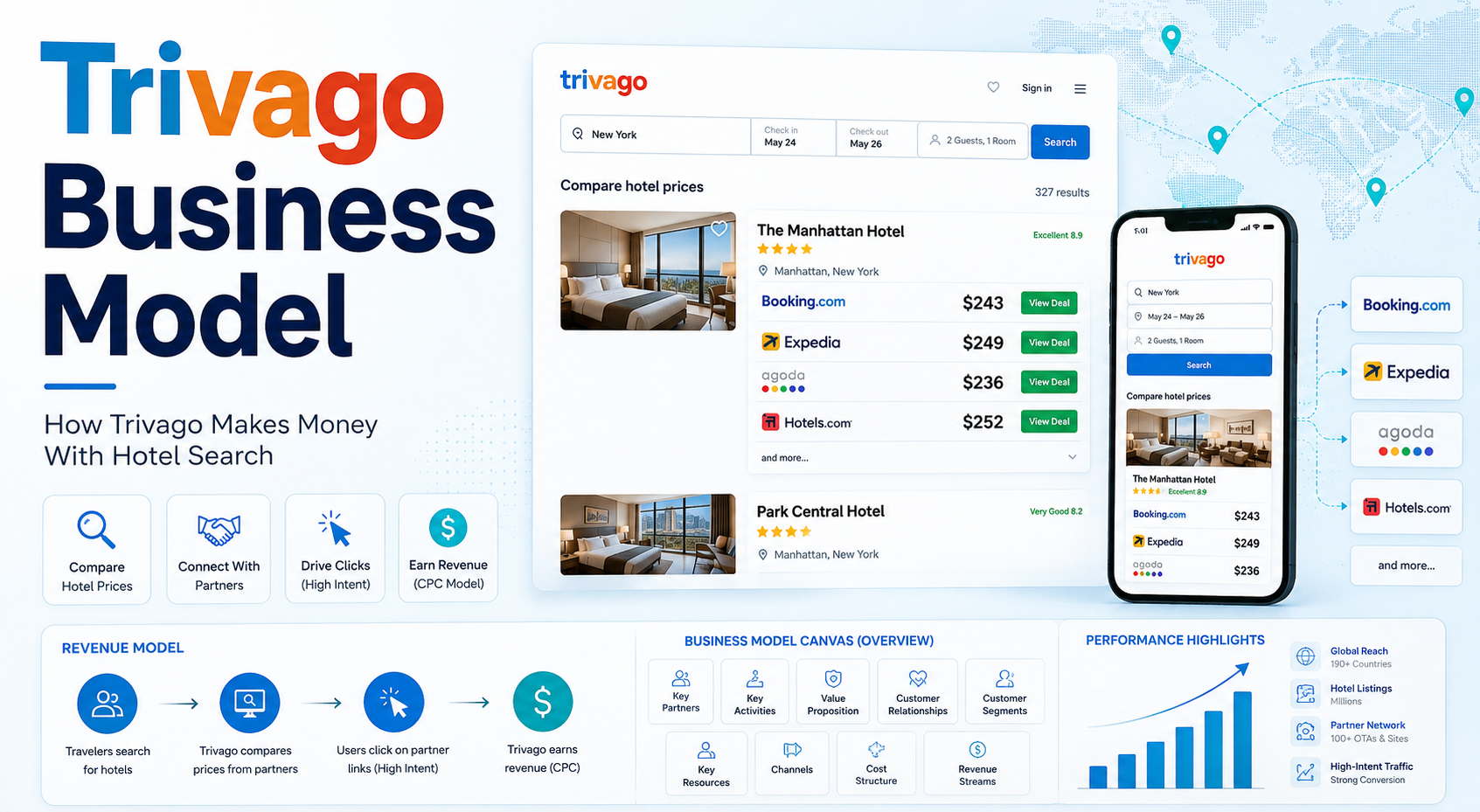
Trivago is not a hotel booking platform. It is a hotel metasearch engine that compares prices from hundreds of booking websites and redirects users to those sites to complete their reservations.
The core of Trivago’s business model is simple: hotels and online travel agencies (OTAs) pay Trivago every time a user clicks on their listing. This is called cost-per-click (CPC) advertising. Trivago owns no hotels, processes no bookings, and holds no inventory. It makes money purely from advertising revenue generated by travel intent.
This article breaks down the complete Trivago business model, including how it works, how it makes money, its business model canvas, and what startups can learn from it.
What Is Trivago?
Trivago is a hotel price comparison platform that aggregates listings from OTAs, hotel chains, and booking websites in one place so travelers can compare options quickly.
Founded: 2005 Founders: Rolf Schrömgens, Peter Vinnemeier, and Malte Siewert Headquarters: Düsseldorf, Germany Parent Company: Expedia Group (acquired a majority stake in 2012)
Trivago started as a small German travel startup and grew into one of the most recognized hotel search brands globally. Expedia Group’s acquisition gave Trivago the capital and infrastructure to expand across more than 190 countries.
The key distinction most people miss is the difference between a booking platform and a comparison platform.
| Platform Type | Example | What It Does |
|---|---|---|
| OTA (Online Travel Agency) | Booking.com | Handles the full booking transaction |
| Metasearch Engine | Trivago | Compares prices and redirects to OTAs |
Trivago sits one step before the booking happens. It captures travel intent and monetizes the redirect, not the transaction itself.
What Type of Business Model Does Trivago Use?
Trivago operates on a metasearch and advertising-based business model.
It aggregates hotel pricing data from multiple travel platforms, presents it to users in a clean comparison interface, and charges advertisers on a cost-per-click basis when users click through to their sites.
This model is sometimes called an asset-light platform model. Trivago does not need to own hotels, employ booking agents, or manage customer service for reservations. Its only job is to drive high-intent traffic to partners who are willing to pay for it.
Three pillars of Trivago’s business model:
- Aggregation: Pull hotel prices from hundreds of sources in real time
- Comparison: Present those prices in a ranked, user-friendly interface
- Monetization: Charge OTAs and hotels per click on their listings
This structure makes Trivago more of an advertising business than a travel business in the traditional sense.
How Trivago Works
Trivago aggregates hotel prices from multiple travel websites and redirects users to booking partners when they click a listing.
Here is the step-by-step workflow:
Step one: A user enters a destination, check-in date, and number of guests on Trivago’s website or app.
Step two: Trivago’s search engine pulls real-time pricing data from partner OTAs, hotel booking sites, and direct hotel websites.
Step three: Trivago’s ranking algorithm sorts listings based on a combination of bid amount, relevance, price competitiveness, and user preferences.
Step four: Sponsored placements appear at the top of results. These are hotels or OTAs that have paid more to appear prominently.
Step five: The user clicks a hotel listing and gets redirected to the OTA or hotel site to complete the booking.
Step six: Trivago records the click and charges the advertiser the agreed CPC rate.
Trivago never touches payment information. It never confirms a reservation. Its role ends the moment the user leaves for the partner’s site.
The platform also runs a mobile app ecosystem for iOS and Android, allowing users to search and compare hotels on the go. Mobile traffic is increasingly important to Trivago’s overall ad revenue since mobile users generate clicks that are billed at competitive CPC rates.
Trivago Business Model Canvas
The Business Model Canvas explains how Trivago creates, delivers, and captures value in the travel search industry.
Key Partners
Trivago’s platform depends entirely on the partners who supply pricing data and pay for advertising placement.
- Booking.com (Booking Holdings)
- Agoda
- Expedia Group (also its parent company)
- Hotels.com
- Direct hotel chains (Hilton, Marriott, IHG)
- Independent travel advertisers
- API and data providers
The relationship with Booking Holdings is particularly significant. A large share of Trivago’s CPC revenue comes from Booking.com, which creates a dependency that is both a strength and a vulnerability.
Key Activities
- Real-time hotel price aggregation across hundreds of sources
- Search engine optimization to capture organic travel queries
- Advertising platform management and CPC auction systems
- Mobile app development and maintenance
- AI-driven recommendation and personalization systems
- User behavior analytics and A/B testing
Key Resources
- Proprietary search and ranking algorithms
- Hotel database covering millions of properties worldwide
- Brand recognition built through years of TV and digital advertising
- User traffic data that improves personalization over time
- Advertising partnerships with major OTAs and hotel chains
Value Proposition
For travelers:
- Compare hotel prices from hundreds of sites in seconds
- Access transparent pricing without visiting multiple platforms
- Save time and potentially save money by finding the lowest available rate
- Read consolidated reviews and hotel information in one place
For OTAs and hotels:
- Access to high-intent users who are actively looking to book
- Performance-based advertising where they only pay for actual clicks
- Exposure to a global audience without building their own traffic
Customer Relationships
Trivago manages customer relationships through a self-service platform model. Users interact with the search engine directly without needing human support. Relationships are maintained through:
- Personalized hotel recommendations based on search history
- App push notifications for price drops and travel deals
- AI-driven personalization that improves with each search session
- Review systems that help users evaluate properties
Channels
- Website: Primary channel for desktop users across global markets
- Mobile apps: iOS and Android apps for on-the-go searches
- SEO traffic: Organic search rankings for hotel-related queries
- Paid advertising: Google Ads and social media campaigns
- TV commercials: High-visibility brand campaigns like “Hotel? Trivago”
- Affiliate partnerships: Traffic from travel blogs and comparison sites
Customer Segments
Trivago serves two distinct groups at the same time.
Demand side (travelers):
- Budget-conscious travelers looking for the lowest price
- Business travelers comparing rates for corporate trips
- Tourists planning international vacations
- Last-minute bookers comparing quick options
Supply side (advertisers):
- Online travel agencies like Booking.com and Expedia
- Hotel brands running direct booking campaigns
- Smaller regional booking platforms seeking visibility
Cost Structure
Trivago’s biggest cost is marketing. The company spends heavily to maintain brand awareness and drive user traffic to the platform.
- TV and digital advertising: Historically the largest cost line
- Technology infrastructure: Cloud computing, data systems, server costs
- Personnel: Engineers, data scientists, marketing teams, and operations
- Mobile app development: Ongoing updates and feature additions
- SEO and content production: Supporting organic search traffic
Revenue Streams
- Cost-per-click fees from OTA and hotel advertisers
- Sponsored placement premiums for top-of-results positioning
- Display advertising on the platform
- Referral partnership arrangements
How Trivago Makes Money
Most of Trivago’s revenue comes from CPC advertising paid by hotel booking platforms and hotel chains.
Cost-Per-Click Revenue Model
This is Trivago’s primary revenue engine. Here is how the bidding system works:
OTAs and hotels bid in an auction for visibility on Trivago’s results pages. The more a partner is willing to pay per click, the higher their listing tends to rank. However, Trivago’s algorithm also weighs factors like price competitiveness and user relevance so that the highest bidder does not always win automatically.
When a user clicks on a hotel listing and gets redirected to a partner site, Trivago charges that partner the agreed CPC rate. The rate varies by market, season, device type, and competition level.
The CPC model benefits advertisers because they only pay for actual traffic, not impressions. It benefits Trivago because high-intent travel searches command premium CPC rates compared to general display advertising.
Advertising Revenue
Beyond standard CPC listings, Trivago sells premium advertising placements. Hotels and OTAs can pay to appear in sponsored positions at the top of search results or in featured sections of the platform.
Display advertising within the platform also contributes to revenue, though it is a smaller portion compared to CPC-based income.
Referral Partnerships
Some revenue comes from structured referral arrangements where Trivago receives a fee based on booking conversion rates rather than just clicks. These partnerships are less common than straight CPC deals but exist with select OTA partners.
Trivago Revenue Streams Breakdown
Trivago monetizes travel intent rather than hotel ownership or booking transactions.
| Revenue Stream | Mechanism | Notes |
|---|---|---|
| CPC Advertising | Pay-per-click from OTAs and hotels | Primary revenue source |
| Sponsored Placements | Premium positioning fees | Top-of-results visibility |
| Display Advertising | Banner and visual ads on platform | Smaller share of revenue |
| Referral Partnerships | Conversion-based fees | Selective OTA arrangements |
One important thing to understand about Trivago’s revenue model: traffic quality matters more than traffic volume.
A user who clicks through with genuine booking intent is worth far more than a casual browser. Trivago’s entire business hinges on delivering high-converting traffic to partners. If click quality drops, partners lower their bids, and Trivago’s CPC rates fall with them. This is why Trivago invests heavily in search algorithm quality and user experience optimization.
Trivago Marketing Strategy
Trivago scaled globally through memorable branding and aggressive investment in both digital and traditional advertising.
“Hotel? Trivago” Campaign
This campaign became one of the most recognized taglines in travel advertising. The simplicity of the phrase made it sticky and repeatable across dozens of international markets. It was localized into multiple languages and ran on TV across Europe, North America, Latin America, and beyond.
SEO Strategy
Trivago targets high-volume hotel and travel-related search queries. By ranking for terms like “hotels in [city]” and “cheap hotels [destination],” Trivago captures organic traffic that does not require paid ad spend to acquire.
Performance Marketing
Beyond TV, Trivago runs targeted digital campaigns on Google and social platforms. These campaigns focus on retargeting users who have previously searched for hotels and driving them back to the platform.
International Localization
Trivago operates in more than 55 languages and tailors its platform and marketing for each local market. This localization strategy helped it expand beyond European roots into North America, Asia-Pacific, and Latin America.
Mobile Marketing
With travel searches increasingly happening on smartphones, Trivago has invested in app store optimization and mobile-first advertising. The mobile app is a key channel for repeat users who come back to check prices multiple times before booking.
Trivago vs Booking.com vs Expedia
Trivago is a comparison engine, while Booking.com and Expedia are booking platforms.
| Feature | Trivago | Booking.com | Expedia |
|---|---|---|---|
| Handles bookings | No | Yes | Yes |
| Revenue model | CPC advertising | Commission per booking | Commission and ads |
| Owns hotels | No | No | Some (Vrbo) |
| Main function | Price comparison | Hotel booking | Hotel and travel booking |
| Relationship with hotels | Advertising | Contractual listing | Contractual listing |
| User stays on platform | No (redirects) | Yes | Yes |
The biggest difference is where the money comes from. Booking.com and Expedia take a commission on every completed booking, typically between ten and thirty percent of the reservation value. Trivago gets paid the moment someone clicks, regardless of whether that person actually books.
This means Trivago’s revenue is tied to traffic and click volume, while Booking.com and Expedia’s revenue is tied to completed transactions.
Technology Behind Trivago’s Platform
Technology powers Trivago’s ranking, personalization, and hotel comparison systems.
Search Algorithms
Trivago’s ranking algorithm determines which hotels appear in which order for each search query. It factors in bid amount, price competitiveness, hotel quality scores, user preferences, and historical performance data.
Machine Learning and AI
Trivago uses machine learning to personalize search results based on a user’s past behavior. If you previously searched for budget hotels, the algorithm learns to surface lower-priced options more prominently in future searches.
Real-Time Pricing Systems
Hotel prices change constantly. Trivago’s infrastructure pulls pricing data from partner APIs in near real-time to ensure the rates displayed are accurate and up to date. This requires significant engineering investment in data pipelines and caching systems.
User Behavior Analytics
Every click, scroll, and search interaction generates data. Trivago analyzes this data to improve search relevance, optimize ad placements, and understand what drives users to click through to partner sites.
Challenges in Trivago’s Business Model
Trivago faces intense competition and heavy dependency on OTAs.
Dependence on Booking Holdings
A significant portion of Trivago’s revenue comes from Booking.com, which is owned by Booking Holdings. If Booking Holdings reduces its advertising spend on Trivago or shifts budget elsewhere, Trivago’s revenue takes a direct hit. This concentration risk is one of the most cited concerns about the business.
Competition from Google Travel
Google Hotel Search allows users to compare hotel prices directly within Google Search results. Users no longer need to visit Trivago to do what Trivago does. Google’s dominance in search means it can capture travel intent before users ever reach Trivago’s platform.
Rising Customer Acquisition Costs
As digital advertising becomes more competitive, the cost of acquiring new users through paid channels increases. Trivago must spend more on marketing to maintain traffic volume, compressing its margins.
Ad Dependency
Because Trivago’s model depends entirely on advertiser spend, any pullback in OTA advertising budgets directly reduces revenue. During economic downturns or travel disruptions like the COVID-19 pandemic, advertisers cut budgets sharply and Trivago’s revenue contracts fast.
Mobile Competition
Apps like Google Maps, TripAdvisor, and hotel brand apps compete for mobile travel searches. Trivago must fight for screen time on a device category that is increasingly dominated by a handful of platforms.
SWOT Analysis of Trivago
| Category | Factor |
|---|---|
| Strength | Global brand recognition built through years of advertising |
| Strength | Massive hotel inventory across millions of properties |
| Strength | Asset-light model with low overhead compared to OTAs |
| Strength | Strong OTA partnership network |
| Weakness | Heavy reliance on Booking Holdings for revenue |
| Weakness | No ownership of the booking transaction or customer relationship |
| Weakness | Vulnerable to advertiser budget cuts |
| Opportunity | AI-powered travel planning and itinerary tools |
| Opportunity | Expansion into underpenetrated emerging markets |
| Opportunity | Deeper personalization using accumulated user data |
| Threat | Google Travel capturing travel intent directly in search |
| Threat | OTAs building their own discovery and comparison tools |
| Threat | Economic downturns reducing travel demand and advertiser spend |
Future of Trivago’s Business Model
Future growth depends on AI-driven travel experiences and smarter personalization.
AI-Powered Travel Planning
Rather than simply comparing prices, Trivago could evolve into a travel planning assistant that helps users choose destinations, build itineraries, and find hotels that match specific travel styles. AI makes this kind of conversational, personalized search possible.
Voice Search Integration
As voice search grows through smart speakers and mobile assistants, Trivago needs to optimize for voice-based hotel queries. Searches like “find me a hotel in Miami under 150 dollars a night” require different SEO and interface strategies than typed queries.
Predictive Travel Search
Using historical booking data and behavioral signals, Trivago could proactively suggest hotels before a user even searches. Predictive tools that surface the right hotel at the right moment would increase engagement and click-through rates.
Super App Potential
Some metasearch platforms are moving toward super app models that combine hotel search with flights, car rentals, and local experiences in one interface. If Trivago expands its scope, it could capture more of the travel planning journey and generate more advertising touchpoints.
Lessons Startups Can Learn From Trivago
Trivago proves that aggregation platforms can scale massively without owning inventory.
Asset-Light Scalability
Trivago built a global business without owning a single hotel room. The lesson here is that you do not need to own what you index. If you can aggregate, compare, and direct high-intent traffic, you can build a valuable platform.
Monetize Search Intent, Not Transactions
Most startups chase transaction revenue. Trivago shows that monetizing the moment of search intent, before a transaction happens, can be equally lucrative if traffic volume and click quality are high.
Brand Recall Drives Organic Traffic
The “Hotel? Trivago” campaign was not just about awareness. It was about ensuring that when someone thought about comparing hotel prices, Trivago was the first brand that came to mind. Brand recall reduces customer acquisition costs over time.
Partnership-Driven Growth
Trivago did not build its hotel inventory from scratch. It partnered with OTAs who already had it. Startups can accelerate growth dramatically by leveraging existing data, inventory, or infrastructure through partnerships rather than building everything independently.
Traffic Quality Over Traffic Quantity
Trivago’s revenue depends on high-intent clicks, not raw page views. This is a valuable lesson for any ad-supported business: optimizing for user intent and engagement quality matters more than chasing vanity traffic metrics.
Wrapping Up on Trivago’s Business Model
Trivago built a billion-dollar business by sitting between travelers and booking platforms, capturing intent, and charging for access to that intent.
The model works because travel search has enormous volume, hotel prices vary widely across platforms, and both travelers and OTAs benefit from a neutral comparison layer. Travelers get price transparency. OTAs get qualified traffic. Trivago takes its cut per click.
The core monetization strength is the CPC model itself. It scales with traffic, aligns incentives between Trivago and its advertisers, and requires no ownership of inventory or booking infrastructure.
The biggest vulnerabilities are concentration risk from Booking Holdings and competitive pressure from Google Travel. If Google continues expanding its hotel search product, Trivago loses traffic before it can monetize it. That is an existential challenge the company is actively navigating.
Long-term sustainability depends on whether Trivago can evolve beyond price comparison into a more personalized, AI-driven travel discovery platform. If it can, the business model becomes stickier and less replaceable by a Google search result.
For founders and strategists, Trivago remains one of the cleanest examples of how a platform business can scale globally by aggregating supply, serving demand, and charging for the connection between the two.
Discover more from Business Model Hub
Subscribe to get the latest posts sent to your email.