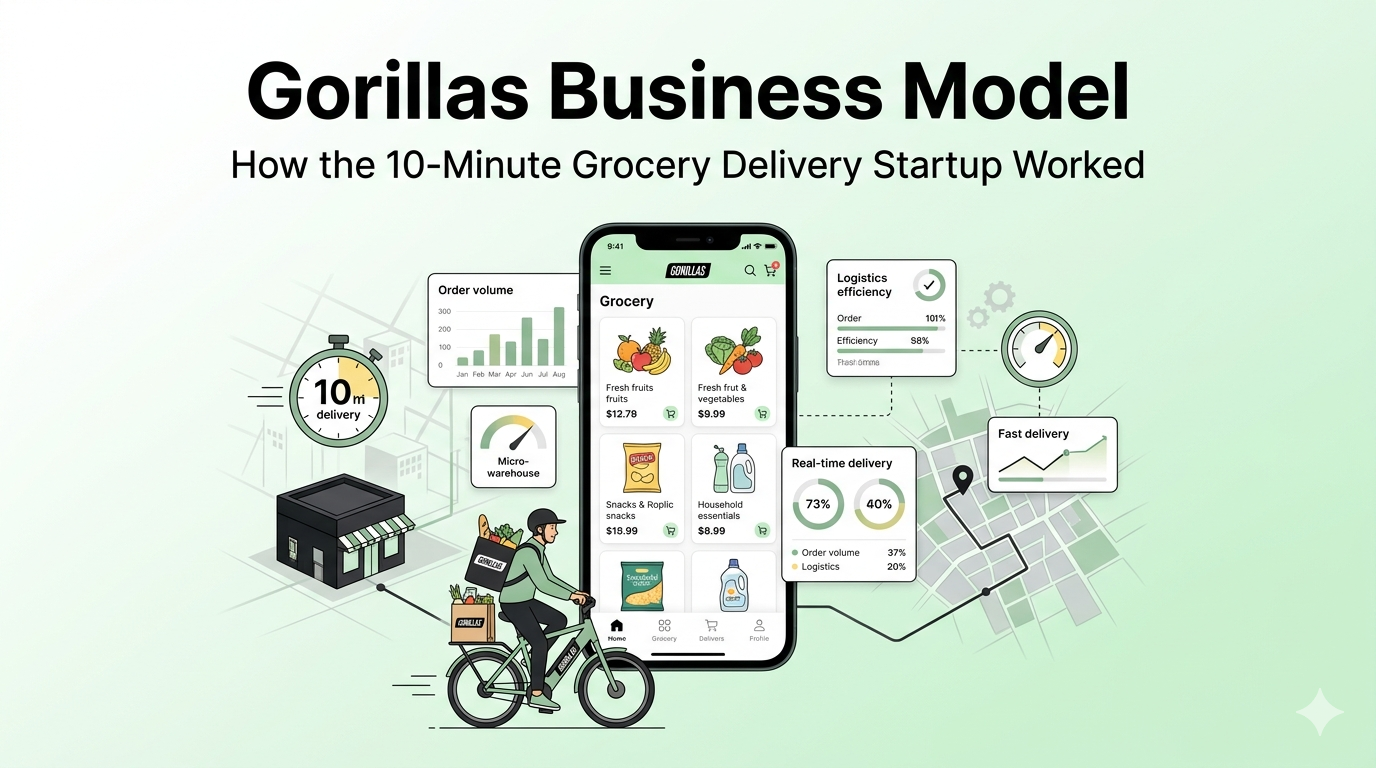
Gorillas Business Model And How the 10-Minute Grocery Delivery Startup Worked

Gorillas was a Berlin-based grocery delivery startup that promised to get essentials to your door in under 10 minutes. It launched in 2020 and quickly became one of the most talked-about players in quick commerce.
The company attracted massive investor attention by doing something traditional grocery delivery couldn’t: making speed the core product. While other services took 30 minutes to an hour, Gorillas cut that down to a single-digit promise.
This blog breaks down exactly how the Gorillas business model worked, how it made money, why it grew fast, and why it ultimately struggled.
What Is Gorillas?
Gorillas was a German quick-commerce startup that delivered groceries in under 10 minutes using a network of local micro-warehouses and bike riders.
Founders of Gorillas
Gorillas was co-founded by Kağan Sümer and Jörg Kattner in Berlin, Germany. Sümer served as CEO and became the public face of the brand. The founding team had backgrounds in logistics, e-commerce, and operations, which shaped the company’s aggressive, execution-first approach.
When Gorillas Was Founded
Gorillas launched in May 2020, right in the middle of the COVID-19 pandemic. The timing was not a coincidence. Lockdowns pushed consumers online, and demand for home delivery exploded almost overnight.
Within six months of launching, Gorillas became the fastest European startup to reach unicorn status, hitting a valuation of over $1 billion.
Markets Gorillas Expanded Into
Gorillas started in Berlin and rapidly expanded across Europe and into the United States. Key markets included:
- Germany (home market)
- The Netherlands
- France
- the United Kingdom
- Italy
- the United States (New York City)
The expansion was aggressive and capital-heavy, which later became one of its biggest vulnerabilities.
What Is the Gorillas Business Model?
Gorillas operated on a quick-commerce model. Groceries were stored in dark stores — small, neighborhood-level warehouses not open to the public — and delivered by salaried bike riders within a tight geographic radius.
How the Ten-Minute Delivery System Worked
The entire operation was built around proximity. Here is the basic flow:
- A customer places an order through the Gorillas app
- The order goes to the nearest dark store, usually within one to two miles
- A picker inside the dark store grabs the items within minutes
- A rider picks up the order and delivers it immediately
No stops. No batching multiple orders. One order, one rider, one delivery. That is how the ten-minute window stayed realistic.
Role of Dark Stores in the Business Model
Dark stores are the backbone of quick commerce. Unlike traditional grocery stores, dark stores are small warehouse spaces designed purely for order fulfillment. They carry a curated selection of around 2,000 products, compared to the 30,000-plus SKUs at a regular supermarket.
The smaller inventory made picking faster and reduced waste. Location was everything — stores had to be placed in dense urban neighborhoods to keep delivery distances short.
Customer Ordering Journey
The experience was simple by design:
- Download the Gorillas app
- Browse a curated product catalog
- Add items to cart
- Pay through the app
- Receive delivery at the door in under ten minutes
No membership required. No minimum order in most markets. That low friction was a major reason for strong early adoption.
How Gorillas Makes Money
Gorillas generated revenue through product markups, delivery fees, brand partnerships, and private-label items.
Grocery Product Margins
Like any retailer, Gorillas bought groceries at wholesale prices and sold them at retail prices. The margin between those two numbers is the core revenue driver.
However, grocery margins are notoriously thin — typically in the range of two to five percent on average. Gorillas had to sell a high volume of orders to generate meaningful revenue from product sales alone.
Delivery Charges
Gorillas charged a flat delivery fee per order, typically around $1.99 in the US and similar amounts in European markets. For small basket sizes, this fee was significant relative to the order total.
The model also had a small basket fee built into certain markets, discouraging very low-value orders that were unprofitable to fulfill.
Brand Partnerships
Consumer packaged goods brands paid for premium placement inside the Gorillas app. Think of it like digital shelf space — a beverage brand might pay to be featured at the top of a category page.
This created a sponsored product revenue stream similar to what Amazon does with its search results. For brands wanting urban millennial visibility, Gorillas was an attractive platform.
Private Label Products
Gorillas developed its own private-label products in select categories. Private label items carry higher margins than branded goods because there is no national brand markup built into the cost.
Exclusive private-label items also gave Gorillas a differentiation point — products customers could not get anywhere else.
Subscription or Loyalty Opportunities
Gorillas explored subscription models in some markets, offering waived delivery fees or discounts for repeat users. This kind of recurring revenue model improves unit economics by increasing order frequency from existing customers.
However, subscription programs were never a dominant revenue stream for Gorillas before its acquisition.
How Gorillas Operates Behind the Scenes
Gorillas relied on localized warehouses, rider fleets, inventory software, and demand forecasting to maintain ultra-fast deliveries.
Dark Store Network
Each dark store served a delivery radius of roughly one to two miles. Inside, products were organized for speed — high-velocity items like milk, eggs, and snacks placed closest to the picking area.
Gorillas had to sign leases, hire staff, and stock inventory for every single location. That meant high fixed costs in every new city it entered.
Inventory Management
With only around 2,000 SKUs per location, inventory management was tighter than a traditional supermarket. Gorillas used software to track stock levels in real time and trigger reorders before items ran out.
Spoilage was a real risk. Perishables that did not sell by their expiry date were a direct hit to margins.
Delivery Fleet Operations
Gorillas employed its riders directly rather than classifying them as independent contractors. This was a deliberate choice that provided riders with benefits and labor protections.
It also meant Gorillas bore full employment costs — wages, benefits, equipment, insurance — which added significant operational overhead compared to gig-economy competitors.
Route Optimization Technology
Even with short delivery distances, route optimization mattered. Gorillas used logistics software to assign the right rider to the right order based on location, current workload, and estimated delivery time.
The goal was to keep actual delivery times consistently under ten minutes, not just in ideal conditions.
Real-Time Order Processing
Every order triggered an instant chain of actions — inventory deduction, picker assignment, rider dispatch, and customer notification. This real-time coordination required reliable software infrastructure running without latency.
Gorillas Customer Segments
Gorillas targeted urban consumers who valued convenience over cost savings.
Primary customer groups included:
- Urban professionals — time-poor workers who needed essentials fast
- Busy parents — families who ran out of something and needed it immediately
- Students — young consumers comfortable with app-based shopping
- High-income city residents — consumers willing to pay a premium for speed
- Impulse shoppers — people who wanted snacks or drinks for an immediate occasion
City density was non-negotiable. Gorillas only operated in dense urban areas where short delivery distances were achievable and demand was concentrated.
Gorillas Value Proposition
Gorillas sold time back to consumers. The core pitch was simple: stop planning grocery runs, stop waiting, and get what you need right now.
Ten-Minute Grocery Delivery
Speed was the entire product. No other value proposition mattered if the delivery was slow. Gorillas built every operational decision around protecting that ten-minute promise.
Convenience Over Traditional Shopping
Consumers did not have to travel, park, wait in checkout lines, or carry bags. For an increasing number of urban consumers, that friction removal was worth paying for.
Curated Product Selection
Instead of overwhelming customers with choices, Gorillas offered a tight, well-edited product catalog. Fewer decisions meant faster ordering and faster fulfillment.
Mobile-First Shopping Experience
Gorillas was app-only. No desktop website ordering, no phone calls. The app was designed for fast, repeat purchases with minimal steps between opening the app and placing an order.
Reduced Waiting Time
Compared to traditional grocery delivery services that required scheduling slots days in advance, Gorillas was truly on-demand. No pre-planning required.
Technology Used in Gorillas Business Model
Technology was not a flashy add-on for Gorillas — it was what made ten-minute delivery operationally possible.
Delivery Algorithms
Gorillas used proprietary dispatch algorithms to match orders with the nearest available rider instantly. The algorithm factored in rider location, store preparation time, and delivery distance simultaneously.
Inventory Tracking Systems
Every item in every dark store was tracked in real time. When stock dropped below a threshold, automatic reorder triggers prevented stockouts during high-demand periods.
Mobile Application Infrastructure
The Gorillas app handled real-time inventory display, payment processing, order tracking, and customer communication in a single interface. Backend infrastructure had to be reliable enough to process orders without crashes during peak periods.
Demand Prediction Tools
Gorillas used historical order data and external signals — weather, local events, time of day — to predict demand spikes. Dark stores could be pre-stocked accordingly, reducing the chance of popular items running out.
Logistics Automation
Warehouse picking was partially systematized using shelf layouts designed for speed. While picking was manual, the layout and workflow were engineered to minimize the time between order receipt and handoff to a rider.
Gorillas Marketing Strategy
Gorillas used aggressive urban marketing and word-of-mouth to build awareness quickly in each new city.
Referral and Discount Campaigns
Early users were offered free deliveries or discounted first orders. Referral codes gave existing customers a reward for bringing in new users. This classic growth-hacking playbook helped Gorillas acquire users cheaply in early markets.
Social Media Marketing
Gorillas leaned into Instagram and Twitter for brand building. Content focused on urban lifestyle, convenience, and relatable food moments. The brand voice was casual and city-native.
Influencer Collaborations
Gorillas partnered with food bloggers, lifestyle influencers, and local content creators to drive app downloads in specific cities. These campaigns were hyperlocal — an influencer in Amsterdam was not being used for the Berlin market.
Hyperlocal Advertising
Physical advertising in subway stations, bus stops, and high-foot-traffic urban areas reinforced the brand in each city. The ads were designed to appear right where the target customer already was.
Performance Marketing
Paid digital advertising on Google and Meta drove app installs. Performance marketing teams tracked cost per install and cost per first order closely, optimizing spend across channels.
Why Gorillas Grew So Fast
Pandemic-Driven Demand
COVID-19 lockdowns forced millions of consumers to stop visiting physical stores. On-demand grocery delivery became a necessity rather than a luxury. Gorillas launched at exactly the right moment.
Venture Capital Funding
Gorillas raised over $1 billion in funding across multiple rounds. Investors including Coatue Management, Atlantic Food Labs, and others bet that quick commerce would become a permanent consumer category. That capital funded rapid expansion.
Rising Convenience Economy
Even before the pandemic, consumer behavior was shifting toward paying for convenience. Food delivery, ride-hailing, and on-demand services had already normalized the idea of paying a premium for speed.
Fast Geographic Expansion
Gorillas moved fast into new cities and countries. Being first into a market created brand recognition and customer habit formation before competitors arrived.
Consumer Habit Changes
Once consumers tried ten-minute delivery, the behavioral shift was hard to reverse. Repeat usage rates in established markets showed strong retention among users who had experienced the convenience firsthand.
Challenges in the Gorillas Business Model
High Delivery Costs
Each delivery required a dedicated rider, even for small orders. The cost of labor, equipment, and benefits per delivery was high relative to the revenue generated on a small grocery basket.
Thin Grocery Margins
Grocery retail is a low-margin business even at supermarket scale. Gorillas was operating with the same thin margins but without the volume advantages that make grocery retail economics work.
Rider Management Issues
Gorillas faced internal tensions with its rider workforce. Riders organized labor actions in Berlin and other cities, demanding better pay and working conditions. Managing a large, distributed rider workforce was operationally complex.
Expansion Burn Rate
Opening a new city required leasing dark store space, hiring staff, purchasing inventory, and running marketing campaigns — all before a single profitable order was placed. Multiply that by dozens of cities and the cash burn was enormous.
Intense Competition
Every major market Gorillas entered already had or quickly gained a direct competitor. Getir, Flink, GoPuff, and others were all chasing the same urban consumers with similar products.
Gorillas Competitors
| Competitor | Home Market | Key Differentiator |
|---|---|---|
| Getir | Turkey | Pioneer in ultrafast delivery, global scale |
| Flink | Germany | Gorillas’ direct Berlin rival, similar model |
| GoPuff | United States | Wider product range including alcohol |
| DoorDash | United States | Marketplace model, restaurant-first |
| Instacart | United States | Personal shopper model, wider SKU range |
Where Gorillas stood out:
- Stronger brand identity in European markets
- Direct rider employment model
- Tighter, curated inventory focused on essentials
- Early-mover advantage in Germany and the Netherlands
Where Gorillas fell short:
- Higher operating costs than gig-economy competitors
- Slower to build the unit economics required for profitability
- Less diversified revenue than broader delivery platforms
Why Gorillas Struggled Financially
Unsustainable Unit Economics
The math was difficult from the start. A small grocery order generating $15 in revenue, with a $2 delivery fee, could not easily cover the cost of a salaried rider plus dark store overhead plus inventory waste.
Heavy Discounting
To acquire and retain users, Gorillas offered aggressive promotions. Free first deliveries, discount codes, and referral rewards all reduced revenue per order while increasing acquisition costs.
Rising Operational Costs
Labor costs increased. Lease prices in urban areas were high. Energy, equipment, and logistics software added up. Every additional city brought a new layer of fixed costs.
Funding Slowdown
In 2022, the global venture capital market tightened significantly. The easy money that had funded hypergrowth startups dried up. Gorillas, like many burn-rate-heavy startups, found it harder to raise new capital on favorable terms.
Post-Pandemic Consumer Changes
As pandemic restrictions lifted, consumers returned to physical grocery stores. The urgency that drove early adoption faded for some user segments, and order volumes in some markets declined from peak pandemic levels.
Acquisition and Future of Gorillas
Gorillas was acquired by Getir, its Turkish competitor, in late 2022. The deal was part of a broader consolidation wave across the quick-commerce industry as companies with weak unit economics either folded or merged with better-capitalized players.
Acquisition Details
Getir absorbed Gorillas’ operations, customers, and infrastructure in key markets. The acquisition allowed Getir to expand its European footprint without building from scratch in markets where Gorillas had already established a presence.
Industry Consolidation
Gorillas was not alone. Across Europe and the US, quick-commerce startups collapsed, merged, or scaled back dramatically. Buyk, Jokr, and 1520 all shut down. Flink and Getir pulled back from unprofitable markets.
Lessons for Startups
The Gorillas story became a case study in the dangers of growth-at-all-costs strategies when unit economics do not improve with scale.
What Happened After the Acquisition
Gorillas as an independent brand ceased to exist. Its technology, customer base, and some operations were integrated into Getir’s broader platform. The ten-minute delivery promise continued — just under a different name.
Lessons Entrepreneurs Can Learn From Gorillas
Speed Can Create Market Demand
Gorillas proved that if you make something fast enough and convenient enough, consumers will change their behavior. Ten-minute grocery delivery was not something consumers were demanding before it existed — Gorillas created the expectation.
Growth Without Profitability Is Risky
Scaling a business that loses money on every order does not become profitable just because you do it in more cities. Gorillas needed to solve its unit economics problem before expanding, not after.
Logistics Businesses Need Strong Economics
Delivery businesses have hard cost floors — labor, fuel, vehicles, insurance. Unlike software, you cannot scale without proportional cost increases. That physical reality needs to be accounted for from day one.
Convenience Is a Powerful Consumer Trend
Despite the financial outcome, Gorillas correctly identified a real and growing consumer preference. Convenience-based businesses are not going away. The opportunity was real; the execution economics were the problem.
Expansion Must Be Sustainable
Moving fast into new markets is exciting. But each new location that loses money increases the total loss. Sustainable expansion means finding profitability in one market before replicating the model elsewhere.
Future of the Quick-Commerce Industry
Quick commerce as a category is not dead — but it looks very different than it did in 2021.
What is changing:
- Fewer but stronger players dominate each market
- Dark store networks are being optimized for profitability, not just speed
- AI-powered demand forecasting is reducing spoilage and improving inventory efficiency
- Delivery time windows have expanded slightly in some markets to reduce costs
- Partnerships with existing grocery retailers are replacing pure-play quick-commerce models
What is staying the same:
- Consumer appetite for convenience is still growing
- Urban density remains the key enabler of quick delivery
- Mobile-first ordering behavior is now deeply established
The question is not whether quick commerce will survive. It is which companies have the operational discipline to build it profitably.
Wrapping up on Gorillas Business Model
Gorillas changed what consumers think is possible when it comes to grocery delivery. Before Gorillas, 30-minute delivery felt fast. After Gorillas, ten minutes became the benchmark.
The startup proved that speed is a real product differentiator and that convenience drives modern consumer decisions. It also proved that a great consumer experience is not enough on its own — the underlying economics have to work.
Quick commerce created a new digital retail category. The companies that survive in this space will be the ones that solve the profitability equation without sacrificing the speed promise that made the category worth building in the first place.
FAQs
Gorillas used a quick-commerce model — groceries stored in dark stores were delivered to customers via bike riders in under ten minutes. Revenue came from product margins, delivery fees, brand partnerships, and private-label items.
By placing small fulfillment warehouses within one to two miles of customers in dense urban areas, using dedicated riders for single-order deliveries, and streamlining the picking process inside dark stores.
No. Gorillas was not profitable before its acquisition. High delivery costs, thin grocery margins, and heavy discounting made it difficult to achieve positive unit economics.
Getir, a Turkish quick-commerce company, acquired Gorillas in late 2022 as part of broader industry consolidation.
Dark stores are small warehouse spaces used exclusively for order fulfillment. They are not open to the public. They stock a curated selection of products and are located in urban neighborhoods to enable fast local delivery.
The core problem was unit economics. Each delivery cost more to fulfill than the revenue it generated. High rider wages, urban lease costs, thin grocery margins, and heavy customer discounting made profitability very hard to achieve.
Getir, Flink, GoPuff, DoorDash, and Instacart were the primary competitors, depending on the market.
Quick-commerce companies generate revenue through product markups, delivery fees, sponsored product placements from brands, private-label product sales, and subscription programs that charge for perks like free delivery.
Discover more from Business Model Hub
Subscribe to get the latest posts sent to your email.