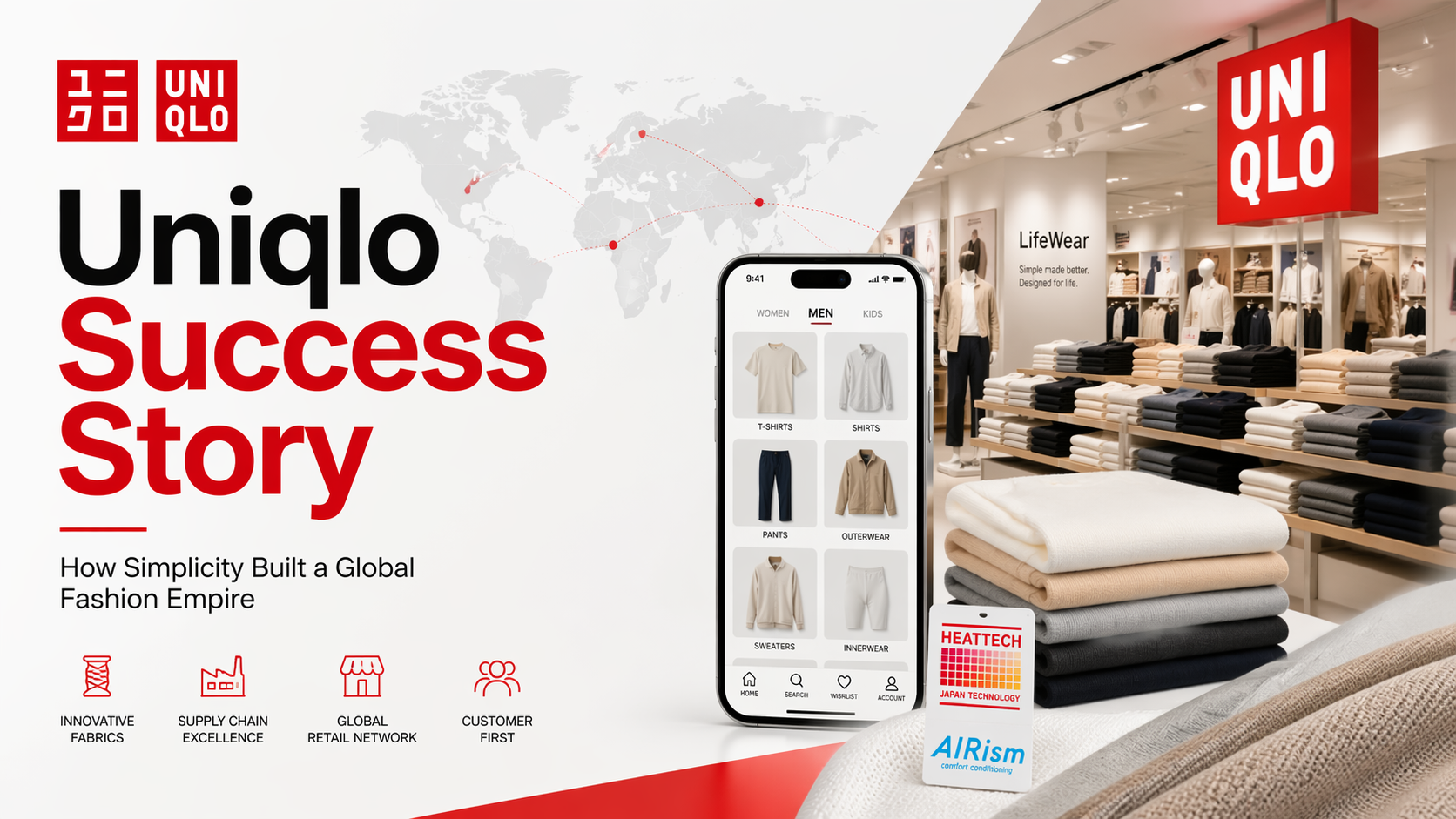
Uniqlo Success Story And How It Built a Global Fashion Empire Without Chasing Trends

What Made Uniqlo So Successful?
Uniqlo became successful by doing the opposite of what every other fashion brand does. No trend chasing. No influencer overload. No seasonal chaos. Instead, they built a system around high-quality basics, fabric innovation, and complete supply chain control.
The real advantage is not branding. It is operational excellence disguised as simplicity.
Most people look at Uniqlo and see affordable t-shirts and fleece jackets. What they are actually looking at is one of the most disciplined retail systems ever built.
What Kind of Company Is Uniqlo, Really?
Here is the honest answer: Uniqlo is not a fashion company.
It is closer to a product engineering company that happens to sell clothing. While brands like Zara and H&M are obsessed with what is trending on runways and social media, Uniqlo is obsessed with how fabric performs, how a seam holds up, and how a product solves a daily problem.
That distinction sounds small. It is actually everything.
Fashion companies are driven by taste. Uniqlo is driven by function. That shift in identity changes every single decision downstream, from how they design to how they manufacture to how they price.
The Origins: From One Store to a Global System
Where It Started
Uniqlo was founded by Tadashi Yanai, and the first store opened in Hiroshima in 1984. The early model was simple, a discount casual wear shop trying to offer affordable clothing to everyday consumers.
But the real story is not where it started. It is what happened after the early stumbles.
The Early Failure That Changed Everything
When Uniqlo tried to expand into Tokyo in the early days, it failed. The positioning was off. The stores felt cheap rather than smart. Consumers in a larger, more competitive market were not buying in.
That failure forced a shift in thinking. Yanai stopped thinking like a retailer and started thinking like a systems builder. The question changed from “how do we sell more clothes” to “how do we build a backend that scales without breaking.”
That pivot is why Uniqlo exists at the scale it does today. They fixed the machine before they turned up the volume.
The Core Philosophy: LifeWear
What LifeWear Actually Means
Uniqlo does not call itself a fashion brand. It calls itself a LifeWear brand. That is not marketing fluff. It is a strategic positioning decision that shapes everything they do.
LifeWear means clothing designed for everyday life. Timeless, functional, universally wearable. Not clothes you buy because they are trending. Clothes you buy because they work.
The practical results of this philosophy show up clearly:
Neutral color palettes. Uniqlo is not chasing seasonal color trends. Their colors are designed to pair with anything, last across years, and appeal across demographics.
Functional design. Every product has to justify its existence through utility. A jacket keeps you warm efficiently. A shirt breathes properly. A pair of pants moves with you.
Universal appeal. The target customer is essentially everyone. That sounds like a weakness. For Uniqlo, it is a strength because it eliminates the volatility that comes with targeting a narrow demographic.
The Hidden Business Benefit
Here is what most people miss about the LifeWear philosophy: it dramatically reduces inventory risk.
Inventory risk is the single biggest killer in the fashion industry. When you chase trends, you manufacture based on predictions about what people will want three to six months from now. Get it wrong and you are left with warehouses full of unsellable product.
When your products are timeless, demand stabilizes. You are not trying to predict what is cool next spring. You are fulfilling consistent demand for things people always need.
That stability compounds into serious business advantages over time.
The Real Competitive Moat: The SPA Model
What SPA Means
Uniqlo operates on what is called the SPA model, which stands for Specialty store retailer of Private label Apparel. This is the same model used by a handful of the world’s most successful retailers, but Uniqlo has arguably executed it better than anyone in their category.
Here is what SPA actually involves:
In-house design. Uniqlo designs its own products. There are no outside brands or licensed labels. Everything that goes on the floor was conceived internally.
Controlled manufacturing. Rather than outsourcing to whoever is cheapest, Uniqlo builds long-term relationships with partner manufacturers and maintains close oversight of the production process.
Owned retail distribution. Uniqlo sells through its own stores and its own website. There are no third-party department store partnerships diluting the brand or the margin.
Why This Matters More Than Most People Realize
The SPA model gives Uniqlo three things that competitors cannot easily copy: lower costs, faster iteration, and better quality control.
Lower costs come from cutting out middlemen at every layer. When you design, manufacture, and sell your own product, you capture margin at each stage.
Faster iteration comes from having direct feedback loops. When store sales data flows back to the design and manufacturing team without any intermediaries, the company can respond to what is actually working.
Better quality control comes from sustained manufacturing relationships. Uniqlo does not just tell a factory what to make and walk away. They embed technical experts called “Takumi” on factory floors to ensure production standards are maintained.
Uniqlo vs. Zara: A Real Comparison
Most people assume Zara has the best supply chain in fashion. And Zara is genuinely impressive on speed. They can go from runway trend to retail floor in under three weeks.
But Uniqlo is not competing on speed. Uniqlo is competing on predictability.
Zara’s supply chain is optimized to respond to trends fast. Uniqlo’s supply chain is optimized to produce consistent quality at scale without the volatility that comes from trend dependency. These are fundamentally different goals, and Uniqlo’s version is actually harder to replicate.
Fabric Innovation: The Most Underrated Part of the Business
Uniqlo Innovates Scientifically, Not Visually
Most fashion brands innovate through aesthetics. New colors, new silhouettes, new patterns. Uniqlo innovates through materials science.
This is one of the most important things to understand about how they build competitive advantage. Instead of designing new styles each season, they develop new fabrics that perform better than anything else on the market.
The results are products that become cultural touchstones in their own right.
HEATTECH
HEATTECH is Uniqlo’s thermal wear technology, developed in partnership with Toray Industries, a Japanese materials science company. The fabric converts body moisture into heat, providing warmth without the bulk of traditional thermal wear.
When HEATTECH launched, it changed what people expected from base layers. It was not a fashion statement. It was a functional breakthrough. And because it was a proprietary technology, competitors could not just copy the look. They would have to reverse-engineer the material science.
AIRism
AIRism is Uniqlo’s breathable fabric technology, designed to wick moisture, control odor, and keep the wearer comfortable in warm conditions. It became particularly popular in Southeast Asian markets where humidity is a daily reality.
Again, this is not a style. It is a solution to a problem. That distinction is the whole Uniqlo playbook in a single product.
Ultra Light Down
Ultra Light Down jackets became a mainstream product category that other brands have tried to replicate for years. Uniqlo was not the first brand to make lightweight down jackets, but they productized it, scaled it, and made it accessible at a price point that unlocked mass adoption.
The Strategic Takeaway
When you innovate through fabric rather than style, you build a different kind of moat. Style can be copied by any designer with a good eye. Material science requires years of R&D, supplier relationships, and manufacturing know-how. That is a much harder wall to climb over.
Why Uniqlo Does Not Depend on Trends
The Deliberate Choice to Ignore Trend Culture
Uniqlo made a conscious decision to opt out of the trend cycle. Minimal influencer dependency. Limited seasonal collections. No chasing what is hot on social media this week.
This looks like a liability on the surface. In practice, it is one of their biggest competitive advantages.
What Trend Independence Actually Delivers
No overproduction. Trend-driven brands manufacture speculatively based on trend predictions. When predictions are wrong, they overproduce. Overproduction means discounting, which destroys margin. Uniqlo’s stable demand means more accurate production planning.
Stable demand forecasting. When you sell products that people want year-round without a trend catalyst, your demand curves are smoother. Smoother demand means better inventory management, which feeds back into cost efficiency.
Lower marketing costs. Trend-driven brands need to constantly advertise to generate new purchase triggers. Uniqlo’s products sell because people need them, not because they were reminded to want them by an influencer campaign.
The Long Game
Trend-driven brands can scale incredibly fast. Shein is the most extreme example. But fast scaling on trend dependency creates fragility. When tastes shift, demand collapses quickly.
Uniqlo scales slower. But the demand it builds compounds over time because it is based on utility and trust rather than hype. A customer who buys HEATTECH and loves it comes back every winter. That is a fundamentally different relationship than a customer who bought something because it was trending on TikTok.
Global Expansion: A Different Playbook
Early Struggles Outside Japan
Uniqlo’s early attempts at international expansion were not smooth. The US market was particularly difficult. The brand struggled with positioning because American consumers had trouble understanding where Uniqlo fit relative to Gap, H&M, and other mid-market competitors.
The stores did not fail because the products were bad. They struggled because the brand story had not been localized effectively.
What Uniqlo Learned and Changed
The key shift was this: standardize the backend, localize the front-end.
Uniqlo did not change how it designed products or managed its supply chain for each new market. Those systems stayed consistent. What changed was how they communicated, which product lines to emphasize, and how they engaged with local culture.
In China, for example, Uniqlo went deep on digital integration and adapted to WeChat commerce early. In Southeast Asia, AIRism became a centerpiece product because of the climate. In the US and Europe, the brand leaned into its Japanese heritage as a mark of quality and intentionality.
The Export Model
Most global fashion brands export fashion. They take what is working in their home market and assume it will work everywhere.
Uniqlo exports a system. The manufacturing efficiency, the quality standards, the LifeWear philosophy. Then they adapt the layer that faces the customer.
That is a more sophisticated approach to global expansion, and it is why Uniqlo has been able to grow in markets where other Japanese retailers never gained traction.
The Store Experience: Simplicity as Strategy
What Walking Into a Uniqlo Feels Like
Walk into a Uniqlo and the experience is immediately different from most clothing stores. Clean layouts. Neatly folded stacks organized by color and size. Clear signage. No chaos.
It does not feel like a discount store. It feels intentional. That feeling is engineered.
The Psychology Behind the Layout
Retail design is not decoration. It is a conversion tool.
Uniqlo’s store layouts are built to reduce decision fatigue. When products are organized clearly by category, color, and size, the customer can find what they want quickly and confidently. The absence of clutter communicates quality even before the customer touches a product.
The comparison that keeps coming up, and it is accurate, is Apple Stores. Apple removed excess from its retail environment to make the product the center of attention. Uniqlo does the same thing with clothing.
When your environment feels calm and intentional, customers associate those qualities with the product itself. That association justifies a higher perceived value even when the price point is moderate.
Marketing: Quiet but Precise
What Uniqlo Does Not Do
Uniqlo does not flood social media with influencer campaigns. It does not run aggressive promotional cycles. It does not manufacture urgency through artificial scarcity the way streetwear brands do.
For a company of its size, Uniqlo’s marketing presence is remarkably restrained.
What Uniqlo Does Instead
Product storytelling. Uniqlo’s marketing focuses on explaining what their products do and why they were built. The narrative is functional, not aspirational. They are not selling you a lifestyle. They are selling you a solution.
Strategic collaborations. Uniqlo has a track record of well-chosen collaborations with designers like Jil Sander and Christophe Lemaire, as well as pop culture IPs like Manga and film franchises. These collaborations generate cultural heat without turning the core brand into a trend-dependent property.
The collaborations work because they are time-limited and clearly positioned as special editions. They do not change what Uniqlo fundamentally is. They just give existing and new customers a reason to engage with the brand in a slightly different way.
Utility and Trust Over Lifestyle
Most apparel brands sell aspiration. They show you the life you could have if you wore their clothes.
Uniqlo sells trust. The implicit promise is: this product will work, it will last, and it will be worth what you paid. That is a different kind of brand relationship, and it tends to be stickier because it is based on actual experience rather than projected identity.
Pricing Strategy: Why Customers Feel Like They Are Getting a Deal
The Value Perception Gap
Uniqlo operates in a mid-range price point, but customers consistently report feeling like they are getting more than they paid for. That gap between price and perceived value is not accidental. It is the result of several deliberate business decisions compounding together.
How They Pull It Off
Supply chain control. Because Uniqlo controls design, manufacturing, and retail, they capture margin at each stage rather than paying it out to intermediaries. That margin efficiency lets them price more competitively while maintaining quality.
Bulk production. Uniqlo does not produce a huge variety of styles. They produce a limited number of styles in massive quantities. That volume drives down per-unit manufacturing costs significantly.
Limited SKU complexity. Fewer styles means simpler inventory management, less production complexity, and lower operational overhead. The cost savings flow into either product quality or pricing.
The result is a product that feels like it belongs in a higher price bracket than it actually occupies. Customers walk out feeling like they won. That feeling is one of the most powerful drivers of repeat purchase behavior.
Technology and Data: The Invisible Engine
Uniqlo Is Closer to a Data Company Than Most People Know
Behind the clean stores and simple products is a sophisticated data operation.
Uniqlo uses advanced demand forecasting systems to predict what products need to be in which stores at what quantities before demand actually materializes. This is not a small advantage. Inventory errors are enormously expensive in retail, and Uniqlo’s ability to minimize those errors through data is a major contributor to its profitability.
RFID Integration
Uniqlo has implemented RFID tagging across its product lines. Every item has a chip that can be scanned instantly at checkout or during inventory counts.
This gives Uniqlo real-time visibility into exactly what is on the floor, what is in the back, and what is moving. That visibility feeds into replenishment decisions, demand forecasting models, and supply chain adjustments.
Most consumers have no idea this infrastructure exists when they are browsing folded stacks of HEATTECH. That is exactly the point. The technology is invisible because it is embedded in operations, not showcased as a feature.
Online and Offline Integration
Uniqlo has invested significantly in connecting its digital and physical retail channels. The goal is a seamless experience where inventory data, customer preferences, and purchasing history are consistent regardless of whether someone is buying in-store or online.
This kind of omnichannel infrastructure is expensive to build and maintain, which means it creates a barrier that smaller competitors cannot easily clear.
Challenges and Failures Uniqlo Has Actually Faced
The US Market Problem
Uniqlo’s struggles in the US have been real and persistent. The brand opened flagship stores in major US cities and has maintained a presence, but it has not achieved the cultural penetration in America that it has in Asia.
Part of this is a brand perception challenge. In Japan, Uniqlo is deeply embedded in daily life. In the US, consumers have more alternatives in the basics category and less cultural context for why Uniqlo is different from Gap or Old Navy.
The “Too Basic” Problem
There is a legitimate criticism of Uniqlo that the brand sometimes struggles to communicate its differentiation. To a casual shopper, a Uniqlo t-shirt looks like a t-shirt. The fabric technology, the quality standards, the manufacturing precision that goes into it are not visible until the product is worn and tested.
That perception gap is a real marketing challenge. How do you communicate quality that only reveals itself through use?
Competition From All Directions
Uniqlo faces pressure from multiple angles simultaneously. Zara and H&M compete on trend responsiveness. Shein competes on price in a way that is genuinely hard to undercut. Lululemon and other premium basics brands compete on the aspirational end of functional clothing.
Uniqlo’s answer to all of this has been to stay the course on its core identity while continuing to invest in fabric innovation and operational efficiency. Whether that is sufficient as Shein continues to grow is a legitimate open question.
Uniqlo vs. Zara vs. H&M: What the Comparison Actually Shows
Understanding Uniqlo is easier when you put it next to its most frequent comparisons.
Zara is built around speed. Its core capability is getting trend-driven product from concept to shelf faster than any other retailer. Zara’s customer buys because something is new and on-trend.
H&M is built around accessibility. Its core proposition is trend-adjacent clothing at the lowest possible price point. H&M’s customer buys because it is affordable and broadly fashionable.
Uniqlo is built around systems and quality. Its core proposition is functional clothing made better than the price would suggest. Uniqlo’s customer buys because the product works and lasts.
These are not variations of the same strategy. They are completely different games. And that is why Uniqlo does not need to beat Zara at speed or H&M at price. It is competing in a category it largely defined for itself.
What Founders and Business Leaders Can Take From the Uniqlo Model
Build Systems Before You Scale
Uniqlo’s early lesson was that scale amplifies whatever system you have underneath it. A broken system scaled is a bigger broken system. They fixed the foundation before they turned up the volume. Most founders do the opposite.
Control Your Supply Chain Earlier Than You Think You Need To
Every layer of supply chain you control is a layer of margin you capture and a layer of quality you can actually enforce. Uniqlo’s SPA model is not easy to build, but it is the source of nearly every advantage the company has.
Product Beats Branding at Scale
Uniqlo spends relatively little on traditional advertising for a company of its size. The product does the talking. A customer who buys HEATTECH and loves it through a cold winter is a more valuable marketing asset than any influencer campaign. Invest in the product first.
Simplicity Is a Competitive Strategy
The instinct in business is often to add more. More styles, more SKUs, more markets, more features. Uniqlo built a multi-billion dollar company on the discipline of doing less, but doing it better. Fewer styles in massive quantities. Fewer trends, more timeless design. That simplicity is not laziness. It is a deliberate competitive choice.
Boring Products Can Build Extraordinary Businesses
This is the most counterintuitive lesson from Uniqlo. T-shirts, thermal underwear, basic pants, and light down jackets are not exciting products. But executed with sufficient precision, quality, and operational discipline, they became the foundation of one of the most valuable apparel companies on earth.
The business world tends to reward novelty and disruption. Uniqlo rewards the harder discipline of perfecting the ordinary.
Where Uniqlo Is Headed
Deeper Technology Integration in Retail
Uniqlo is continuing to invest in making its retail experience more data-driven and tech-integrated. RFID, demand forecasting, and omnichannel consistency are ongoing investments rather than completed projects.
Asia Remains the Core Growth Engine
China is Uniqlo’s largest market outside Japan and represents the most significant near-term growth opportunity. Southeast Asia is also a priority, given the climate alignment with products like AIRism and the growing middle class consumer base.
Sustainability as Both a Values and Business Priority
Uniqlo has been increasing its focus on sustainability, including recycling programs for used Uniqlo clothing and investment in more sustainable manufacturing processes. This is partly values-driven and partly a response to increasing consumer and regulatory pressure in key markets.
The Commoditization Risk
The most serious long-term risk Uniqlo faces is the commoditization of the basics category. If fabric technology advances become accessible to more competitors, and if low-cost producers can match Uniqlo’s quality at lower price points, the core differentiation weakens.
Staying ahead of this risk requires continued investment in materials science, manufacturing relationships, and brand trust. There is no finish line in that race.
The Bottom Line
Uniqlo’s success is a story about discipline, not about fashion.
While most apparel brands are running a game of constant attention-seeking, trend-chasing, and volume-through-hype, Uniqlo built something structurally different. Better systems. Better fabrics. Better operations. A retail experience designed around the customer’s cognitive comfort. A supply chain built for predictability rather than speed.
The result is a company that does not dominate fashion conversations but dominates actual closets. That is a harder thing to achieve, and a more durable competitive position once it is built.
For anyone building a business, the Uniqlo model offers a useful counterargument to the idea that growth requires excitement. Sometimes the most powerful thing you can do is find something genuinely useful, make it better than anyone else, and then build the operational system that lets you do that at scale without losing quality.
That is not a glamorous strategy. It is a winning one.
Discover more from Business Model Hub
Subscribe to get the latest posts sent to your email.