Hinge Success Story And How a Dating App Built a Business Around Helping You Delete It

Quick Answer: What Is Hinge and Why Is It Successful?
What is Hinge? Hinge is a relationship-focused dating app founded in 2012, designed to help people find serious, long-term relationships rather than casual connections.
Why is it successful? Hinge succeeded by solving the emotional problem that other dating apps created. While Tinder optimized for engagement, Hinge optimized for outcomes.
One-line positioning: “Hinge became successful by positioning itself as the dating app designed to be deleted.”
Why Hinge Is Different
Dating apps had a trust problem before Hinge came along.
Tinder trained an entire generation to swipe fast, judge on looks alone, and move on in seconds. People were spending hours on these apps but walking away with nothing meaningful. The apps were great at keeping users hooked. They were terrible at actually helping people find relationships.
That was the gap Hinge identified. Not a technology gap. An emotional one.
Most dating apps were built like slot machines. Hinge was built like a tool with a clear job to do. Once the job was done, users were supposed to leave. That counterintuitive thinking is exactly what made Hinge stand out in one of the most crowded consumer app markets in the world.
They didn’t try to win dating. They tried to end it.
About Hinge
Founded: 2012 Founder: Justin McLeod Headquarters: New York City, New York Parent Company: Match Group (acquired in 2018, full acquisition) Target Audience: Millennials and Gen Z users seeking serious, committed relationships
Hinge started as a fairly standard dating app connecting people through Facebook friends. It didn’t take off immediately. But after a complete product overhaul in 2016, it became one of the fastest-growing dating apps in the US and eventually a core asset of the Match Group portfolio.
The Problem Hinge Identified
To understand why Hinge worked, you have to understand what was broken before it.
Swipe fatigue was real. Tinder launched in 2012 and completely changed how people approached dating. Swiping felt fun at first. Then it felt exhausting. Users were going on dates that went nowhere, matching with people they never talked to, and spending more time on the app than actually dating.
Matches had no quality filter. On most apps, you could match with someone based entirely on a photo. No context, no personality, no conversation starters built into the product. The burden of starting a real conversation fell entirely on the users, and most people weren’t equipped for it.
Ghosting became normalized. When a match is shallow and the investment in it is zero, walking away without a word feels easy. Ghosting became epidemic in online dating precisely because apps made connections feel disposable.
The real connection was missing. People wanted to date with purpose. They wanted to meet someone, not collect matches. No major app was serving that need directly. That was Hinge’s opening.
Hinge’s Core Idea: Designed to Be Deleted
This is the most important thing to understand about Hinge as a business.
What the Slogan Actually Means
“Designed to be deleted” sounds like a weird thing for a company to say. Why would a business want its users to stop using its product?
The answer is positioning. Hinge was making a promise that no other dating app was willing to make. The message was direct: we’re not trying to keep you scrolling forever. We’re trying to help you find a real relationship. Once you do, delete us. That’s the win.
Why the Psychological Positioning Worked
Most dating apps feel extractive. They want your attention, your time, your money. They’re designed to keep you coming back whether or not the app is actually helping you.
Hinge’s messaging said the opposite. It told users, “We’re on your side.” That immediately created a different emotional relationship between the product and its users.
When someone trusts that an app has their best interests at heart, they engage more honestly. They fill out their profile properly. They take conversations seriously. They show up on dates. Better behavior from users creates better outcomes, which creates better word-of-mouth.
The Trust-Building Strategy Behind It
The slogan also served as a filter. People who just wanted to swipe mindlessly stayed on Tinder. People who were serious about finding a relationship downloaded Hinge. That self-selection made the user base more intentional, which improved match quality, which reinforced the brand promise.
It was a self-fulfilling loop built on a single honest message.
Product Strategy That Changed Everything
Hinge’s product decisions were all pointed at the same goal: meaningful connections over volume.
No Endless Swiping
Hinge limits the number of likes a free user can send per day. On the surface this looks like a restriction. In practice, it changes behavior completely.
When you have unlimited swipes, you swipe fast and carelessly. When you have a limited number of likes, you slow down. You actually look at profiles. You think about who you’re engaging with. That small constraint made every interaction feel more intentional.
This is a great example of a product limitation that improves user experience rather than hurting it.
Profile Prompts Instead of Bios
Standard dating app bios are awkward. Most people don’t know what to write. They either leave it blank or write something generic like “I love to travel and laugh.”
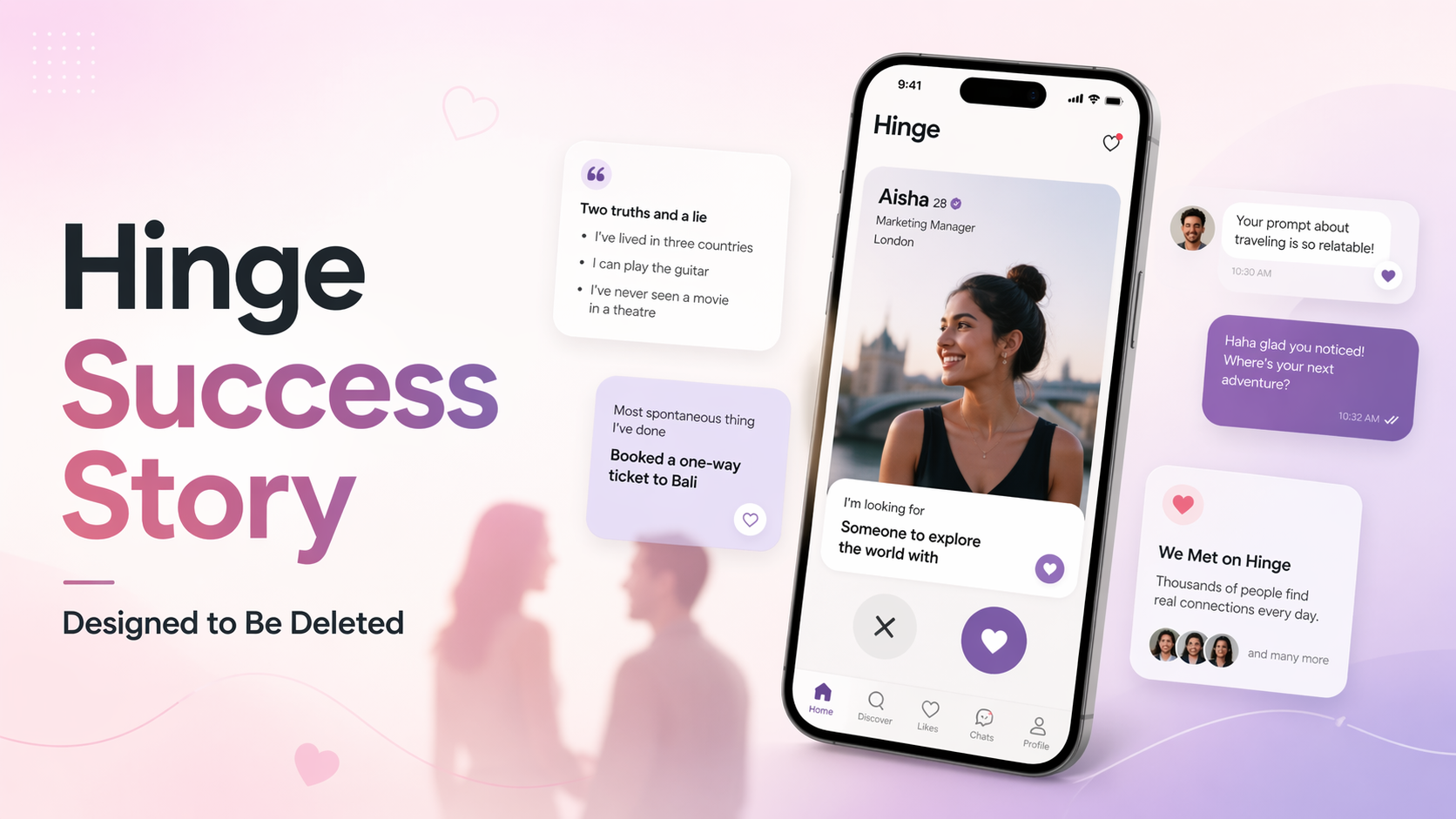
Hinge replaced the blank bio with structured prompts. Questions like “Two truths and a lie” or “The most irrational thing I’m passionate about” gave users a framework to show personality. Prompts created natural conversation starters. Someone could like a specific answer and immediately have something real to say.
This single product decision had a massive impact on conversation quality. Instead of opening with “hey,” users could comment on something specific and authentic.
Liking Specific Parts of Profiles
On most apps, you either like or pass on the whole person. Hinge lets you like or comment on a specific photo, prompt answer, or detail.
That changes the interaction completely. It shows the other person exactly what caught your attention. It signals real interest rather than a reflexive swipe. It gives both people something concrete to start a conversation around.
It’s a small UX decision with a big behavioral outcome.
Algorithm Focused on Compatibility
Hinge’s algorithm is designed to surface compatibility signals beyond physical appearance. It factors in user behavior over time. If two users consistently engage with similar types of people, share similar values based on prompt answers, or have mutual connections, they’re more likely to appear in each other’s feeds.
The goal is to show you fewer people who are a better fit, rather than showing you more people you’ll mostly ignore.
Growth Strategy: What Actually Scaled Hinge
Word-of-Mouth Growth
Hinge grew largely because the product worked. When an app helps you meet someone you actually like, you tell your friends. You share that it’s different. You become a brand advocate without being asked.
This is the most durable form of growth. It doesn’t scale as fast as paid acquisition, but it builds a user base that actually trusts the product.
Rebranding in 2016
This was the defining moment for Hinge as a business.
The original Hinge connected people through Facebook mutual connections. It was a decent idea but not differentiated enough. The 2016 rebrand was a complete overhaul. New product design, new brand identity, new slogan, new target audience focus.
The prompts system, the limited likes, the specific liking feature. All of that came from this rebrand. It’s rare for an app to reinvent itself so thoroughly and come out stronger, but Hinge did it.
Focus on Urban Millennials
Hinge specifically targeted educated urban millennials who had tried other apps and were burned out. This was a deliberate choice. These users were high-intent, had spending power for a premium subscription, and were influential in their social circles.
Focusing on a specific user type let Hinge build a product and voice that actually resonated rather than trying to appeal to everyone.
Leveraging Match Group Resources
When Match Group acquired Hinge, Hinge didn’t get absorbed into the same product strategy as Tinder. Instead, it was kept separate with its own identity and allowed to serve a different market segment.
But behind the scenes, Hinge benefited from Match Group’s data infrastructure, marketing knowledge, and operational resources. That combination of independent brand identity and corporate resources was a significant competitive advantage.
Business Model of Hinge
Hinge runs on a freemium model. The core app is free to download and use. Revenue comes from users who want more features and more control over their experience.
Free Tier
Free users get a functional product. They can create a full profile with prompts and photos, receive and send a limited number of likes per day, and have conversations with their matches.
Hinge Preferred Membership (Paid Tier)
The paid subscription unlocks several features.
Unlimited likes. Free users are capped at a small daily limit. Subscribers can like as many profiles as they want.
Advanced filters. Paying users can filter matches by dealbreakers like religion, family plans, relationship type, and more specific preferences.
See who liked you. Free users have to match first to know someone liked them. Subscribers can see the full list of people who liked them and choose who to match with.
Roses. Roses are a premium signal of strong interest that stands out from regular likes. Subscribers get more of them.
Boosts. Temporarily increases your profile’s visibility in other users’ feeds.
Match Group Monetization Layer
As part of Match Group, Hinge also benefits from cross-platform learnings about what drives subscription conversion, how to structure free-to-paid funnels, and pricing strategy across different markets.
Match Group’s experience with Tinder’s Gold and Platinum tiers directly informed how Hinge built out its own premium product.
How Hinge Makes Money
Subscription revenue is the primary driver. Users pay monthly or annually for Hinge Preferred.
In-app purchases like Roses and Boosts allow non-subscribers to access specific premium features without committing to a full membership. This lowers the barrier to spending and captures revenue from users who aren’t ready for a subscription.
Geographic expansion has opened new revenue markets. Hinge has expanded significantly into the UK, Australia, Canada, and parts of Europe, growing its paying user base globally.
The business model is not complicated. It works because the free product is genuinely good, which drives user growth, which builds a large enough audience to convert meaningfully into subscribers.
Marketing Strategy Breakdown
Emotional Branding
Hinge’s marketing never talks about features first. It talks about feelings. Finding someone you actually connect with. Being done with apps that waste your time. Wanting something real.
That emotional framing made Hinge’s advertising feel different from the start. It didn’t look like tech marketing. It felt more like something a trusted friend would say.
Storytelling Through “We Met” Campaigns
Hinge has run campaigns featuring real couples who met on the app. These aren’t staged or overly polished. They feel authentic because they are. Real stories from real users are the most credible proof that the app actually works.
This type of social proof hits differently than any statistic or feature highlight. It shows the end result in human terms.
Anti-Tinder Positioning
Hinge never directly attacked Tinder by name in most of its marketing, but the positioning was clear. Serious relationships. Not hookups. Intentional matching. Not infinite swiping.
Users who were burned out on Tinder understood exactly what Hinge was offering without Hinge having to say anything negative. It was competitive differentiation delivered through clarity of identity rather than attack advertising.
Social Proof and User Testimonials
Success stories serve double duty. They prove the app works and they reinforce the brand promise. Every couple that shares their Hinge story becomes free marketing and a trust signal for potential new users.
Key Turning Points in Hinge’s History
The 2016 Product Redesign. This was the moment Hinge stopped being a forgettable app and became a brand with a clear point of view. Everything that makes Hinge distinct today traces back to this pivot.
Match Group Acquisition. The full acquisition in 2018 gave Hinge the resources to scale without losing its identity. Match Group understood that Hinge needed to stay differentiated from Tinder, not be merged into it.
Focused Market Positioning. Choosing to go deep with one type of user (serious relationship seekers) rather than trying to attract everyone was a critical strategic decision. It made the product, the marketing, and the community coherent.
Challenges Hinge Has Faced
Competing With Tinder and Bumble
Tinder has brand dominance. Bumble has a strong female-first narrative. Both have significantly larger user bases. For Hinge, competing means staying focused on differentiation rather than trying to out-feature or out-spend either competitor.
The User Retention Paradox
Hinge’s core value proposition creates a weird business problem. If the app works really well, users delete it and stop paying. The company has to balance genuinely helping users succeed (which drives word-of-mouth) while keeping enough users in the product to sustain subscription revenue.
This tension is built into the business model. Hinge manages it by continuously attracting new users to replace those who leave after finding relationships.
Monetization vs. User Happiness
Any paywall creates friction. Limiting likes on the free tier can frustrate users. Advanced filters being locked behind a subscription can feel unfair. Hinge has to calibrate these trade-offs carefully. Too aggressive with monetization and the product feels predatory. Too generous and there’s no reason to subscribe.
Getting that balance right is an ongoing product challenge, not a one-time decision.
What Founders Can Learn From Hinge
This is where Hinge’s story becomes genuinely useful.
Solve an emotional problem, not just a functional one. Hinge didn’t invent a new technology. It diagnosed an emotional wound (dating exhaustion, loneliness, frustration) and built a product that directly addressed it. Emotional product-market fit is more durable than feature-based differentiation.
Repositioning beats competing on features. Hinge didn’t out-feature Tinder. It reframed the entire conversation. Instead of “a better way to swipe,” it offered “a reason to stop swiping.” That’s a fundamentally different value proposition, and it required no technological breakthrough.
Product experience is your best marketing channel. Hinge’s growth was driven by the quality of its matches and the honesty of its brand. Every dollar spent on features that improved match quality was worth more than paid advertising. Build a product people naturally talk about.
Build for long-term outcomes, not short-term engagement metrics. Most apps optimize for daily active users and session length. Hinge optimized for relationship success. That made the product worse on standard engagement metrics but better on the metric users actually cared about.
Message clarity wins markets. “Designed to be deleted” is five words that completely define a brand. It communicates the product’s purpose, the company’s values, and the user’s desired outcome in a single phrase. When your positioning is that clear, marketing becomes much easier.
Restraint is a product strategy. Limiting likes, structuring prompts, building in intentional friction. These choices made the product feel different. Not every product needs unlimited everything. Sometimes constraints create better experiences.
The Future of Hinge
AI-Based Matchmaking
Hinge is already investing in machine learning to improve its compatibility algorithm. The next frontier is more personalized matching that goes beyond stated preferences to learn from actual behavior, conversation patterns, and outcome signals.
AI could help Hinge predict not just who you’ll match with but who you’ll actually go on a date with, and potentially who you’ll stay with.
Video and Voice Features
Text-based profiles have limits. Video prompts and voice notes are increasingly common in the dating space. Hinge has been building toward richer media that lets users show personality beyond photos and written answers.
This matters especially for post-pandemic users who are more comfortable with video communication and want to get a better sense of someone before meeting in person.
Deeper Personalization
Future versions of Hinge will likely let users express more nuanced preferences and values. Not just “do you want kids” but how you approach conflict, what kind of relationship structure you’re looking for, what your daily life actually looks like.
The more context the app has, the better it can match people on compatibility signals that actually predict long-term relationship success.
Global Expansion
Hinge is still significantly underpenetrated outside the US. The UK and Australia are growing markets. Europe and parts of Asia represent long-term expansion opportunities. The brand message translates well globally because the frustration with shallow dating culture is universal.
Conclusion
Hinge didn’t win the dating app market by getting bigger than everyone else. It won by being clearer about what it was trying to do.
It identified a real emotional problem. It built a product that directly addressed it. It told the truth about its purpose in a way that made users trust it. And it stayed consistent with that identity even after acquisition by a company with far more resources and a very different flagship product.
The most important insight from Hinge’s story isn’t about dating. It’s about positioning. Finding the one underserved emotional need in a crowded market, building around it relentlessly, and having the discipline to stay focused when growth pressure pushes you toward becoming everything to everyone.
Sometimes the best business strategy is to help users leave your product.
FAQs
It depends on what you’re looking for. Tinder has a larger user base and is better suited for casual dating and quick connections. Hinge is designed specifically for people seeking serious relationships. The profile prompts, limited likes, and compatibility-focused algorithm make Hinge a stronger choice if you’re looking for something long-term. Most users who have tried both report that Hinge leads to higher-quality conversations and more meaningful connections.
Yes, Hinge is free to download and use. The free version includes creating a full profile, sending a limited number of likes per day, and messaging your matches. Hinge Preferred is the paid subscription that unlocks unlimited likes, advanced filters, the ability to see who liked you, and additional Roses. You can use Hinge meaningfully without paying, but the paid tier gives you significantly more control over your experience.
Hinge is owned by Match Group, the same parent company that owns Tinder, OkCupid, Match.com, and several other dating platforms. Match Group acquired a majority stake in Hinge in 2018 and completed the full acquisition shortly after. Despite being part of Match Group, Hinge operates independently with its own brand, product team, and strategy focused on serious relationship seekers.
Discover more from Business Model Hub
Subscribe to get the latest posts sent to your email.