Blinkit Business Model And How 10-Minute Delivery Actually Makes Money

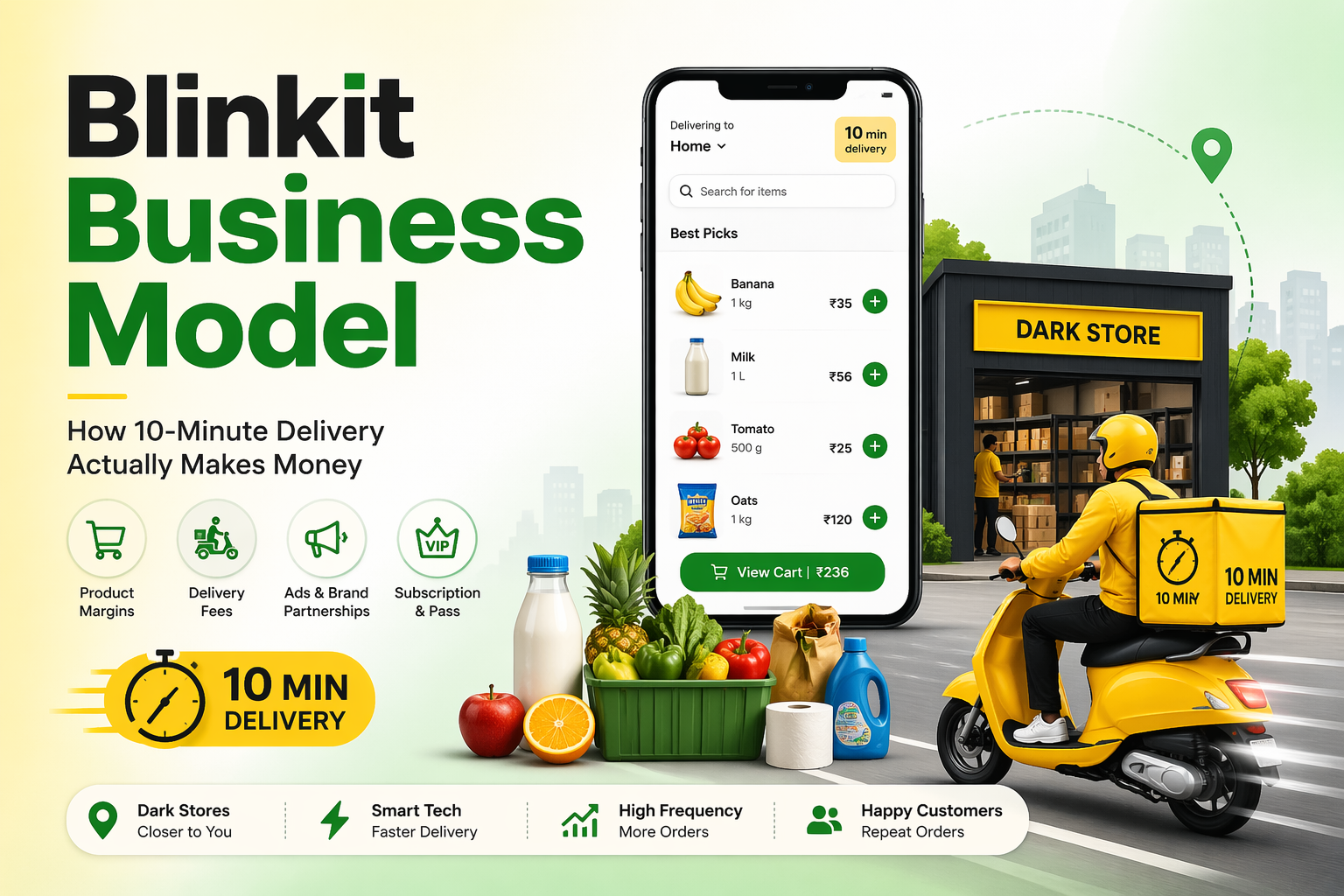
Blinkit’s business model runs on quick commerce. It delivers groceries and essentials within minutes using a network of dark stores, making money through product margins, delivery fees, platform commissions, and brand partnerships, while using logistics tech and demand forecasting to stay fast and lean.
What is Blinkit?
Blinkit is an Indian instant delivery platform that promises groceries, household essentials, and everyday items at your door in 10 to 20 minutes.
It started as Grofers in 2013, a scheduled grocery delivery service. By 2021, the company pivoted hard into quick commerce and rebranded as Blinkit. Zomato, India’s leading food delivery platform, acquired Blinkit in 2022 for approximately $568 million.
That acquisition gave Blinkit serious firepower: Zomato’s delivery infrastructure, data, and capital.
The core promise is simple. You open the app, add items to your cart, and a delivery partner shows up before you finish making your coffee.
Key idea: Blinkit is not a grocery store. It is a logistics and demand prediction company that happens to sell groceries.
The Core Idea Behind Blinkit
Traditional eCommerce optimizes for variety and price. Quick commerce optimizes for speed.
Blinkit made a deliberate bet that a segment of urban consumers would pay a premium for instant fulfillment. Not next-day. Not same-day. Now.
That shift changes everything about how the business works.
Why speed beats variety here:
Blinkit does not try to carry 50,000 SKUs like Amazon. It carries around 2,000 to 5,000 carefully selected items per dark store. The focus is on what people actually need in a pinch: eggs, bread, chips, cleaning supplies, medicines, phone chargers.
Consumer psychology at play:
When someone runs out of onions mid-cooking or needs baby formula at 11 PM, price sensitivity drops. The willingness to pay a delivery fee jumps. Blinkit targets these high-urgency, low-patience moments.
The real product Blinkit sells is time. Groceries are just the delivery vehicle.
How Blinkit Works
The User Journey
The customer experience is intentionally frictionless.
You open the Blinkit app, browse or search for items, add them to your cart, pay online, and wait. A timer appears on screen. Most deliveries land between 8 and 20 minutes depending on your location and traffic.
No scheduling. No waiting for a delivery window. No minimum order value in many cases.
The Backend Flow
This is where the real complexity lives.
When you place an order, it routes automatically to the nearest dark store. A trained picker inside that store receives the order on a handheld device and starts pulling items from shelves. Packing takes under two minutes in optimized stores.
Simultaneously, the system assigns the nearest available delivery partner. By the time items are packed, the delivery partner is already at the store or close to it.
The delivery partner picks up the sealed bag and rides directly to your location. No pit stops. No multi-order drops in most cases.
The whole system is built to minimize handoff time at every stage.
What Are Dark Stores?
Dark stores are the foundation of Blinkit’s entire operation.
A dark store is a small warehouse, typically 2,000 to 3,000 square feet, located inside a residential neighborhood. It looks like a closed retail unit from outside. No walk-in customers. No retail staff. Just inventory, pickers, and technology.
Why dark stores work:
They are positioned close to where demand actually lives. Instead of shipping from a large warehouse on the outskirts of a city, Blinkit places micro-fulfillment centers inside the neighborhoods they serve. This cuts delivery distance dramatically.
Shelves are organized for picking speed, not visual appeal. High-frequency items are placed at the front. Cold storage is available for dairy, produce, and frozen goods. Every inch is optimized for operational throughput, not customer browsing.
Dark stores give Blinkit three major advantages:
First, delivery time drops because distance is short. Second, inventory control improves because each store manages a smaller, curated SKU list. Third, shrinkage and waste go down because demand data for each location is highly specific.
Blinkit operates hundreds of dark stores across major Indian metros. Expansion of this network is the single biggest driver of its growth strategy.
Blinkit Business Model Breakdown
Revenue Streams
Product margin is the primary revenue driver. Blinkit marks up products above their procurement cost. Margins vary by category, typically ranging from 15% to 25% on packaged goods and higher on private label products.
Delivery fees add a direct revenue line. Blinkit charges a flat delivery fee per order, which has increased over time as the platform matures and reduces its reliance on subsidies.
Surge pricing kicks in during peak hours, bad weather, or high-demand periods. This protects margin during the most expensive times to operate.
Brand promotions and advertising are a fast-growing revenue stream. FMCG brands pay Blinkit for prime placement on the app: featured spots on the home screen, search result boosts, banner ads, and sponsored category pages. This is high-margin revenue with minimal operational cost.
Blinkit Pass is the subscription product. Subscribers pay a monthly or quarterly fee in exchange for free deliveries, priority service, or exclusive discounts. Subscriptions improve order frequency and reduce churn.
Cost Structure
Delivery partner payouts are the largest variable cost. Blinkit pays per-delivery fees to its gig delivery workforce. These costs scale directly with order volume.
Dark store rent and operations are fixed costs that do not flex with volume. Rent in urban residential areas is not cheap. Add staff salaries for pickers, store managers, and ops teams, and dark store overhead becomes significant.
Inventory and procurement require working capital. Blinkit holds physical stock, which means capital is tied up in shelves at all times. Spoilage and expired goods are a real cost, particularly in fresh categories.
Technology and infrastructure cover the app, backend systems, route optimization, forecasting models, and data infrastructure. These are substantial but mostly fixed once built.
Unit Economics: The Simple View
The unit economics of quick commerce are brutally simple.
Take the average order value (AOV). Subtract the cost of goods sold, delivery payout, packaging, and a share of dark store overhead. What remains is your contribution margin per order.
For Blinkit, AOV has been trending upward, reaching around Rs 600 to Rs 700 per order in recent quarters. At that level with optimized density, each order can generate a positive contribution margin.
But here is the catch. Profitability only works when order density is high. If a dark store in a given neighborhood is getting 300 orders a day, the fixed costs per order are manageable. If it is getting 80 orders a day, the math breaks.
Density is everything in this model.
How Blinkit Actually Makes Money
The revenue streams are clear. But the real logic of profitability runs deeper.
High-frequency orders are the engine. Blinkit wins when customers order multiple times a week, not once a month. Each incremental order from an existing customer costs almost nothing in acquisition. The customer is already in the app. The dark store already serves their area. The margin improves with every repeat order.
Basket optimization matters more than it sounds. Blinkit’s app is designed to increase cart size. Suggested add-ons, combo deals, and “frequently bought together” prompts push AOV up without increasing delivery cost. Delivering one item or ten items costs roughly the same in logistics.
Private label products carry significantly higher margins than branded equivalents. When a customer buys Blinkit’s own brand of chips instead of Lay’s, the margin difference can be 10 to 20 percentage points. Scaling private label is a high-priority play.
Advertising revenue from brands is structurally high-margin. A brand paying for a featured placement on Blinkit’s home screen generates pure revenue with no incremental logistics cost. As Blinkit’s user base grows, this ad inventory becomes more valuable.
Reality check: Margins in quick commerce are thin at the individual order level. Scale is not just a growth goal. It is a survival requirement.
Customer Segments
Blinkit’s primary customer base clusters into three groups.
Urban working professionals are the core segment. Busy schedules, decent disposable income, and low tolerance for time-wasting tasks make them ideal quick commerce customers. They order frequently and have high AOV.
Students and young adults living away from family order heavily for daily essentials: instant noodles, snacks, beverages, toiletries. Order frequency is high but AOV tends to be lower.
Emergency buyers are situational customers. Someone who has run out of a key ingredient, needs medicine at midnight, or forgot a birthday gift. These customers are not necessarily frequent, but their willingness to pay is high and they spread word of mouth effectively.
Value Proposition
Blinkit’s value proposition is not price. It is not the widest selection. It is one thing done extremely well.
Ultra-fast delivery is the headline. No other format consistently delivers in under 20 minutes at scale.
Convenience over cost is the implicit trade Blinkit asks customers to make. And a growing segment of urban India is willing to make that trade repeatedly.
Reliable availability matters more than people realize. Customers return to Blinkit not just because it is fast, but because the items they need are actually in stock when they need them. Inventory accuracy at the dark store level is a genuine competitive advantage.
Key Partners
FMCG brands are commercial partners paying for shelf space and advertising. Hindustan Unilever, Nestle, ITC, and dozens of others have a strategic interest in Blinkit’s success and pay accordingly.
Local suppliers for fresh produce and regional products help Blinkit maintain margins on perishables and offer neighborhood-relevant inventory.
Delivery partners are the gig workforce that makes physical fulfillment possible. Blinkit’s relationship with this group involves a constant balance between cost control and service reliability.
Zomato as the parent company is perhaps the most important structural partner. Zomato provides capital, shared infrastructure, combined data insights, and cross-platform marketing. A Zomato food order and a Blinkit grocery order from the same customer creates compounding loyalty.
Technology Behind Blinkit
Technology is not just a support function at Blinkit. It is the actual moat.
Demand forecasting determines what each dark store stocks and in what quantities. Getting this wrong is expensive. Understocking means failed orders and frustrated customers. Overstocking means spoilage and wasted capital. Blinkit’s ML models analyze order history, time of day, day of week, local events, and weather to predict demand at the SKU level for each dark store.
Route optimization minimizes delivery time for each order. The system factors in real-time traffic, delivery partner location, store readiness, and customer location to assign the fastest possible path.
Inventory prediction systems trigger restocking before items run out. This is especially critical for high-velocity SKUs. Running out of milk or eggs at 7 AM in a residential neighborhood is a customer experience failure with real retention consequences.
The app itself is engineered for conversion. Load time, search accuracy, product placement, and checkout flow are all optimized to increase order frequency and cart size.
This is where Blinkit actually wins against potential competitors. You can rent dark stores. You can hire delivery partners. You cannot easily replicate three years of hyperlocal demand data.
Competitive Landscape
Quick commerce in India is a three-player race with clear differentiation.
Zepto is Blinkit’s closest direct competitor. Founded in 2021, Zepto has aggressively expanded its dark store network and competes directly on speed and SKU selection. It has raised significant venture capital and operates with a similar dark store model.
Swiggy Instamart leverages Swiggy’s existing food delivery infrastructure and customer base. It has broad reach and benefits from Swiggy’s marketing scale, but its quick commerce execution has sometimes lagged behind Blinkit.
BigBasket (now backed by Tata) focuses on planned grocery shopping with same-day and scheduled delivery. It competes on variety and trust but is not primarily a quick commerce player. Its BBNow product attempts to compete in the 10-minute space.
Where Blinkit stands out:
Speed and reliability at scale. Blinkit consistently posts faster average delivery times than its competitors in tier-one markets. The Zomato integration and capital backing provide durability that standalone players lack.
Blinkit vs Traditional eCommerce
| Factor | Blinkit | Amazon / BigBasket |
|---|---|---|
| Delivery Time | 10 to 20 minutes | Same day to next day |
| Inventory Depth | 2,000 to 5,000 SKUs | 50,000 or more SKUs |
| Pricing | Slight premium | Competitive or lower |
| Use Case | Urgent, impulse, top-up | Planned, bulk shopping |
| Infrastructure | Dark stores, hyperlocal | Large warehouses |
These are not competing products for the same purchase occasion. They serve fundamentally different buying moments.
Growth Strategy of Blinkit
Expanding the dark store network is the top priority. More dark stores mean more neighborhoods covered, higher order density in existing markets, and lower average delivery distances.
Increasing SKU count per store is the second lever. Adding more categories like electronics accessories, toys, stationery, and pharmaceuticals increases the occasions on which customers reach for the app instead of going to a store.
Improving delivery efficiency through better routing, picker training, and store layout optimization reduces the cost per order without reducing speed.
Leveraging the Zomato ecosystem creates cross-sell opportunities. A customer ordering food on Zomato sees Blinkit promotions. Data from Zomato’s restaurant ordering patterns informs Blinkit’s demand forecasting. Combined loyalty programs increase retention across both platforms.
Challenges in Blinkit’s Business Model
High operational costs are structural. Running dozens or hundreds of dark stores in expensive urban real estate, staffing pickers, and paying gig delivery partners creates a cost base that requires significant order volume to justify.
Thin margins leave little room for error. A spike in delivery partner payouts, a wave of spoilage in fresh inventory, or a period of aggressive discounting to retain customers can swing a unit from profitable to loss-making quickly.
Logistics complexity scales non-linearly. Adding new cities means new dark stores, new supplier relationships, new delivery partner recruitment, and new demand models. Each geography has its own nuances.
Customer retention vs discounts is a constant tension. Quick commerce customers are sticky when the product works, but they respond to competitor discounts. Maintaining loyalty without burning margin on promotions is an ongoing challenge.
Is Blinkit Profitable?
Blinkit has moved from heavy losses toward improved unit economics since Zomato’s acquisition. Zomato’s quarterly reports show Blinkit’s adjusted EBITDA losses narrowing significantly through 2023 and 2024 as order volume grew and per-order costs declined.
The business is not fully profitable at the consolidated level yet, but the trajectory is positive. Contribution margin per order has improved as dark store density increased and delivery fees were raised.
The honest take: Quick commerce as a category is still proving out its long-term unit economics at scale. Blinkit is among the best-positioned players globally, but profitability at scale in this model is still being demonstrated, not yet proven.
The Zomato backing provides a longer runway than most competitors to reach that proof point.
Future of Quick Commerce
Tier-two city expansion is the next frontier. Cities like Pune, Jaipur, Lucknow, and Coimbatore have growing middle-class populations with smartphones and the right income profile for quick commerce. Infrastructure is harder to build there, but first-mover advantage is real.
AI-based inventory management will reduce waste and improve in-stock rates. More granular demand forecasting at the neighborhood level, factoring in hyperlocal events and seasonal patterns, will improve both margin and customer experience.
Dark store automation using robotics for picking and sorting is being piloted in advanced markets globally. As technology costs drop, partial automation of dark store operations becomes economically viable and could materially improve margin.
Category expansion into prescription medicines, pet supplies, and specialty foods will increase the occasions on which Blinkit is the default choice.
Lessons for Founders
Speed can be a sustainable USP. In a world where everyone claims differentiation on price or variety, building operational excellence around a single dimension, speed, creates defensible positioning that is genuinely hard to replicate.
Logistics is a moat. The dark store network, the routing algorithms, and the demand forecasting models are not things a new competitor can copy quickly. They are built through iteration, data, and capital over years.
Unit economics matters more than hype. Quick commerce attracted enormous venture capital during 2021 and 2022. The companies that survived and scaled are the ones that relentlessly focused on the cost and revenue per order, not just gross merchandise value.
Data compounds. Every order Blinkit fulfills makes its demand models more accurate. More accuracy means better inventory, less waste, and faster delivery. The data advantage grows with scale in a way that makes catching up harder for latecomers.
Conclusion
Blinkit is not a delivery app with a nice interface. It is a real-time logistics system engineered to serve instant consumption habits at scale.
The 10-minute promise is a marketing claim, but it is backed by genuine operational infrastructure: dark stores positioned inside neighborhoods, ML models predicting demand at the SKU level, route optimization running in real time, and a workforce trained to fulfill orders in under two minutes of packing time.
The business model works when density is high, order frequency is strong, and technology keeps costs in check. All three of those are improving.
Whether quick commerce becomes a generational business or consolidates into one or two dominant players, Blinkit’s combination of Zomato’s backing, operational depth, and data advantage makes it the most credible bet in the space.
FAQs
Blinkit is not fully profitable at a consolidated level yet, but unit economics have improved significantly. Contribution margin per order has turned positive in mature markets. Full profitability depends on continued scale growth and cost efficiency.
Blinkit places small dark stores inside residential neighborhoods, cutting delivery distance to under two or three kilometers. Trained pickers fulfill orders in under two minutes. Route optimization assigns the nearest available delivery partner. The combination of proximity, preparation, and technology makes 10-minute delivery operationally achievable.
Zomato acquired Blinkit in 2022. Blinkit operates as a subsidiary of Zomato Limited, which is publicly listed on Indian stock exchanges.
Discover more from Business Model Hub
Subscribe to get the latest posts sent to your email.