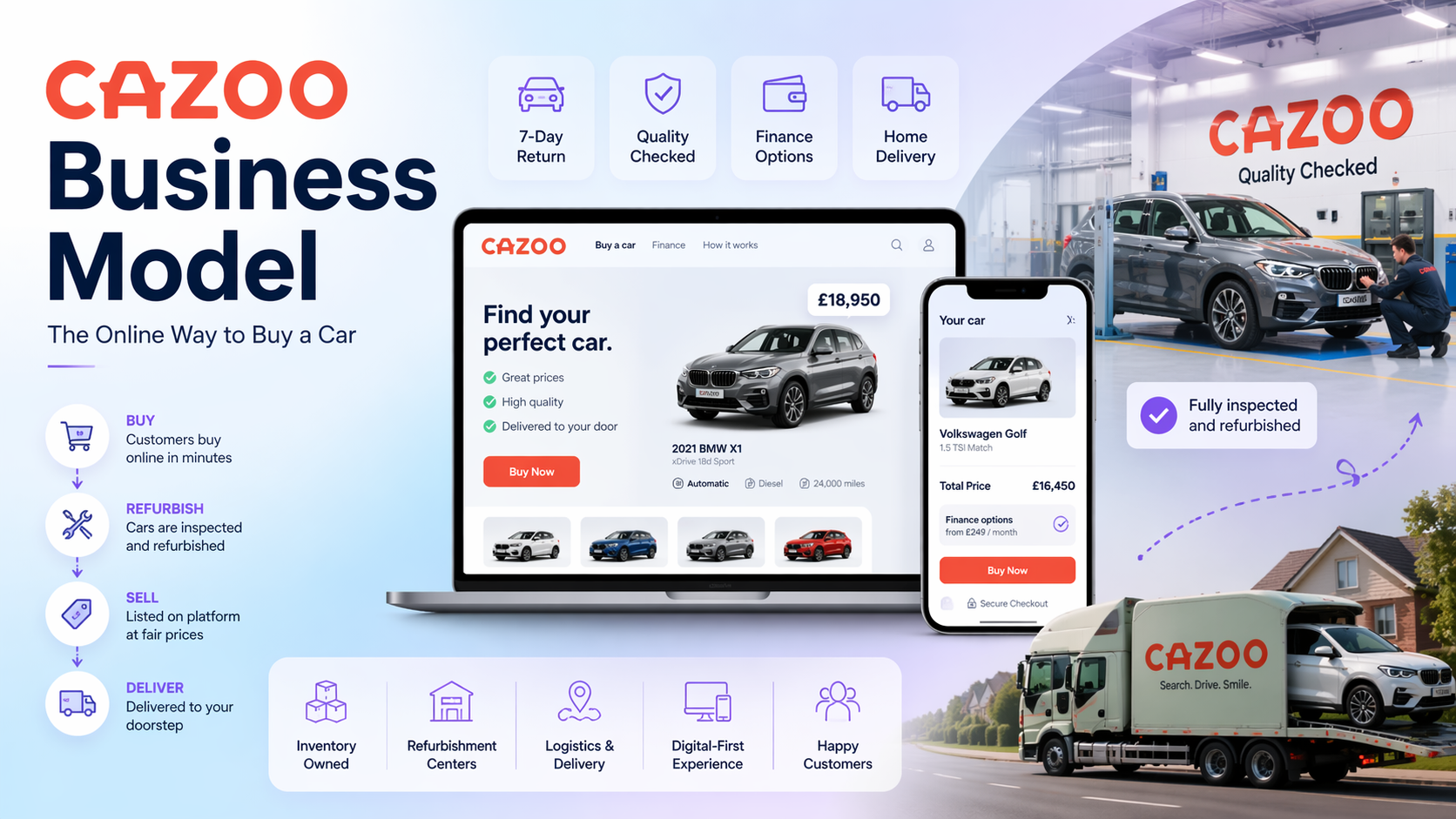

The Cazoo business model is based on buying, refurbishing, and selling used cars directly to customers online, combined with home delivery and financing options. It follows an inventory-led, full-stack model, meaning Cazoo owns the cars it sells rather than acting as a marketplace.
What Is Cazoo?
Cazoo is a UK-based online used car retailer founded in 2018 by Alex Chesterman, the same entrepreneur behind Zoopla and LoveFilm.
The core pitch was simple. Buy a used car online in minutes. Get it delivered to your door. Skip the dealership entirely.
Cazoo was built around one idea: car buying should feel as easy as ordering anything else online. No haggling. No showroom pressure. No wasted weekends driving lot to lot.
At launch, it was positioned as one of the most ambitious startup ideas in European automotive retail. And for a while, it looked like it might actually work.
The Problem Cazoo Was Built to Solve
Traditional used car buying in the UK and across most markets is a painful process. Anyone who has gone through it knows the frustrations.
It takes too long. Between researching, test driving, negotiating, and finalizing paperwork, buying a used car can eat up days or even weeks.
Pricing is not transparent. Dealership prices are often starting points for negotiation rather than honest offers. Most buyers have no idea whether they are getting a fair deal.
The experience is dealership-dependent. If you want a specific car, you have to go where that car is. There is no centralized, consistent buying experience.
Online options were limited. Platforms like Auto Trader let you browse listings, but the actual transaction still happened through dealers. There was no end-to-end digital journey.
Cazoo looked at all of this and decided to build the solution from scratch. Fixed prices. Seven-day returns. Home delivery. One platform, one experience.
The Cazoo Business Model Explained
Cazoo operates on what is called a full-stack inventory model. That is the foundation of everything.
What Full-Stack Inventory Means
Unlike a marketplace that connects buyers and sellers, Cazoo owns the cars it sells. Every single vehicle on its platform belongs to Cazoo until it is purchased by a customer.
Here is how the model works step by step.
Step one: Cazoo sources used cars directly from auctions, fleet companies, part-exchange programs, and private sellers.
Step two: Those cars go to Cazoo’s own refurbishment and inspection centers. Every vehicle gets checked, cleaned, repaired, and prepared to a standardized condition.
Step three: The cars are listed on Cazoo’s platform with fixed prices, detailed photos, condition reports, and specification breakdowns.
Step four: A customer browses online, selects a car, arranges financing or pays outright, and completes the transaction digitally.
Step five: Cazoo delivers the car to the customer’s home, often within a few days.
The customer never visits a dealership. They never negotiate. They never deal with a salesperson.
That is the model in its cleanest form.
How Cazoo Makes Money
The business has several revenue streams, but they are not all equal.
Car Sales
This is the primary revenue driver. Cazoo buys cars below market rate, refurbishes them, and sells them at a markup. The margin between the acquisition cost and the selling price is the core of the business.
The problem is that used car margins are thin. Even in a favorable market, dealers typically work with margins in the range of a few hundred to a couple of thousand dollars per unit. When you factor in refurbishment costs, logistics, and overhead, that margin shrinks fast.
Financing and Loans
When customers finance a purchase through Cazoo, the company earns commission from lending partners. It can also capture interest margin depending on the financing structure.
This is a meaningful revenue line because the majority of car purchases involve financing. Getting a cut of each financed transaction adds up at volume.
Add-Ons and Services
Cazoo sells extended warranties, GAP insurance, and other protection products alongside its vehicles. These have higher margins than the cars themselves and are a logical upsell in the purchase flow.
Delivery Charges
In some markets and configurations, Cazoo charges for home delivery. This partially offsets the logistics cost, though it rarely covers it fully.
Key Components That Make the Model Work
Or in Cazoo’s case, the components that had to work in order for the model to work.
Inventory Ownership
Owning the cars gives Cazoo full control over quality, presentation, and pricing. There is no reliance on third-party dealers to maintain standards or honor commitments.
But inventory ownership is capital-intensive. Cazoo has to buy every car before it sells it. That means cash is constantly tied up in stock sitting in warehouses.
Logistics and Warehousing
Cazoo built its own network of vehicle preparation centers across the UK. These handle inspection, refurbishment, and storage.
It also built a delivery operation to get cars from those centers to customers’ homes. Running that at scale is operationally complex and expensive.
Technology Platform
The buying experience has to be seamless. Customers need to be able to search, filter, inspect, finance, and purchase entirely online without friction.
Cazoo invested heavily in its platform to make this work. That includes the front-end shopping experience, back-end inventory management, and the integration of financing tools.
Customer Experience
The seven-day return policy is a significant trust signal. Customers who are uncertain about buying a car without seeing it in person can take comfort in knowing they have a week to change their mind.
Free returns, money-back guarantees, and transparent condition reporting are the tools Cazoo used to overcome the hesitation that comes with buying a high-ticket item online without a test drive.
Why Cazoo Scaled So Fast
Between 2018 and 2022, Cazoo grew at a pace that few startups in any category can match.
Investor funding was enormous. Cazoo raised over $2 billion in funding and reached unicorn status in record time. That capital gave it the runway to build fast without worrying about near-term profitability.
Marketing was aggressive. Cazoo became one of the most visible brands in the UK through major sports sponsorships, including Premier League football clubs, cricket, and darts. The brand became hard to miss.
COVID accelerated adoption. The pandemic pushed consumers toward online purchasing across almost every category. Car buying was no exception. With dealerships closed and people reluctant to go in person, Cazoo’s model was well-timed.
Demand for used cars surged. Supply chain disruptions caused new car shortages, which drove prices and demand for used vehicles to historic highs. Cazoo benefited from that tailwind.
Why Cazoo Struggled
This is the part of the Cazoo story that matters most for anyone building a business in a capital-intensive category.
High Operational Costs
The full-stack model is expensive to run. Buying cars requires constant capital outlay. Warehousing requires physical infrastructure. Logistics requires a delivery fleet and workforce.
Cazoo was spending heavily on all three simultaneously while also investing in technology, marketing, and international expansion.
Thin Margins on the Core Product
Used cars are not a high-margin product. A dealership selling one car at a time from a local lot has relatively low overhead. Cazoo selling thousands of cars through a complex national logistics operation has much higher costs per unit.
When the margin on each car is modest and your cost structure is enormous, the math is very difficult to make work.
Overexpansion Into Europe
Cazoo launched in France, Germany, Spain, and Italy, among other markets. International expansion requires rebuilding the entire supply chain, regulatory compliance, customer acquisition, and brand presence in each new country.
That is expensive even when the core business is profitable. For Cazoo, expanding internationally while the UK business was still burning cash made the financial situation significantly worse.
Market Conditions Turned
Used car prices surged during COVID and then fell sharply as supply chains normalized and economic pressure mounted. Cazoo held significant inventory when prices dropped, which damaged its margins on existing stock.
Rising interest rates also cooled consumer appetite for financed purchases, which is a large portion of used car sales.
Revenue Did Not Grow Fast Enough to Justify the Burn
Cazoo was spending at a rate that required rapid revenue growth to eventually justify. When growth slowed and costs stayed high, the business faced serious pressure.
Cazoo vs the Marketplace Model
This comparison is important for understanding the fundamental trade-off in the Cazoo model.
Inventory-led model (Cazoo’s approach)
Cazoo owns every car it sells. That gives it full control over quality and experience. It also means it takes on full financial risk. Every car in stock is capital tied up. If prices fall, Cazoo absorbs the loss.
Marketplace model (Auto Trader’s approach)
Auto Trader connects buyers with dealers. It never owns a car. It earns listing fees and advertising revenue. Its margins are high. Its capital requirements are low. It scales with almost no additional cost per listing.
The trade-off is control. Auto Trader cannot guarantee the quality of every car on its platform because it does not own any of them. Cazoo can guarantee quality because it owns and prepares every vehicle.
But control has a cost. And in Cazoo’s case, that cost was enormous.
This is one of the central tensions in marketplace versus inventory-led business models. The inventory model looks more defensible and customer-friendly. The marketplace model looks more scalable and financially efficient.
Founders choosing between the two need to be honest about their capital situation and their tolerance for operational complexity.
Cazoo’s Pivot and Current Strategy
Cazoo went public through a SPAC merger in 2021, which gave it access to public market capital. But the public markets proved less forgiving than its venture backers had been.
The company has since made significant strategic changes.
It exited several international markets. European operations were scaled back significantly as part of a move to cut costs and focus resources on the UK.
It shifted toward a marketplace-style approach. Rather than exclusively selling its own inventory, Cazoo began moving toward a model where it also lists dealer vehicles on its platform. This reduces the capital intensity of the business.
Profitability replaced growth as the stated goal. The mindset shifted from capture as much market share as possible to make each transaction financially viable.
Whether this pivot is enough to establish a sustainable business remains to be seen. But the direction reflects a realistic acknowledgment of what the original model required to work and the gap between that and what was achievable.
Lessons for Founders
The Cazoo story is genuinely instructive. Not because it is a failure story, but because it reveals exactly where ambitious, well-funded, well-intentioned businesses run into trouble.
Full Control Comes With Full Risk
Owning inventory gives you quality control and a consistent customer experience. But it also means you absorb all the risk. Price drops, slow sales, storage costs, and working capital pressure all land on you.
Founders who choose inventory-led models need deep pockets, excellent inventory management, and a clear path to margin improvement. Without those three things, control becomes a liability.
Growth Without Profit Is a Strategy, Not a Business
Cazoo raised billions. It had strong brand recognition. It built impressive operational infrastructure. But a business that consistently loses money on each transaction cannot solve that problem by doing more transactions.
Scaling a loss-making model just scales the losses. The unit economics have to work before growth makes sense.
Unit Economics Matter More Than Narrative
The story of Cazoo was compelling. Easy car buying. Home delivery. Transparent pricing. That narrative attracted investors, press coverage, and customers.
But narrative does not replace unit economics. If the margin on each car sold does not cover the cost of acquiring, preparing, delivering, and supporting that car, no amount of storytelling fixes the business.
Founders need to know their numbers per transaction before they think about total addressable market.
Logistics Businesses Are Harder Than They Look
Building a national delivery network sounds straightforward. In practice, it involves fleet management, driver hiring and training, route optimization, customer scheduling, returns handling, and a hundred other operational details.
Cazoo underestimated how much operational complexity would compound as it scaled. Any founder building a business with a physical delivery component should expect logistics to be harder, slower, and more expensive than the initial plan assumes.
Timing and Market Conditions Are Not Under Your Control
Cazoo benefited enormously from COVID tailwinds. Used car prices were high. Online purchasing behavior was accelerating. Investor sentiment was favorable.
When those conditions reversed, the business was exposed. Tailwinds cannot substitute for a durable model. The business has to work in neutral or adverse conditions, not just in the best possible environment.
International Expansion Multiplies Operational Risk
Entering a new country is not just a marketing exercise. It means rebuilding supply chain relationships, navigating new regulations, establishing brand presence, and hiring local teams. Doing this in multiple countries simultaneously, while the core business is not yet profitable, is extremely high-risk.
Cazoo’s European expansion consumed capital and management attention that might have been better deployed deepening the UK business first.
The Bigger Picture: What Cazoo Tells Us About Digitizing Traditional Industries
Cazoo is often discussed as a cautionary tale. That framing is understandable but slightly incomplete.
The underlying insight was correct. Car buying is a broken experience. Customers deserve transparency, convenience, and fairness. A digital-first model can deliver all of those things.
The execution proved harder than the idea. Physical inventory is capital-heavy. Logistics is operationally complex. Used car margins are thin. Combining all three at national scale requires either extraordinary operational efficiency or extraordinary patience from investors.
Cazoo had the latter but needed more of the former.
The companies that successfully digitize traditional industries usually do one of two things. They either find a way to deliver a better experience without owning the heavy assets (the marketplace approach), or they accept that asset ownership is necessary and build with relentless focus on making each unit profitable before scaling.
Cazoo tried to do both rapidly and simultaneously. That is where the model broke down.
Conclusion
Cazoo is a case study in the gap between vision and sustainable business model.
The vision was right. Online car buying is where the market is heading. Home delivery, fixed pricing, and digital transactions are what consumers want.
The model was structurally difficult. Thin margins, high capital requirements, and operational complexity made profitability elusive at the scale Cazoo was trying to reach.
The lesson is not that online car buying cannot work. The lesson is that digitizing a capital-intensive, low-margin, operationally complex industry requires either a fundamentally different cost structure or extraordinary patience and discipline.
Cazoo proved that customers want what it was selling. The harder question, which every founder in a similar category needs to answer, is whether you can sell it profitably enough to build something that lasts.
That question does not get answered by raising more money or acquiring more customers. It gets answered by the numbers on each individual transaction.
Get those right first. Then scale.
Discover more from Business Model Hub
Subscribe to get the latest posts sent to your email.