Perplexity AI Business Model And How This AI Search Startup Is Challenging Google

Perplexity AI is not trying to build a better search engine. It is trying to kill the concept of search entirely and replace it with something fundamentally different: direct answers backed by real sources, delivered instantly, without ads cluttering the experience.
That is a bold bet. And so far, it is working.
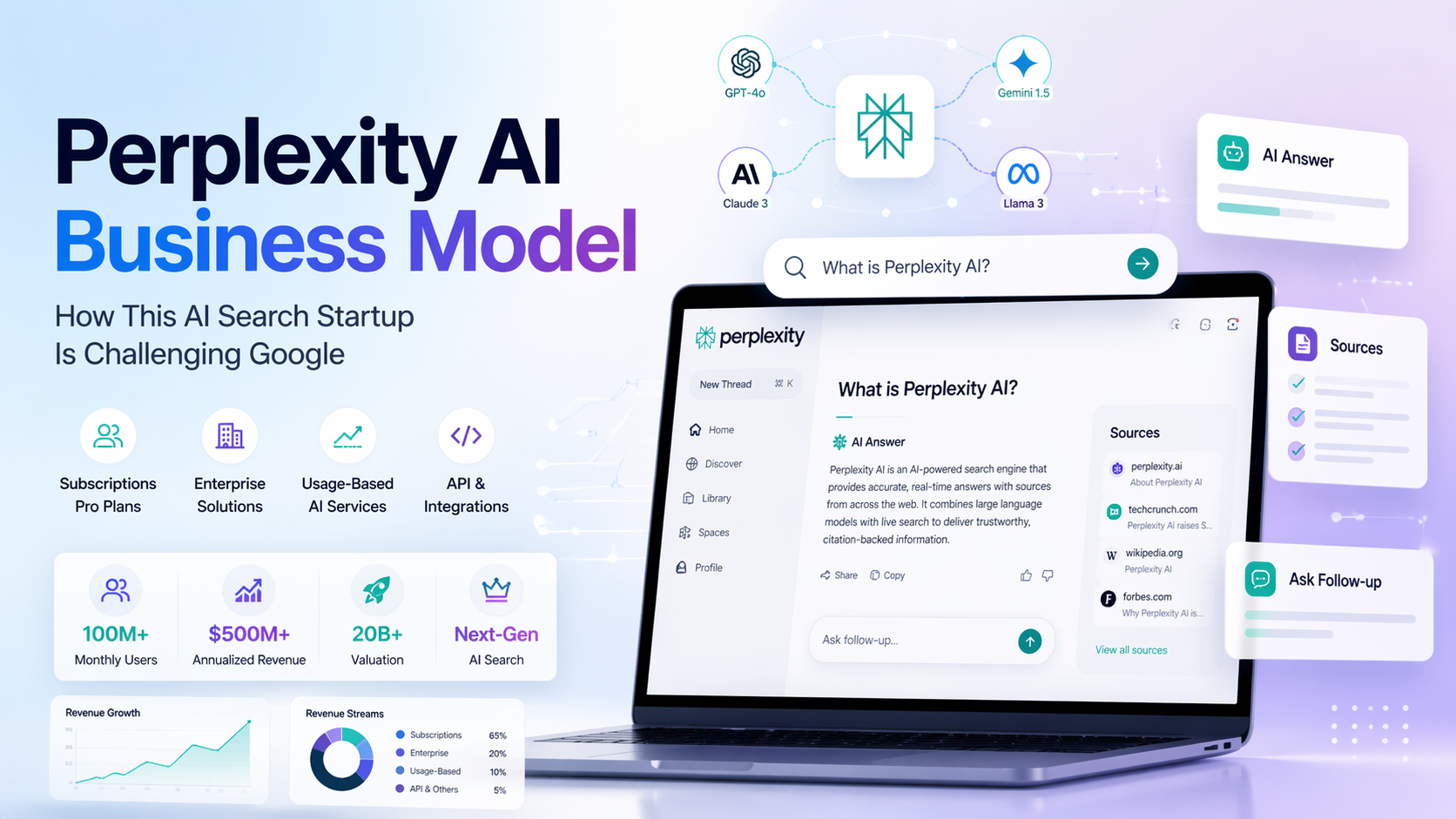
With over 100 million monthly users, an estimated $500 million in annualized revenue, and a valuation pushing past $20 billion, Perplexity has gone from a niche research tool to one of the fastest-growing AI companies in the world. The business model behind that growth is worth understanding in detail, whether you are a founder, investor, marketer, or just someone curious about where search is headed.
What Perplexity AI Actually Is
Perplexity AI is an answer engine. That distinction matters.
A search engine gives you links. An answer engine gives you the answer, with citations attached so you can verify it yourself. Perplexity sits in a unique position in the AI market. It is not trying to directly compete with ChatGPT on open-ended creativity or coding. It is not trying to out-feature Google on breadth. It is doing something more targeted: replacing the entire “search for links, open tabs, skim articles” workflow with a single, direct response.
Under the hood, Perplexity combines large language models with real-time web retrieval. When you ask a question, it does not just pull from training data. It searches the live web, pulls relevant sources, synthesizes the information, and presents a clean answer with numbered citations. You get research-quality output in seconds.
Key product features include a Deep Research mode for multi-step investigations, a Model Council feature that lets users compare outputs across different AI models, and AI agents that can perform tasks beyond answering questions. The product is genuinely useful for students, researchers, founders, analysts, journalists, and anyone whose job involves gathering and processing information quickly.
Why the Business Model Is Different From Google
Google built one of the most profitable businesses in history on a simple formula: attract users with free search, monetize their attention with ads. That model generated hundreds of billions in revenue. It also created a structural problem. Ad-supported search has an inherent conflict of interest. The algorithm has to balance what is best for the user with what is profitable for the advertiser. Over time, that tension degrades the product.
Perplexity made a deliberate choice to step away from that model.
The company experimented with advertising early on and has since pulled back significantly. The reason is straightforward: ads introduce bias. If a sponsored result influences an AI-generated answer, even subtly, the user loses trust in the entire product. For a company whose core value proposition is “trust us to give you the right answer,” that is an existential threat.
So instead of selling attention, Perplexity sells utility. Users pay for the product directly because it saves them time and delivers real value. That is a fundamentally different relationship between a tech product and its users, and it is the foundation everything else is built on.
The Core Value Proposition: Selling Time and Clarity
Perplexity does not sell information. Information is everywhere. Perplexity sells two things that are genuinely scarce: time and clarity.
For individual users, the value is obvious. Instead of spending 20 minutes reading through five different articles to get an answer, you get a synthesized, sourced response in 10 seconds. For professionals, that time savings compounds. A researcher who uses Perplexity for hours every day is not just saving time on individual queries. They are fundamentally changing how they work.
For enterprises, the value proposition shifts slightly. It becomes about internal knowledge management, secure data querying, and workflow automation. Instead of having employees dig through internal wikis, Slack archives, and shared drives to find information, an enterprise AI assistant can surface the right answer instantly.
This layered value proposition is why Perplexity can charge different prices to different customer segments and build sustainable revenue across all of them.
How Perplexity Makes Money: Full Revenue Model Breakdown
Subscription Revenue
The core of Perplexity’s business is its Pro subscription, priced at around $20 per month. This tier gives users unlimited queries, access to multiple AI models including GPT-4o, Claude, and Gemini, plus the ability to upload and analyze files.
Subscription revenue accounts for the majority of total revenue, estimated at roughly 65% of the overall mix. The reason this model works is that Perplexity is a daily-use product. Power users are not opening it occasionally. They are using it multiple times every single day, which means the perceived value far exceeds the monthly cost. That drives strong retention and relatively low churn.
The subscriber base skews toward a highly valuable demographic: researchers, startup founders, marketers, consultants, and knowledge workers who need fast, reliable information as part of their core job function. These are not casual users who might cancel after a slow month. These are people whose productivity depends on the tool.
The Freemium Funnel
Before anyone pays $20 per month, they use the product for free. Perplexity’s free tier offers a limited number of queries per day with access to a baseline AI model. It is good enough to demonstrate the value of the product, but limited enough that heavy users run into the ceiling quickly.
This is a classic SaaS freemium structure, but it works particularly well for Perplexity because the product creates a strong habit loop. Once you have gotten used to getting direct answers with citations, going back to Google feels painful. The free tier acquires the habit. The paid tier captures the value of that habit.
Conversion rates from free to paid are not publicly disclosed, but the combination of 100 million monthly users and $500 million in annualized revenue implies a healthy conversion rate, especially given that enterprise contracts likely inflate the average revenue per paying customer significantly.
Enterprise AI Solutions
Perplexity’s enterprise product targets knowledge-heavy organizations: technology companies, financial services firms, consulting agencies, research institutions. The enterprise offering includes private data handling, meaning the AI can be connected to internal company databases and documents without that data being used for model training. It also includes admin controls, user management, and custom deployment options.
Enterprise revenue is estimated at around 20% of total revenue. The business dynamics here are very different from consumer subscriptions. Enterprise contracts are larger, longer, and stickier. A company that deploys Perplexity as an internal knowledge assistant and trains their team on it is not going to cancel after a quarter. The switching costs are high, which makes enterprise revenue extremely valuable even if it is smaller in volume than consumer subscriptions.
The growth ceiling for enterprise is also significant. As AI adoption in the workplace accelerates, companies are actively looking for tools that give their employees a productivity edge. Perplexity is well-positioned to capture that spending.
Usage-Based Pricing for AI Agents
This is the newest and potentially most scalable part of Perplexity’s revenue model. Beyond answering questions, Perplexity is building AI agents capable of taking actions: booking travel, completing purchase flows, running multi-step research workflows, and automating repetitive tasks.
These agents operate on a credit system. Rather than paying a flat subscription fee, users or businesses pay based on what the agent actually does. The more complex the task, the more credits it consumes.
This model is significant because it moves Perplexity from SaaS pricing into AI infrastructure pricing. Instead of revenue being capped by the number of subscribers, it scales with the volume and complexity of tasks being processed. As AI agents become more capable and more integrated into business workflows, the usage-based revenue layer could grow to rival or exceed subscription revenue over time.
API and Developer Ecosystem
Developers and businesses can access Perplexity’s search and answer capabilities through an API, integrating them directly into their own applications. Use cases include AI-powered customer support tools, research platforms, internal knowledge bases, and specialized chatbots.
API revenue is currently a smaller portion of the total, estimated around 5%. But it represents an important strategic layer. Every business that integrates Perplexity’s API becomes a distribution channel. It also creates switching costs at the infrastructure level, which is far stickier than user-level switching costs.
As the developer ecosystem grows, the API becomes a compounding asset. More integrations lead to more use cases, which lead to more developers building on the platform, which expands the reach of the product without significant additional marketing spend.
Publisher Partnerships and Revenue Sharing
One of the thorniest problems for any AI company that scrapes and synthesizes web content is the legal and ethical question of content ownership. Publishers have been vocal about the fact that AI companies are using their content to generate answers without compensation, which reduces the traffic and ad revenue those publishers depend on.
Perplexity has started addressing this directly with publisher partnership agreements that include revenue sharing. Publishers who participate get a cut of the revenue generated from queries that use their content. They also get better visibility and attribution within Perplexity’s answers.
This is a smart move for several reasons. It reduces legal exposure from content scraping lawsuits. It incentivizes high-quality publishers to keep their content accessible. And it positions Perplexity as a better partner to the content ecosystem than pure scrapers, which strengthens relationships with the publishing industry at a time when those relationships matter a lot.
The Declining Role of Advertising
Perplexity did experiment with advertising. It introduced sponsored questions and ad placements in 2024. The reception was mixed, and the company has since pulled back from aggressive ad monetization.
The strategic logic is clear. Ads work in search because users trust that the organic results are unbiased, and they accept that some results are paid. In an answer engine, that separation is harder to maintain. If an AI-generated answer is influenced even slightly by a paid placement, the entire credibility of the product is at risk. For a company whose differentiation is trustworthy answers, that is too high a price to pay.
Perplexity’s decision to step back from ads is not a failure. It is a strategic choice to protect the core value proposition and build a different kind of business, one where users pay because the product is genuinely worth paying for.
Growth Strategy: How Perplexity Scales
Product-Led Growth
Perplexity’s growth engine is the product itself. Users discover it, use the free tier, get hooked, and upgrade. There is no complex sales funnel for individual consumers. The product does the selling.
This works because Perplexity targets a high-frequency use case. Search is not something people do occasionally. It is something people do dozens of times per day. Every time a user chooses Perplexity over Google, the habit reinforces. Every time they get a better answer faster, the value proposition strengthens. The product creates its own retention mechanism.
AI Agent Expansion
The long-term growth bet is on AI agents. Right now, Perplexity primarily answers questions. The roadmap points toward agents that take actions: searching, booking, purchasing, summarizing, monitoring, and automating workflows on behalf of users.
This is a significant expansion of the total addressable market. Instead of competing only in the “research and information” space, Perplexity would be competing in the broader “knowledge work automation” space. That is a much larger opportunity, and usage-based pricing means revenue scales directly with the value delivered.
Enterprise Expansion
The enterprise segment is where the economics get really attractive. Enterprise contracts are larger, longer, and create organizational dependencies that drive very low churn. As more companies seek to deploy AI tools internally, Perplexity’s combination of real-time web knowledge plus internal data integration becomes a compelling offering.
Enterprise sales also benefit from a top-down and bottom-up motion. Individual employees who use Perplexity personally can advocate for adoption internally, while the enterprise sales team can pursue larger contracts with IT and operations buyers. That dual motion accelerates penetration.
Building an Ecosystem
Perplexity’s ambitions extend beyond a single app. The company is developing Comet, its own AI-powered browser. It has an API that developers build on. It has mobile apps and integrations with third-party tools.
The goal is to become the default AI interface layer for how people interact with information online. Not just one tool among many, but the underlying layer through which knowledge workers do their jobs. That is an enormously ambitious vision, and if even a fraction of it materializes, the business becomes extraordinarily valuable.
Business Model Canvas at a Glance
Customer segments include general consumers like students and professionals, knowledge workers and researchers, enterprises in tech and finance, and developers building on the API.
Value propositions center on fast and accurate cited answers, research-quality outputs with source transparency, a trust-first experience free from ad bias, and an AI assistant that saves measurable time.
Channels include the web app, mobile apps, the Comet browser, and API integrations with third-party platforms.
Revenue streams span subscriptions at the consumer level, enterprise contracts, usage-based billing for AI agents, and API licensing.
Key resources are the AI model access across providers like OpenAI and Anthropic, cloud infrastructure supported by partnerships with Microsoft Azure, proprietary data pipelines, and a strong engineering team.
Cost structure is dominated by AI compute, which is substantial for any company running real-time LLM inference at scale. Cloud infrastructure, top-tier AI engineering talent, and data acquisition round out the major cost categories.
Competitive Positioning: Why Perplexity Has an Edge
Trust as a Structural Advantage
Google’s ad-supported model is not just a business choice. It is a structural constraint that limits how much Google can optimize purely for user trust. Every ad placement is a small compromise. Perplexity does not have that constraint. Its incentives are aligned with users, not advertisers, and that alignment is increasingly rare and increasingly valuable.
Better User Experience Than Traditional Search
For many queries, especially research-oriented ones, Perplexity simply delivers a better experience than Google. Instead of clicking through multiple links, evaluating source quality manually, and synthesizing information yourself, you get a clean, cited answer. For users who do that kind of work regularly, the difference is night and day.
Multi-Model Flexibility
Perplexity does not tie itself to a single AI model. It uses the best model for the task, pulling from OpenAI, Anthropic, Google, and others. This is a significant competitive advantage because it means Perplexity improves automatically as the underlying models improve, without needing to invest in frontier model research itself.
Speed and Simplicity
The product is fast and clean. There is no clutter, no ads, no sidebar recommendations. You ask a question and get an answer. That simplicity is both a UX advantage and a brand statement. It communicates exactly what the product stands for.
Challenges and Risks
High AI Compute Costs
Running real-time LLM inference at scale is expensive. Every query costs money in compute. At low volume, that is manageable. At 100 million monthly users running multiple queries per day, the compute bill is enormous. Achieving profitability requires either reducing compute costs through model efficiency improvements or increasing revenue per user, ideally both.
Legal Exposure from Content Scraping
Several major publishers have filed lawsuits against Perplexity over unauthorized use of their content. The publisher partnership program is a step toward resolving this, but the legal landscape around AI and content ownership is still unsettled. An adverse ruling could significantly change how Perplexity operates.
Intensifying Competition
Google has shipped AI Overviews, which brings AI-generated answers into its core search product. Microsoft has integrated Copilot into Bing. OpenAI has expanded ChatGPT to include web search. Every major tech company is now competing in some version of the “AI answer engine” space. Perplexity’s head start is real but not insurmountable.
Monetization Pressure vs. Growth
Perplexity is still a high-growth company, which means it is prioritizing user acquisition and product development over near-term profitability. That is the right call for now, but investors will eventually want to see a clearer path to sustainable margins. Balancing growth investment with monetization efficiency is a challenge every scaling startup faces.
Where Perplexity Is Headed
The clearest signals from Perplexity’s product roadmap point in one direction: from answering questions to taking actions. The Comet browser, the AI agent features, the usage-based pricing layer, all of it points toward a future where Perplexity is not just the place you go to find information but the interface through which you interact with the digital world.
Think of it less as a search engine and more as an AI operating layer. Instead of browsing to book a flight, you ask your AI to book the best flight within your budget. Instead of researching a topic across ten different sources, you get a comprehensive briefing with citations and recommended next steps. Instead of managing workflows manually, AI agents handle the repetitive parts automatically.
Perplexity’s financial and workflow automation ambitions are significant. The company is positioning itself for a future where AI handles an increasingly large share of the cognitive work that knowledge workers currently do manually. If that vision materializes, the total addressable market is not “search,” it is a much larger slice of how professional work gets done.
Key Takeaways
Perplexity AI has built a genuinely differentiated business in a space dominated by one of the most powerful companies in history. Its business model is not just a product variation. It is a structural challenge to the ad-supported search paradigm.
The core strengths are clear. A trust-based model aligned with users rather than advertisers. A product that delivers enough daily utility to command a paid subscription. Multiple revenue layers including subscriptions, enterprise contracts, usage-based agent billing, and API licensing. A multi-model strategy that captures AI improvements without requiring frontier research investment.
The risks are real but manageable. Compute costs are high, competition is intensifying, and legal questions around content are unresolved. None of these are fatal, and the company has the capital and growth momentum to navigate them.
The bigger picture is this: Perplexity is not building a search engine. It is building the interface layer for how people access and act on information in an AI-native world. That is a very large market, and Perplexity has a real shot at owning a significant part of it.
FAQs
Perplexity generates revenue primarily through its Pro subscription at around $20 per month, enterprise contracts for organizations that need private AI search capabilities, usage-based billing for AI agent tasks, and an API that developers integrate into third-party applications. The company has moved away from advertising as a primary revenue source.
Perplexity is not publicly traded and does not disclose detailed financials. The company is in a high-growth phase, prioritizing user acquisition and product development. With $500 million in annualized revenue and significant venture backing, it has a pathway to profitability, though AI compute costs remain a significant expense.
Google is an ad-supported search engine that returns links and lets users find answers themselves. Perplexity is an ad-minimized answer engine that returns direct, cited responses synthesized from multiple sources. The core difference is alignment: Google’s revenue depends on advertisers, while Perplexity’s revenue depends on users finding the product valuable enough to pay for.
Perplexity Pro costs around $20 per month and includes unlimited queries, access to multiple premium AI models, file upload and analysis capabilities, and early access to new features like AI agents. For heavy users who do research, content work, or information-intensive tasks regularly, the time savings typically justify the cost many times over.
The primary competitors are Google with AI Overviews, Microsoft Bing with Copilot, and ChatGPT with its web search capabilities. Secondary competition comes from specialized research tools and AI assistants. Perplexity’s main differentiator across all of these is its focus on cited, real-time answers with a clean, ad-minimal interface.
Yes. Perplexity offers enterprise plans that include private data handling, admin controls, team management features, and custom deployment options. These plans are designed for organizations that want to give employees AI-powered research and knowledge management capabilities without exposing sensitive internal data.
Comet is Perplexity’s AI-powered browser currently in development. The goal is to embed AI capabilities directly into the browsing experience, moving toward a future where users can get AI assistance contextually as they navigate the web, rather than switching to a separate app for research. It represents Perplexity’s broader ambition to become the default AI interface layer for online activity.
Perplexity’s core value proposition is trustworthy, unbiased answers. Advertising introduces a conflict of interest: if sponsored content influences AI-generated responses even slightly, user trust erodes. The company made a strategic decision to build a business where user interests and company interests are aligned, which requires subscription revenue rather than ad revenue as the foundation.
As of 2026 estimates, Perplexity AI is valued at over $20 billion, making it one of the most highly valued AI startups globally. The valuation reflects both its current revenue trajectory and the market’s assessment of its potential to capture a significant share of AI-powered knowledge work.
Discover more from Business Model Hub
Subscribe to get the latest posts sent to your email.