
Quick Answer: Amazon is the world’s largest eCommerce and cloud computing company. A SWOT analysis reveals it dominates through logistics speed, ecosystem design, and AWS profitability but faces real pressure from regulation, thin retail margins, and rising competition. The core insight: Amazon’s strength is not its products. It’s its systems.
Why Studying Amazon Still Matters
Most people look at Amazon and see an online store.
That’s the wrong lens.
Amazon is a logistics company. A cloud infrastructure giant. An advertising platform. A subscription ecosystem. An entertainment studio. A grocery chain. All running under one roof, feeding each other in ways most businesses never achieve.
For founders and strategists, Amazon isn’t interesting because of its size. It’s interesting because of its thinking. The company has been playing a long-term compounding game since 1994 while most of its competitors chased quarterly results.
Most businesses copy Amazon’s features. Free shipping. Easy returns. Product recommendations. Smart founders study something different. They study Amazon’s decision-making logic, its flywheel design, and how it turns one business unit into fuel for the next.
That’s what this SWOT analysis is built to uncover.
What Is a SWOT Analysis and Why Does It Matter Here
SWOT stands for Strengths, Weaknesses, Opportunities, and Threats.
It’s a framework that maps what a company does well, where it’s exposed, where it can grow, and what’s working against it externally.
For Amazon, a SWOT isn’t just an academic exercise. It’s a window into how a company that started selling books now runs the internet’s backbone, competes with Hollywood, and delivers packages faster than most people can drive to a store.
The key rule with SWOT: it’s only useful when you connect it to real strategic decisions. A list of bullet points means nothing. The analysis has to explain the “so what” behind every point.
That’s exactly what this breakdown does.
Amazon SWOT Snapshot
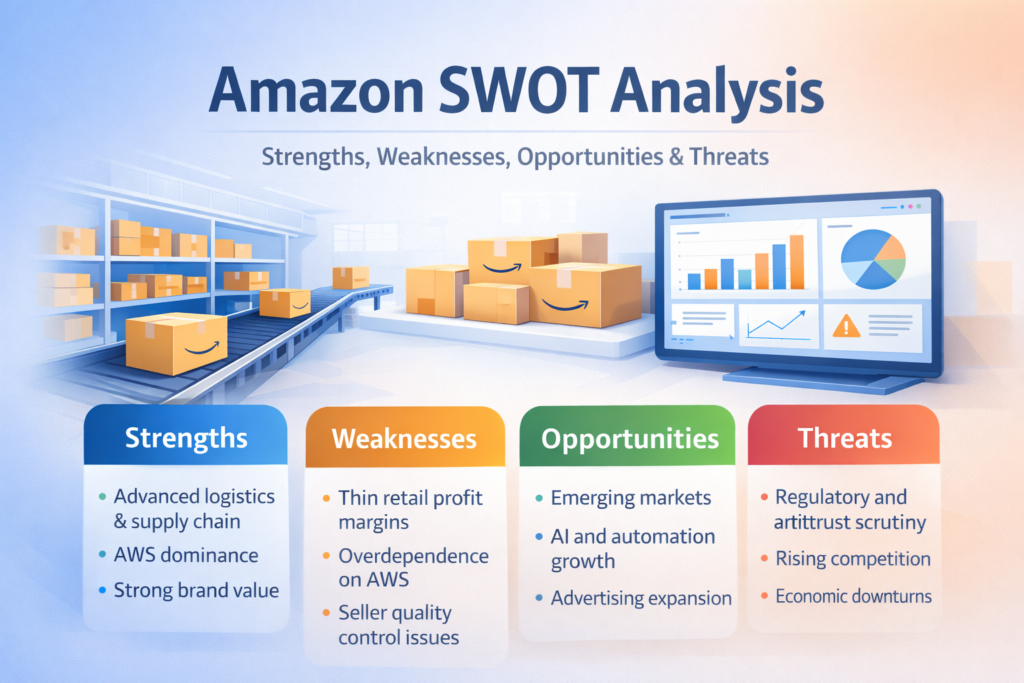
| Strengths | Weaknesses | Opportunities | Threats |
|---|---|---|---|
| Logistics infrastructure | Thin retail margins | Emerging markets | Antitrust regulation |
| AWS profit engine | Overdependence on third-party sellers | AI and automation | Walmart and Alibaba |
| Ecosystem flywheel | Labor and PR issues | Advertising growth | Rising fuel costs |
| Data and personalization | AWS concentration risk | Private label expansion | Counterfeits |
| Brand trust | Operational complexity | Subscription growth | Economic slowdown |
| Revenue diversification | Quality control gaps | Content and streaming | Cybersecurity risks |
Strengths of Amazon
Logistics as a Competitive Moat
Amazon has built one of the most sophisticated logistics networks on the planet. It controls warehousing, last-mile delivery, air freight, and increasingly its own delivery fleet. This is not a support function. It’s a core competitive advantage.
When a customer gets a package in two hours or the next morning, that’s not luck. That’s the result of years of infrastructure investment, algorithmic routing, and fulfillment center placement strategy.
Speed is sticky. Once a customer is conditioned to two-day or same-day delivery, anything slower feels broken. That psychological lock-in is worth more than any loyalty program.
Most Amazon competitors cannot replicate this. Building a fulfillment network at Amazon’s scale takes decades and billions of dollars. That gap is a moat.
The Ecosystem Flywheel
Amazon’s real power isn’t any single product. It’s how every product feeds another.
More customers on the marketplace attract more sellers. More sellers bring more product variety. More variety improves the customer experience. Better experience brings more customers. That loop compounds over time without Amazon having to restart it.
Prime accelerates this further. Once a customer pays for Prime, they are incentivized to buy everything from Amazon to justify the subscription. That drives higher spending, which generates more data, which improves recommendations, which drives more spending.
This is flywheel thinking. Each part of the business makes every other part stronger. It’s what most startups fail to build because they optimize for individual features instead of interconnected systems.
AWS: The Profit Engine Behind the Curtain
Amazon Web Services is the reason Amazon can afford to operate razor-thin margins in retail.
AWS provides cloud computing, storage, and infrastructure to businesses worldwide. It is a high-margin business in a sector with massive and growing demand. As of recent filings, AWS generates the overwhelming majority of Amazon’s operating income even though it represents a smaller share of total revenue.
This matters strategically. Amazon’s retail operation looks almost unprofitable when examined in isolation. But AWS quietly bankrolls the whole thing, funding aggressive logistics expansion, content investment, and market entry into new verticals.
Understanding this is critical. Amazon is not a retail company that also does cloud. It’s a cloud company that uses that margin to subsidize a retail empire.
Data and Personalization at Scale
Amazon tracks everything. Search behavior. Purchase history. Browsing patterns. Time spent on product pages. Wish list additions. Return reasons.
This data feeds recommendation systems that drive a significant portion of Amazon’s total sales. When Amazon surfaces the right product at the right moment, it doesn’t feel like advertising. It feels like a helpful suggestion. That’s what makes it powerful.
Beyond recommendations, this data gives Amazon a strategic advantage over every seller on its platform. Amazon knows which products are trending before sellers do. It knows pricing gaps, demand spikes, and category whitespace. That information is a competitive weapon.
Brand Trust and Customer Obsession
Amazon has built deep customer trust over three decades through consistent execution on a simple promise: fast delivery, easy returns, and a frictionless experience.
Easy returns changed consumer behavior permanently. The willingness to send something back without hassle reduced the psychological risk of buying online. That drove conversion rates up across the entire platform.
Customer obsession, as a stated internal value at Amazon, shapes product decisions in ways that most companies only claim to do. When something breaks in the customer experience, Amazon’s culture is oriented toward fixing it, not defending it.
That trust is an asset that took decades to build and would take competitors decades to replicate.
Diversification Across Revenue Streams
Amazon generates revenue from eCommerce, cloud computing, digital advertising, Prime subscriptions, third-party seller fees, logistics services, grocery, pharmacy, and entertainment.
This diversification reduces risk in a meaningful way. When one segment faces pressure, others absorb the impact. When consumer spending drops, AWS keeps performing. When ad revenue grows, it offsets retail margin compression.
Most companies are dangerously concentrated in one revenue model. Amazon has built an economic structure where multiple high-value businesses coexist and reinforce each other.
Weaknesses of Amazon
Thin Margins in Core Retail
Amazon’s retail business is not a profit machine. Shipping costs, warehouse operations, price competition, and return logistics eat into margins constantly.
The scale of Amazon’s retail business is impressive. The profitability of it, in isolation, is not. Amazon has historically accepted thin or negative retail margins in exchange for market share and customer data.
This works as long as AWS and advertising continue to grow. But it creates structural vulnerability. Amazon cannot afford a simultaneous slowdown in its high-margin businesses and a downturn in retail demand.
Overdependence on Third-Party Sellers
More than half of all units sold on Amazon come from third-party sellers, not Amazon directly.
This creates a quality control problem. Amazon cannot inspect every item from every seller. Counterfeit products, misrepresented listings, and substandard goods regularly surface on the platform. When a customer receives a fake product, they blame Amazon even if Amazon never touched it.
This also creates a marketplace trust issue. The more Amazon depends on outside sellers, the more its brand reputation depends on seller behavior it doesn’t fully control.
Operational Complexity at Scale
Running Amazon’s operation is extraordinarily complex. Millions of SKUs. Hundreds of fulfillment centers. Millions of daily deliveries. Third-party integrations. International regulations. Supply chain variability.
At this scale, small inefficiencies become enormous costs. A 1% error rate across a billion transactions is still ten million errors. Coordination failures compound quickly in a system this large.
Managing this complexity requires massive investment in technology, people, and processes. It is a constant drain on resources and executive attention.
Labor and Workplace Criticism
Amazon has faced sustained criticism over working conditions in its warehouses. High injury rates, intense productivity tracking, limited breaks, and anti-union practices have generated significant negative press and legal challenges.
This creates brand reputation risk. As consumers become more aware of labor practices, purchasing decisions increasingly reflect those values. A company known for mistreating workers faces growing pressure from customers, regulators, and potential employees.
Amazon has also faced unionization efforts at multiple facilities. The outcome of these organizing campaigns will shape labor costs and operational flexibility going forward.
AWS Concentration Risk
AWS generates the profit that subsidizes much of Amazon’s other businesses. That concentration is a risk.
If AWS faces meaningful slowdown from competition, pricing pressure from Microsoft Azure or Google Cloud, or a regulatory challenge, the entire Amazon business model faces pressure. The retail business cannot sustain itself at current investment levels without the margin contribution from AWS.
This is not a theoretical risk. Cloud infrastructure is a competitive space with well-funded rivals making real gains.
Opportunities for Amazon
Emerging Market Expansion
India is the most important growth market for Amazon’s retail business. The country has a massive and growing middle class, rising digital adoption, increasing smartphone penetration, and a large population that is still early in its eCommerce journey.
Amazon has invested heavily in India and continues to build infrastructure there. The long-term potential is significant. Capturing even a fraction of India’s eCommerce growth over the next decade would be a major value driver.
Beyond India, Southeast Asia, Latin America, and parts of Africa represent markets where digital commerce infrastructure is still being built. Early positioning in these markets could yield advantages similar to what Amazon built in the US years ago.
AI and Automation Integration
Amazon is one of the best-positioned companies in the world to benefit from AI and automation advances.
Smart warehouses driven by robotics already operate within Amazon’s network. Predictive logistics, which anticipates demand before orders are placed and pre-positions inventory, is an active area of development. AI-powered demand forecasting reduces overstock and stockout problems.
The integration of AI into customer service, fraud detection, search ranking, and advertising optimization is already underway. Each improvement compounds. A warehouse that’s 10% more efficient at Amazon’s scale saves billions of dollars.
Amazon also has the data advantage needed to train effective AI systems. The feedback loop between data collection and AI improvement is a durable competitive edge.
Advertising Business Growth
Amazon’s advertising business is one of the most underappreciated growth engines in tech.
Advertisers pay to show products to customers who are actively searching for things to buy. That purchase intent makes Amazon’s ad inventory extremely valuable. It competes directly with Google Shopping and is taking meaningful share.
Advertising is a high-margin business. As Amazon’s ad platform grows, it contributes directly to profitability without requiring significant additional infrastructure investment. This is a genuine opportunity to expand margins across the business.
Private Label Expansion
Amazon sells its own branded products across dozens of categories through its private label program. These products typically carry better margins than third-party goods because Amazon cuts out the intermediary.
Private label also gives Amazon supply chain control. Amazon can respond faster to demand shifts, control quality directly, and protect margins even in competitive categories.
The opportunity here is to expand private label into high-value categories where quality assurance matters and margin potential is significant.
Subscription Economy Growth
Amazon Prime is one of the most successful subscription products in history. It bundles shipping, streaming, music, gaming, and storage into a single membership that drives retention and spending.
The opportunity is to deepen this bundle. Adding health services, pharmacy benefits, financial products, or other high-frequency services could increase Prime’s stickiness and revenue per member.
As the subscription economy grows broadly, Amazon is positioned to capture a larger share of household spending by expanding what Prime includes and how central it becomes to daily life.
Content and Entertainment Expansion
Amazon Prime Video has grown into a legitimate streaming competitor. Original content investments have produced award-winning shows and films. Live sports rights are becoming a focus.
The opportunity here goes beyond entertainment. Content drives Prime subscriptions. Prime subscriptions drive retail spending. This means investing in content is ultimately an investment in the retail flywheel.
As traditional TV continues to fragment and streaming competition intensifies, Amazon has both the financial resources and the strategic incentive to play aggressively in this space.
Threats to Amazon
Rising Competition
Walmart has invested heavily in eCommerce and logistics over the past decade. Its combination of physical stores and growing digital infrastructure gives it a real foothold in grocery and general merchandise. Walmart’s scale in physical retail is a genuine competitive asset Amazon cannot easily replicate.
Alibaba and its ecosystem dominate eCommerce in China and have growing international ambitions. Temu and Shein have demonstrated that price-aggressive competitors from Asia can capture meaningful market share quickly, particularly among cost-conscious consumers.
Shopify is enabling independent eCommerce at scale in a way that reduces merchant dependence on Amazon’s marketplace. As Shopify’s fulfillment network grows, it becomes a more direct competitor.
Regulatory and Antitrust Pressure
Amazon faces regulatory scrutiny on multiple fronts in the US and Europe.
Antitrust investigations focus on whether Amazon uses its marketplace data to advantage its own private label products over third-party sellers. This is a legitimate concern that regulators in both Washington and Brussels have examined seriously.
Data privacy regulation is a growing constraint on how Amazon can collect, store, and monetize customer information. GDPR in Europe has already imposed costs and limitations. Similar regulation in the US is increasingly likely.
Any meaningful antitrust action, such as a forced separation of AWS from the retail business or limitations on private label, would fundamentally change Amazon’s economics.
Rising Logistics and Fuel Costs
Amazon’s logistics network is enormous and energy-intensive. Fuel costs directly impact the cost of delivery operations. When fuel prices rise, Amazon’s delivery economics worsen immediately.
Labor costs in fulfillment centers are also rising across the US and globally as minimum wages increase and competition for warehouse workers intensifies. These costs cannot be fully automated away in the near term.
Inflation in logistics inputs is a direct margin pressure that Amazon cannot easily pass on to consumers who are already accustomed to low or free shipping.
Counterfeit and Seller Trust Issues
Counterfeits remain a persistent problem on Amazon’s marketplace. Despite significant investment in brand protection programs, fake products continue to surface in product listings.
This creates trust risk with both customers and brands. Major brands have pulled their products from Amazon or restricted their presence specifically because of counterfeit concerns. If this trend accelerates, Amazon’s product selection advantage erodes.
Customers who receive fake products often share that experience publicly. Enough of these incidents at scale damage the trust that Amazon has spent decades building.
Economic Slowdowns
Amazon is not immune to macroeconomic cycles.
When consumer spending contracts, discretionary eCommerce purchases decline. When businesses tighten technology budgets, AWS growth slows. Both dynamics were visible during periods of economic uncertainty in recent years.
A prolonged recession or sustained period of reduced consumer confidence would put real pressure on Amazon’s revenue growth and make its massive infrastructure investments harder to justify in the short term.
Strategic Insights That Actually Matter
Amazon Is a System, Not a Company
This is the most important thing to understand about Amazon.
It is not a collection of businesses that happen to share a parent company. It is a system where logistics creates customer data, data improves recommendations, recommendations drive sales, sales fund AWS development, AWS revenue funds logistics expansion.
Every part feeds every other part. This is intentional design, not accidental growth. Jeff Bezos drew the flywheel napkin sketch in the early 2000s and the company has been executing against that logic ever since.
Systems thinking is what separates Amazon from competitors who try to compete with individual products or features.
Profit Doesn’t Come From Where You Think
Most people assume Amazon makes money from selling products. It doesn’t. Not really.
AWS and advertising are where Amazon’s profit lives. Retail is a customer acquisition and retention mechanism that happens to also generate revenue. This distinction matters enormously for understanding how Amazon makes decisions.
Amazon can afford to price aggressively, offer free shipping, and absorb return costs in retail because those behaviors build the customer relationship that eventually monetizes through multiple other channels.
If you only look at retail margins, Amazon looks borderline irrational. When you see the full system, it makes complete sense.
Speed Is the Real Product
Amazon doesn’t sell books or electronics or groceries. Amazon sells speed and convenience.
The product is the experience of wanting something and having it appear at your door faster than you thought possible. Everything else, the selection, the price, the recommendations, is in service of that core promise.
This reframing matters because it explains why Amazon invests so heavily in logistics rather than in product development. The logistics network is the product. The faster it gets, the better the product.
Flywheel Thinking Beats Growth Hacks
Amazon does not chase growth tactics. It builds compounding systems.
Growth hacks produce spikes. Flywheels produce compounding. The difference over a decade is enormous. Amazon’s Prime membership, its seller ecosystem, its AWS customer base, these all compound over time in ways that a promotional campaign or a feature launch never can.
For any business studying Amazon, this is the most transferable lesson. Stop optimizing individual channels. Start building systems where each part makes every other part stronger.
What Founders Should Actually Learn From Amazon
Build moats, not features. A feature can be copied in weeks. A logistics network, a data advantage, or an ecosystem takes years to build and is nearly impossible to replicate quickly.
Obsess over customer experience. Not superficially. Structurally. Amazon’s easy return policy wasn’t just customer-friendly. It was strategically designed to reduce purchase friction, which increased conversion rates, which increased transaction volume, which generated more data. Every customer-friendly policy has a strategic logic behind it.
Create interconnected products. Single-product businesses are fragile. Amazon built a web of products where each one reinforces the others. Aim for the same structure, even at a small scale.
Think in decades, not quarters. Amazon accepted losses for years because Bezos believed the long-term payoff justified the short-term pain. That kind of conviction requires a clear strategic vision and the patience to execute against it.
The most practical takeaway for founders: don’t try to build the next Amazon. Instead, study how Amazon built itself in one category first, books, and ask what that kind of focused, system-oriented thinking looks like in your niche.
Amazon’s Position Today
Amazon remains the dominant force in global eCommerce and cloud computing. Its logistics network, AWS business, and Prime ecosystem give it durable advantages that will not erode quickly.
But the pressure is real. Regulatory scrutiny is intensifying. Competition from Walmart, Temu, and specialized eCommerce players is growing. Labor costs are rising. AWS is facing genuine competition from Microsoft and Google.
Amazon’s future depends on three things: how well it integrates AI into its operations, how effectively it expands logistics efficiency, and whether its ecosystem continues to hold customers who have more alternatives than ever before.
The company that wins long-term will be the one that keeps its systems compounding while managing the regulatory and competitive friction that comes with operating at this scale.
FAQs
Amazon’s biggest strengths are its logistics infrastructure, the AWS profit engine, its ecosystem flywheel, and deep customer trust built over three decades. The combination of these creates a system that is very difficult to replicate.
AWS generates the majority of Amazon’s operating profit. It is the high-margin business that funds Amazon’s aggressive investment in retail, logistics, and content. Without AWS, Amazon’s thin retail margins would make its current investment levels unsustainable.
Amazon’s primary weaknesses include thin retail margins, dependence on third-party sellers for product quality control, labor and workplace criticism, and the concentration of profitability in AWS, which creates risk if cloud demand slows.
In eCommerce, Walmart, Temu, and Shopify-powered merchants are the most significant competitors. In cloud computing, Microsoft Azure and Google Cloud are direct rivals. In advertising, Google and Meta compete for the same marketing budgets.
The most important lessons are flywheel thinking over growth hacks, moat-building over feature-copying, long-term orientation over quarterly optimization, and designing interconnected products rather than standalone offerings. Study the system, not the surface.
Discover more from Business Model Hub
Subscribe to get the latest posts sent to your email.