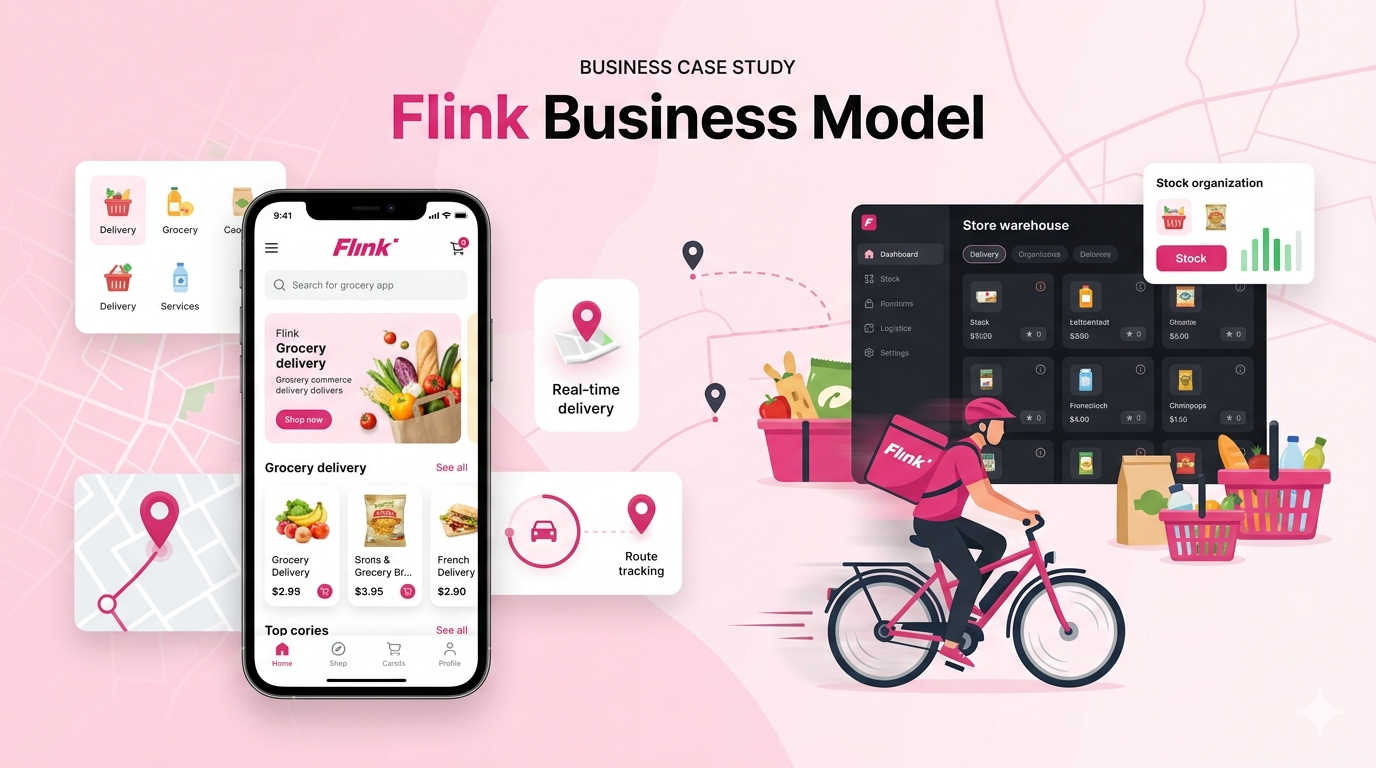

Flink is one of Europe’s fastest-growing quick-commerce companies. It delivers groceries and daily essentials to your door in minutes, not hours. Built around speed and convenience, Flink has reshaped how urban consumers think about grocery shopping.
The company runs a lean, tech-driven model using dark stores, hyperlocal logistics, and a mobile app that makes ordering simple. Flink earns money through product margins, delivery fees, brand partnerships, and subscription programs.
This blog breaks down exactly how Flink operates, how it generates revenue, and what makes its business model work.
What Is Flink?
Flink is a quick-commerce startup that delivers groceries and daily essentials within minutes using dark stores and hyperlocal logistics.
Founded in Germany, Flink launched with a clear goal: eliminate the friction of traditional grocery shopping. Instead of heading to a supermarket, users open the Flink app, place an order, and receive their groceries in under 15 minutes.
Flink operates across multiple European markets and positions itself as a convenience-first platform for urban consumers. The app covers everything from fresh produce to household products, all available on demand.
Core traits of the Flink model:
- Ultra-fast delivery powered by dark stores
- Mobile-app-based ordering with real-time tracking
- Hyperlocal fulfillment using neighborhood-level warehouses
- Focus on dense urban markets with high delivery demand
Flink Company Overview
| Detail | Info |
|---|---|
| Founded | 2020 |
| Headquarters | Berlin, Germany |
| Industry | Quick Commerce, Grocery Delivery |
| Business Type | B2C, Inventory-Led Commerce |
| Key Markets | Germany, Netherlands, France, Austria |
| Funding | Over $1 billion raised |
| Key Investors | Rewe Group, Bond Capital, DoorDash |
| Main Competitors | Getir, Gorillas, GoPuff, Blinkit, Zepto |
Flink grew rapidly after launch, attracting major venture capital investment and strategic backing from Rewe Group, one of Germany’s largest grocery retailers. That partnership gave Flink supply chain advantages most competitors lacked from day one.
What Problem Does Flink Solve?
Flink solves the inconvenience of traditional grocery shopping by offering near-instant delivery for everyday needs.
Traditional grocery shopping has real friction points. Long checkout lines, out-of-stock items, travel time, and the mental load of planning a store visit all add up. For urban consumers, especially those without cars, a quick grocery run can take 45 minutes or more.
Flink targets situations where convenience matters most:
- Forgot an ingredient mid-recipe
- Need household supplies without leaving the house
- Restocking snacks, drinks, or essentials last-minute
- Avoiding crowds during peak hours
The demand for on-demand commerce has grown steadily. Urban consumers, especially younger demographics, increasingly expect services to work around their schedule, not the other way around. Flink built its entire model around that expectation.
How Flink Works
Flink uses dark stores, local inventory hubs, and delivery riders to fulfill orders within minutes.
The operational model is built for speed at every step. Here is how a typical Flink order flows from tap to doorstep:
Step-by-step order process:
- User opens the app and browses available products by category
- Order is placed and instantly routed to the nearest dark store
- In-store staff (pickers) locate and pack the order in under two minutes
- A delivery rider receives the packed order and departs
- Delivery is completed typically within 10 to 15 minutes
Dark Stores
Dark stores are small, closed warehouses located inside dense neighborhoods. They look nothing like regular stores. There are no customers walking in, no retail displays, no checkout counters. Everything is optimized for picker speed and inventory turnover.
Flink places dark stores strategically within specific delivery radius zones. Each store covers a defined geographic area to keep delivery times short.
Inventory Management
Flink carries a curated SKU count, typically a few thousand products, compared to tens of thousands at a traditional supermarket. This makes inventory easier to manage, reduces waste, and speeds up the picking process.
Products are restocked based on demand data, time of day, and local buying patterns.
Last-Mile Logistics
Flink uses a mix of employed and contracted riders, typically on e-bikes or scooters. Riders are dispatched efficiently using route-optimization software that factors in distance, traffic, and order volume in real time.
Flink Business Model Explained
Flink operates a quick-commerce, inventory-led delivery business model focused on urban hyperlocal fulfillment.
Unlike marketplace models where third-party sellers fulfill orders, Flink owns its inventory. It buys products directly, stores them in dark stores, and controls the entire delivery chain. This gives Flink more control over quality and speed but also means it carries more operational risk.
Core Model Components
Inventory-led commerce: Flink purchases and holds its own stock. Revenue comes from the markup between wholesale purchase price and the retail price customers pay.
Hyperlocal fulfillment: Dark stores are placed within 1 to 2 kilometers of target customer clusters. Proximity is the core logistics advantage.
App-driven ecosystem: The mobile app is the single touchpoint for ordering, payment, tracking, and customer communication. This creates a direct data pipeline on user behavior.
Fast delivery infrastructure: Speed is the primary value proposition. The entire cost structure, from store placement to staffing ratios, is designed to protect delivery time targets.
Unit Economics Challenges
Flink’s model is operationally intensive. Rider costs, dark store leases, and inventory holding costs create significant fixed and variable expenses. The average order value in quick commerce is often lower than traditional delivery platforms, which compresses margin per transaction.
Customer retention is critical. Flink needs high order frequency per user to justify acquisition costs and maintain profitability at the unit level.
Flink Revenue Model
Flink makes money through grocery margins, delivery charges, subscriptions, and brand partnerships.
Product Margins
The primary revenue source is the markup on grocery and FMCG (fast-moving consumer goods) products. Flink buys in bulk from suppliers and sells at retail-equivalent prices through the app.
Margins on groceries are typically thin, ranging from 10% to 30% depending on category. Fresh produce carries different margin profiles than packaged goods. Flink looks to build private-label products over time, which carry significantly higher margins than branded alternatives.
Delivery Fees
Flink charges delivery fees on orders below a minimum basket size. This nudges customers toward larger orders while generating additional revenue on smaller ones.
There is also potential for surge pricing during peak demand windows, though this varies by market and competitive pressure.
Subscription Programs
Flink has tested and offered subscription plans that give members free delivery in exchange for a monthly fee. These programs serve two purposes:
- Generate predictable recurring revenue
- Increase order frequency by removing per-order friction
Subscribers tend to order more often, improving lifetime value and making customer acquisition costs easier to justify.
Brand Partnerships
Flink’s app is a retail media channel. FMCG brands pay for sponsored product placements, featured positioning, and in-app promotional campaigns.
This is an increasingly important revenue stream. Brands want access to Flink’s high-intent purchase environment, and Flink can monetize its platform beyond just product margins.
Types of brand partnership revenue:
- Sponsored listings and search placements
- Promotional bundle deals and featured collections
- In-app banner advertising
- Co-branded campaign activations
Data and Consumer Insights
Flink captures granular data on purchasing behavior, product preferences, order timing, and basket composition. This data has commercial value for brands looking to understand real-time consumer trends in specific urban markets.
While not a widely publicized revenue stream, retail analytics and consumer intelligence represent a growing monetization layer for platforms like Flink.
Flink Business Model Canvas
Key Partners
- Grocery and FMCG suppliers
- Rewe Group (strategic investor and supply partner)
- Delivery fleet partners and rider networks
- Payment processors and fintech providers
- App stores and digital marketing platforms
Key Activities
- Inventory purchasing and management
- Dark store operations and staffing
- Last-mile delivery logistics
- Customer acquisition and retention
- App development and product improvement
Key Resources
- Dark store network and lease infrastructure
- Proprietary technology and logistics platform
- Delivery rider workforce
- Supplier relationships and procurement contracts
- Consumer data and behavioral analytics
Value Propositions
- Grocery delivery in under 15 minutes
- Convenient, app-based shopping experience
- Fresh and curated product selection
- No-trip-required replenishment for daily essentials
Customer Relationships
- Push notifications for promotions and order updates
- Loyalty rewards and repeat-order incentives
- In-app customer support and refund handling
- Subscription programs for high-frequency users
Channels
- iOS and Android mobile app (primary)
- Website for browsing and account management
- Paid digital advertising on social and search
- Referral and word-of-mouth programs
Customer Segments
- Urban professionals with limited time
- Students and young adults in city centers
- Busy households needing frequent restocking
- Convenience-first shoppers in dense metro areas
Cost Structure
- Rider salaries, wages, and compensation
- Dark store leases and facility operations
- Inventory purchasing and holding costs
- Technology infrastructure and app development
- Marketing and customer acquisition spend
- Administrative and regulatory compliance costs
Revenue Streams
- Product sales and grocery margins
- Delivery fees
- Subscription membership revenue
- Brand partnerships and retail media
- Consumer data and analytics (emerging)
Why Flink Grew So Fast
Flink scaled quickly due to a perfect combination of changing consumer behavior, pandemic-driven demand, and aggressive venture capital funding.
Pandemic Acceleration
COVID-19 shifted grocery shopping behavior dramatically. Lockdowns, social distancing, and health concerns made in-store shopping difficult. Consumers who had never ordered groceries online tried it for the first time, and many never fully returned to old habits.
Flink launched into this environment and captured demand that was already building.
Urban Convenience Trend
Quick commerce is fundamentally an urban product. Dense city neighborhoods, high smartphone penetration, and a concentration of convenience-oriented demographics made European cities ideal launch markets.
Berlin, Amsterdam, Paris, and Vienna all have the population density and infrastructure Flink needed to make its logistics model economically viable.
Venture Capital Fuel
Flink raised over $1 billion in funding across multiple rounds. That capital funded aggressive expansion, dark store buildout, rider hiring, and customer acquisition through discounts and promotions.
The quick-commerce space attracted massive VC investment globally between 2020 and 2022, and Flink was one of the primary European beneficiaries.
Mobile-First Consumer Habits
Younger urban consumers are comfortable making purchases entirely through a smartphone. Flink’s app-first model aligned perfectly with how its core demographic already shops, communicates, and manages daily life.
Flink Marketing Strategy
Flink uses a mix of performance marketing, referral incentives, and hyperlocal tactics to acquire and retain customers.
Referral programs: Flink has offered credits and discounts for users who refer friends, turning existing customers into acquisition channels.
Discount campaigns: First-order discounts and limited-time promotions drive app downloads and first purchases. These are standard acquisition tools in the quick-commerce space.
App store optimization: Flink invests in visibility on the App Store and Google Play, particularly in categories related to grocery delivery and food ordering.
Retention notifications: Push notifications are used strategically to remind users to reorder, alert them to promotions, and reduce churn among lapsed users.
Hyperlocal advertising: Flink runs geo-targeted digital ads in neighborhoods close to its dark stores, focusing marketing spend on areas where it can actually fulfill orders efficiently.
Flink Competitive Advantages
Flink’s biggest advantage is delivery speed combined with localized inventory systems and strategic supplier backing.
Dark Store Proximity
Placing dark stores inside target neighborhoods rather than on city outskirts is what makes sub-15-minute delivery possible. This requires significant real estate investment but creates a logistics barrier that is hard for traditional grocery retailers to replicate quickly.
Rewe Group Partnership
Having a major grocery retailer as both an investor and supply partner gives Flink procurement advantages, established supplier relationships, and credibility in the European grocery market. This is a structural advantage competitors without similar backing do not have.
Curated Inventory Model
Fewer SKUs means faster picking, less waste, and more efficient restocking. Flink does not try to compete with a supermarket on breadth. It competes on speed and convenience for the most commonly purchased items.
Technology-Driven Logistics
Flink’s route optimization, inventory forecasting, and demand prediction tools are core operational assets. Better technology means faster deliveries, fewer stockouts, and lower waste, all of which improve unit economics over time.
Challenges in Flink Business Model
Quick commerce is operationally complex and expensive. Flink faces real structural challenges.
High burn rate: Scaling dark stores, hiring riders, and offering discounts requires ongoing capital. Profitability has been elusive for most players in the space.
Rider management costs: Delivery riders are the most visible cost line. Managing a large, distributed workforce with fluctuating demand is operationally challenging and increasingly subject to labor regulations across European markets.
Thin grocery margins: Groceries are not a high-margin category. Earning meaningful profit on a basket of everyday items requires high order volume and operational efficiency that takes time to build.
Competitive pressure: Getir, Gorillas, GoPuff, and regional players all compete for the same urban consumer. Competitive discounting and promotion wars erode margins across the board.
Customer acquisition costs: Getting someone to download the app and place a first order is expensive. Converting that user into a loyal, frequent customer is the real challenge.
Regulatory environment: Rider classification, labor protections, and gig economy regulations vary by country and are evolving. This adds compliance complexity and potential cost increases across Flink’s markets.
Flink vs Traditional Grocery Stores
| Feature | Flink | Traditional Grocery |
|---|---|---|
| Delivery Speed | Under 15 minutes | Hours or next day |
| Shopping Method | Mobile app | In-store or online |
| Convenience Level | Very high | Moderate |
| Inventory Model | Dark stores | Retail stores |
| Product Range | Curated (few thousand SKUs) | Broad (tens of thousands) |
| Customer Experience | App-based, contactless | Physical browsing |
| Pricing | Market-rate with delivery fees | Lower base price, no delivery |
| Availability | Urban areas only | Widespread |
Flink Competitors
The quick-commerce space is crowded. Flink competes with well-funded rivals across Europe and globally.
Getir: The Turkish quick-commerce giant that expanded aggressively across Europe. One of Flink’s most direct competitors in overlapping markets.
Gorillas: A Berlin-based competitor that ran a very similar model. Gorillas was eventually acquired by Getir, consolidating competition in the European market.
GoPuff: A US-based quick-commerce platform that expanded into European markets. Focuses on convenience and household essentials alongside groceries.
Blinkit: Formerly Grofers, Blinkit is the dominant quick-commerce player in India. While not a direct geographic competitor, it represents the global scale the category can reach.
Zepto: Another India-based quick-commerce startup operating a 10-minute delivery model similar to Flink’s European approach.
The consolidation of Gorillas into Getir signals that the quick-commerce space is maturing. Weaker players are exiting, and the survivors are those with the best unit economics and market positioning.
Is Flink Profitable?
Flink focuses heavily on growth, but profitability remains a significant challenge across the quick-commerce category.
Grocery margins are structurally thin. When you layer in rider costs, dark store leases, technology infrastructure, and marketing spend, reaching profitability at scale requires high order volume per dark store and strong average basket values.
Key profitability pressure points:
- Low margin per product category (especially fresh goods)
- High fixed costs from dark store real estate
- Variable rider costs that scale with every order
- Ongoing customer acquisition spend in competitive markets
- Discounting and promotions that erode revenue per order
Flink, like most quick-commerce players, has been in growth mode rather than profit mode. Investor expectations have historically prioritized market share over near-term profitability. That dynamic is shifting as capital becomes more expensive and investors demand clearer paths to sustainable economics.
The companies that will survive in quick commerce are those that can improve order density per dark store, grow basket sizes, build subscription revenue, and reduce reliance on discounting to drive retention.
Lessons Startups Can Learn From Flink
Convenience drives retention more than price. Flink’s stickiest customers are not the ones who downloaded the app for a discount. They are users who experienced the speed and integrated it into their routine.
Logistics infrastructure can become a competitive moat. Building a dark store network inside urban neighborhoods takes time, capital, and operational expertise. Once established, it is difficult for competitors to replicate quickly.
Speed is a product feature, not just a metric. In quick commerce, delivery time is the core value proposition. Every operational decision, from store placement to picker workflow to rider routing, is in service of protecting that promise.
Hyperlocal operations improve efficiency. Serving smaller geographic zones allows Flink to optimize inventory for local demand patterns, reduce delivery distances, and improve service reliability.
Growth without a path to profitability is risky. Flink’s rapid expansion was impressive, but the broader quick-commerce market has shown that scaling at all costs without sustainable unit economics leads to exits, acquisitions, or shutdowns.
Future of Flink
Flink’s future depends on sustainable logistics, operational efficiency, and market consolidation playing in its favor.
AI-Driven Logistics
Machine learning tools for demand forecasting, inventory optimization, and rider routing will become increasingly important. Companies that use data well will outperform on cost and delivery speed simultaneously.
Automation in Dark Stores
Automated picking systems and robotic warehouse technology are being explored across the quick-commerce space. Reducing the labor intensity of order fulfillment would meaningfully improve unit economics.
Private Label Expansion
Building out Flink-branded products in high-frequency categories like snacks, beverages, and household essentials would boost margins significantly without changing the customer experience.
Market Consolidation
The quick-commerce sector is consolidating. Flink’s strategic positioning, backed by Rewe Group and with a strong presence in Germany and the Netherlands, makes it a survivor candidate in that consolidation process.
Profitability Optimization
The next phase for Flink will be about efficiency, not just growth. That means reducing cost per delivery, improving order density, growing subscription revenue, and finding the right balance between market coverage and operational sustainability.
Wrapping Up
Flink built a compelling business around one simple idea: people want their groceries now, not later. The dark store model, the hyperlocal logistics, and the app-first experience all serve that central promise.
The business model generates revenue through product margins, delivery fees, subscriptions, and brand partnerships. The challenges are real, including thin margins, high operational costs, and fierce competition. But the structural demand for convenience-first commerce is not going away.
Quick commerce as a category is maturing. The players who survive will be those who can turn speed into a sustainable, profitable business, not just a growth story. Flink has the backing, the infrastructure, and the market position to be one of them.
Whether it gets there depends on execution, efficiency, and how the European quick-commerce market continues to consolidate.
Discover more from Business Model Hub
Subscribe to get the latest posts sent to your email.