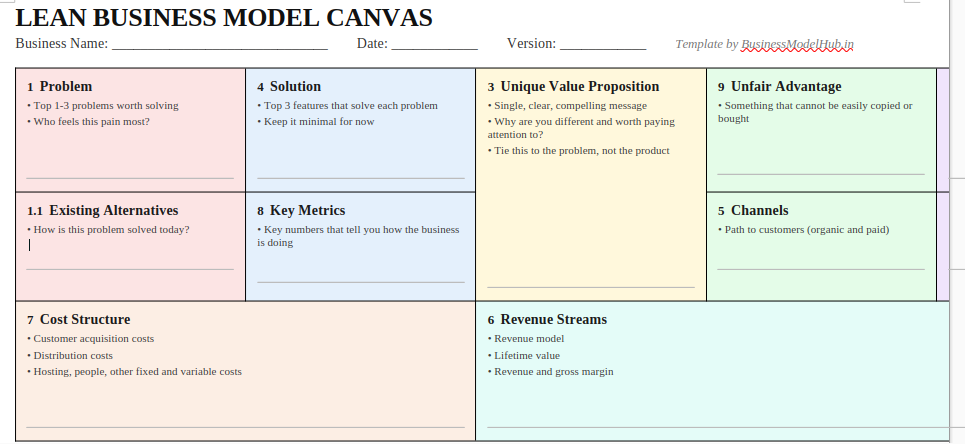

A lean business model canvas is a one-page plan that replaces a 40-page business plan with nine boxes: problem, solution, customer segments, unique value proposition, channels, revenue streams, cost structure, key metrics, and unfair advantage. Fill it in an hour, revise it every time you learn something new, and use it to test a business idea before writing a single line of code.
Download the free, ready-to-fill Lean Canvas template above. It works in Word, Google Docs, and most PDF editors.
What is a lean business model canvas?
The lean canvas is a one-page business planning tool created by Ash Maurya, adapted from Alexander Osterwalder’s original Business Model Canvas. It swaps out four boxes that fit big companies (key partners, key activities, key resources, customer relationships) for four boxes that fit early-stage startups (problem, solution, unfair advantage, key metrics). The result is a template built for speed and validation, not for looking impressive in an investor binder.
Why founders use the lean canvas instead of a full business plan
| Traditional business plan | Lean canvas |
|---|---|
| Takes weeks to write | Takes about an hour |
| Assumes you already know the answers | Forces you to state and test assumptions |
| Rarely gets revisited | Meant to be rewritten as you learn |
| Focuses on financial projections | Focuses on problem-solution fit |
| One long document | One page, nine boxes |
The nine boxes, explained
1. Problem
List the top one to three problems your customer actually has. Note how they solve this problem today, even if the current solution is a spreadsheet, a competitor, or doing nothing.
2. Customer Segments
Who has this problem? Get specific. “Small business owners” is a category, not a customer segment. “Solo bookkeepers running three or more client accounts on QuickBooks” is a customer segment. Note your early adopters separately since they behave differently from the mainstream market.
3. Unique Value Proposition
One clear sentence that explains why you’re different and worth switching to. This is the box most founders get wrong by describing features instead of outcomes. A useful test: could a customer repeat your value proposition back to a friend after hearing it once?
4. Solution
Only after problem and customer segments are defined do you list your top three features. This order matters. Building the solution box first is how founders end up with a product nobody asked for.
5. Channels
How will customers find you? List both free channels (SEO, referrals, communities) and paid channels (ads, sponsorships). Early on, one channel that works beats five channels that don’t.
6. Revenue Streams
How does the business make money? Subscription, one-time sale, commission, freemium, usage-based. Note pricing if you have a hypothesis, and how it ties to customer lifetime value.
7. Cost Structure
List customer acquisition cost, distribution cost, hosting, and team cost. This box keeps the rest of the canvas honest. A business model with high acquisition cost and low customer lifetime value is a warning sign, not a detail to fix later.
8. Key Metrics
The two or three numbers that tell you if the business is actually working. For a subscription product this might be activation rate and monthly churn. Vanity metrics like total signups belong on a dashboard, not here.
9. Unfair Advantage
Something a competitor cannot easily copy or buy: proprietary data, a unique network, deep domain expertise, or a regulatory position. Most early-stage companies leave this box blank at first, and that’s fine. It’s the hardest box to fill honestly.
How to fill out a lean canvas in the right order
Fill the boxes in this sequence, not left to right:
- Problem
- Customer Segments
- Unique Value Proposition
- Solution
- Channels
- Revenue Streams
- Cost Structure
- Key Metrics
- Unfair Advantage
This order forces you to understand the customer’s pain before you propose a fix, and it stops you from designing a solution around a problem that was never validated.
Lean canvas vs business model canvas: what’s the difference?
Both are one-page strategy tools built on the same nine-box structure, but they answer different questions.
- The Business Model Canvas (Osterwalder) is built for existing or well-understood businesses. It includes key partners, key activities, key resources, and customer relationships, boxes that assume a working business model already exists.
- The Lean Canvas (Maurya) is built for new ventures with unresolved risk. It replaces those four boxes with problem, solution, key metrics, and unfair advantage, boxes that force you to test assumptions before scaling.
If you’re validating a new idea, use the lean canvas. If you’re mapping how an established company creates and captures value, use the business model canvas.
Common mistakes to avoid
- Writing the solution box first. Features without a validated problem produce guesses, not a business.
- Vague customer segments. “Everyone” is not a customer segment.
- Treating the canvas as a one-time exercise. The canvas is a living document. Revisit it after every round of customer interviews or every pricing test.
- Skipping the unfair advantage box out of discomfort. Leave it blank rather than filling it with something generic like “our team” or “our passion.”
FAQs
How long should filling out a lean canvas take?
About 20 minutes for a first draft. Don’t overthink individual boxes on the first pass; treat it as a hypothesis you’ll refine.
Can I use a lean canvas for a non-tech business?
Yes. The framework applies to service businesses, physical products, and agencies as well as software startups.
Should each product have its own canvas?
Yes, if you’re testing multiple ideas or multiple customer segments, use a separate canvas for each combination. A single business with three distinct customer segments may need three canvases.
What comes after the lean canvas?
Once your riskiest assumptions are validated, most teams move to a more detailed go-to-market plan or a full business model canvas for the parts of the business that have stabilized.
Discover more from Business Model Hub
Subscribe to get the latest posts sent to your email.