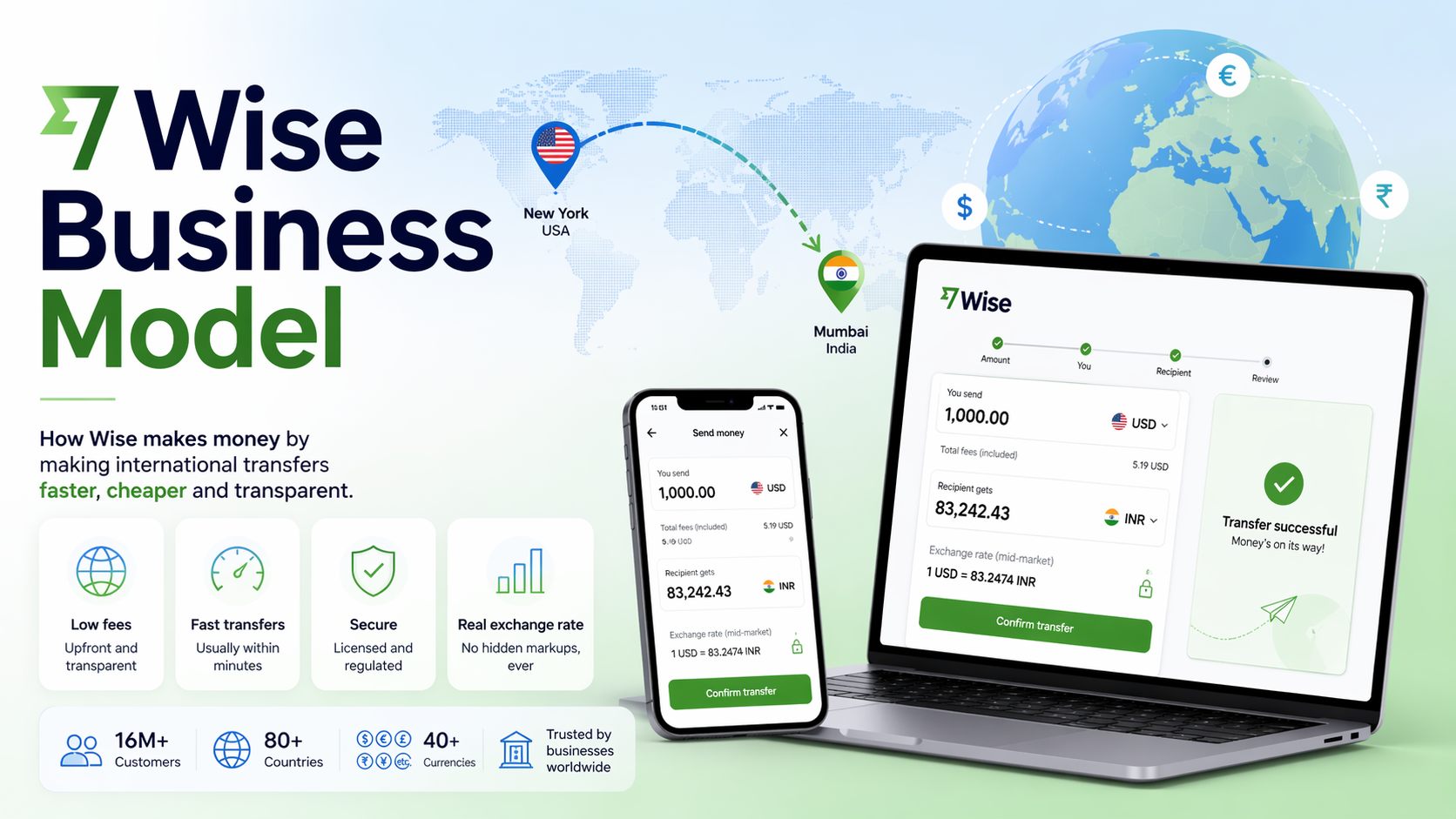

Wise plc runs on a low-cost, transparent money transfer model. Instead of routing funds through expensive traditional banking systems, it uses a peer-to-peer currency matching system that sidesteps high forex fees entirely. Revenue comes from small, upfront transaction fees and minimal currency conversion margins.
No hidden charges. No surprise deductions. Just a clear fee shown before you confirm the transfer.
That’s the whole pitch. And it works.
About Wise: The Company Behind the Model
Wise plc, originally called TransferWise, was founded in 2011 by two Estonians living in London: Taavet Hinrikus and Kristo Käärmann. Both were dealing with the same frustration: getting paid in one currency while living in another, and losing money every time to bank fees.
Headquarters: London, UK
Core offering: International money transfers and multi-currency accounts
Users: Millions of individuals and businesses across 160+ countries
The founding idea was dead simple. Stop letting banks charge people 4% to move their own money across borders. Give people the real exchange rate. Charge a small, honest fee. Build trust by being upfront.
That simplicity became a multi-billion dollar company.
Wise went public on the London Stock Exchange in July 2021 via a direct listing, reaching a valuation of around $11 billion. As of recent financials, Wise processes over $100 billion in cross-border transfers annually.
The Core Problem Wise Solves
To understand the Wise business model, you need to understand what it’s pushing against.
Here’s what traditional banks do when you send money internationally:
They use SWIFT, the global messaging network that connects banks. Your money hops from one bank to another, often through correspondent banks, with each one skimming a fee. By the time the money arrives, you’ve paid a wire transfer fee, a receiving fee, and a foreign exchange markup that’s quietly baked into the exchange rate.
Most banks charge an FX markup of 2% to 5% over the mid-market rate. They don’t call it a fee. They call it “the exchange rate.” That’s the trick.
On top of that, transfers can take two to five business days. Sometimes longer.
What customers actually want:
Wise figured out early that people sending money abroad don’t care about fancy banking. They’re not looking for investment portfolios or premium rewards programs. They want:
- The real exchange rate
- A low, visible fee
- Fast delivery
- A simple interface
That gap between what banks offer and what customers actually want is exactly where Wise built its business.
How Wise Works: The Core Mechanism
This is where the Wise model gets genuinely clever. Most people assume Wise sends your money from one country to another. It mostly doesn’t.
The Local-to-Local Transfer Model
Wise operates pools of money in bank accounts across multiple countries. When you initiate a transfer, here’s what actually happens:
Say you want to send $1,000 from the US to someone in India.
- You deposit $1,000 into Wise’s US bank account
- Wise pays your recipient from its Indian rupee account in India
- At the same time, someone else is sending rupees to the US
- That person’s rupees fund Wise’s Indian account, and their US dollars come from Wise’s US account
The money barely crosses any border. What crosses is information. Wise is matching flows of currency in opposite directions, netting them out internally.
This is called the local-to-local transfer model, and it’s the structural foundation of everything Wise does cheaply.
Why This Changes Everything
Traditional international transfers rely on correspondent banking relationships. Each handoff costs money, adds time, and introduces exchange rate risk.
Wise bypasses most of that. By keeping funds local and matching transfers internally, it avoids:
- SWIFT fees
- Correspondent bank markups
- Currency conversion at every hop
- Multi-day settlement delays
The result is transfers that often arrive same-day or within hours, at a fraction of what a traditional bank charges.
This isn’t just a smarter app. It’s a fundamentally different infrastructure model.
Wise Business Model Breakdown
Revenue Streams
Wise makes money in a few clearly defined ways. There’s no mystery about it, and that transparency is actually part of the business strategy.
Transfer Fees
This is the primary revenue driver. Every time you send money, Wise charges a small percentage-based fee. The exact percentage varies by currency corridor and transfer amount, but it’s always displayed upfront before you confirm.
For common routes like USD to GBP or EUR to USD, fees are often well under 1%. For less common or higher-risk corridors, fees are slightly higher. But they’re always visible and always competitive against bank alternatives.
Currency Conversion Margin
Wise uses the mid-market rate, also called the interbank rate. This is the “real” exchange rate you see on Google. Most competitors add a hidden markup of 2% to 5% on top of this rate to quietly profit.
Wise does charge a small conversion margin in some cases, but it’s fractional compared to traditional banks and it’s disclosed. On many transfers, users get exactly the mid-market rate with only the upfront fee applied.
Wise Business Accounts and APIs
Wise has a strong and growing B2B revenue line. Businesses can open Wise accounts, hold multiple currencies, pay international vendors, and manage payroll across borders. These accounts often come with slightly higher fees or subscription tiers.
The Wise Platform is an API product that lets banks, fintechs, and enterprises plug into Wise’s payment infrastructure. This is white-label infrastructure. A bank can offer Wise-powered international transfers under its own brand. This segment is growing fast and carries strong margins.
Debit Cards and Account Services
The Wise debit card lets users spend in local currencies wherever they are, pulling from whichever currency balance is cheapest at that moment. Wise earns interchange fees from card transactions, similar to how most debit card issuers make money.
There are also fees for some account features like ATM withdrawals beyond a free monthly limit, expedited transfers, and certain currency conversions within accounts.
Key Products
Wise Account
A multi-currency wallet that lets you hold money in 50+ currencies. Think of it as a bank account that speaks every language. You get local bank details in major currencies including USD, GBP, EUR, AUD, and more, which means you can receive payments like a local in those markets.
International Transfers
The original and still core product. Send money to 160+ countries using the local-to-local matching system. Fast, transparent, cheap.
Wise Business
A separate product tier for companies. Includes batch payments, accounting integrations, team access controls, and higher transfer limits. Designed for freelancers running their own show up to mid-sized companies paying international teams.
Wise Debit Card
A physical and virtual card linked to your Wise account. Spend in any currency without conversion fees up to certain limits. The card automatically uses the best available currency balance.
Wise Platform
The B2B infrastructure product. Banks and fintechs integrate Wise’s rails into their own products. This is Wise operating as infrastructure-as-a-service for the financial industry. Major partnerships include banks in Europe, Asia, and North America.
Customer Segments
Freelancers and Remote Workers
A massive segment. Anyone who works internationally and gets paid in foreign currencies benefits enormously from Wise. Getting paid in USD while living in Brazil or receiving EUR while based in Southeast Asia used to mean losing 3% to 5% on every payment. Wise brings that down to under 1%.
Expats and Immigrants
People who live abroad and send money home regularly. Remittances are a huge global market, estimated at over $800 billion annually. Even small fee reductions per transfer add up to significant savings over a year.
Small and Mid-Sized Businesses
Companies that pay international suppliers, contractors, or employees. Every international payment through a traditional bank costs more and takes longer. Wise cuts both.
Global Enterprises and Fintechs
Through the Wise Platform API, larger organizations embed Wise’s infrastructure into their own products. This is the fastest-growing customer segment and the one with the highest revenue potential per account.
Why Wise Is So Cheap: The Real Cost Advantages
Price transparency is the marketing. But what actually makes the price low is infrastructure design.
No SWIFT Dependency
SWIFT is the dominant system for international bank transfers. It works, but it’s slow and expensive because it involves multiple intermediary banks, each of which charges fees. Wise mostly avoids SWIFT entirely for its matching-based transfers.
Local Banking Rails
Instead of routing money internationally, Wise maintains accounts in local banking systems around the world. Domestic transfers within a country are fast and cheap. Wise turns most international transfers into domestic ones by matching opposite flows.
Automation and Low Operational Overhead
Wise is heavily automated. The compliance checks, currency matching, and payment routing are largely algorithmic. This keeps headcount low relative to transaction volume, which is unusual for a company processing over $100 billion annually.
No physical branches. No teller windows. No paper-based processes.
Regulatory Licenses, Not Banking Charters
Wise isn’t a bank in most markets. It holds money transmitter licenses and e-money institution licenses, which are lighter regulatory frameworks. This reduces capital requirements and compliance overhead while still allowing it to move money legally across borders.
In the US, Wise is licensed as a money services business in all 50 states. In the EU, it holds an e-money institution license. This structure keeps costs down compared to maintaining full banking charters everywhere.
How Wise Grew: The Growth Strategy
Wise didn’t scale through traditional advertising. Its growth strategy was built on a different foundation.
Word-of-Mouth and Trust
The early growth was almost entirely organic. When you save someone $200 on a transfer, they tell their friends. Expat communities, immigrant networks, freelancer forums all spread the word. Wise’s early marketing budget was tiny because its product was the marketing.
The company leaned into this deliberately. It encouraged users to share their savings. It made the comparison against bank fees easy and visible on its website.
Radical Transparency as a Marketing Strategy
Wise publishes its fee structure in full, including a live comparison against what competitors charge for the same transfer. This is counterintuitive marketing. Most companies hide their fees. Wise puts them center stage.
This transparency builds trust, which is especially important in financial services where people are handing over real money. When users see that Wise shows them exactly what they’ll pay and the comparison looks good, conversion happens naturally.
The pricing calculator on the Wise homepage is arguably its most powerful marketing tool.
SEO and Content Strategy
Wise invested early in content marketing targeting search queries like “how to send money to India” or “best way to transfer money internationally.” These are high-intent searches from exactly the right audience.
By ranking for these terms with genuinely useful, honest content that didn’t just sell Wise but explained how international transfers work, Wise captured organic traffic at scale.
Bank Partnerships via Wise Platform
Rather than always fighting banks, Wise partnered with some of them. Through the Wise Platform, banks can offer Wise-powered international transfers to their own customers. This expanded Wise’s reach without requiring Wise to acquire those customers directly.
It’s a counterintuitive but smart move. The bank handles the customer relationship. Wise handles the infrastructure. Both benefit.
Competitive Moat: Why Wise Is Hard to Beat
Transparent Pricing as a Trust Moat
Once you’ve used Wise and seen your savings versus what a bank would charge, it’s psychologically hard to go back. Switching cost isn’t just the effort of changing services. It’s the feeling that you’d be getting ripped off again.
Wise has built a brand that is synonymous with fair pricing in international transfers. That reputation compounds over time.
Real Exchange Rate Access
Offering the mid-market rate is simple to claim but hard to match profitably without Wise’s infrastructure advantages. Competitors who use traditional banking rails can’t offer the same rate without losing money. The operational model and the pricing model are linked.
Global Local Banking Infrastructure
Wise has spent over a decade building local banking relationships across 160+ countries. That network is an asset that takes years and significant regulatory effort to replicate. A new competitor can build a great app in six months. Building the underlying payment infrastructure in dozens of countries takes much longer.
Brand in the Remittance Space
In the consumer remittance market, Wise is one of the most recognized names globally. Brand trust in financial services compounds slowly but holds firm once established. This is a soft moat that takes years to build.
Competitors of Wise
Wise operates in a crowded market, but most competitors have structural disadvantages.
PayPal and Venmo
PayPal processes international transfers, but its exchange rates include significant markups. Fees are often higher and less transparent. The brand is strong, but Wise beats it on price for most currency corridors.
Western Union
Western Union has massive global reach, especially in emerging markets with cash pickup options. But its fees are much higher and it relies heavily on the traditional agent network model. It serves a different segment in some ways but competes directly for the digital remittance customer.
Payoneer
Popular with freelancers and marketplace sellers. Payoneer competes directly with Wise in the international payouts space. Fees are comparable in some corridors but Wise generally wins on transparency and FX rates.
Revolut
The closest product competitor. Revolut offers multi-currency accounts, a debit card, and international transfers with competitive rates. It has expanded into more banking features than Wise. But Revolut has faced regulatory and compliance challenges in several markets, and its fee structure is more complex, especially for users without a premium subscription.
Most of Wise’s competitors still rely on FX spreads or hidden fees to some degree. That’s the defining differentiation Wise maintains.
Business Model Canvas Snapshot
Key Partners: Local banks in 160+ countries, regulators, compliance partners, enterprise API customers
Key Activities: Payment processing, currency matching, compliance management, product development, regulatory licensing
Value Proposition: Low-cost international transfers at the real exchange rate with full fee transparency
Customer Relationships: Self-service digital product, transparent pricing, strong support for business accounts
Revenue Streams: Transfer fees, currency conversion margins, business accounts, API platform fees, card interchange
Key Resources: Local banking infrastructure, regulatory licenses, brand trust, technology platform
Cost Structure: Banking infrastructure maintenance, compliance and regulatory costs, technology development, customer acquisition
Challenges and Risks
No business model is without pressure points. Wise faces several genuine challenges.
Regulatory Pressure
Wise operates across 160+ countries, each with its own financial regulations, licensing requirements, and compliance demands. As regulators globally pay more attention to fintech and money movement, compliance costs rise. Any regulatory action in a key market can affect operations significantly.
In 2022, Wise faced scrutiny from some regulatory bodies over its compliance processes. Managing this at global scale requires constant investment.
Currency Volatility
While Wise’s matching model reduces currency risk significantly, it doesn’t eliminate it. During periods of extreme currency volatility, the matching system can be imbalanced in certain corridors, requiring Wise to take on more currency exposure than usual.
Competition from Neobanks
Revolut, N26, Monzo, and similar neobanks are adding international transfer features. As these products mature and their user bases grow, the competitive pressure on Wise increases. Some of these companies are also targeting the same customer segments with broader product offerings.
Trust and Fraud Management
At $100+ billion in annual transfer volume, Wise is an attractive target for fraud. Managing fraud without adding so much friction that the user experience suffers is an ongoing operational challenge. Any major fraud incident or data breach could damage the brand trust that underpins the entire business model.
The Future of Wise
Expanding Into a Full Financial Ecosystem
Wise has been quietly adding banking-like features. Interest-bearing accounts in some markets, investments, and expanded card features are on the roadmap. The goal appears to be becoming the primary financial account for globally mobile individuals, not just a transfer tool they use occasionally.
Wise Platform Growth
The B2B infrastructure play is the most significant long-term growth lever. Banks and fintechs embedding Wise’s rails into their own products represent a much larger addressable market than consumer transfers alone. This segment grows as more financial companies realize that building international payment infrastructure from scratch is expensive and slow.
Deeper Global Expansion
Wise continues to add currency corridors and local banking integrations. Each new corridor opens up a new customer segment. Expansion into markets like Africa, Southeast Asia, and Latin America represents significant volume growth potential.
Integrations With Global Fintech Apps
Wise is increasingly embedded into other apps and platforms through its API. Accounting software, payroll platforms, marketplace tools, and expense management apps are all potential integration partners. Each integration expands Wise’s reach without requiring direct customer acquisition.
Key Takeaways
Wise wins by removing inefficiencies, not adding features.
The entire business model is built on doing less: fewer banking intermediaries, fewer hidden fees, fewer unnecessary currency conversions. Every cost Wise eliminates is a saving it can pass to users while still making money.
Transparency is the marketing strategy.
Most financial companies hide fees. Wise leads with them. This is not just an ethical choice. It’s a customer acquisition strategy that builds trust faster and more durably than any ad campaign.
Infrastructure is the moat.
The app is nice. But the real competitive advantage is the global local banking network that took years to build and significant regulatory effort to maintain. That network makes the low prices possible and makes Wise genuinely hard to replicate quickly.
The business model scales in both directions.
Consumer transfers generate volume. The Wise Platform generates margin. As the platform business grows, Wise’s overall economics improve even if consumer transfer fees stay low or fall further.
Wise didn’t disrupt banks by being louder or flashier. It disrupted them by being simpler, cheaper, and honest about how it makes money. In financial services, that’s a genuinely rare combination. And it turns out, it’s a powerful one.
Discover more from Business Model Hub
Subscribe to get the latest posts sent to your email.