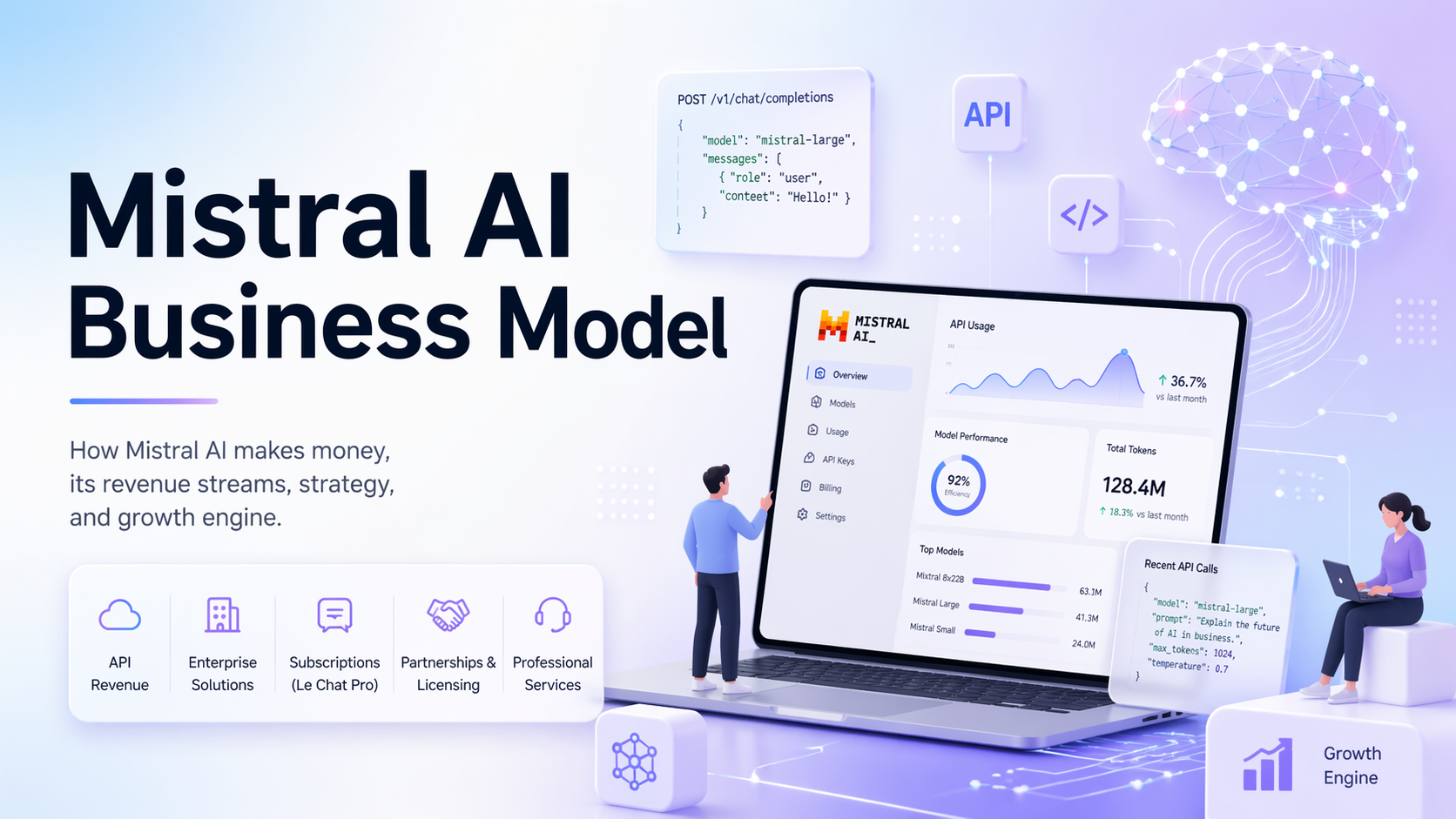
Mistral AI Business Model And How This European Startup Is Challenging OpenAI (And Making Money)

Mistral AI launched in 2023 out of Paris, France, and within months became one of the most talked-about names in enterprise AI. Not because it out-chatted ChatGPT. Not because it had the flashiest demo. But because it made a smart, deliberate choice to play a completely different game.
While OpenAI chased consumers and Anthropic doubled down on safety, Mistral went after something more valuable in the long run: enterprise infrastructure. The companies, governments, and developers who need AI that works on their terms, with their data, under their control.
Mistral is not trying to win the chatbot war. It is competing sideways, targeting the infrastructure layer that sits beneath everything AI-powered today.
This article breaks down exactly how Mistral AI works, how it makes money, and why its business model is one of the most strategically interesting plays in AI right now.
What Is Mistral AI
Mistral AI is a French artificial intelligence company that builds large language models (LLMs), an AI assistant called Le Chat, and enterprise AI platforms. It was founded in 2023 by former researchers from DeepMind and Meta, and it has grown rapidly thanks to a combination of strong technical output and smart go-to-market positioning.
The core product is a family of AI models, ranging from lightweight open-weight models like Mistral 7B to more powerful proprietary systems built for enterprise clients. These models can be accessed through an API, deployed on private infrastructure, or used as the foundation for custom AI systems.
A simple way to think about Mistral: it is less like ChatGPT and more like AWS for AI. It is not just a chatbot. It is a platform that powers AI applications built by others.
That positioning matters because it shapes everything about how Mistral makes money, who its customers are, and where it is headed.
The Market Opportunity Mistral Is Going After
The AI market is growing fast. But the real opportunity is not in building one more consumer chatbot. It is in solving a specific problem that enterprises face every day.
Most companies cannot use off-the-shelf AI tools like ChatGPT for serious business tasks. The reasons are straightforward.
Data privacy is a concern. Sending sensitive customer data, financial records, or internal documents to an external AI system creates legal and security risks. Many industries, including banking, healthcare, and government, have strict regulations around where data can go and who can access it.
Transparency is another concern. Enterprise buyers want to understand how their AI system works. Black-box models that produce outputs with no explanation are hard to trust and harder to audit.
Control is the biggest concern. Companies want AI that they can customize, retrain on their own data, and deploy in their own environment. They do not want to be dependent on a third-party API they have no control over.
This is exactly the gap Mistral is targeting. It is positioning itself as the AI infrastructure provider for organizations that need custom, controllable, compliant AI. That is a massive and underserved market.
How the Mistral AI Business Model Is Structured
The Mistral business model operates across three distinct layers. Understanding these layers is key to understanding how the company creates and captures value.
The Platform Layer sits at the foundation. This includes the AI models themselves, from open-weight models available to developers for free or low cost, to proprietary models available through the API. The platform layer drives developer adoption and builds the ecosystem.
The Product Layer sits in the middle. This is where Le Chat lives, Mistral’s AI assistant product. Le Chat serves as the consumer-facing entry point into the Mistral ecosystem. It drives brand awareness, user adoption, and subscription revenue.
The Enterprise Layer sits at the top in terms of revenue and strategic value. This is where Mistral works directly with large companies and governments to deploy custom AI solutions, private model instances, and specialized AI systems built on top of its core models.
The flow looks like this: Models feed the API, the API powers the product, and the product and enterprise relationships generate the majority of revenue.
How Mistral AI Makes Money
API Usage-Based Pricing
The primary revenue driver for Mistral AI is usage-based API pricing. Developers and companies pay per token, meaning they pay based on how much of the model they actually use.
This model has several advantages. It is predictable and scalable. As usage grows, revenue grows. Customers do not need to make large upfront commitments, which lowers the barrier to entry and drives adoption. Once integrated, the switching costs are high because replacing an embedded API means rewriting significant amounts of code and retraining teams.
This is classic SaaS economics applied to AI infrastructure. The more developers build on Mistral’s API, the stickier the platform becomes.
Usage-based billing has become the dominant pricing model across the AI industry because it aligns cost with value. Customers pay for what they use, and Mistral earns more as its customers grow.
For startups and independent developers, the entry-level pricing is accessible. For larger companies with high volume usage, the per-token costs add up into significant contracts. This creates a natural upsell path from small developer to mid-market company to enterprise client.
Enterprise Contracts
Enterprise contracts are where the serious money lives. This revenue stream involves working directly with large organizations to deploy custom AI systems tailored to their specific needs.
What does an enterprise AI contract with Mistral look like? It typically involves one or more of the following.
Custom model training on the client’s internal data. A bank might need a model trained on its proprietary financial documents. A telecom company might want a model trained on its customer service history. A government agency might need a model that understands specific regulatory or legal language.
On-premise or private cloud deployment. Regulated industries cannot send data to a shared API. Mistral deploys models within the client’s own infrastructure, which meets compliance requirements and addresses data sovereignty concerns.
Dedicated model instances with guaranteed performance and availability. Enterprise clients cannot accept downtime or shared compute resources. They pay premium prices for guaranteed service levels.
The industries most likely to buy enterprise AI contracts from Mistral include financial services, healthcare, defense, government, legal, and telecom. These are all sectors with high data sensitivity, regulatory requirements, and significant budgets for technology infrastructure.
Enterprise contracts are high-margin and long-term. A single enterprise deal can be worth millions of dollars over a multi-year contract. This type of revenue is more stable and more profitable than consumer subscription revenue.
Subscription Model Through Le Chat Pro
Le Chat is Mistral’s AI assistant, and Le Chat Pro is the premium subscription tier. Priced around $14.99 per month, it gives subscribers access to advanced features, higher usage limits, and faster response times.
It is important to put this revenue stream in context. Consumer subscription revenue is not Mistral’s primary business. It is a secondary revenue stream that serves a different strategic purpose.
Le Chat Pro drives brand awareness. It puts Mistral’s AI in front of everyday users who might not otherwise interact with the technology. It builds the company’s public profile in markets where OpenAI and Google currently dominate consumer mindshare.
It also serves as a funnel. Developers who start as Le Chat Pro subscribers might eventually build products on the Mistral API. Enterprise decision-makers who use Le Chat personally might advocate for Mistral internally. Consumer adoption creates enterprise opportunities.
So while the subscription revenue itself is not the main driver, it plays an important supporting role in the overall growth strategy.
Licensing and Cloud Partnerships
Mistral has entered into partnerships with major cloud providers, including Microsoft Azure. These partnerships involve licensing Mistral’s models so they are available on the cloud marketplace alongside native offerings.
Why is this important? Distribution. The fastest way to reach enterprise customers is through the platforms they already use. Most large companies have existing Azure, AWS, or Google Cloud contracts. Making Mistral models available on these platforms means enterprise buyers can access them without new vendor relationships, new procurement processes, or new infrastructure setups.
This distribution-first thinking is a core part of Mistral’s go-to-market strategy. Rather than trying to build direct enterprise relationships from scratch in every market, partnering with cloud providers lets Mistral scale distribution rapidly.
The financial structure of these partnerships typically involves revenue sharing. Mistral earns a portion of what cloud customers spend on its models through the marketplace. While the margins are lower than direct sales, the volume potential is significantly higher.
Model licensing also applies in cases where companies want to integrate Mistral technology into their own products rather than accessing it through an API. This creates another revenue stream that requires minimal ongoing support from Mistral’s team.
Professional Services
Professional services is the quieter revenue stream that does not get as much attention but plays an important role in building enterprise relationships.
This includes consulting work to help companies understand how AI can be applied to their specific use case. It includes deployment support, where Mistral’s team helps engineer and implement AI systems within the client’s environment. It also includes custom model training services where Mistral’s experts work hands-on with client data.
Professional services margins are lower than software margins because they require human time and expertise. But they serve a strategic function. They build deep relationships with enterprise clients. They create trust. They often serve as the entry point for a larger ongoing software contract.
A company that hires Mistral for a consulting engagement is far more likely to sign an enterprise API contract afterward. Professional services is the relationship layer that unlocks larger revenue opportunities.
The Business Model Canvas
Looking at Mistral’s business model through a structured canvas helps illustrate how all the pieces fit together.
Key Partners include cloud infrastructure providers like Microsoft Azure and Nvidia, enterprise clients across regulated industries, and government agencies in Europe and beyond.
Key Activities center on model training and AI research, enterprise AI deployment, and ongoing platform development and maintenance.
Key Resources are the AI talent and research teams, the compute infrastructure required to train and run models, and the proprietary model architecture that differentiates Mistral’s output from competitors.
Value Propositions include cost-efficient AI that is more affordable than comparable closed models, the flexibility of open-weight models that enterprises can inspect and customize, and enterprise-ready deployment options that meet compliance and data sovereignty requirements.
Customer Segments split across enterprises as the primary segment, developers and startups as a secondary segment, government and public sector organizations as a high-value niche, and consumers through Le Chat as a brand-building segment.
Channels include the direct API, cloud marketplace distribution through Azure and others, and a direct enterprise sales team for high-value contracts.
Cost Structure is dominated by compute costs for training and running models, followed by talent and R&D investment, and operational infrastructure.
Revenue Streams flow from API usage fees, enterprise contracts, Le Chat Pro subscriptions, and licensing and partnership agreements.
What Makes Mistral’s Strategy Different
The Open-Weight Play
One of the most discussed aspects of Mistral’s strategy is its approach to open-weight models. Mistral releases some of its models with open weights, meaning developers can download, inspect, and run the models independently. This is different from fully open-source and different from closed proprietary models.
The strategic logic is clear. Open-weight models drive adoption. Developers who can access a model for free will experiment with it, build with it, and become familiar with it. This creates a base of users who are more likely to pay for premium access or enterprise features down the line.
But Mistral does not give everything away. The most powerful, most capable models are closed and require paid access. The open models are genuinely useful for many use cases, but companies with serious requirements need the paid tiers.
This is sometimes described as “give away the hook, sell the engine.” The free models attract the ecosystem. The paid models capture the value.
This approach also creates a competitive moat. A large developer ecosystem built around Mistral’s model architecture creates switching costs. Developers invested in the Mistral ecosystem are less likely to migrate to a competitor, even if a better model becomes available.
Enterprise-First Positioning
While OpenAI started with consumers and later moved to enterprise, Mistral was enterprise-first from early in its development. This is not just a marketing choice. It shapes product decisions, pricing, deployment capabilities, and partnership strategy.
Enterprise-first means building features that large organizations actually need. Audit logs, access controls, compliance certifications, private deployment options, dedicated support, and SLA guarantees. These are not features that a consumer chatbot needs. They are requirements for enterprise buyers.
It also means building a sales and customer success organization capable of navigating enterprise procurement. Enterprise deals take months to close. They involve multiple stakeholders. They require detailed security reviews and legal negotiations. A team optimized for developer self-service cannot serve enterprise clients effectively.
Mistral’s enterprise-first approach means it is competing for a different budget than ChatGPT. Enterprise technology budgets are larger, more stable, and more resistant to the volatility that affects consumer spending.
Build-Your-Own AI
Mistral’s most distinctive strategic bet is on what might be called the build-your-own-AI opportunity. Instead of giving companies an AI tool they use as-is, Mistral gives companies the ability to build AI that is genuinely theirs.
Custom models trained on proprietary data. Private deployments that never touch external servers. AI systems designed around specific workflows, not generic use cases.
This represents a significant shift in how enterprise software works. The SaaS era was defined by companies buying software built by someone else and configuring it to their needs. The AI era is enabling something different: companies building their own AI systems, with their own data, tailored to their own processes.
Mistral is positioning itself as the infrastructure layer for this shift. Not the AI application that companies use, but the platform and models that companies build their applications on top of.
This is a larger and more defensible market position than being an AI application vendor. Infrastructure providers tend to win long-term because they sit beneath the entire ecosystem.
European AI Sovereignty
Mistral has an advantage that no American AI company can replicate: it is European. This matters more than it might initially seem.
European governments and enterprises face specific regulatory requirements around data residency and AI governance under frameworks like GDPR and the EU AI Act. Working with an American AI provider creates jurisdictional complexity that many European organizations want to avoid.
Beyond regulation, there is a political dimension. European governments, particularly in France and the EU more broadly, have expressed strong interest in maintaining strategic autonomy in AI. They do not want critical infrastructure dependent on American or Chinese technology companies.
Mistral is the natural choice for European organizations that want capable AI without the geopolitical dependency. This is a durable competitive advantage because it is structural. It is not something OpenAI or Anthropic can address by improving their models.
The European sovereignty angle also creates direct government contract opportunities. National AI programs, defense applications, and public sector modernization initiatives are all potential enterprise clients for a trusted European AI provider.
Competitive Positioning
Understanding Mistral’s position requires being clear about who it is and is not competing with.
OpenAI competes across both consumer and enterprise segments. Its primary strength is brand recognition and the ChatGPT ecosystem. Its enterprise offering is growing but it carries the baggage of a consumer-first reputation in some enterprise sales conversations.
Anthropic focuses heavily on AI safety and enterprise use cases. It competes directly with Mistral for enterprise contracts in regulated industries. Claude is a strong technical competitor, and Anthropic’s safety focus resonates with certain enterprise buyers.
Google DeepMind and the broader Google AI operation have distribution advantages through Google Cloud but are perceived in some enterprise contexts as a competitive threat given Google’s position in many adjacent markets.
Where Mistral wins is on cost, flexibility, and control. Its models are competitive on performance benchmarks at a lower price point than most alternatives. Its open-weight options give developers flexibility that closed models cannot match. And its deployment options give enterprises more control over their AI infrastructure than providers who only offer cloud-based access.
The positioning is not “we are better than everyone.” It is “we are the right choice for specific enterprise use cases where cost, control, and compliance matter most.” That is a focused and defensible position.
Growth Strategy
Developer Adoption as the Foundation
Mistral’s growth strategy starts with developers. Open-weight models attract developer attention. A strong developer community creates an ecosystem of applications, tutorials, integrations, and advocacy that drives organic awareness.
Developers who build on Mistral today are the engineering leads, CTOs, and technology decision-makers at enterprises tomorrow. Building developer loyalty early is an investment in future enterprise relationships.
Enterprise Expansion
From the developer base, Mistral expands upmarket into enterprise. This is a well-established go-to-market pattern in B2B software. Bottom-up developer adoption creates enterprise pull. IT leaders see Mistral being used in their organizations and the business case for formal enterprise contracts becomes easier to make.
Enterprise expansion is where the majority of revenue growth will come from. Each new enterprise contract is a multi-year revenue relationship that grows as the client’s AI usage expands.
Strategic Partnerships
Partnerships with cloud providers are not just distribution channels. They are strategic relationships that accelerate enterprise adoption. When a company’s existing Azure or AWS rep recommends Mistral as part of a broader cloud solution, the sales process is fundamentally different than a cold outreach from a startup.
Mistral is building the kind of partner ecosystem that makes it easier for enterprise customers to say yes.
Ecosystem Development
Long-term, Mistral’s growth strategy is about building an ecosystem around its models. Tools, integrations, fine-tuning services, industry-specific model variants, and community resources all make the Mistral platform stickier and more valuable over time.
This is how infrastructure platforms compound value. Each addition to the ecosystem makes the core platform more useful, which attracts more users, which generates more data and revenue to fund more additions.
Challenges and Risks
Competition from Well-Resourced Competitors
OpenAI, Google, Meta, and Microsoft are all competing in the same general space with significantly more resources. Meta’s open-source Llama models compete directly with Mistral’s open-weight offering. Google has distribution advantages that are hard to overcome. These are real competitive threats.
Infrastructure Costs
Training large AI models requires massive compute investment. This is one of the highest cost structures in all of technology. Managing compute costs while maintaining model competitiveness is an ongoing operational challenge.
As models scale, the compute required scales with them. This means Mistral needs to generate significantly growing revenue to fund the infrastructure required to stay competitive on model performance.
The Open vs. Paid Tension
Mistral’s open-weight strategy creates a tension that all hybrid open/commercial AI companies face. If the open models are too good, companies have less reason to pay for the premium versions. If the paid models are not significantly better, the value proposition for enterprise contracts weakens.
Getting this balance right is a continuous product and pricing challenge. So far Mistral has managed it well, but maintaining the right level of differentiation between open and paid tiers requires ongoing attention.
Performance Perception
Despite strong technical benchmarks, Mistral is not yet the default choice for enterprise AI buyers in the way that OpenAI is. Changing perception in enterprise markets is slow. Procurement teams default to the safest choice, and “nobody got fired for buying OpenAI” is a real dynamic in some organizations.
Building the reputation and case studies required to overcome this default preference takes time.
Where Mistral Is Headed
The future of Mistral AI is not in building better chatbots. It is in becoming the infrastructure layer for enterprise AI deployment at scale.
The direction of travel is clear. From selling models to selling AI systems. From one-size-fits-all APIs to industry-specific platforms. From helping companies use AI to helping companies own their AI.
The shift from SaaS to AI infrastructure is still early. Most enterprises are still in the evaluation and pilot phase of AI adoption. The companies that establish strong infrastructure relationships now will capture a disproportionate share of the enterprise AI market as adoption accelerates.
Mistral is betting that the real business in AI is not the models themselves but the deployment, customization, and ongoing operation of AI systems within enterprise environments. That is a bet on infrastructure over application, on B2B over consumer, and on the long game over the short one.
Given the competitive dynamics of the industry, this is a smarter bet than trying to out-ChatGPT ChatGPT.
Key Takeaways
Mistral AI is not building another ChatGPT. It is building the AI infrastructure layer that enterprises need to deploy serious AI at scale.
Its business model is built on API usage pricing as the primary revenue engine, enterprise contracts as the high-value growth driver, Le Chat Pro subscriptions as the brand and funnel layer, and licensing partnerships as the distribution multiplier.
Its strategy is differentiated by the open-weight model approach that drives developer adoption, the enterprise-first product and sales motion, the build-your-own-AI positioning, and the European sovereignty angle that creates structural advantages no American competitor can replicate.
The challenges are real: well-resourced competition, high infrastructure costs, and the ongoing tension between open and paid tiers. But the strategic position is strong and the market opportunity is significant.
Mistral is not trying to be ChatGPT. It is trying to power the companies that use AI. That is a different business, a larger opportunity, and a more defensible competitive position.
In the long run, infrastructure tends to win. And right now, Mistral is building infrastructure.
Discover more from Business Model Hub
Subscribe to get the latest posts sent to your email.