Starling Bank Business Model And How a UK Digital Bank Built Profitability Without a Single Branch

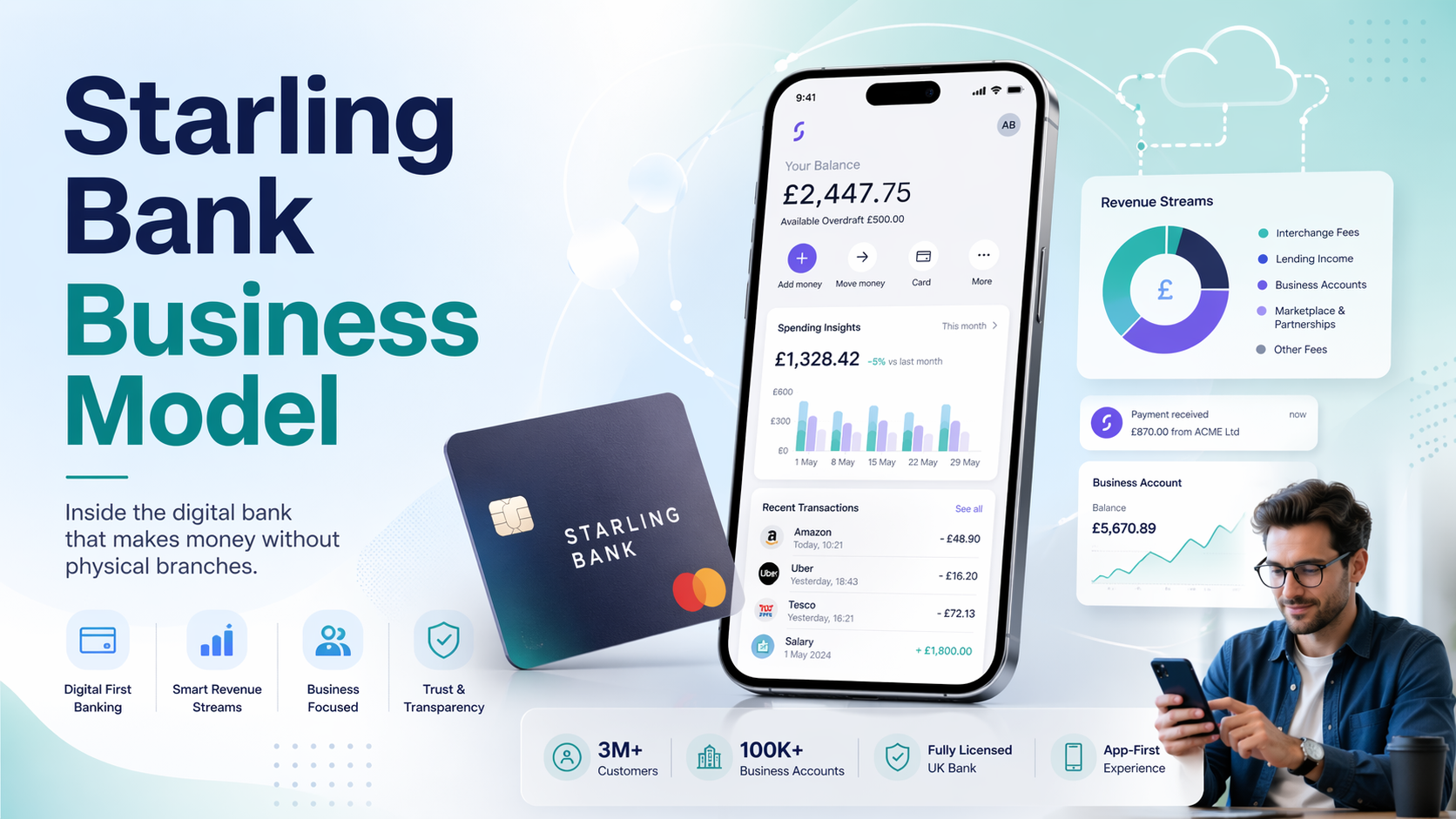
Starling Bank makes money through interchange fees, business account charges, lending interest, marketplace commissions, and overdraft fees. It keeps costs low by operating entirely online with no physical branches, running on proprietary technology infrastructure. This combination of lean cost structure and diversified revenue is what pushed Starling into profitability faster than most of its fintech rivals.
What is Starling Bank?
Starling Bank is a fully licensed UK digital bank, founded in 2014 by Anne Boden, a veteran banking executive who wanted to build a bank from scratch using modern technology rather than retrofitting old systems.
It holds a full UK banking licence, which means it is not just a prepaid card or e-money account. It is a regulated bank, authorised by the Prudential Regulation Authority (PRA) and the Financial Conduct Authority (FCA).
Starling operates entirely through its mobile app. There are no branches, no legacy IT systems, and no unnecessary overhead. Customers open accounts, manage money, apply for loans, and access business tools entirely within the app.
That mobile-first model is not just a design choice. It is the foundation of the entire business model.
The Core Idea Behind Starling Bank’s Business Model
No Branches Means Dramatically Lower Costs
Traditional banks carry enormous fixed costs. Branch networks, property leases, branch staff, physical ATM maintenance, and legacy IT systems consume billions annually across institutions like Barclays, HSBC, and Lloyds.
Starling has none of that. Every pound saved on physical infrastructure can be reinvested into technology, product development, and customer experience.
Built on Proprietary Technology
Most traditional banks run on core banking systems that are decades old. These systems are expensive to maintain, slow to update, and a constant source of operational risk.
Starling built its own core banking platform from the ground up. This gives it full control over its product roadmap, faster feature releases, and significantly lower long-term technology costs compared to banks that rely on third-party legacy vendors.
Customer-First User Experience
Starling’s product decisions are driven by usability. Real-time payment notifications, spending categorisation, budgeting tools, and instant account opening are all standard features on the app.
For business customers, the toolset extends to invoicing, tax pots, integration with accounting software like Xero and FreeAgent, and multi-user access for teams.
Trust and Transparency as a Differentiator
Starling does not charge monthly fees for its personal current accounts. There are no hidden charges for overseas spending on personal accounts. This transparency builds loyalty, particularly among users who feel let down by traditional banks.
How Starling Bank Works
App Onboarding
New customers download the app, complete identity verification using their smartphone camera, and can have a fully functional current account open within minutes. There is no branch visit, no paperwork, and no waiting period for a card to arrive in the post.
Account Usage
Once the account is active, customers manage everything from the app. They can view transactions in real time, set spending limits, freeze cards instantly, and create savings Spaces (ring-fenced pots within the account).
Payments and Cards
Starling issues Mastercard debit cards. Customers can make card payments, bank transfers, direct debits, and standing orders. The bank integrates with Apple Pay and Google Pay.
Business Tools
Business account holders get access to additional features including invoice management, VAT pots, multi-user permissions, and integrations with third-party accounting and payroll tools. These features are particularly useful for sole traders, freelancers, and small business owners.
Marketplace Integrations
Starling runs an in-app marketplace where customers can connect to third-party financial products including insurance, savings, mortgages, and pensions from approved partners. This marketplace model generates referral and commission income without Starling needing to build every product in-house.
How Starling Bank Makes Money
Interchange Fees
Every time a Starling customer makes a card payment, Starling earns a small interchange fee from the merchant’s bank. This is standard across the industry, but because Starling has a large and growing customer base making regular purchases, interchange income adds up significantly.
This is a core, recurring revenue stream that scales directly with customer activity.
Business Account Charges
Starling’s personal current accounts are free. Its business accounts, however, include subscription tiers with monthly fees depending on the level of features and services required.
Business banking has been a major growth driver. Starling captured a significant share of the SME market during the Covid-19 pandemic, particularly through its role as an accredited lender for government-backed Bounce Back Loans. This brought hundreds of thousands of business customers onto the platform.
Lending and Interest Income
Starling offers overdrafts, personal loans, and business lending. The interest charged on these products is one of the most significant revenue contributors.
As interest rates rose across the UK, Starling’s net interest margin improved substantially. The bank earns a spread between what it pays on deposits and what it charges on loans, and with rates at higher levels, that spread has widened considerably.
Marketplace Commissions
When customers access third-party products through Starling’s marketplace, Starling earns a referral fee or commission. This model allows Starling to monetise its customer base without the risk of directly underwriting every financial product.
Partners in the marketplace have included mortgage providers, insurance products, and investment platforms.
Overdraft Fees
Starling charges interest on arranged overdrafts. The rates are clearly disclosed within the app. This is a smaller but consistent revenue line that adds to the overall mix.
Starling Bank Business Model Canvas
The Business Model Canvas is a framework that maps out the nine building blocks of how a company creates, delivers, and captures value. Here is how Starling fits into each block.
Key Partners
Starling’s ecosystem depends on several critical external relationships.
Payment networks such as Mastercard enable Starling to issue cards and process payments globally. Without these network relationships, the core banking product would not function.
Third-party fintech providers populate the Starling Marketplace. These partners extend Starling’s product range without requiring Starling to build everything in-house.
Regulators and compliance bodies, specifically the FCA and PRA, are not optional partners but essential ones. Maintaining strong regulatory relationships protects the banking licence and enables new product launches.
Cloud and infrastructure providers power the technology stack. Starling uses cloud infrastructure to maintain uptime, scalability, and security across millions of accounts.
The insight here is that Starling’s partner strategy is deliberately lean. Rather than trying to own every part of the value chain, it partners strategically and focuses its own resources on the core banking platform.
Key Activities
Managing the digital banking platform is the central activity. Everything else depends on the reliability, speed, and security of the core system.
Processing payments is continuous and must be near-flawless. A payment failure damages trust in ways that take a long time to recover from.
Lending operations include credit scoring, loan origination, risk monitoring, and collections. This is increasingly important as lending becomes a larger part of Starling’s revenue.
Risk and compliance management is non-negotiable for a licensed bank. Starling invests significantly in financial crime prevention, KYC (Know Your Customer) processes, and regulatory reporting.
Product development is what keeps Starling competitive. Continuous improvement of the app, new features, and new product lines are all ongoing activities.
Key Resources
The banking licence is arguably Starling’s most valuable asset. Obtaining a full UK banking licence is a multi-year, capital-intensive process. It creates a significant barrier to entry and gives Starling capabilities that e-money institutions like early Revolut or Wise do not have.
Technology infrastructure, built in-house, gives Starling control, speed, and cost efficiency that legacy-dependent competitors cannot match.
The mobile app and platform is the primary customer touchpoint. Its quality directly drives acquisition, retention, and revenue.
Customer data informs credit decisions, product development, and risk management. Used responsibly and within GDPR frameworks, it is a genuine competitive resource.
Brand trust has been built through transparency, fair fees, and consistent delivery. Trust is difficult to build and easy to destroy, making it a meaningful resource in financial services.
Value Propositions
Zero or low fees is the headline for personal customers. No monthly account fees, no overseas transaction charges on personal accounts, and transparent pricing across all products.
Fast, seamless digital banking means account opening in minutes, instant payment notifications, and a frictionless in-app experience that removes the friction of traditional banking.
Real-time notifications give customers visibility over every transaction as it happens. This builds confidence and reduces disputes.
Easy business banking tools address a genuine gap in the market. Small business owners historically received poor service from traditional banks. Starling built a business account that actually works for how modern businesses operate.
Transparent financial services is a broader promise. No jargon, no hidden charges, no surprises. This resonates particularly with customers who have been stung by opaque fees at traditional institutions.
Customer Relationships
Starling’s relationship model is primarily app-based and self-service. Customers manage everything through the app without needing to speak to anyone.
In-app chat support is available for when things go wrong or customers have questions. The focus is on resolving issues quickly within the digital interface rather than routing people to call centres.
This model keeps support costs low whilst maintaining a high-quality experience for the majority of interactions that are straightforward.
UX-driven engagement means customers interact with Starling frequently, not because they have to, but because the app is genuinely useful for managing money day-to-day. High engagement drives retention and increases the likelihood of customers using additional products.
Customer Segments
Individual retail users are Starling’s personal current account holders. These range from digitally native younger users to older customers who have switched from traditional banks seeking better tools and fairer fees.
Freelancers and sole traders represent a significant segment. Starling’s personal and business account features align well with the needs of self-employed individuals who want simple, low-cost banking with useful integrations.
SMEs (small and medium-sized enterprises) are where Starling has built particularly strong traction. The business account product, combined with accounting integrations and lending access, serves small businesses better than most traditional alternatives at a lower cost.
Channels
The mobile app is the primary channel for virtually everything. Acquisition, onboarding, account management, customer support, and product discovery all happen within the app.
The website supports brand awareness, SEO-driven acquisition, and provides information for prospective customers before they download the app.
App stores (Apple App Store and Google Play) are the distribution channels for the core product. Strong ratings and reviews on these platforms drive organic downloads.
Cost Structure
Technology and infrastructure is a major cost line, but Starling’s proprietary systems mean it is not paying expensive third-party licensing fees that traditional banks face.
Salaries for technology and compliance teams are significant. Attracting engineering talent in a competitive market is expensive, and compliance headcount is non-negotiable for a regulated bank.
Regulatory costs include the direct costs of maintaining licences, conducting audits, and meeting reporting requirements.
Customer support, whilst primarily digital, still requires a team, particularly for fraud, disputes, and complex account issues.
Marketing has been relatively modest compared to some fintech competitors. Starling has relied more on word-of-mouth, PR, and app store visibility than on heavy paid advertising.
The cost structure advantage is real and significant. By avoiding branches and legacy systems, Starling operates with a materially lower cost-to-income ratio than traditional banks, which is a key driver of its path to profitability.
Revenue Streams
To summarise the revenue model within the canvas framework:
Interchange fees from card transactions scale with customer activity and card spend volumes.
Loan interest from overdrafts, personal loans, and business lending is the largest and fastest-growing revenue stream.
Business account subscription fees provide predictable, recurring revenue tied to the growing SME customer base.
Marketplace commissions generate income from third-party product referrals without direct underwriting risk.
Overdraft charges add a steady, smaller revenue line from customers using arranged credit facilities.
The critical insight is that Starling’s revenue is diversified. It is not reliant on any single stream, which makes the business model more resilient than competitors who depend overwhelmingly on one source.
Starling Bank vs Traditional Banks
| Factor | Starling Bank | Traditional Banks |
|---|---|---|
| Branch network | None | Thousands of branches |
| Account opening | Minutes via app | Days to weeks |
| Monthly fees (personal) | None | Often £5 to £25 |
| Core technology | Proprietary, modern | Legacy systems, decades old |
| Overseas fees (personal) | None | Typically 2.75% to 3% |
| Real-time notifications | Yes, standard | Varies, often absent |
| Business account tools | Strong integrations | Limited, often clunky |
| Profitability timeline | Achieved 2022/23 | Long-established |
| Regulatory status | FCA/PRA licensed bank | FCA/PRA licensed bank |
Why Starling Bank Became Profitable
Starling announced its first full year of profitability in 2022/23, making it one of the few UK challenger banks to reach this milestone.
Low Cost Base
The absence of branch infrastructure and legacy technology removes the two largest cost burdens that traditional banks carry. This structural advantage means Starling can reach profitability at a lower revenue level than traditional institutions.
Strong SME Focus
Business accounts carry higher margins than personal accounts. Starling’s decision to invest heavily in business banking features attracted a large and sticky SME customer base that generates more revenue per user than personal account holders.
Smart Lending Strategy
Starling did not chase growth for growth’s sake in lending. It built credit risk capabilities carefully and grew its loan book in line with its ability to manage risk. This avoided the bad debt problems that can derail banks that lend aggressively to hit growth targets.
High Customer Retention
Starling’s product quality drives retention. Customers who switch to Starling tend to stay. High retention means lower acquisition cost per active customer over time, which improves unit economics significantly.
Target Customers
Starling serves three primary groups.
Digital-first individuals who want modern banking tools, real-time visibility over their finances, and fair fees. This group is comfortable managing money entirely through an app and actively prefers it to visiting a branch.
Freelancers and self-employed workers who need a banking solution that works for variable income, easy expense tracking, and potentially separating business and personal finances.
SMEs who need business accounts with genuine utility, accounting integrations, access to lending, and multi-user access without paying the high fees that traditional business banking often demands.
Growth Strategy
UK-First Approach
Unlike Revolut or N26, Starling has focused primarily on the UK market rather than aggressively pursuing international expansion. This focused approach allowed it to go deep rather than wide, building a strong and profitable position at home before considering other markets.
Product Depth
Starling’s growth has come from adding more value to existing customers rather than simply acquiring new ones. New products, better integrations, and expanded lending capabilities increase revenue per customer over time.
Ecosystem Partnerships
The marketplace model allows Starling to offer a broader range of financial services without the capital and regulatory complexity of building each product directly. As the partner ecosystem grows, so does Starling’s ability to serve more of each customer’s financial needs.
Competitors
Monzo is Starling’s closest UK competitor in the personal banking space. Monzo has a larger personal customer base but has taken longer to reach profitability. Its business account product is less developed than Starling’s.
Revolut operates at a much larger scale globally but is a different beast. It started as a foreign exchange and travel card product and has been expanding into banking. It holds a UK banking licence but its product mix and risk profile differ significantly from Starling’s.
N26 is a German challenger bank that has operated in the UK but withdrew from the British market in 2020, citing Brexit-related regulatory complexity. It is less of a direct competitive threat in the UK.
Traditional banks including Barclays, HSBC, Lloyds, and NatWest are also competing for the same customers, particularly SMEs, and have invested in improving their digital offerings.
Challenges
Thin margins on personal accounts remain a reality. Free personal current accounts generate limited direct revenue, meaning Starling relies on cross-selling lending, overdrafts, and marketplace products to make each personal customer profitable.
Regulatory complexity is ongoing. As a fully licensed bank, Starling faces increasing capital requirements, regulatory reporting burdens, and the cost of staying compliant with evolving FCA and PRA expectations.
Intensifying competition comes from all directions. Traditional banks are improving their digital products, fintech rivals are expanding their capabilities, and new entrants continue to emerge.
Lending risk grows as the loan book expands. In a higher interest rate environment with cost-of-living pressures on consumers and businesses, credit losses become a more significant concern.
Future Opportunities
Geographic expansion remains an option. Having proven the model in the UK, Starling has the technology, the licence infrastructure, and the operational experience to enter other markets. It has explored European expansion through its Banking-as-a-Service offering.
Deeper SME ecosystem is a substantial opportunity. Small businesses need more than just a bank account. Payroll, HR tools, lending products, insurance, and embedded payments all represent adjacent services that Starling could offer or partner to provide.
Embedded finance is a growing area where Starling’s Banking-as-a-Service (BaaS) platform plays a role. Other businesses can use Starling’s infrastructure to power their own financial products. This B2B revenue stream is separate from Starling’s direct consumer banking and represents a significant long-term opportunity.
Key Lessons for Founders
Cost Advantage Matters More Than Features
Starling did not win because it had more features than traditional banks. It won because its cost structure was fundamentally different. When you operate at a fraction of a competitor’s cost base, you can be profitable at revenue levels that would be loss-making for them.
Do Not Scale Blindly
Many fintech competitors raised large rounds and grew their customer bases rapidly without a clear path to profitability. Starling grew more deliberately, focusing on the right customers (SMEs) and the right products (lending, business accounts) rather than vanity metrics.
Focus on Trust
In financial services, trust is the product. Transparent pricing, reliable technology, and honest communication are not just good ethics. They are good business. Starling built trust through consistent delivery over time, and that trust reduced churn and drove referrals.
Own Your Core Infrastructure
Starling’s decision to build its own core banking platform rather than licensing a third-party system gave it control, flexibility, and long-term cost efficiency. For any business where technology is central to the value proposition, owning core infrastructure is a strategic advantage worth the upfront investment.
Wrapping Up
Starling Bank’s business model is not complicated to understand, but it is genuinely difficult to replicate. The combination of a full banking licence, proprietary technology, a lean cost structure, and a focused SME strategy created the conditions for profitability that most challenger banks have struggled to achieve.
The Business Model Canvas for Starling reveals a company that has made deliberate trade-offs. It chose depth over breadth, UK focus over global expansion, and sustainable margins over hypergrowth. Those choices, which looked cautious at the time, turned out to be exactly right.
For founders and business strategists, the Starling story is a useful reminder that the most durable competitive advantages are often structural rather than superficial. A better app feature can be copied in weeks. A lower cost base, a banking licence, and a trusted brand take years to build.
FAQs
Starling earns revenue through interchange fees on card transactions, interest on loans and overdrafts, business account subscription fees, and marketplace commissions from third-party partners. The personal current account is free, but the full business generates revenue across multiple streams.
Yes. Starling Bank reported its first full year of profitability in its 2022/23 financial year, making it one of the very few UK challenger banks to achieve this milestone. Rising interest rates improved its net interest margin significantly.
Both are UK digital banks with personal current accounts and business banking. Starling holds a full banking licence, has a stronger SME focus, and achieved profitability earlier. Monzo has a larger personal customer base and is strong on consumer-facing features. They serve overlapping but not identical audiences.
Yes. Starling Bank is authorised by the Prudential Regulation Authority and regulated by the Financial Conduct Authority. It is a fully licensed UK bank, not an e-money institution. Customer deposits are protected up to £85,000 under the Financial Services Compensation Scheme (FSCS).
Starling serves three main groups: individual retail banking customers who prefer digital-first banking, freelancers and sole traders who need simple low-cost banking with good tools, and small to medium-sized businesses that want a better business banking experience than traditional banks typically offer.
Starling’s BaaS platform allows other businesses to use Starling’s banking infrastructure to power their own financial products. This is a B2B revenue stream separate from direct consumer banking and represents a growing area of the business.
Business accounts generate higher margins than free personal accounts. SMEs also tend to have more complex financial needs, making them more likely to use multiple products and less likely to switch for a slightly better interest rate. This focus on business customers was a deliberate strategic decision that significantly accelerated Starling’s path to profitability.
Without branch networks, property costs, or legacy IT systems, Starling operates at a materially lower cost-to-income ratio than traditional banks. This structural cost advantage means it can be profitable at lower revenue levels and price products more competitively without sacrificing margins.
Discover more from Business Model Hub
Subscribe to get the latest posts sent to your email.