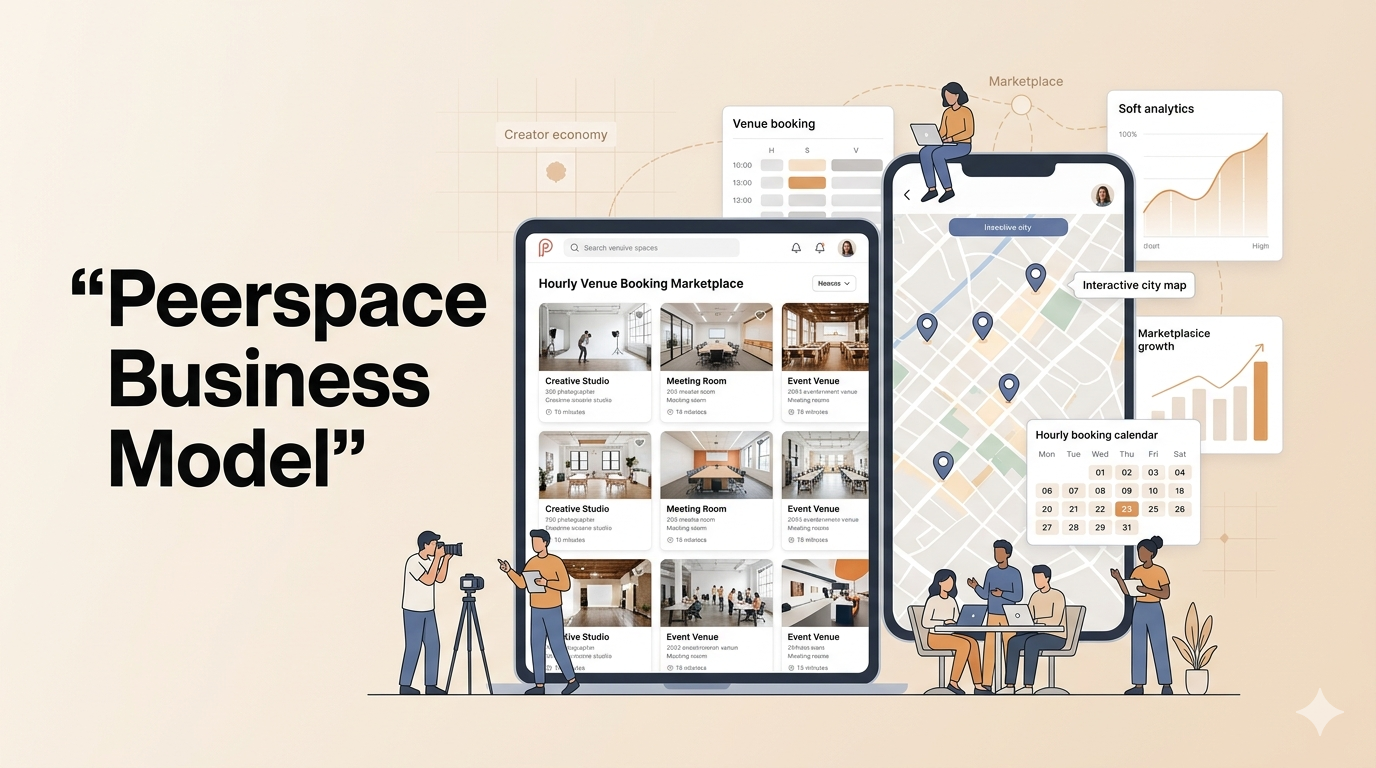

Peerspace is an online marketplace that connects people who need short-term venue access with property owners who have space to rent. The platform works on an hourly booking model, making it one of the most flexible venue rental options available for creators, businesses, and event organizers.
The company earns primarily through commission fees charged to both hosts and guests on every completed booking.
What Is Peerspace?
Peerspace is a two-sided marketplace platform often described as the “Airbnb for event and production spaces.” Instead of overnight stays, users book venues by the hour for meetings, photo shoots, film productions, podcasts, parties, and corporate events.
The platform was founded in 2013 and is headquartered in San Francisco, California. It has expanded to major cities across the United States, United Kingdom, Canada, and Australia, building a localized marketplace network in each urban hub.
Types of spaces available on Peerspace:
- Photography and film studios
- Corporate meeting rooms
- Event venues and ballrooms
- Podcast recording spaces
- Rooftop locations
- Warehouse and loft spaces
- Wedding venues
- Outdoor and garden spaces
Peerspace does not own any of these properties. It connects hosts who already own or manage these spaces with renters who need them for a few hours.
Who Founded Peerspace and When?
Peerspace was co-founded by Rony Chamoun and Matt Bendett in 2013. The company launched with a simple idea: millions of commercial and creative spaces sit empty for most of the day, and just as many creators and businesses need affordable, flexible access to those same spaces.
The platform grew steadily alongside the rise of the creator economy, remote work culture, and the broader shift from asset ownership to flexible access.
How Does Peerspace Work?
Peerspace operates as a digital two-sided marketplace. The platform connects two user groups: hosts who list their spaces and guests who book them. The booking process is fully managed through Peerspace’s platform.
For Hosts
- Create a listing with photos, description, and amenities
- Set an hourly price and minimum booking duration
- Define availability and any house rules
- Accept or decline booking requests
- Get paid through the platform after each completed booking
For Guests
- Search spaces by city, activity type, and capacity
- Filter by price, amenities, and availability
- View photos, reviews, and host details
- Book and pay directly through the platform
- Show up and use the space
Platform Operations
Peerspace handles the full transaction layer between hosts and guests. This includes:
- Payment processing handled securely on-platform
- Review systems for both hosts and guests
- Trust and safety tools including ID verification
- Host protection for damages and disputes
- Customer support for booking issues
The platform’s search algorithm matches renters with the most relevant spaces based on location, activity, and availability, which is one of Peerspace’s strongest product features.
What Value Does Peerspace Offer?
Peerspace delivers distinct value to three different user groups: hosts, renters, and businesses.
Value for Hosts
- Turn an unused space into a consistent revenue stream
- Set your own pricing, availability, and rules
- Get exposure to a large network of creators and companies
- No need to build your own marketing or booking system
Value for Renters
- Access unique, aesthetically curated spaces by the hour
- No long-term leases or commitments
- Transparent pricing with no hidden fees
- Easy discovery through filters and categories
Value for Businesses
- Book professional meeting rooms on demand
- Find on-brand shoot locations without scouting
- Organize team offsites and corporate events flexibly
- Access verified venues with reviews and cancellation policies
How Does Peerspace Make Money?
Peerspace generates revenue through a commission-based model applied to every booking made through its platform. Both sides of the marketplace contribute to the company’s revenue.
Host-Side Commission
Peerspace charges hosts a percentage fee on each booking. This fee is deducted from the host’s payout automatically after the booking is confirmed. The host commission typically ranges around 15% of the total booking value, though this can vary.
Guest-Side Service Fee
Guests pay a service fee on top of the listed hourly rate when they complete a booking. This fee covers platform operations, customer support, payment processing, and trust and safety tools. Guest service fees typically range between 15% and 30% depending on the booking total.
Additional Revenue Streams
Beyond the core commission model, Peerspace generates revenue through several supporting streams:
| Revenue Stream | Description |
|---|---|
| Booking Commissions | Percentage taken from every transaction |
| Guest Service Fees | Added on top of hourly rate at checkout |
| Cleaning Fees | Hosts can add cleaning charges, platform takes a cut |
| Featured Listings | Hosts pay to appear higher in search results |
| Enterprise Bookings | Corporate clients booking at volume |
| Add-on Services | Equipment, catering, or production add-ons |
Enterprise Revenue Opportunity
Peerspace has a growing opportunity in corporate bookings. Companies use Peerspace to book:
- Team offsite venues
- Brand shoot locations
- Product launch event spaces
- Remote team meeting rooms
Enterprise clients often book at higher frequency and larger ticket sizes, making them a high-value customer segment. Corporate partnerships represent a significant growth lever for Peerspace’s revenue model.
Peerspace Business Model Canvas
| Component | Details |
|---|---|
| Key Partners | Property owners, payment processors, photographers, event planners, insurance providers |
| Key Activities | Platform development, host acquisition, trust and safety, customer support |
| Key Resources | Marketplace technology, venue listings, user base, brand recognition |
| Value Propositions | Hourly venue rentals for creators, teams, and businesses |
| Customer Relationships | Self-service booking, reviews, support, host dashboards |
| Channels | Website, SEO, social media, paid advertising, referral programs |
| Customer Segments | Creators, photographers, startups, agencies, event organizers |
| Cost Structure | Technology, marketing, operations, customer support, insurance |
| Revenue Streams | Commissions, service fees, featured listings, enterprise accounts |
Who Uses Peerspace?
Peerspace serves several distinct customer segments. Each group uses the platform for different reasons but shares a common need: flexible, short-term access to quality spaces.
Creators
- YouTubers needing filming locations
- Photographers booking studios for shoots
- Podcasters renting sound-treated recording rooms
- Influencers finding on-brand backdrops
Businesses and Startups
- Remote teams holding quarterly offsites
- Agencies booking client presentation spaces
- Startups hosting pitch events or workshops
- HR teams organizing corporate retreats
Event Organizers
- Birthday parties and milestone celebrations
- Networking events and industry meetups
- Pop-up shops and brand activations
- Fitness classes and wellness workshops
Peerspace Marketing Strategy
Peerspace uses a multi-channel marketing approach that combines organic search, social media, paid advertising, and word-of-mouth referrals.
SEO Strategy
Peerspace invests heavily in local SEO. The platform creates city-specific and activity-specific landing pages targeting high-intent search queries like “photo studio rental in Brooklyn” or “meeting room by the hour in Chicago.”
This approach captures users who are ready to book, not just browse. It also builds long-term organic traffic without ongoing ad spend for each keyword.
SEO tactics Peerspace uses:
- City and neighborhood-based landing pages
- Activity-based category pages (studios, meeting rooms, event spaces)
- Venue listing pages optimized for local search
- User-generated content through reviews and host descriptions
Social Media Marketing
Peerspace’s spaces are visually appealing by nature. The platform leverages this through Instagram and TikTok marketing, showcasing unique and aesthetically interesting venues.
Creator partnerships are a core part of this strategy. When photographers, filmmakers, and influencers post content from Peerspace venues, they drive organic discovery among their audiences.
Referral Growth
Peerspace uses referral programs to grow both sides of its marketplace:
- Hosts refer other property owners and earn incentives
- Guests receive credits for referring new users
This keeps customer acquisition costs low and accelerates supply and demand growth simultaneously.
Performance Marketing
Peerspace runs paid campaigns across:
- Google Ads targeting venue-search keywords
- Meta Ads retargeting past website visitors
- Display campaigns for brand awareness in new cities
Why Did Peerspace Become Successful?
Peerspace’s success is tied to several converging market trends and smart product decisions.
Market Timing
The platform launched right as the creator economy was beginning to grow. As more people began building businesses around content creation, the demand for affordable studio and production space surged. Peerspace was positioned to capture that demand from day one.
The Shift from Ownership to Access
Consumers and businesses increasingly prefer flexible access over long-term ownership or leasing. Peerspace directly addresses this by offering hourly access to spaces that would otherwise require day-long or monthly commitments.
Asset-Light Business Model
Peerspace does not own any properties. This keeps its cost structure lean and allows the business to scale quickly without significant capital investment. As more hosts list spaces, the platform becomes more valuable without proportional cost increases.
Strong Search and Discovery
Peerspace’s filtering system is one of its strongest product features. Users can sort by:
- City and neighborhood
- Activity type
- Capacity
- Amenities
- Price range
- Availability
This makes it easy for high-intent users to find the right space quickly, reducing drop-off in the booking funnel.
Peerspace Competitive Advantages
Niche Focus
Peerspace chose a specific lane and stayed in it. While Airbnb covers overnight stays, Peerspace owns the hourly venue rental category for creative and professional use. This niche focus means the platform’s features, search, and marketing are all built around what creators and businesses actually need.
High-Intent User Base
People who visit Peerspace are usually ready to book. They are not casually browsing. This means conversion rates are higher than broad discovery platforms and advertising ROI tends to be strong.
Creator-Friendly Design
The platform is built for production. Listings include details like ceiling height, natural light availability, equipment included, and whether the space is photographer-friendly. This specificity builds trust with professional users.
Geographic Network Effects
As Peerspace grows in a city, it becomes harder for competitors to enter that market. A larger inventory of listings leads to better search results, higher booking frequency, and more reviews, which attracts more hosts and guests in a self-reinforcing cycle.
Challenges in the Peerspace Business Model
Trust and Safety Risks
Any marketplace dealing with physical property faces risks around damage, fraud, and misuse. Peerspace has to maintain strong verification, insurance coverage, and dispute resolution systems to protect hosts from bad actors and protect guests from misleading listings.
Managing this at scale across thousands of properties in dozens of cities is operationally complex and expensive.
Balancing Supply and Demand
Peerspace needs enough listings in each city to satisfy demand and enough bookings to retain active hosts. In new markets, this balance is difficult to achieve. Too few listings drive guests away. Too few bookings push hosts to leave the platform.
Competition
Peerspace operates in a competitive landscape:
| Competitor | How They Compete |
|---|---|
| Airbnb | Broader platform, some hourly options through Airbnb Rooms |
| Splacer | Direct competitor focused on event and production spaces |
| Breather | Focuses on short-term professional and meeting spaces |
| Local Venues | Hotels and co-working spaces offering their own direct booking |
The biggest competitive risk is that large platforms like Airbnb or Google expand into the hourly venue rental category and use their existing user bases to undercut Peerspace’s market position.
Local Regulations
Peerspace spaces are used for events and productions. This creates regulatory exposure:
- Noise ordinances in residential areas
- Event permit requirements
- Commercial usage rules for residential properties
- Zoning restrictions in some cities
These rules vary by city and can limit the types of spaces that can legally list on the platform.
Peerspace Growth Strategy
International Expansion
Peerspace has expanded beyond the United States into UK, Canadian, and Australian markets. Its growth strategy includes launching in new cities where creator and corporate demand is high. Urban hubs with strong media production industries, like London and Toronto, represent natural expansion targets.
Enterprise Solutions
Corporate clients are a major growth lever. Peerspace is positioned to develop dedicated enterprise tools including:
- Team booking dashboards
- Centralized billing for companies
- Volume discount structures
- Dedicated account management
Enterprise accounts generate larger, more predictable revenue and higher lifetime value than individual bookings.
Vertical Expansion
Peerspace is expanding the types of use cases it supports beyond its original core. This includes:
- Podcast and audio production packages
- Hybrid event infrastructure
- Creator studio subscriptions
- Brand activation spaces for product launches
AI and Smart Discovery
Personalized venue recommendations based on past bookings, stated preferences, and activity type represent a strong product direction. Better matching reduces time to booking and increases satisfaction on both sides of the marketplace.
Lessons Startups Can Learn From Peerspace
Build Around Underutilized Assets
Peerspace identified a clear inefficiency: commercial and creative spaces sit empty for large portions of the day while businesses and creators struggle to find affordable short-term access. The business model was built to close that gap.
Any startup can apply this framework. Find underutilized assets, build the infrastructure to connect them with people who need them, and take a margin on every transaction.
Start with a Niche Marketplace
Peerspace did not try to compete with Airbnb head-on. It picked a specific category: hourly bookings for creative and professional use. This focus allowed it to build features, content, and marketing around a specific user type, which built stronger loyalty and better conversion rates.
Solve Flexibility Problems
Long-term leases and day-rate venue rentals left a gap for users who needed space for just a few hours. Peerspace solved that problem directly. The lesson is that flexibility itself can be the core value proposition, not just the product.
Marketplace Trust Is Not Optional
Without strong trust tools, marketplaces fail. Peerspace invested early in reviews, verification, insurance, and dispute resolution. These systems are not features. They are the foundation of the business model. Without them, neither hosts nor guests would feel safe transacting on the platform.
What Is the Future of the Peerspace Business Model?
The continued growth of the creator economy, hybrid work culture, and on-demand business services all point toward a strong future for Peerspace’s model.
Key future opportunities include:
- Creator studio subscriptions offering recurring access packages for frequent users
- AI-powered venue matching that learns from booking history and creator preferences
- Virtual and hybrid production support as remote event formats continue to grow
- Enterprise collaboration hubs purpose-built for distributed teams
- Expanded insurance and protection products as a separate revenue line
The hybrid work shift has created lasting demand for flexible, professional meeting and event spaces. Companies no longer lease large offices but still need spaces for team gatherings, client events, and productions. Peerspace is directly positioned to capture this demand.
Peerspace vs Airbnb: What Is the Difference?
| Category | Peerspace | Airbnb |
|---|---|---|
| Booking Unit | By the hour | By the night |
| Primary Use Case | Events, shoots, meetings | Overnight accommodations |
| Target User | Creators, businesses, organizers | Travelers and vacationers |
| Space Types | Studios, venues, offices | Homes, apartments, rooms |
| Minimum Stay | One hour | Usually one night |
| Commercial Use | Core focus | Secondary and limited |
Final Takeaway
Peerspace built a scalable marketplace by solving a real, specific problem: flexible, hourly access to creative and professional spaces. Its asset-light structure keeps costs manageable while its commission model scales directly with booking volume.
The business works because it serves two underserved groups at the same time. Hosts with empty spaces get a reliable way to monetize them. Renters who need affordable short-term access get a curated, trust-backed platform to find exactly what they need.
As the creator economy grows and hybrid work becomes the standard, demand for flexible venue access will keep increasing. Peerspace’s positioning, niche focus, and marketplace infrastructure make it one of the more durable business models in the flexible economy space.
FAQs
Peerspace earns revenue through commission fees charged to hosts and service fees charged to guests on every booking. Additional revenue comes from featured listings, cleaning fees, and enterprise accounts.
Both are marketplace platforms, but they serve different use cases. Peerspace focuses on hourly bookings for creative and professional purposes. Airbnb focuses on overnight stays for travelers.
Creators, photographers, podcasters, startups, corporate teams, and event organizers are the core Peerspace user segments.
Its focus on hourly creative and professional venue rentals. The platform is purpose-built for production and event use, with search filters and listing details specifically designed for creators and businesses.
Yes. Peerspace operates in select cities in the United Kingdom, Canada, and Australia in addition to its US markets.
Peerspace has not disclosed detailed financials publicly. Its path to profitability depends on booking volume, operational efficiency, and success in scaling enterprise and corporate revenue streams.
Discover more from Business Model Hub
Subscribe to get the latest posts sent to your email.