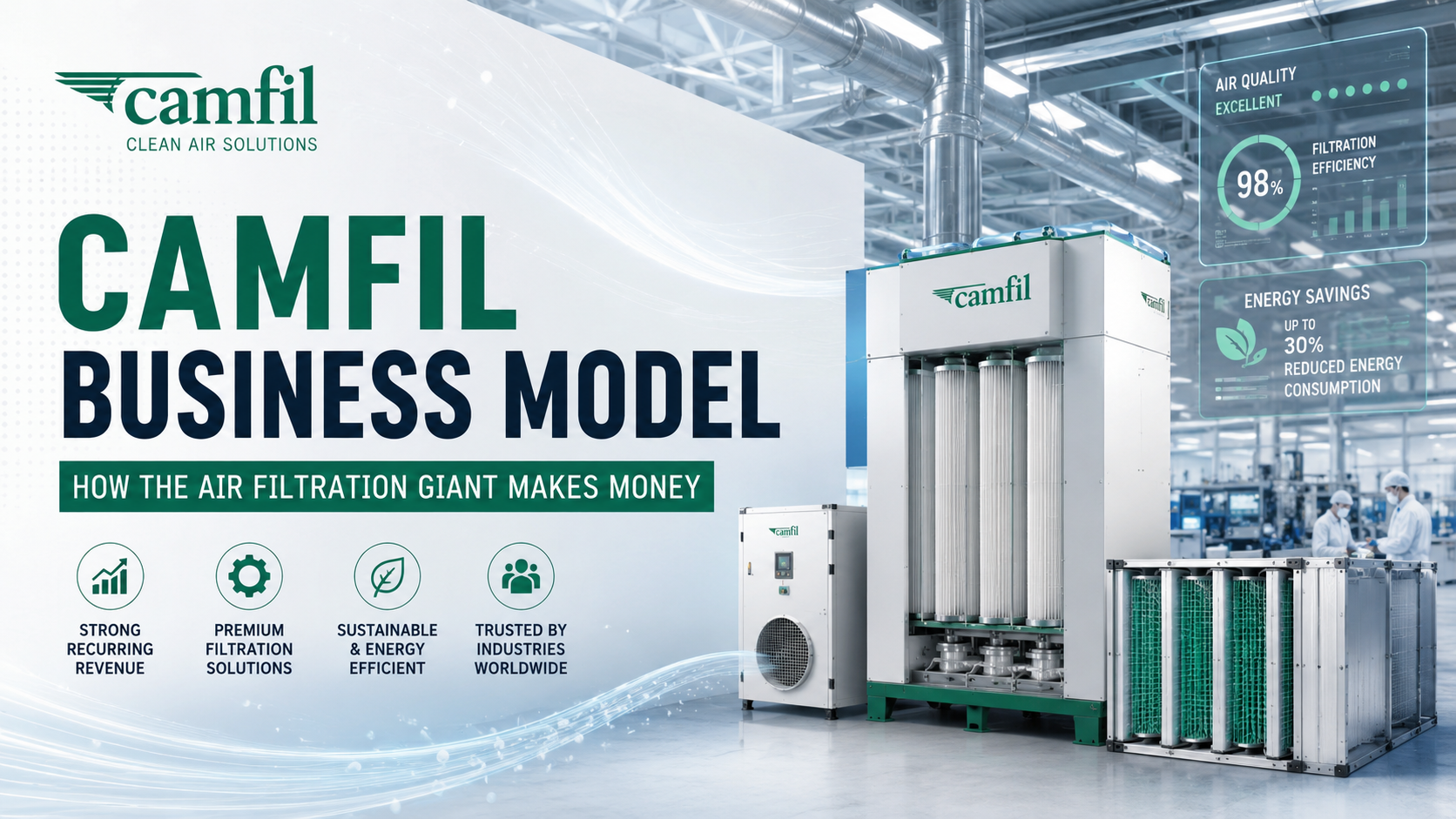

Camfil operates on a B2B manufacturing model that combines product sales with recurring replacement revenue. The company makes money by selling premium air filtration systems to industrial clients, commercial buildings, and healthcare facilities, then generates ongoing income through mandatory filter replacements and maintenance contracts.
Air quality has become a critical business concern. Companies face stricter environmental regulations, energy efficiency mandates, and growing awareness about workplace health. This shift has turned air filtration from a commodity purchase into a strategic infrastructure investment.
The global air filtration market is projected to exceed $40 billion by 2028. Camfil sits at the center of this growth, serving industries that cannot function without clean air: semiconductor manufacturing, pharmaceuticals, data centers, and hospitals.
This article breaks down exactly how Camfil built a profitable business around something most people never think about. You’ll learn their revenue model, customer acquisition strategy, competitive positioning, and why their business remains resilient even during economic downturns.
What is Camfil?
Company Overview
Camfil was founded in 1963 in Sweden. The company started with a simple mission: create air filters that actually work better than existing options.
Today, Camfil operates in over 30 countries with more than 30 manufacturing facilities worldwide. Their headquarters remains in Stockholm, but they maintain significant operations across Europe, North America, and Asia-Pacific regions.
The company serves a diverse range of industries. Manufacturing plants need dust collectors. Hospitals require HEPA filtration for operating rooms. Data centers demand precise climate control. Food processing facilities must prevent contamination. Semiconductor fabs need molecular filtration to protect nanometer-scale production processes.
Camfil’s core mission centers on clean air as a fundamental human right. This isn’t just marketing language. The company invests heavily in research around air quality’s impact on health, productivity, and energy consumption.
What Products Does Camfil Sell?
Camfil manufactures air filtration products across several categories.
HVAC air filters form their largest product segment. These filters fit into heating, ventilation, and air conditioning systems in commercial buildings. They range from basic particulate filters to high-efficiency models that capture sub-micron particles while maintaining low energy consumption.
HEPA filters represent their premium offering. High-efficiency particulate air filters capture 99.97% of particles 0.3 microns in diameter. These filters are mandatory in cleanrooms, hospitals, and pharmaceutical manufacturing.
Industrial dust collectors solve a different problem. Manufacturing processes generate enormous amounts of airborne particulate matter. Metalworking, woodworking, food processing, and chemical production all create dust that poses health risks and equipment damage. Camfil’s dust collection systems capture these particles at the source.
Molecular filtration systems target gases and odors rather than particles. Semiconductor manufacturing, museums, and certain industrial processes require removal of specific molecular contaminants. These specialized filters use activated carbon and other media to adsorb gaseous pollutants.
Air purifiers serve smaller applications. While Camfil focuses primarily on industrial and commercial systems, they also manufacture standalone air cleaning units for specific environments like laboratories or isolation rooms.
Cleanroom filtration solutions represent their most technically demanding products. Pharmaceutical manufacturing, microelectronics production, and medical device assembly require environments with virtually zero airborne contamination. Camfil designs complete air handling systems for these ultra-clean spaces.
The Core Camfil Business Model Explained
Simple Explanation of the Business Model
Camfil operates a B2B manufacturing model with recurring revenue characteristics.
The company designs and manufactures premium air filtration products. They sell these products directly to large enterprises and through distributor networks to smaller customers. Revenue comes from initial equipment sales, but the real profit driver is replacement filters.
This model resembles the classic razor-and-blade approach. Sell the infrastructure once, then generate ongoing revenue from consumable components that must be replaced regularly.
Unlike pure subscription businesses, Camfil doesn’t require contracts for replacement purchases. The business model works because air filters physically degrade. A clogged filter restricts airflow, increases energy consumption, and eventually fails to protect air quality. Customers must replace filters whether they want to or not.
Long-term B2B relationships anchor the entire operation. Camfil doesn’t compete on price. They compete on total cost of ownership: energy efficiency, filter lifespan, and technical support. This positioning allows them to maintain premium pricing and high customer retention.
Why This Model Is Strong
Three factors make Camfil’s business model particularly resilient.
Mandatory replacement cycles create predictable revenue. Air filters are consumables. A typical HVAC filter lasts three to six months. Industrial filters might need replacement every few weeks in high-dust environments. This creates recurring purchase patterns that competitors cannot disrupt without physically replacing installed equipment.
Industrial regulations generate inelastic demand. Many of Camfil’s customers operate in heavily regulated industries. Pharmaceutical manufacturing must meet FDA cleanroom standards. Semiconductor fabs follow strict contamination control protocols. Hospitals face healthcare facility requirements. These regulations don’t disappear during recessions. Companies cannot simply stop buying filters to cut costs.
Air quality has become a strategic priority. The COVID-19 pandemic accelerated awareness of indoor air quality. Building owners now face pressure from tenants, employees, and regulators to demonstrate clean air. This trend supports sustained investment in filtration infrastructure.
Energy costs provide additional momentum. HVAC systems typically consume 40-50% of a commercial building’s total energy. High-quality filters that maintain airflow while capturing particles can significantly reduce this consumption. When energy prices rise, the ROI on premium filtration improves.
How Camfil Makes Money
Product Sales
Camfil’s primary revenue stream comes from selling filtration equipment and replacement filters.
Commercial HVAC filters generate substantial volume. Every office building, shopping mall, hotel, and airport requires regular filter replacement. While individual filters might cost $20-200, large facilities need hundreds or thousands of filters annually.
Industrial filtration equipment carries much higher price points. A complete dust collection system for a manufacturing facility can cost $100,000 to over $1 million depending on size and complexity. These are capital investments that companies depreciate over many years.
Air purification systems serve specialized applications. A portable HEPA air cleaner for a hospital isolation room might cost $2,000-5,000. Larger commercial air purification systems for building-wide applications run significantly higher.
Specialized cleanroom filters command premium pricing. A single HEPA filter for a pharmaceutical cleanroom can cost $500-2,000. Large facilities might have hundreds of these filters, all requiring replacement on regular schedules.
Recurring Filter Replacement Revenue
This is where Camfil’s business model really shines.
Once a customer installs Camfil equipment or standardizes on their filters, replacement purchases become nearly automatic. Facility managers know which filters they need. They establish purchasing relationships. They build Camfil products into maintenance schedules and budgets.
Repeat purchases from enterprises create stable cash flow. A large pharmaceutical company might spend $500,000 to $2 million annually just on replacement filters across their facilities. This spending continues year after year with minimal sales effort required.
Subscription-like purchasing cycles emerge naturally. Even without formal contracts, customers develop predictable buying patterns. Some set up automatic reordering. Others schedule quarterly or semi-annual bulk purchases.
Long-term client retention runs extremely high. Switching costs are significant. Changing filter suppliers means reengineering systems, retraining maintenance staff, and potentially compromising air quality during transition. Most customers stay with their chosen supplier for decades.
The economics are compelling. Camfil might sell initial equipment at modest margins to win an account, then earn strong margins on replacement filters for 10-20 years. The customer lifetime value far exceeds acquisition costs.
Industrial Projects & Custom Solutions
Large industrial projects represent Camfil’s highest-value revenue opportunities.
Pharmaceutical plants require complete air handling solutions. A new pharmaceutical manufacturing facility might invest $5-20 million in air filtration and cleanroom systems. Camfil doesn’t just sell products for these projects. They provide engineering consultation, custom design, installation supervision, and validation support.
Semiconductor factories have even more demanding requirements. Modern chip fabrication requires Class 1 cleanrooms, meaning less than one particle larger than 0.1 microns per cubic foot of air. Achieving this requires sophisticated filtration cascades, continuous monitoring, and precise control. A single semiconductor fab project can generate $10-50 million in revenue for Camfil.
Food processing facilities need contamination control combined with easy cleaning and FDA compliance. Camfil designs systems that meet food safety regulations while handling the specific challenges of different food production processes.
Hospitals and laboratories require validated HEPA filtration for operating rooms, isolation rooms, and research spaces. Each installation must meet stringent healthcare standards and undergo regular testing.
These projects generate revenue over extended periods. Initial design and equipment sales, then ongoing filter replacement, monitoring, and system upgrades create annuity-like income streams.
Service & Maintenance Contracts
Camfil increasingly emphasizes services alongside products.
Installation services ensure systems perform as designed. While distributors or contractors might handle basic filter changes, complex industrial systems require expert installation. Camfil provides or supervises these installations, generating service revenue and ensuring customer satisfaction.
Performance monitoring helps customers optimize operations. Camfil offers monitoring systems that track differential pressure across filters, air quality metrics, and energy consumption. This data tells facility managers exactly when filters need replacement, preventing both premature changes and overdue replacements.
Energy optimization creates measurable value. Camfil consultants analyze HVAC systems to identify efficiency opportunities. Sometimes better filters reduce energy consumption enough to pay for themselves within months. This consultative approach builds customer relationships beyond transactional sales.
Filter lifecycle management programs handle the entire process for large customers. Camfil monitors filter conditions, schedules replacements, manages inventory, and handles disposal. Customers pay for this convenience and expertise, while Camfil secures long-term revenue streams.
Camfil’s Target Customers
Commercial Buildings
Office buildings, shopping malls, airports, and hotels all require substantial air filtration.
Offices face increasing demands for better indoor air quality. Studies show improved air quality boosts worker productivity and reduces sick days. Building owners use superior filtration as a competitive advantage when attracting premium tenants.
Airports move enormous volumes of air. A major airport might have hundreds of HVAC units, each requiring multiple filters. The combination of high air volumes, strict safety standards, and 24/7 operations creates significant filtration demand.
Shopping malls prioritize customer comfort and retail success. Poor air quality drives shoppers away. Mall operators invest in filtration to maintain pleasant environments that encourage extended visits.
Hotels compete partly on air quality. Luxury hotels particularly emphasize fresh, clean air as part of the guest experience. Chain hotels often standardize on specific filtration solutions across properties.
Industrial Manufacturing
Manufacturing creates some of the most demanding air filtration applications.
Automotive plants generate welding fumes, paint overspray, and metal grinding dust. Worker safety regulations require effective capture of these contaminants. Camfil’s industrial dust collectors address these challenges.
Chemical industries often produce hazardous airborne substances. Filtration systems must capture toxic particulates and gases while meeting environmental discharge standards.
Electronics manufacturing demands extremely clean environments. Dust particles can ruin circuit boards and electronic components. Even non-cleanroom electronics production requires better air quality than typical industrial environments.
Food production faces dual challenges: keeping contaminants out of food products while capturing airborne food particles that create fire and contamination hazards. Camfil designs systems meeting both food safety and industrial safety requirements.
Healthcare & Cleanrooms
Medical and pharmaceutical applications represent Camfil’s most technically demanding segment.
Hospitals require HEPA filtration in operating rooms, intensive care units, isolation rooms, and other critical areas. These applications are non-negotiable. Hospitals must maintain specific air quality standards regardless of cost.
Research labs working with pathogens, chemicals, or sensitive experiments need controlled air environments. Contamination can invalidate months of research or create safety hazards.
Pharmaceutical companies face FDA requirements for cleanroom classification. Different pharmaceutical processes require different cleanliness levels, all documented and validated. Camfil provides the filtration systems and validation support these companies need.
Data Centers
Data centers have emerged as a major growth segment for air filtration.
Cooling efficiency is critical. Data centers consume enormous energy for cooling. Any restriction to airflow increases cooling costs. Camfil’s low-resistance filters maintain air quality without excessive energy penalty.
Dust-sensitive environments protect expensive equipment. Dust accumulation on servers and networking equipment accelerates failures and reduces performance. Effective filtration extends equipment life and improves reliability.
Large hyperscale data centers represent particularly valuable customers. A single facility might require thousands of filters replaced on coordinated schedules, generating millions in annual recurring revenue.
Why Customers Choose Camfil
Premium Product Quality
Camfil positions as a quality leader, not a low-cost provider.
Their filters consistently demonstrate higher particle capture efficiency than competitors. Independent testing verifies these claims. For customers where air quality actually matters, this performance justifies premium pricing.
Product reliability matters equally. A filter that fails prematurely can shut down a production line or compromise a cleanroom. Camfil’s reputation for consistent quality reduces these risks.
Energy-Efficient Filtration
This represents Camfil’s strongest competitive differentiator.
Traditional thinking assumed better filtration meant higher energy costs. Denser filter media captures more particles but restricts airflow, forcing HVAC systems to work harder.
Camfil invested heavily in developing filter media that captures particles efficiently while maintaining low airflow resistance. Their high-efficiency filters often consume less energy than competitors’ standard filters.
The economics are compelling. A commercial building spending $100,000 annually on HVAC energy might save $20,000-40,000 by upgrading to Camfil’s energy-efficient filters. Even if the filters themselves cost more, the total cost of ownership is lower.
Sustainability Positioning
Environmental credentials have become a significant purchase factor.
Camfil publishes detailed lifecycle assessments of their products. They measure carbon footprint, energy consumption, and waste generation. This transparency appeals to corporate sustainability managers who must report ESG metrics.
Long-life filters reduce waste. A Camfil filter lasting 12 months versus a competitor’s 6-month filter means 50% less disposal. For customers with aggressive sustainability targets, this matters.
The company also emphasizes sustainable manufacturing. They’ve reduced energy consumption in their factories, minimized waste, and increased recycled content in packaging.
Long Product Lifespan
Filters that last longer reduce total cost even at higher unit prices.
Camfil’s premium filters often last 50-100% longer than budget alternatives. This means fewer change-outs, less labor cost, lower disposal expenses, and reduced inventory carrying costs.
For industrial applications, extended filter life also means less production disruption. Changing filters often requires shutting down systems. Fewer changes mean more uptime.
Strong Technical Expertise
Camfil employs engineers who understand air filtration deeply.
When customers face complex air quality challenges, Camfil provides genuine expertise. They analyze applications, recommend solutions, and support implementation. This consultative approach builds relationships beyond transactional sales.
Technical support continues after purchase. Customers can call with questions about filter performance, troubleshooting issues, or optimization opportunities. This support creates switching costs and customer loyalty.
Camfil’s Competitive Advantages
Recurring Revenue Model
The consumable nature of filters creates automatic revenue regeneration.
Competitors must continuously win new customers to grow. Camfil grows both through new customer acquisition and natural expansion of filter usage within existing accounts.
This recurring revenue makes the business highly predictable. Camfil can forecast quarterly revenue with unusual accuracy based on installed filter base and replacement cycles.
High Customer Switching Costs
Once a customer standardizes on Camfil products, changing suppliers is difficult.
Physical switching costs include reengineering HVAC systems to accommodate different filter dimensions, retraining maintenance staff on new products, and updating purchasing systems and vendor relationships.
Risk costs matter more. Switching filtration suppliers might compromise air quality during transition. For pharmaceutical or semiconductor customers, this risk is unacceptable. The potential cost of a contamination event far exceeds any savings from cheaper filters.
Performance validation in regulated industries creates additional friction. Pharmaceutical companies must revalidate cleanrooms when changing filters. This process costs time and money, discouraging switches.
Global Manufacturing & Distribution
Camfil’s worldwide presence enables local service with global consistency.
Large multinational customers want standardized solutions across facilities. A pharmaceutical company operating in 20 countries prefers one filtration partner who can serve all locations rather than managing regional suppliers.
Local manufacturing reduces lead times and shipping costs. European customers receive filters from European plants. Asian customers get locally produced inventory.
This global footprint also spreads business cycle risk. When manufacturing slows in one region, other regions might be growing.
Strong B2B Relationships
Camfil invests in long-term customer relationships rather than transactional sales.
Account managers work with the same customers for years, understanding their facilities, challenges, and goals. This relationship depth creates loyalty beyond product specifications.
Many customer relationships span decades. A facility manager who has worked successfully with Camfil for 15 years is unlikely to switch suppliers based on a competitor’s sales pitch.
Regulatory Demand Creates Stable Business
Many of Camfil’s customers must buy filters regardless of economic conditions.
Pharmaceutical companies cannot reduce cleanroom air quality to cut costs. Semiconductor fabs cannot tolerate contamination even during downturns. Hospitals must maintain operating room standards.
This regulatory floor supports revenue even when discretionary spending drops. While new construction projects might pause during recessions, filter replacement in existing facilities continues.
The Role of Sustainability in Camfil’s Business Strategy
Energy-Efficient HVAC Systems
Energy efficiency has evolved from a nice-to-have feature into a core value proposition.
Commercial buildings face increasing pressure to reduce energy consumption. Utility costs rise. Carbon regulations tighten. Tenants demand efficient operations.
HVAC typically represents 40-50% of building energy use. Filtration directly impacts this consumption. Filters that restrict airflow force fans to work harder, consuming more electricity.
Camfil positions its products as energy investments rather than maintenance expenses. Their filters might cost more upfront but deliver lower total cost through energy savings.
Independent studies verify these claims. Buildings using Camfil’s high-efficiency filters consistently measure lower HVAC energy consumption compared to conventional alternatives.
ESG & Green Building Trends
Environmental, social, and governance criteria now influence corporate purchasing decisions.
Corporate sustainability managers must report scope 1, 2, and 3 emissions. HVAC energy consumption affects these numbers. Choosing energy-efficient filters demonstrates environmental commitment with measurable impact.
Green building certifications like LEED award points for superior indoor air quality and energy efficiency. Camfil’s products help buildings achieve higher certification levels, potentially increasing property values and rental rates.
Investors increasingly evaluate companies on ESG metrics. Facilities using sustainable infrastructure can improve their ESG scores, potentially affecting their cost of capital.
Reducing Carbon Emissions Through Better Filtration
Camfil quantifies the carbon impact of their products.
They calculate that their energy-efficient filters prevent millions of tons of CO2 emissions annually compared to standard alternatives. This messaging resonates with environmentally focused customers.
The company also addresses filter disposal. Traditional filters end up in landfills. Camfil has developed recycling programs and incineration with energy recovery options, reducing environmental impact.
Some Camfil filters use recycled materials in their construction. Others are designed for easier disassembly and material recovery at end of life.
Sustainability as a Brand Differentiator
Environmental positioning helps Camfil stand out in a commoditized market.
Many customers view air filters as interchangeable commodities. Sustainability credentials create a differentiation point beyond technical specifications.
This positioning particularly resonates with European customers where environmental awareness runs high. It’s increasingly relevant in North America and Asia as sustainability concerns grow.
Camfil publishes sustainability reports, carbon footprint data, and environmental impact assessments. This transparency builds credibility with environmentally conscious customers.
Camfil’s Sales & Distribution Strategy
Direct Enterprise Sales
Large industrial customers typically buy directly from Camfil.
Account managers develop deep relationships with key accounts. They understand each facility’s filtration needs, upcoming projects, and budget cycles.
This direct relationship allows Camfil to capture full margins on high-value accounts. It also provides direct customer feedback that informs product development.
Enterprise sales cycles are long. Winning a new pharmaceutical plant or semiconductor fab might take years of relationship building, technical consultation, and bid processes. But once won, these accounts generate revenue for decades.
Distributor Partnerships
Smaller customers and maintenance-driven purchases flow through distribution networks.
Industrial supply distributors carry Camfil products alongside other maintenance supplies. HVAC contractors stock common filter sizes for quick replacement jobs. This distribution reach provides market coverage without Camfil maintaining direct relationships with thousands of small customers.
Distributors appreciate Camfil’s premium positioning. Higher-priced products mean better margins. Strong brand recognition makes products easier to sell.
Camfil supports distributors with training, marketing materials, and technical assistance. This support helps distributors sell value rather than price, protecting margins throughout the channel.
Technical Consultation-Based Selling
Camfil sales emphasizes problem-solving over product pushing.
Sales engineers analyze customer applications before recommending solutions. They might conduct air quality testing, review facility layouts, or calculate energy consumption scenarios.
This consultative approach builds credibility. Customers trust recommendations backed by data and expertise rather than generic sales pitches.
It also allows Camfil to uncover opportunities beyond basic filter replacement. A customer calling to reorder filters might discover they could save significant energy costs by upgrading to a different product line.
Global Supply Chain Operations
Reliable product availability matters enormously in this business.
A hospital that runs out of operating room filters faces potential surgical delays. A semiconductor fab experiencing filter supply disruption risks contaminating production. Customers need confidence that filters will be available when needed.
Camfil maintains significant inventory across its global network. Regional distribution centers stock common products for rapid delivery. Manufacturing facilities produce standardized items continuously while handling custom orders.
Supply chain reliability becomes a competitive advantage. Customers pay premium prices partly for the assurance that products will be available when needed.
Challenges in Camfil’s Business Model
Intense Industrial Competition
The air filtration industry is crowded with capable competitors.
AAF International (American Air Filter) is a major global competitor with similar scale and capabilities. They compete directly in most market segments.
Donaldson Company brings strong industrial filtration expertise, particularly in mobile equipment and industrial dust collection.
MANN+HUMMEL leverages automotive industry relationships and broad filtration technology.
Multiple regional players compete in specific geographies or niches. Chinese manufacturers offer low-cost alternatives that appeal to price-sensitive customers.
This competition pressures margins and requires continuous innovation to maintain differentiation.
Economic Slowdowns in Manufacturing
While regulated industries provide stable demand, industrial manufacturing is cyclical.
During recessions, factories reduce production or shut down entirely. New facility construction pauses. Discretionary filtration upgrades get deferred.
Camfil’s revenue is somewhat protected by replacement demand, but growth slows during downturns. Industrial project revenue particularly suffers when manufacturing investment drops.
Geographic diversification helps. When one region enters recession, others might be growing. But global downturns affect the entire business.
Raw Material Price Volatility
Filter manufacturing requires various materials whose prices fluctuate.
Filter media often uses synthetic fibers derived from petrochemicals. Oil price increases flow through to raw material costs. Metal frames use steel or aluminum, subject to commodity price swings.
Activated carbon for molecular filtration faces supply constraints and price volatility.
Camfil cannot always immediately pass these cost increases to customers. Many contracts lock in pricing for extended periods. Distributors resist frequent price changes.
Managing raw material costs while maintaining margins requires careful procurement and sometimes accepting compressed margins during volatile periods.
Maintaining Global Supply Chains
Operating manufacturing and distribution worldwide creates complexity.
Different regions have different regulations, standards, and customer preferences. Products must be customized for local markets while maintaining global efficiency.
Supply chain disruptions can cascade across the network. The COVID-19 pandemic illustrated how global supply dependencies create vulnerability.
Quality control across dozens of facilities requires strong processes and culture. A quality failure at one plant can damage Camfil’s reputation globally.
Labor costs vary dramatically by region, creating pressure to shift production to lower-cost locations while maintaining quality and customer proximity.
Growth Opportunities for Camfil
Rising Global Air Pollution Concerns
Awareness of air quality’s health impacts continues growing.
Urban air pollution affects billions of people. Indoor air quality has gained attention following COVID-19. People increasingly understand that air filtration is not just about comfort but health.
This awareness translates into stricter regulations, higher building standards, and greater willingness to invest in superior filtration.
Emerging markets industrializing rapidly face severe air quality challenges. As these countries grow wealthier, they invest more in pollution control and filtration.
Growth of Data Centers
Cloud computing and AI are driving explosive data center growth.
Every new hyperscale data center requires sophisticated air filtration. These facilities need thousands of filters, creating substantial recurring revenue once operational.
Data center operators increasingly recognize that superior air filtration reduces total cost of ownership by extending equipment life and improving reliability.
The shift toward edge computing is creating thousands of smaller data centers, further expanding the addressable market.
Expansion of Semiconductor Manufacturing
Global semiconductor shortages have triggered massive fab construction investments.
Each new semiconductor fabrication facility represents a $20-100 million opportunity for air filtration systems. These fabs then generate ongoing filter replacement revenue for decades.
Governments are subsidizing semiconductor manufacturing to ensure supply security. This public investment reduces the typical cyclicality of chip industry capital spending.
Advanced chip manufacturing requires increasingly stringent contamination control. This trend favors premium filtration suppliers like Camfil over low-cost competitors.
Increasing Healthcare Infrastructure
Aging populations and rising health spending drive hospital construction and upgrades.
Developing countries are building modern healthcare systems. These facilities require cleanroom-grade filtration for operating rooms and other critical spaces.
Pandemic preparedness has become a priority. Hospitals are investing in isolation rooms, negative pressure capabilities, and enhanced air quality systems.
Healthcare consolidation creates larger customers with standardized procurement. Hospital systems operating dozens or hundreds of facilities prefer working with global filtration partners.
Smart & Energy-Efficient Buildings
Building automation and smart systems create new opportunities.
IoT sensors can monitor filter conditions in real-time, optimizing replacement timing and system performance. Camfil can offer monitoring services that generate recurring revenue beyond filter sales.
Net-zero energy buildings require extremely efficient HVAC systems. Superior filtration becomes essential rather than optional in these designs.
Building owners increasingly evaluate infrastructure investments based on total cost of ownership rather than first cost. This shift favors Camfil’s premium, high-efficiency approach.
What Startups Can Learn From Camfil
Build Recurring Revenue
The most valuable businesses generate predictable, recurring income.
Camfil demonstrates how physical products can create subscription-like revenue through consumables. The initial equipment sale is just the beginning. The real value comes from ongoing replacement demand.
Startups should look for similar dynamics. What products or services create natural repurchase cycles? How can you design offerings that customers must buy repeatedly?
Focus on Essential Infrastructure
Building infrastructure businesses provides recession resistance.
Camfil serves customers who cannot simply stop buying their products. Air filtration is essential for regulated industries. This creates a revenue floor even during downturns.
Startups chasing trends face high risk. When the trend fades, revenue evaporates. Infrastructure businesses serving genuine needs demonstrate more durability.
Solve Expensive Industrial Problems
B2B customers will pay premium prices for solutions to costly problems.
Camfil’s energy-efficient filters cost more than commodity alternatives, but they save customers much more in energy costs. The ROI is clear and measurable.
Startups should identify problems where failure is expensive. Customers facing high costs enthusiastically pay for solutions that reduce those costs, even at premium prices.
Premium Positioning Can Work in B2B
Competing on quality rather than price can build stronger businesses.
Camfil earns higher margins by delivering superior performance. They attract customers who value total cost of ownership over initial purchase price.
Startups often default to aggressive pricing to win customers. This creates difficult businesses with low margins and price-sensitive customers. Premium positioning requires better products but yields better economics.
Sustainability Can Become a Competitive Advantage
Environmental credentials increasingly influence purchase decisions.
Camfil’s energy efficiency messaging resonates with customers facing sustainability pressures. It differentiates them from competitors selling on price or basic specifications.
Startups should consider how sustainability integrates into their value proposition. It can be a differentiator in crowded markets and aligns with long-term trends in regulation and customer preferences.
Conclusion
Camfil’s business model demonstrates the power of recurring revenue combined with essential infrastructure.
The company generates consistent cash flow by serving customers who must buy their products regardless of economic conditions. Filter replacement creates predictable revenue that compounds as the installed base grows. Long customer relationships and high switching costs protect margins.
Industrial air filtration might seem unglamorous compared to software or consumer technology. But this business exhibits characteristics that create durable value: recurring revenue, customer lock-in, regulatory tailwinds, and genuine product differentiation.
Air quality will only become more important globally. Rising pollution, stricter regulations, and health awareness all support long-term industry growth. Climate change concerns favor energy-efficient solutions. These trends position Camfil for sustained success.
For entrepreneurs, Camfil offers a different model than typical startup narratives. Instead of chasing viral growth or network effects, they built a global industrial business solving real problems for customers who pay well for solutions. The time horizon is longer. The path is less glamorous. But the results are durable.
The best businesses often hide in plain sight, serving essential needs that everyone depends on but few people think about. Camfil proves that building infrastructure for basic necessities can create more value than chasing the latest trend.
Discover more from Business Model Hub
Subscribe to get the latest posts sent to your email.