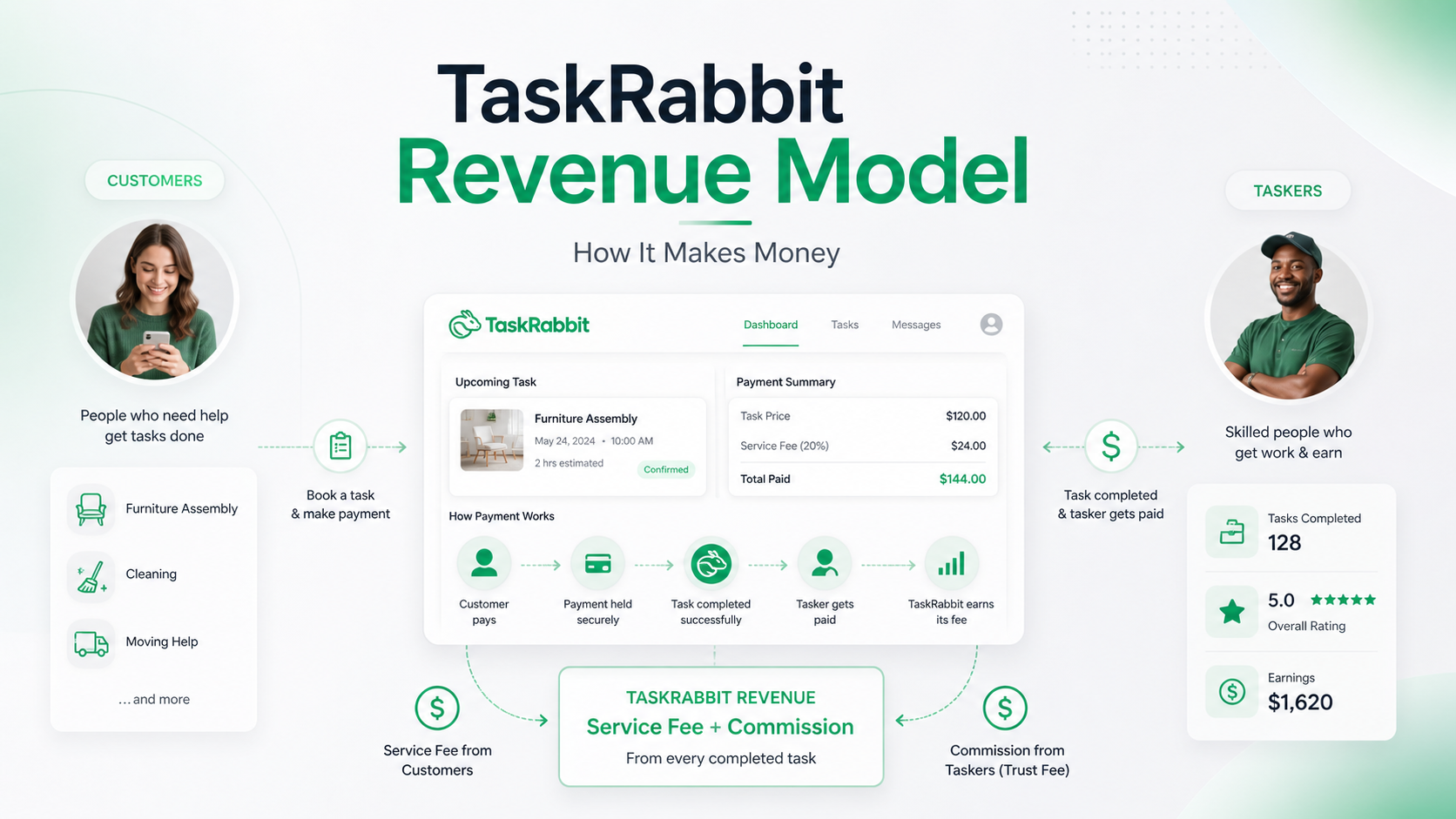

TaskRabbit makes money by owning the transaction layer between customers and freelancers.
Every time a task gets completed on the platform, TaskRabbit takes a cut from both sides. Customers pay a service fee at checkout. Taskers pay a commission (called a trust fee) from their earnings. That dual-sided take rate is the core of the entire model.
The business does not deliver a single service itself. It does not employ a single Tasker. It simply enables transactions and collects a percentage of every one.
What TaskRabbit Actually Is
TaskRabbit is a two-sided marketplace for local, on-demand services.
On one side, you have demand. People who need help with furniture assembly, moving, cleaning, handyman work, and dozens of other household tasks. On the other side, you have supply. Freelancers called Taskers who list their availability and hourly rates, and accept jobs through the app.
The platform sits in the middle. It handles discovery, booking, payments, and trust. It does not touch the actual service delivery.
One thing most people overlook: TaskRabbit is owned by IKEA. That is not just a corporate footnote. That ownership gives TaskRabbit a built-in demand channel that most marketplaces would pay hundreds of millions to acquire. More on that below.
The Core Business Model
TaskRabbit operates on a pure marketplace model.
Here is the simple flow that drives every dollar of revenue:
A user posts a task with their location, timeline, and budget range. A Tasker accepts the job. The work gets done. Payment processes automatically through the platform. TaskRabbit takes its cut before the Tasker receives anything.
That’s it. No inventory. No employees doing the work. No operational complexity at the service level.
Why this matters for founders: A pure marketplace is one of the most scalable business models in existence because the platform does not need to grow headcount proportional to revenue. When more transactions happen, more revenue flows in without a matching increase in labor costs. The leverage is structural, not operational.
The challenge, which we will get to, is that building and maintaining marketplace liquidity is genuinely hard. But once you have it, the model compounds.
Revenue Model of TaskRabbit
Customer Service Fee
Every customer pays a service fee at checkout. This fee is added on top of whatever the Tasker charges for the job.
The fee scales with every transaction. If task volume grows, this revenue grows automatically. TaskRabbit does not need to renegotiate contracts or change pricing strategy. The model captures value passively as the marketplace grows.
This is demand-side monetization. The customer is paying for convenience, trust, and access to vetted Taskers. They are not just paying for the task itself.
Tasker Commission (Trust Fee)
On the supply side, Taskers pay what TaskRabbit calls a trust fee. This is a percentage deducted from their earnings on each completed job.
This creates dual monetization. The platform collects from both sides of every transaction. Most gig platforms only monetize one side aggressively. TaskRabbit does both, which is why its effective take rate is higher than it appears when you look at either fee in isolation.
Founder note: Dual-sided monetization is powerful but has a ceiling. Push commissions too high and Taskers leave or start taking jobs off-platform. TaskRabbit manages this tension by positioning the fees as payment for trust infrastructure, insurance, and guaranteed payment protection, not just lead generation.
The IKEA Demand Engine
This is the most underappreciated part of the TaskRabbit model.
When someone buys furniture at IKEA, they are offered the option to book a Tasker for assembly right at the point of purchase. The customer is already in a buying mindset. They just spent money on a product. The incremental decision to add assembly is low-friction.
This is embedded demand. IKEA sends TaskRabbit a stream of high-intent customers who are ready to convert immediately.
What this does to unit economics: Customer acquisition cost drops significantly when demand is built into a partner’s purchase flow. TaskRabbit does not need to run a separate campaign to convince someone they need furniture assembled. IKEA already created that need. TaskRabbit just captures it.
For context, paid customer acquisition in marketplace businesses is expensive and unpredictable. The IKEA channel removes a major cost from the demand-generation equation. That is a structural cost advantage most competitors cannot replicate.
Pricing Influence and Indirect Revenue Uplift
TaskRabbit does not set Tasker prices, but it shapes them.
The platform provides suggested hourly rates based on category, geography, and demand signals. Taskers who are new to the platform often anchor to these suggestions. The platform also shows demand data that nudges Taskers toward competitive but market-rate pricing.
Why does this matter for revenue? TaskRabbit’s cut is a percentage of the transaction value. Higher transaction values mean more absolute revenue per task, even at the same take rate.
This is indirect monetization. TaskRabbit benefits from higher task prices without raising its own fees.
Cancellation and Protection Fees
These are smaller revenue contributors but they serve two purposes.
First, they generate consistent, low-volume revenue from every cancellation or protection claim. Second, they enforce platform discipline. Taskers and customers who cancel frequently or behave in ways that damage marketplace integrity face financial consequences.
This keeps the platform quality high, which supports repeat usage and GMV growth over time.
B2B and Bulk Services
TaskRabbit has a commercial side that most coverage ignores.
Businesses use the platform for office furniture assembly, event setup, moving assistance, and recurring facility tasks. The average order value on B2B tasks is significantly higher than consumer tasks. Higher AOV at similar take rates means more absolute revenue per transaction.
The B2B segment is also stickier. A business that regularly uses TaskRabbit for office needs becomes a recurring revenue source without continuous re-acquisition spending.
Unit Economics
Most content about TaskRabbit skips this section. Founders should not.
The average order value on TaskRabbit sits roughly in the range of $80 to $150 per task. The combined take rate across service fees and trust fees lands somewhere between 15% and 30% depending on task size and category.
Doing simple math: on a $100 task, TaskRabbit captures roughly $20 in gross revenue.
That sounds thin until you think about volume. TaskRabbit has millions of tasks completed per year across dozens of service categories and geographies. At scale, $20 per task across millions of transactions compounds into substantial revenue.
The honest insight: This is a volume model, not a margin model. Profitability depends on maintaining low customer acquisition costs, high repeat usage rates, and operational leverage in trust and safety infrastructure. If any of those three variables deteriorates, the unit economics get squeezed quickly.
The IKEA channel addresses the acquisition cost problem directly. Repeat usage is driven by product quality and Tasker reliability. Trust and safety is an ongoing operational investment that never fully goes away.
The Demand-Supply Flywheel
TaskRabbit’s growth engine is a classic marketplace flywheel.
More users posting tasks attracts more Taskers who want to earn income. More Taskers on the platform means faster fulfillment and more service category coverage. Better fulfillment creates better customer experiences. Better experiences drive repeat usage and referrals. Repeat usage and referrals bring more users, restarting the cycle.
Revenue grows as a byproduct of liquidity improvement, not just traffic volume.
This is a critical distinction. Many marketplace founders optimize for traffic when they should be optimizing for liquidity. Liquidity means there are enough buyers and sellers in a specific geography and category that matches happen quickly and reliably. TaskRabbit has geographic liquidity in most major US cities. That liquidity is a moat that takes years and significant capital to build.
A competitor can copy the app. They cannot instantly copy the Tasker base in 50 cities.
Distribution Strategy
TaskRabbit does not rely primarily on paid advertising to drive demand. That is a deliberate choice and a structural advantage.
IKEA integration is the centerpiece. As covered above, this creates embedded demand at the point of purchase. It is an acquisition channel that scales with IKEA’s own retail traffic, not with TaskRabbit’s ad budget.
SEO for local service intent is the second major channel. Searches like “furniture assembly near me” or “handyman services Chicago” represent high purchase intent. TaskRabbit has invested in capturing these searches through local landing pages and category-specific content. These are customers who are actively looking for exactly what TaskRabbit offers.
App-based repeat usage is the third channel. Once a customer books a task and has a good experience, the app becomes the default tool for future tasks. Repeat customers have zero acquisition cost on subsequent bookings.
The combination of embedded demand, organic search, and repeat usage creates a distribution model that is less dependent on paid media than most consumer marketplaces. That matters enormously for long-term margin sustainability.
Cost Structure
The marketplace model looks capital-light from the outside. It is, compared to a business that owns inventory or employs service workers. But there are real costs that compress margins.
Customer acquisition still requires meaningful investment in SEO, content, app store optimization, and some paid channels to expand into new geographies.
Platform and engineering is a continuous cost. The matching algorithm, payment infrastructure, scheduling tools, and app experience all require ongoing development. Two-sided marketplaces have more product complexity than single-sided businesses.
Trust and safety systems are expensive and non-negotiable. Background checks for Taskers, fraud detection, dispute resolution, and insurance coverage all cost money. These are not optional line items. They are the foundation of the value proposition.
Customer support is another real cost. When tasks go wrong, customers and Taskers both need resolution. Marketplace support is inherently more complex than traditional e-commerce support because the platform is mediating between two parties, not just handling a return.
Founder takeaway: Marketplace gross margins can look attractive in the aggregate, but trust infrastructure is a permanent, significant cost line. Any marketplace model that underinvests in trust will face quality degradation and eventual churn on both sides.
Competitive Positioning
TaskRabbit competes in the local services marketplace category, but its positioning is distinct from its closest rivals.
Urban Company takes a more controlled approach. They standardize service delivery more heavily and exert more operational control over service providers. This produces more consistency but also more operational overhead. Urban Company looks more like a managed marketplace than a pure marketplace.
Thumbtack operates primarily as a lead generation platform. Professionals pay for leads, but transactions do not necessarily process through Thumbtack. This means Thumbtack monetizes at the top of the funnel, not the transaction. TaskRabbit monetizes at the transaction itself, which creates different incentive structures.
Fiverr focuses on digital freelance services, not local physical tasks. The overlap with TaskRabbit is minimal. They compete for freelancer attention on the supply side but serve fundamentally different demand.
TaskRabbit’s positioning is local, flexible, and fast. The speed of the on-demand model, the geographic focus on local services, and the flexibility in Tasker pricing and availability are the differentiating dimensions. The IKEA integration adds a unique demand advantage that no direct competitor has.
What Makes This Model Work
Strip away all the details and four things make the TaskRabbit revenue model function.
Asset-light structure. TaskRabbit does not own equipment, employ Taskers, or manage service delivery logistics. This keeps the capital requirements low and the margin profile significantly better than a traditional service business.
Dual monetization. Collecting from both sides of every transaction doubles the revenue capture per GMV dollar without requiring additional transactions.
Trust infrastructure. Background checks, payment protection, and dispute resolution create the confidence that makes customers willing to let strangers into their homes. Remove trust and the demand side collapses.
Built-in demand via IKEA. This is the differentiator that makes the model defensible. Embedded demand at point-of-purchase with a global retail partner is not something a competitor can replicate with a product decision or a budget line.
Where the Model Breaks
Honest analysis requires looking at the failure modes too.
Quality inconsistency is the core risk on the supply side. Because Taskers are independent contractors with varying skill levels, the customer experience can be wildly inconsistent across the same category in the same city. A bad experience does not just lose one customer. It damages trust in the platform brand.
Tasker churn is a structural challenge in any gig marketplace. Taskers have low switching costs. When a competitor offers better terms, or when a Tasker builds enough of a client base to work independently, they leave. Maintaining Tasker supply requires continuous value delivery to the supply side.
Off-platform leakage is a real problem. Once a customer and Tasker establish a relationship, there is financial incentive for both to transact outside the platform and avoid fees. TaskRabbit manages this through terms of service and trust mechanisms, but it is an ongoing leak in the model.
Geographic density requirements limit expansion velocity. The model only works when there is sufficient supply density to fulfill demand quickly. Low-density markets have slow match times, which produces bad customer experiences, which suppresses repeat usage, which prevents the flywheel from spinning.
Future Monetization Opportunities
The current model captures revenue at the transaction level. There are several adjacent opportunities that could expand that capture.
Subscription plans for customers could offer priority booking, reduced service fees, or dedicated Tasker access for a monthly fee. This creates predictable recurring revenue and increases retention on the demand side. Amazon Prime demonstrated that customers will pay for access and convenience. The same logic applies here.
SaaS tools for Taskers could include scheduling software, client management, invoicing tools, or business analytics. High-earning Taskers who treat this as a primary income source would pay for productivity tools. This monetizes the supply side beyond commission.
AI-based matching improvements could increase match rates and speed, which improves GMV without increasing take rate. Better matching means fewer abandoned searches and more completed tasks. Revenue grows as a byproduct of product quality.
Deeper retail integrations beyond IKEA could add additional embedded demand channels. Any retailer that sells products requiring installation, assembly, or delivery could be a potential integration partner. Appliance retailers, flooring companies, and furniture brands beyond IKEA all represent addressable opportunities.
Key Metrics Founders Should Track
If you are building a marketplace and using TaskRabbit as a reference model, these are the numbers that matter.
GMV (Gross Merchandise Value) is the total value of all transactions processed through the platform. This is the top-line measure of marketplace scale. Revenue is derived from GMV through the take rate.
Take rate is the percentage of GMV captured as revenue. For TaskRabbit, this is the combined customer service fee and Tasker trust fee. Take rate trends up or down as a signal of pricing power and competitive pressure.
Repeat usage rate measures what percentage of customers return for a second task. In marketplace businesses, repeat usage is the primary driver of long-term unit economics. Acquiring a customer is expensive. Retaining them is cheap. A high repeat rate means the model is healthy.
Task completion rate measures what percentage of posted tasks actually get completed. This is a liquidity metric. Low completion rates signal supply shortages, geographic gaps, or matching failures. High completion rates confirm that the flywheel is working.
Lessons for Founders
The TaskRabbit model contains several principles that transfer to marketplace building broadly.
Build a marketplace, not a service. TaskRabbit does not clean houses or assemble furniture. It connects people who need those things done with people who do them. The distinction sounds semantic but it is fundamental to unit economics, scalability, and defensibility.
Own the payment layer. Control of the transaction is what allows TaskRabbit to take its cut reliably and reduce off-platform leakage. Marketplaces that allow payment to happen outside the platform eventually lose the ability to monetize at scale.
Distribution partnerships beat paid ads. The IKEA relationship is worth more than any paid acquisition channel TaskRabbit could build. Strategic distribution embedded into a partner’s purchase flow produces high-intent, low-cost customers. Founders should pursue these relationships aggressively and early.
Liquidity beats features. A marketplace with limited supply in a given city is not useful regardless of how good the app is. Customers do not care about feature sets if their task cannot get matched in a reasonable time. Build supply density in one market before expanding. Thin coverage in many markets is worse than deep coverage in a few.
Final Take
The TaskRabbit revenue model is straightforward in its structure. Take a percentage of every task completed on both sides of the transaction. That is the model.
But the model only works because of three things that are genuinely hard to build: distribution through IKEA, a trust system that makes customers comfortable with strangers, and marketplace liquidity deep enough to fulfill demand reliably.
A competitor could launch an identical fee structure tomorrow. They could not replicate the IKEA channel, the years of Tasker supply-building, or the trust infrastructure that backs every transaction.
That gap between model simplicity and execution complexity is exactly why marketplace businesses are hard to compete against once they reach scale, and why most attempts to clone them fail.
FAQs
TaskRabbit earns revenue by charging a service fee to customers at checkout and a trust fee (commission) from Taskers on each completed task. Both fees apply to every transaction, creating dual-sided monetization.
The combined take rate is estimated at roughly 15% to 30% per transaction depending on task size and category. The customer service fee and Tasker trust fee together represent TaskRabbit’s total revenue capture per job.
TaskRabbit does not publish standalone financials as it is owned by IKEA. Profitability details are not publicly disclosed. The model is structurally capable of profitability at scale given its asset-light structure and dual monetization, but exact figures are not available.
IKEA acquired TaskRabbit in 2017. TaskRabbit continues to operate independently under IKEA ownership, with the integration providing a significant built-in demand channel through IKEA’s global retail presence.
Discover more from Business Model Hub
Subscribe to get the latest posts sent to your email.