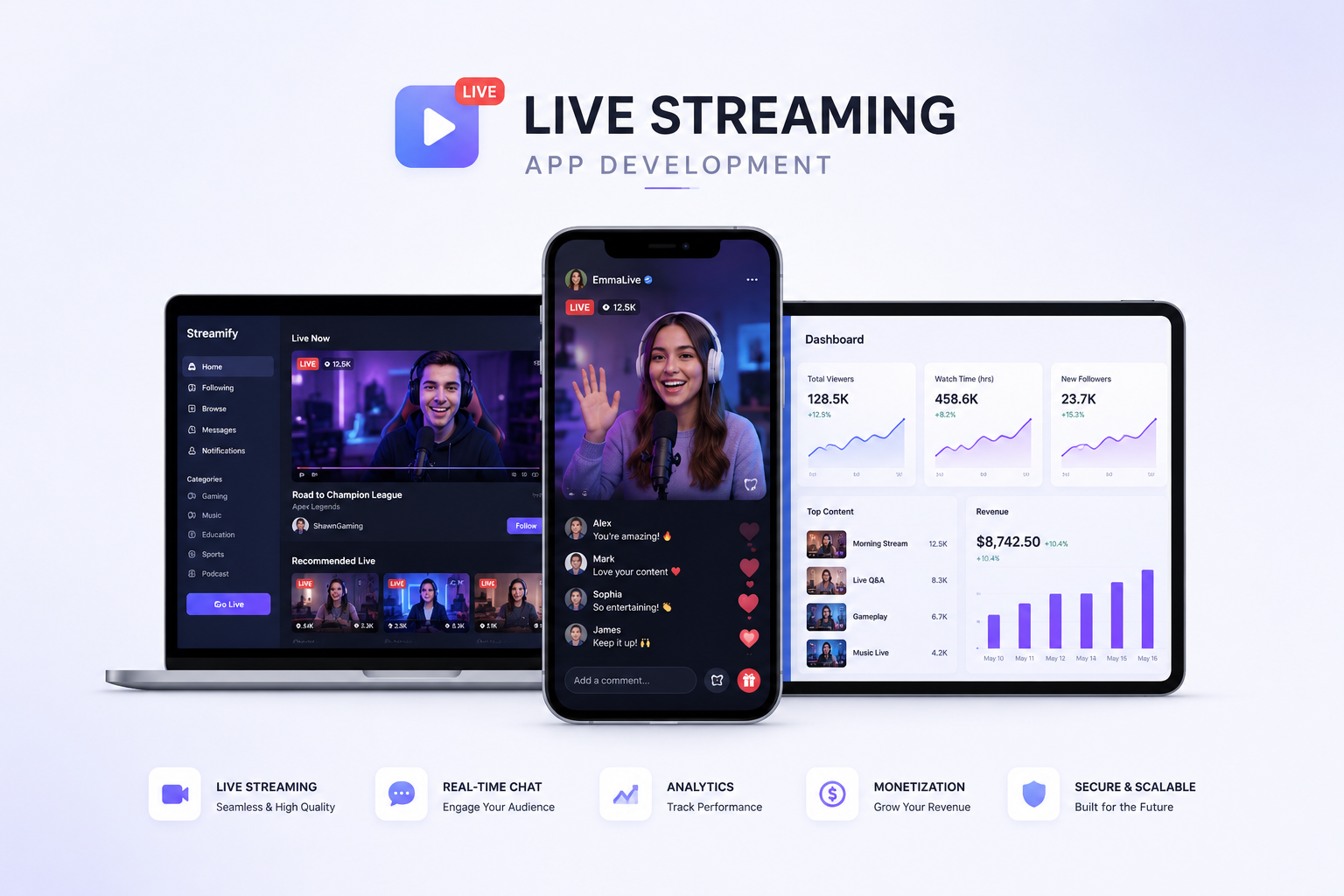

Live streaming is no longer a niche feature. It is a core product strategy for startups, media companies, fitness brands, gaming platforms, and creators worldwide.
The global live streaming market is projected to exceed $247 billion by 2027, growing at a CAGR of over 28%. Platforms like Twitch, YouTube Live, TikTok Live, and Netflix Live Events have proven that real-time content drives massive user engagement and revenue.
If you are a startup founder, product manager, or business owner exploring live streaming app development, this guide covers everything: business models, monetization strategies, must-have features, AI integration, tech stack, development cost, and how to build a scalable streaming platform from scratch.
Have a live streaming app idea? Business Model Hub helps you validate it, model the revenue, and connect with developers who can build it. Free to start.
What is Live Streaming App Development?
Live streaming app development is the process of designing, building, and deploying a mobile or web application that allows users to broadcast and consume real-time video or audio content.
Unlike pre-recorded video streaming (think Netflix originals or YouTube uploads), live streaming delivers content instantly as it happens. There is virtually no delay between what the broadcaster does and what the audience sees.
How live streaming apps work:
- A broadcaster captures video/audio through a device
- The stream is encoded and sent to a media server
- The server processes and distributes the stream via a CDN
- Viewers receive the stream through adaptive bitrate playback
Types of live streaming:
- Live video streaming (social, events, news)
- Audio streaming (podcasts, radio)
- Gaming streaming (Twitch, Kick)
- Event streaming (concerts, sports, conferences)
- OTT live streaming (Disney+, Peacock live sports)
The difference between video streaming and live streaming comes down to latency and delivery method. Live streaming demands ultra-low latency, real-time encoding, and massive scalable infrastructure.
Why Businesses Are Investing in Live Streaming Apps
Massive Growth of the Creator Economy
Over 200 million creators worldwide are actively monetizing content. Live streaming gives creators a direct, unfiltered connection to their audience. Platforms that support creator monetization attract and retain talent, which drives user growth.
Rise of Online Events and Virtual Communities
Post-pandemic behavior permanently shifted how people attend events. Virtual concerts, live fitness classes, online church services, and corporate town halls are now standard. Businesses need streaming infrastructure to serve these communities.
Higher User Engagement
Live content generates significantly more engagement than static video. Viewers spend three times longer watching live video compared to pre-recorded content. Real-time comments, reactions, and interactive polls create a two-way experience that keeps users hooked.
Monetization Opportunities
Live streaming apps support multiple revenue streams simultaneously. Subscriptions, virtual gifts, pay-per-view events, brand sponsorships, and ad revenue can all run on the same platform. This makes streaming one of the highest-revenue app categories available.
AI-Based Personalized Streaming
AI recommendation engines now serve hyper-personalized content feeds based on viewing behavior, location, and engagement patterns. This dramatically increases session duration and reduces churn.
Market Statistics:
- Live streaming market size: $70+ billion in 2024
- Expected to hit $247 billion by 2027
- Over 1.1 billion people watched live streams in 2023
- Gaming streaming alone generates $3+ billion annually
- OTT platforms collectively crossed $300 billion in revenue in 2024
Popular Types of Live Streaming Apps
Social Live Streaming Apps
These apps let everyday users go live and interact with followers in real time.
Examples: Instagram Live, TikTok Live, Facebook Live
Key characteristics include real-time comments, virtual gifts, live reactions, and follower notifications. Monetization happens through gifting, brand deals, and platform ad revenue sharing.
Gaming Streaming Apps
Dedicated platforms for gamers to broadcast gameplay, interact with fans, and build communities.
Examples: Twitch, Kick, YouTube Gaming
These platforms are built around long-session viewing, chat culture, subscriber tiers, and emote customization. They generate revenue through subscriptions, Bits (virtual currency), and ads.
OTT Streaming Apps
Over-the-top platforms deliver premium video content directly to users without cable or satellite. Many now include live sports and events.
Examples: Netflix, Disney+, Peacock, Paramount+
OTT platforms rely heavily on subscription revenue and original content investment to retain users.
E-learning Live Streaming Apps
Educational platforms use live streaming for instructor-led classes, coding bootcamps, tutoring sessions, and corporate training.
Examples: Coursera live sessions, Udemy live Q&As, Kajabi
These platforms typically combine live sessions with recorded course libraries.
Fitness Live Streaming Apps
Fitness brands use live streaming for group classes, personal training sessions, and wellness content.
Examples: Peloton, Obé Fitness, Apple Fitness+
Subscription models dominate this category, with premium pricing justified by instructor quality and community features.
Corporate Streaming Platforms
Enterprises use private streaming platforms for all-hands meetings, product launches, investor presentations, and training programs.
These platforms prioritize security, access control, recording capabilities, and integration with tools like Slack, Zoom, and Microsoft Teams.
Live Streaming App Business Model
Choosing the right business model is the most important decision you will make before development begins. Your entire feature set, tech stack, and monetization infrastructure depends on it.
Subscription Model
Users pay a monthly or annual fee for access to content.
This works best for OTT platforms, fitness apps, and e-learning platforms. It provides predictable recurring revenue and low transaction friction. Tiers (basic, premium, family) allow upselling.
Advertisement Model
Revenue comes from pre-roll, mid-roll, and banner ads shown during streams.
This model works well for social streaming platforms with high traffic volume. Free access drives user growth, while advertisers pay for attention. The trade-off is user experience; too many ads increase churn.
Pay-Per-View Model
Users pay a one-time fee to access a specific live event.
This works exceptionally well for sports events, concerts, comedy specials, and professional conferences. High-demand events can generate six to seven figures in a single broadcast.
Freemium Model
Core features are free. Premium features require payment.
This is a hybrid approach that converts casual viewers into paying subscribers over time. Common gated features include HD quality, ad-free viewing, offline downloads, and exclusive creator content.
Creator Monetization
Platforms take a revenue cut from creator earnings. Creators generate income through:
- Donations and tips from fans
- Virtual gifts (coins, stars, roses)
- Super chats during live broadcasts
- Channel subscriptions
- Paid shoutouts and memberships
This model aligns platform and creator incentives. When creators earn more, they invest more in content quality, which attracts more viewers.
Affiliate and Sponsorship Revenue
Creators or the platform promote products during live streams. Revenue comes from affiliate commissions or flat-rate brand deals.
This model works well alongside other monetization methods and does not require a large user base to generate meaningful revenue.
Want to validate your streaming app business model before you build? Business Model Hub helps founders map out revenue streams, validate pricing strategies, and build sustainable app business models. Explore it before you write a single line of code.
Essential Features of a Live Streaming App
User Features
- User registration and social login: Support email, Google, Apple, and Facebook sign-in
- User profiles: Display name, bio, follower count, streaming history
- Follow and subscription system: Let users subscribe to creators for notifications
- Live comments: Real-time chat during broadcasts
- Reactions and emojis: Animated reactions visible to all viewers
- Watch history: Resume where you left off, track previously viewed streams
- Push notifications: Alert users when followed creators go live
Streamer Features
- Go live functionality: One-tap or scheduled broadcast initiation
- Stream scheduling: Let creators announce upcoming streams in advance
- Audience analytics: Real-time viewer count, geographic data, engagement rate
- Multi-camera streaming: Switch between camera angles during broadcast
- Monetization dashboard: Track earnings, withdrawals, and subscriber growth
Admin Features
- Content moderation: Flag, review, and remove policy-violating content
- User management: Ban, warn, and manage accounts at scale
- Revenue tracking: Platform-wide financial reporting and payout management
- AI moderation tools: Automated detection of inappropriate content
AI Features
These features separate modern streaming platforms from outdated ones:
- AI subtitles: Real-time auto-captioning in multiple languages
- AI content recommendations: Personalized stream suggestions based on behavior
- AI moderation: Detect nudity, hate speech, and spam automatically
- AI clipping: Automatically detect and clip highlight moments from streams
- AI thumbnails: Generate optimized thumbnails from stream frames
- AI translation: Real-time dubbing or subtitle translation
- AI chatbot integration: Answer viewer questions and automate moderation
Technology Stack for Live Streaming App Development
Frontend Development
- React Native: Cross-platform mobile development (iOS and Android from one codebase)
- Flutter: High-performance cross-platform apps with custom UI
- Swift: Native iOS development for performance-critical features
- Kotlin: Native Android development
Backend Development
- Node.js: High-performance, event-driven backend ideal for real-time features
- Python: AI/ML model integration, data processing, analytics
- Go: Ultra-fast backend services for latency-sensitive streaming functions
Streaming Protocols
- RTMP (Real-Time Messaging Protocol): Standard for ingesting streams from broadcasting software
- HLS (HTTP Live Streaming): Apple’s adaptive bitrate streaming protocol, widely supported
- WebRTC: Ultra-low latency (sub-second) for interactive live experiences like video calls and auctions
Cloud Infrastructure
- AWS: EC2 for compute, S3 for storage, AWS Elemental for video processing
- Google Cloud: Media CDN, Transcoder API, Firebase for real-time features
- Azure: Azure Media Services, Azure CDN
CDN and Storage
- Cloudflare Stream: Global CDN optimized for video delivery
- AWS CloudFront: Scalable content delivery integrated with AWS ecosystem
- Backblaze B2: Cost-effective storage for recorded stream archives
AI Technologies
- OpenAI APIs: GPT-4 for chatbots, Whisper for real-time transcription
- AWS Rekognition: AI-powered content moderation
- Custom recommendation engines: Built with TensorFlow or PyTorch
- Dolby.io: Real-time audio enhancement for stream quality
Step-by-Step Live Streaming App Development Process
Market Research and Niche Selection
Before development, identify your target audience and niche. Trying to compete directly with YouTube or Twitch from day one is a losing strategy. Find an underserved vertical: niche sports, local language content, professional communities, or industry-specific streaming.
Choosing Your Business Model
Define how you will make money before writing a single line of code. Your monetization model directly impacts which features you build, how you price tiers, and what infrastructure you need.
UI and UX Design
Design the user journey from onboarding to first stream viewed. Focus on low friction: new users should be able to find content and start watching within 60 seconds of download. Use wireframes and prototypes to validate flows before development begins.
MVP Development
Build only the core features needed to prove your concept. A streaming MVP typically includes user registration, basic stream playback, live chat, and one monetization method. Launch fast, collect data, and iterate.
Backend Infrastructure Setup
Set up your cloud infrastructure, media server, database, and API layer. This is where architecture decisions matter most. Choosing the wrong database or streaming protocol at this stage creates expensive technical debt later.
Video Streaming Integration
Integrate your chosen streaming protocols (RTMP for ingest, HLS for playback). Set up transcoding to support multiple quality levels (1080p, 720p, 480p, 360p) for adaptive bitrate delivery.
AI Integration
Add AI features after your core streaming pipeline is stable. Start with the highest-impact features: content recommendations, auto-captions, and basic moderation. Expand AI capabilities in later iterations.
Testing and QA
Test across devices, network conditions, and geographic locations. Streaming apps must be tested under low-bandwidth conditions, with concurrent users simulated to identify bottleneck points.
App Launch
Submit to the App Store and Google Play. Plan a launch strategy: creator partnerships, press coverage, and targeted paid acquisition in your niche.
Scaling and Optimization
Monitor server costs, latency metrics, and user retention closely after launch. Scale infrastructure proactively before traffic spikes, not after.
Common mistakes startups make while building streaming platforms:
- Underestimating CDN and bandwidth costs
- Skipping adaptive bitrate streaming
- Building too many features before validating core demand
- Ignoring content moderation infrastructure
- Not planning for creator onboarding from day one
How AI is Transforming Live Streaming Apps
AI Content Recommendations
Recommendation engines analyze watch history, engagement patterns, and user demographics to surface relevant streams automatically. Platforms using AI recommendations see 30-40% longer session times.
AI-Based Video Moderation
Manual content moderation cannot scale with live video volume. AI moderation systems detect nudity, violence, hate speech, and spam in real time, flagging content for human review or automatically removing it.
AI Auto Captions
Real-time transcription (powered by models like OpenAI Whisper) makes streams accessible to deaf and hard-of-hearing audiences, and boosts discoverability through searchable transcripts.
AI-Powered Analytics
AI analytics platforms break down viewer drop-off points, predict churn, identify peak engagement moments, and give streamers actionable data to improve future broadcasts.
AI Video Clipping
AI identifies the most engaging moments in a live stream (based on chat spikes, reaction volume, and audio analysis) and automatically generates shareable clips for social media.
Personalized Streaming Feeds
Instead of a generic content grid, AI builds a unique homepage for every user. Netflix reports that its AI recommendation engine saves the company over $1 billion annually by reducing churn.
AI Search Optimization
AI-powered search understands natural language queries. Instead of keyword matching, users can search for things like “beginner yoga class under 30 minutes” and get relevant results.
Emerging AI capabilities in streaming:
- Generative AI avatars for virtual hosts
- Real-time voice and language translation
- AI-generated highlight reels
- Synthetic media and deepfake detection
Live Streaming App Development Cost
Cost Breakdown by Component
| Component | Estimated Cost |
|---|---|
| UI/UX Design | $3,000 to $15,000 |
| Frontend Development | $10,000 to $40,000 |
| Backend Development | $15,000 to $50,000 |
| Streaming Server Setup | $5,000 to $20,000 |
| CDN and Storage | $500 to $5,000/month |
| AI Integration | $10,000 to $40,000 |
| QA and Testing | $3,000 to $10,000 |
| Ongoing Maintenance | $3,000 to $8,000/month |
Pricing by App Type
| App Type | Estimated Cost |
|---|---|
| MVP Streaming App | $15,000 to $40,000 |
| Mid-Level Platform | $50,000 to $120,000 |
| Enterprise OTT Platform | $150,000 and above |
Factors That Affect Development Cost
Features and complexity: More features mean more development hours. AI features, multi-camera support, and real-time translation add significant cost.
Scalability requirements: Building for 1,000 concurrent users is fundamentally different from building for 1 million. Infrastructure architecture decisions affect cost significantly.
AI integration: Off-the-shelf AI APIs (like OpenAI or AWS Rekognition) cost less than custom-trained models. Your choice here affects both build cost and ongoing operational cost.
Security requirements: DRM implementation, end-to-end encryption, and compliance with GDPR or CCPA add development time.
Team location: Development teams in the US or Western Europe typically charge $100 to $200 per hour. Teams in Eastern Europe charge $40 to $80 per hour. Teams in South Asia charge $20 to $50 per hour.
Challenges in Live Streaming App Development
Low Latency Streaming
Every extra second of delay hurts the live experience. For interactive streaming (auctions, Q&As, gaming), latency must be under one second. Achieving this requires WebRTC or similar ultra-low latency protocols and edge computing infrastructure.
Server Scaling
Traffic spikes during major live events can overwhelm unprepared infrastructure. Auto-scaling cloud architecture is mandatory. Pre-planned capacity for known high-traffic events is equally important.
Video Compression
High-quality video at scale consumes enormous bandwidth. Efficient codecs (H.264, H.265, AV1) and adaptive bitrate streaming reduce bandwidth without sacrificing perceived quality.
Copyright Protection
Preventing unauthorized redistribution of licensed content requires DRM (Digital Rights Management) systems like Widevine, FairPlay, and PlayReady. This adds complexity and licensing cost.
Data Security
Live streaming apps collect significant user data. Protecting this data against breaches, complying with regional privacy laws, and securing payment information are non-negotiable requirements.
Real-Time Chat Moderation
Live chat moves fast. Spam, harassment, and hate speech must be detected and removed in seconds, not minutes. AI moderation combined with trained human moderators is the standard approach.
Bandwidth Optimization
Mobile users on limited data plans need bandwidth-efficient streaming options. Adaptive bitrate streaming and data-saving modes are expected features in any modern streaming app.
Best Live Streaming Apps in the Market
YouTube Live
YouTube Live leverages the world’s largest video platform and search engine. Its business model combines ads, channel memberships, Super Chats, and YouTube Premium subscriptions. Growth is driven by creator tools, monetization incentives, and YouTube’s algorithm that pushes live content to relevant subscribers.
Twitch
Twitch dominates gaming streaming with a business model built on subscriptions, Bits (virtual currency), and ad revenue. User retention is driven by community culture, streamer loyalty, and exclusive gaming partnerships.
TikTok Live
TikTok Live integrates seamlessly into TikTok’s algorithm-driven feed. Monetization happens through virtual gifts. The discovery algorithm exposes live streams to non-followers, accelerating creator growth faster than any competing platform.
Netflix
Netflix uses a pure subscription model with no ads. Live sports and events are being added as a retention strategy. Its AI recommendation engine is the most sophisticated in the industry, responsible for 80% of content viewed on the platform.
Disney Plus
Disney Plus combines subscription revenue with Disney’s intellectual property library. It bundles with Hulu and ESPN Plus to increase perceived value and reduce churn. Live sports on ESPN Plus are a major subscriber acquisition driver.
How to Choose the Right Live Streaming App Development Company
Checklist for evaluating a development partner:
- Proven experience building streaming or OTT platforms (ask for portfolio)
- Deep understanding of streaming protocols (RTMP, HLS, WebRTC)
- AI integration expertise with references to real implementations
- Cloud infrastructure experience on AWS, GCP, or Azure
- Scalability track record with high-concurrency applications
- Strong UI and UX design capability for media-heavy apps
- Post-launch support and maintenance contracts
- Security implementation experience including DRM and encryption
- Transparent pricing with milestone-based billing
Building your streaming platform starts with the right business model. Visit Business Model Hub to explore proven app monetization frameworks, revenue model templates, and startup-ready business strategies for streaming and OTT platforms.
Future Trends in Live Streaming App Development
AI-Generated Live Content
Generative AI can now create real-time virtual hosts, AI news anchors, and synthetic streamers. Early adopters are already testing AI influencers that broadcast 24/7 without human intervention.
Interactive Streaming
The next evolution is two-way streaming where viewers influence content in real time. Polls, viewer-controlled cameras, branching storylines, and interactive games during live broadcasts are becoming expected features.
VR and AR Streaming
Spatial computing platforms like Apple Vision Pro and Meta Quest are opening new formats for immersive live streaming. Concerts, sporting events, and gaming broadcasts in VR will become mainstream within the next three to five years.
Blockchain Streaming Platforms
Decentralized streaming platforms use blockchain for transparent creator royalties, token-based monetization, and censorship-resistant content distribution. Projects like Livepeer are building decentralized video infrastructure.
Powered by Streaming
As 5G coverage expands globally, mobile streaming at 4K resolution with ultra-low latency becomes possible. This enables new use cases like live drone footage, real-time sports statistics overlays, and remote live production.
Creator Economy Expansion
The creator economy is projected to reach $500 billion by 2027. Streaming platforms that offer superior creator monetization tools, analytics, and community features will win the creator acquisition battle.
AI Influencers and Virtual Hosts
Virtual AI streamers are already popular in markets like Japan and South Korea. Western platforms are beginning to experiment with AI hosts for news, sports commentary, and entertainment broadcasting.
Wrap Up
Live streaming app development is one of the highest-opportunity categories in mobile and web product development right now. The infrastructure is mature, the audience behavior is established, and AI tools have dramatically lowered the barrier to building competitive features.
The businesses that win in this space will not just build streaming technology. They will build communities, creator ecosystems, and monetization infrastructure that keeps both creators and viewers locked into their platform.
Whether you are launching a niche OTT platform, a creator monetization app, a corporate streaming tool, or a gaming community, the fundamentals are the same: a solid business model, scalable infrastructure, meaningful creator tools, and AI-powered personalization.
Start with your business model. Validate your monetization strategy. Then build.
Have a live streaming app idea? Business Model Hub helps you validate it, model the revenue, and connect with developers who can build it. Free to start.
FAQs
A basic MVP streaming app costs between $15,000 and $40,000. A mid-level platform with AI features ranges from $50,000 to $120,000. Enterprise OTT platforms with full feature sets start at $150,000 and scale significantly based on complexity, team location, and AI integration scope.
The best tech stack depends on your use case. For ultra-low latency interactive streaming, WebRTC is the standard. For broad compatibility and adaptive bitrate delivery, HLS is the go-to choice. RTMP handles stream ingest from broadcasting tools. Most production platforms use a combination of all three.
Streaming apps generate revenue through subscriptions, advertising, pay-per-view events, virtual gifts, creator revenue sharing, brand sponsorships, and freemium upgrades. Most successful platforms use multiple revenue streams simultaneously rather than relying on a single model.
HLS (HTTP Live Streaming) is the most widely supported protocol for standard streaming delivery. WebRTC delivers sub-second latency for interactive use cases. RTMP is the standard for ingesting streams from OBS and similar broadcasting software. The right protocol depends on your latency requirements and audience device mix.
A basic MVP takes three to five months to build. A full-featured streaming platform with AI integration typically takes eight to fourteen months. Timeline depends on team size, feature scope, and infrastructure complexity.
Yes, significantly. AI improves content recommendations, automates moderation, generates real-time captions and translations, identifies highlight clips automatically, personalizes content feeds, and provides streamers with actionable analytics. Platforms with strong AI features see measurably higher engagement and lower churn.
OTT (over-the-top) refers to delivering video content over the internet without traditional cable or broadcast infrastructure. Live streaming is specifically about real-time content delivery. OTT platforms often include both live and on-demand content. All live streaming apps deliver content over the internet, but not all OTT platforms focus on live streaming.
Twitch uses RTMP to ingest streams from broadcasters, transcodes them into multiple quality levels, and delivers them globally via CDN using HLS. Real-time chat runs on WebSocket connections. Twitch monetizes through subscription fees split between the platform and creator, Bits (virtual currency purchased by viewers), and advertising revenue. Its recommendation algorithm surfaces streams to relevant viewers based on game category, tags, and viewer behavior.
Discover more from Business Model Hub
Subscribe to get the latest posts sent to your email.