
Most businesses fail not because they lack a good idea, but because they spend too much time, money, and energy building something nobody wants. Traditional business planning assumes you know what customers need before you ever talk to them. That assumption is expensive.
The lean business model flips that approach entirely. It puts customer feedback at the center of every decision, keeps costs low in the early stages, and treats every product launch as an experiment rather than a final answer.
Whether you are a first-time founder or a seasoned entrepreneur looking to cut waste, understanding the lean business model can change how you build, launch, and grow a business.
What Is a Lean Business Model?
Definition of Lean Business Model
A lean business model is a framework that focuses on building products or services with minimal waste by testing ideas quickly, gathering real customer feedback, and improving continuously.
Instead of spending years perfecting a product before launch, lean businesses ship a simple version first, measure how customers respond, and make improvements based on actual data.
The core philosophy is three words: Build. Measure. Learn.
Every cycle starts with building the simplest version of your idea. Then you measure how customers use it. Then you learn what to fix, change, or cut entirely. Then you repeat.
Origin of the Lean Business Model
The lean business model did not start in Silicon Valley. It traces back to the Toyota Production System developed in post-war Japan. Toyota engineers focused on eliminating waste, reducing inefficiency, and continuously improving manufacturing processes. That thinking became known as Lean Manufacturing.
Eric Ries later adapted these principles for startups in his book The Lean Startup, published in 2011. He argued that startups are not small versions of large companies. They operate under extreme uncertainty, and the only way to reduce that uncertainty is through rapid experimentation.
His work popularized terms like MVP, pivoting, and validated learning, which are now standard vocabulary in the startup world.
Why Businesses Prefer Lean Models Today
Markets move faster than they did a decade ago. Customer preferences shift. New competitors appear overnight. Technologies become obsolete within months.
In this environment, spending 18 months building a product based on assumptions is a serious risk. Lean models allow businesses to adapt in real time, cut losses early, and double down on what actually works.
That is why lean principles are used not just by startups but also by product teams inside large corporations like Google, Amazon, and General Electric.
Core Principles of the Lean Business Model
Customer-Centric Development
Every lean business starts with one question: what problem does my customer actually have?
Not the problem you assume they have. Not the problem that sounds interesting. The real, specific, painful problem they deal with daily and would pay to solve.
Customer-centric development means getting out of the building early. Talk to potential users before you build anything. Run surveys. Conduct interviews. Read reviews of competing products. The goal is to deeply understand the customer before spending a single dollar on development.
Minimum Viable Product
The MVP is one of the most important concepts in lean business strategy.
A minimum viable product is the simplest version of your product that still delivers value and allows you to test your core assumptions. It is not a half-baked product. It is a focused product that does one thing well.
Examples of MVPs include:
- Dropbox launched a demo video before writing a single line of code. The video explained what the product would do and measured how many people signed up for early access.
- Airbnb started by renting out air mattresses in the founders’ apartment to test whether strangers would pay to stay in someone else’s home.
- Zappos tested online shoe sales by posting photos from local shoe stores and only purchasing inventory after a customer actually placed an order.
None of these were polished final products. All of them validated demand before major investment.
Continuous Improvement
Lean businesses treat launch as a starting point, not a finish line.
After releasing a product or feature, the goal is to gather feedback as fast as possible and use it to improve the next version. This cycle of iteration keeps the product aligned with what customers actually want.
Continuous improvement is powered by feedback loops. These loops connect customer behavior back to your development process so that every update is informed by real data rather than internal opinion.
Waste Reduction
In lean thinking, waste is anything that does not create value for the customer.
This includes building features nobody uses, hiring too early, investing in expensive marketing before validating product-market fit, and running long planning cycles when quick experiments would give better answers.
Lean businesses are ruthless about cutting what does not matter so they can invest more in what does.
Data-Driven Decision Making
Gut feeling has its place. But lean businesses rely on metrics to make important calls.
Instead of debating whether a feature is good in a meeting room, lean teams test it with real users and look at the data. Conversion rates, retention figures, session lengths, drop-off points — these numbers reveal the truth faster than any internal opinion.
Data-driven decision making also reduces the influence of the loudest voice in the room. Numbers do not have opinions. They just tell you what is happening.
Key Components of a Lean Business Model
Problem Statement
Every lean business model starts with a clearly defined problem. Not a general industry challenge, but a specific problem your target customer faces regularly.
The more precisely you can define the problem, the better your solution will be.
Target Audience
Who experiences this problem? What do they look like? Where do they spend time? What else have they tried?
Defining your ideal customer as specifically as possible helps you build a solution that fits them precisely rather than vaguely serving everyone and delighting nobody.
Unique Value Proposition
Your unique value proposition is a single, clear statement that explains what you offer, who it is for, and why it is better than the alternatives.
This is not a slogan. It is the answer to the question: why should this customer choose you over every other option, including doing nothing at all?
Solution
Once the problem and customer are clear, you define your solution. In a lean model, the solution is always the simplest version that addresses the core problem. You can add complexity later. Start with the minimum.
Revenue Streams
How does the business make money? Lean businesses identify at least one clear revenue stream from the beginning.
Common models include subscriptions, one-time purchases, licensing, service fees, advertising, and marketplace commissions. The earlier you test your revenue model, the sooner you know whether the business is financially viable.
Cost Structure
What does it cost to run the business? Lean businesses aim to keep their cost structure as light as possible in the early stages.
This means avoiding long-term leases, large headcounts, and expensive infrastructure until the model is proven. Low costs extend your runway and give you more time to find product-market fit.
Channels
How do you reach your customers? Channels include organic search, paid advertising, social media, partnerships, email marketing, direct sales, and more.
Lean businesses test multiple channels early and then focus resources on the ones that deliver the best return.
Key Metrics
What numbers tell you whether the business is working? Choose a small set of metrics that directly reflect the health of your business and track them consistently.
Vanity metrics like total website visitors feel good but rarely tell you anything useful. Focus instead on metrics tied to revenue, retention, and customer satisfaction.
Lean Business Model vs Traditional Business Model
| Lean Business Model | Traditional Business Model |
|---|---|
| Fast experimentation | Long planning cycles |
| Customer feedback driven | Assumption driven |
| Low initial investment | High upfront investment |
| Flexible and adaptive | Rigid structure |
| Continuous iteration | Fixed product approach |
| Launch early, improve often | Launch once, hope for the best |
Which One Is Better?
Neither model is universally superior. The answer depends on your industry, your resources, and your goals.
Traditional business models work well in stable industries where regulations, infrastructure, or capital requirements demand detailed upfront planning. Construction, manufacturing, and pharmaceuticals often follow more traditional paths.
Lean models excel in fast-moving environments where customer preferences are uncertain, technology is evolving rapidly, and the cost of being wrong is high. Software, consumer apps, eCommerce, and digital services are natural fits for lean approaches.
For most startups today, lean is the smarter starting point.
Benefits of a Lean Business Model
Lower Business Risk
By testing assumptions early and cheaply, lean businesses avoid the biggest risk in entrepreneurship: spending years and capital building something that does not sell.
Failed assumptions discovered in week two cost a fraction of what they cost when discovered after a full product launch.
Faster Product Launch
Lean teams ship faster because they are not trying to build the perfect product. They are trying to build the right product. That shift in mindset cuts development time dramatically.
Getting to market faster also means getting real customer data faster, which accelerates every subsequent decision.
Better Customer Satisfaction
Products built with continuous customer input tend to solve real problems better than products built behind closed doors.
Lean businesses listen constantly. That listening produces products customers actually want to use, which drives higher satisfaction and stronger retention.
Improved Cash Flow Management
Lower upfront costs and faster revenue generation create healthier cash flow from the start.
Lean businesses do not need massive funding rounds to get off the ground. Many validate their models with minimal investment and only raise significant capital once they have proof that the business works.
Higher Innovation Potential
When teams are encouraged to experiment, test, and learn, innovation happens naturally.
Lean businesses create a culture where failure is treated as information rather than a catastrophe. That mindset unlocks creative thinking and leads to better, more original solutions.
Easier Scalability
Scaling a proven model is far easier than scaling an unproven one.
Lean businesses do not rush to scale. They first confirm that the product works, that customers love it, and that unit economics make sense. Then they scale with confidence.
Challenges of the Lean Business Model
Constant Testing Can Be Exhausting
The build-measure-learn cycle never really stops. For teams that want to ship and move on, the ongoing demand for testing and analysis can feel overwhelming.
Managing this requires strong systems, clear priorities, and a culture that embraces iteration as a permanent state rather than a temporary inconvenience.
Uncertain Revenue in Early Stages
Early-stage lean businesses often sacrifice short-term revenue to focus on learning. That can create financial pressure, especially for founders without significant savings or investor backing.
Having a clear timeline for when the business needs to become profitable is essential.
Difficulties in Scaling
Lean principles work beautifully at small scale. Applying them to a growing team, expanding operations, and a larger customer base requires deliberate effort.
Processes that worked informally when the team was small often need to be formalized as the business grows.
Requires Strong Customer Feedback Systems
Lean strategy depends entirely on good customer feedback. Without systems in place to collect, organize, and act on that feedback, the approach breaks down.
Building feedback channels early, whether through surveys, interviews, analytics, or customer support data, is not optional. It is foundational.
Risk of Frequent Changes
Iterating based on feedback is healthy. But pivoting too often in response to every piece of customer input creates instability and confuses your team.
Lean businesses need to balance responsiveness with focus. Not every piece of feedback requires a pivot.
How to Create a Lean Business Model
Step One: Identify a Real Customer Problem
Start with research, not ideas.
Talk to people in your target market. Ask them about their biggest frustrations. Look at forums, review sites, and social media to find patterns in what people complain about. Run surveys. Conduct one-on-one interviews.
Your goal at this stage is not to sell anything. It is to deeply understand a specific group of people and the problems they deal with regularly.
Step Two: Build a Minimum Viable Product
Once you have a validated problem, build the simplest possible solution.
Resist the urge to add features. Focus entirely on solving the core problem in the most direct way. Your MVP should be testable, usable, and reflective of your core value proposition. Nothing more.
Step Three: Test the Market
Release your MVP to a small group of real users.
Watch how they use it. Track where they drop off. Ask them what they love and what frustrates them. Monitor engagement metrics. The goal is to learn as much as possible from as few resources as possible.
Step Four: Analyze Data
After gathering feedback and usage data, sit down and interpret what you found.
Are users engaging with the core feature? Are they completing the key action you designed the product around? Where are they getting confused or leaving?
Let the data tell you what to fix before you decide anything.
Step Five: Improve and Pivot if Necessary
Based on your analysis, make changes to the product or strategy.
Sometimes those changes are small: fixing confusing UI, simplifying onboarding, or adjusting pricing. Sometimes the data points to something bigger: the problem you are solving is not painful enough, the target customer is wrong, or the solution needs to work differently.
A pivot is not a failure. It is a course correction based on evidence.
Step Six: Scale the Business
Once you have strong evidence of product-market fit, meaning customers love the product, retention is healthy, and unit economics make sense, it is time to scale.
Scaling after validation dramatically increases the odds of sustainable growth.
Lean Business Model Canvas Explained
What Is a Lean Canvas?
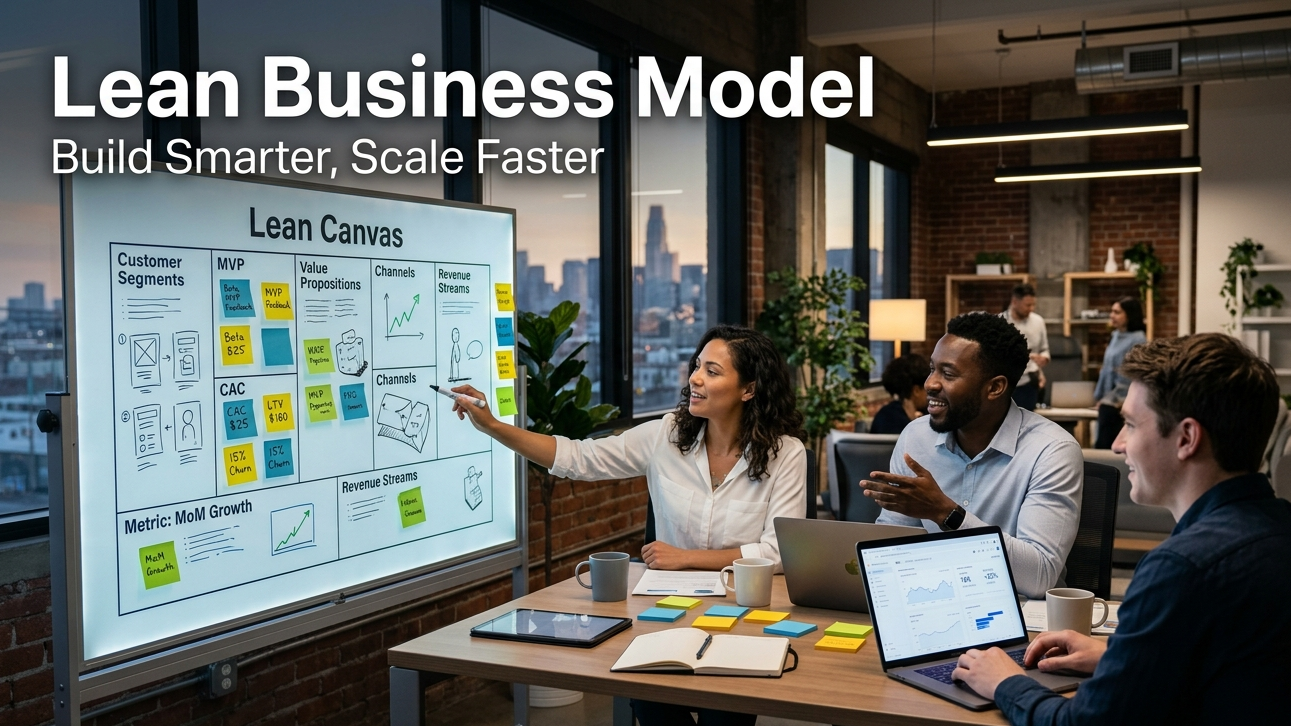
The Lean Canvas is a one-page business planning tool designed specifically for startups. It was created by Ash Maurya as an adaptation of the Business Model Canvas.
The goal is to capture your entire business model on a single page so you can identify gaps, test assumptions, and communicate your strategy quickly.
Main Sections of Lean Canvas
Problem: What are the top three problems your customer faces?
Solution: What is the simplest version of your solution for each problem?
Unique Value Proposition: Why should the customer choose you?
Customer Segments: Who are your target customers? Who are your early adopters?
Revenue Streams: How does the business make money?
Cost Structure: What are your major costs?
Channels: How do you reach and acquire customers?
Key Metrics: What are the numbers that tell you the business is working?
Unfair Advantage: What do you have that cannot be easily copied or bought?
Why Startups Use Lean Canvas
The Lean Canvas takes about 20 minutes to fill out. It forces clarity on every key assumption. And it can be updated as you learn, making it a living document rather than a static plan.
For early-stage founders, it is far more useful than a 40-page business plan that will be outdated in 90 days.
Real-World Examples of Lean Business Models
Airbnb
Airbnb did not start with a polished platform. The founders rented out air mattresses in their own apartment to test whether travelers would pay to stay in a stranger’s home.
When people did pay, they validated the core assumption: the demand was real. Only after that validation did they begin building the platform at scale.
Dropbox
Drew Houston built a demo video before writing the actual product code. The video showed how Dropbox would work and directed viewers to a waiting list.
Overnight signups confirmed massive demand. The product was built after the market was validated, not before.
Uber
Uber launched in a single city with a basic app and a small fleet. The founders tested the core experience, gathered feedback, iterated on the product, and only then expanded to new markets.
The lean approach let them prove the model before betting everything on it.
Spotify
Spotify has never stopped testing. New features are rolled out to small user groups first, measured for impact, and then expanded if the data supports it.
That continuous iteration is a defining characteristic of how Spotify has stayed competitive in a market that includes Apple, Amazon, and Google.
Industries That Benefit Most From Lean Business Models
Technology Startups are the most natural fit. Fast development cycles, low cost of iteration, and high uncertainty make lean principles essential.
SaaS Businesses can test features with subsets of users, measure adoption, and deploy updates within hours. The lean model is almost synonymous with modern SaaS development.
eCommerce Brands can test products, pricing, and marketing messages quickly without heavy inventory commitments. Dropshipping and print-on-demand models are inherently lean.
Mobile App Companies can ship updates constantly, run A/B tests, and gather usage data in real time. The app store environment rewards continuous improvement.
Digital Agencies can apply lean principles to service offerings by piloting new services with a small number of clients before scaling them across the business.
Subscription-Based Businesses benefit from lean iteration on onboarding, pricing tiers, and feature sets, each of which directly impacts churn and lifetime value.
Best Tools for Implementing a Lean Business Model
Project Management Tools
Trello is a visual board-based tool that helps teams track tasks across the build-measure-learn cycle. It is simple, flexible, and free for small teams.
Asana offers more structure than Trello and works well for teams that need to manage complex sprints and cross-functional projects.
Analytics Tools
Google Analytics is the standard starting point for tracking website behavior, traffic sources, and conversion funnels. It is free and powerful.
Mixpanel is designed specifically for product analytics. It tracks user behavior inside your product, making it ideal for understanding how people actually use what you build.
Customer Feedback Tools
Typeform makes it easy to create clean, conversational surveys that customers actually complete. Use it to collect structured feedback at key moments in the user journey.
Hotjar records user sessions and generates heatmaps so you can see exactly where users click, scroll, and drop off on your site or product.
Common Mistakes to Avoid in a Lean Business Model
Ignoring Customer Feedback
The most common and costly mistake. Lean strategy is only as good as the feedback it is built on. If you collect feedback and then ignore it, you lose the entire advantage of the model.
Building Too Many Features Early
Feature creep kills lean businesses. The temptation to add more before validating the core is constant. Resist it. Build less. Learn more.
Scaling Too Quickly
Scaling before validating product-market fit amplifies every flaw in your model. Wait until retention is strong, customers are recommending the product, and you understand your growth levers.
Focusing Only on Growth Instead of Profitability
Growth is easy to fake with paid advertising. Profitability is not. Lean businesses track unit economics from the beginning and make sure the model works financially before scaling.
Not Tracking Metrics Properly
Without proper measurement, you are running experiments without reading the results. Set up analytics before you launch. Define your key metrics in advance. Review them consistently.
Future of Lean Business Models
AI-Driven Lean Startups
AI tools are compressing every stage of the lean cycle. Market research, content creation, product development, and customer analysis that used to take weeks now take hours.
Lean startups using AI can run more experiments, learn faster, and iterate with a smaller team than was ever previously possible.
Faster Product Experimentation
No-code and low-code platforms allow founders to build and test MVPs without a development team. This removes one of the biggest bottlenecks in the lean process and opens the door for non-technical founders.
No-Code and Low-Code Development
Tools like Bubble, Webflow, and Glide allow teams to ship functional products in days. The barrier between idea and test has never been lower.
Customer Personalization Trends
Customers increasingly expect products to adapt to their individual needs. Lean businesses that build strong feedback loops are better positioned to deliver personalized experiences because they have more data and more practice acting on it.
Automation in Lean Operations
Automation handles the repetitive tasks that waste time in growing businesses: invoicing, customer onboarding, email sequences, support ticket routing. The leaner your operations, the more time your team has for high-value work.
Why Lean Business Models Matter for Startups
The startup failure rate is well documented. A large percentage of new businesses fail within their first five years.
Many of those failures share a common thread: they built products without validating demand, spent too much too fast, and could not adapt when the market gave them signals they needed to change.
The lean business model directly addresses each of these risks. It forces validation before significant investment. It keeps costs low while learning. It builds adaptability into the culture from day one.
For startups competing in markets dominated by well-funded incumbents, lean is not just a smart approach. It is often the only viable one.
Conclusion
The lean business model is not a shortcut. It is a smarter way to build.
It replaces assumptions with evidence, replaces long planning cycles with rapid experiments, and replaces the hope that a product will sell with proof that it does.
The businesses that succeed in competitive markets are rarely the ones with the biggest budgets or the most original ideas. They are the ones that listen best, adapt fastest, and use every data point to build something their customers genuinely need.
Start small. Test early. Listen constantly. Improve relentlessly. That is the lean business model in practice.
FAQs
To reduce waste and build products based on validated customer demand rather than internal assumptions.
An MVP is the simplest version of a product that delivers core value and allows the business to test its most important assumptions with real users.
No. Startups use it most visibly, but large companies including Google, Amazon, and General Electric apply lean principles inside product teams and innovation departments.
The Business Model Canvas is designed for established businesses. The Lean Canvas is designed for startups, with a stronger focus on problems, solutions, and rapid experimentation under uncertainty.
Absolutely. eCommerce is one of the best environments for lean principles. Businesses can test products, pricing, and marketing with minimal inventory risk and get real customer data quickly.
There is no fixed timeline. Some teams validate core assumptions within weeks. Others take several months. The key is designing clear experiments with measurable outcomes and acting decisively on what the data shows.
Discover more from Business Model Hub
Subscribe to get the latest posts sent to your email.