Minecraft Business Model And How Minecraft Makes Billions from a Block Game

Minecraft is one of the best-selling video games in history, with over 300 million copies sold across all platforms. What started as a solo indie project by Markus “Notch” Persson has grown into a multi-billion dollar franchise under Microsoft. The game generates revenue from game sales, in-game purchases, subscriptions, education licenses, merchandise, and media licensing.
What makes Minecraft’s business model stand out is that it does not rely heavily on advertising or aggressive monetization. Instead, it builds recurring income through community engagement, creative freedom, and platform expansion. This blog breaks down every layer of how Minecraft makes money and why the model continues to work decades after launch.
What Is Minecraft?
Minecraft is a sandbox video game that lets players build structures, explore worlds, gather resources, and survive in procedurally generated environments. There is no fixed storyline or end goal. Players create their own objectives, which is a key reason the game appeals to such a wide age range.
Launch History and Creator Background
Markus “Notch” Persson developed Minecraft and released the alpha version in 2009. The full release came in 2011 through his studio, Mojang. The game gained rapid traction through online communities, YouTube videos, and word of mouth.
Microsoft Acquisition
In 2014, Microsoft acquired Mojang and the Minecraft IP for $2.5 billion. This move gave Minecraft access to Microsoft’s infrastructure, enterprise education tools, Xbox ecosystem, and global distribution reach. Mojang continues to operate as a studio under Microsoft.
Core Gameplay Concept
Minecraft runs on three main gameplay modes. Survival mode requires players to gather resources and manage health. Creative mode gives unlimited resources for building. Multiplayer allows collaboration and competition with other players in shared worlds. This flexibility is why Minecraft attracts casual players, hardcore gamers, and educators alike.
Overview of Minecraft’s Business Model
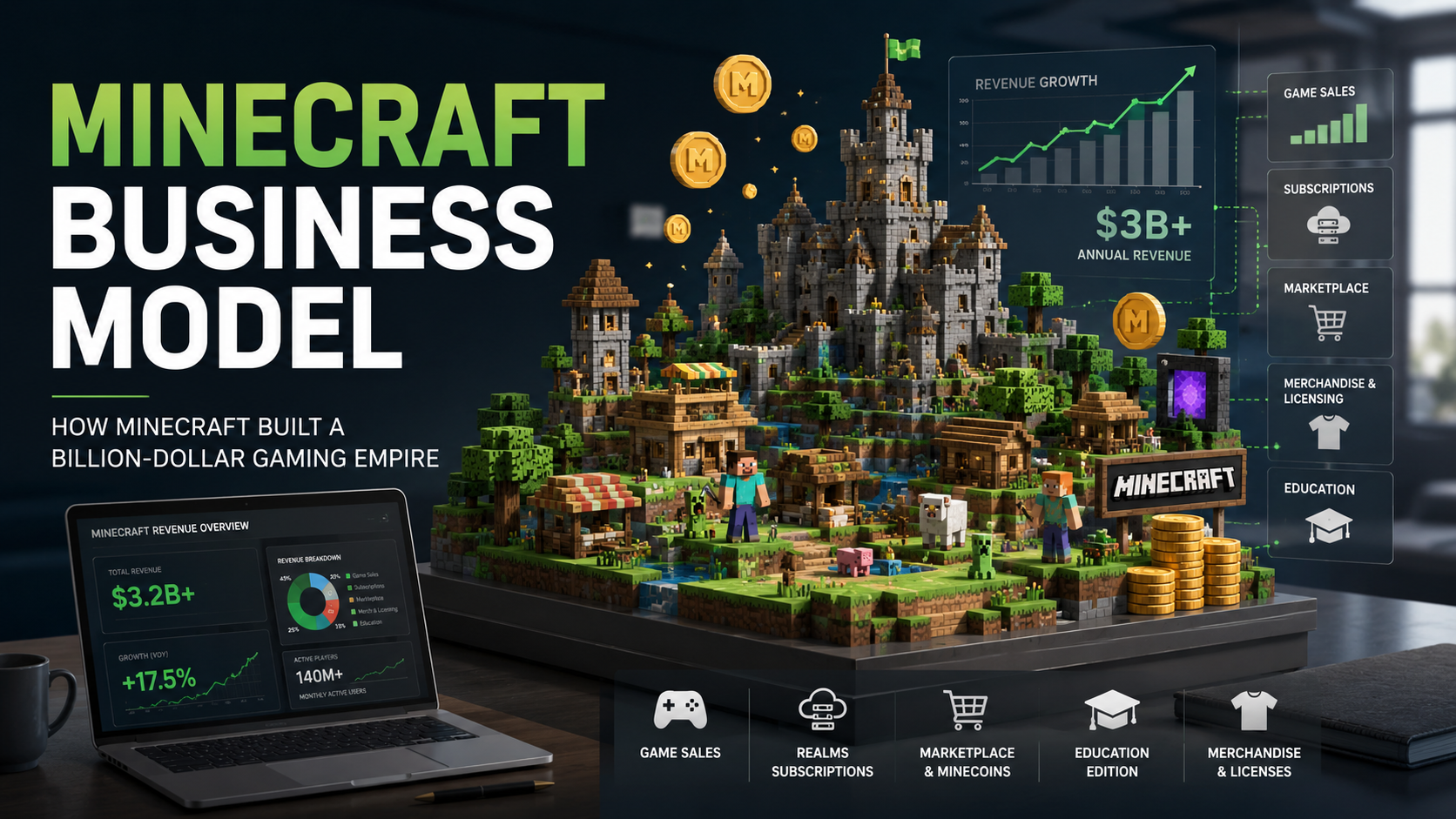
Minecraft uses a diversified revenue model that combines one-time purchases with recurring income streams. Here is a breakdown of its key revenue sources:
Key Revenue Streams
- Game sales across PC, console, and mobile platforms
- In-game Marketplace purchases using Minecoins
- Realms subscription services for private servers
- Education Edition licensing for schools and institutions
- Merchandise including toys, apparel, and LEGO sets
- Licensing deals with brands, publishers, and media companies
Each stream reinforces the others. Game sales grow the player base. A larger player base drives Marketplace spending. Active players subscribe to Realms. Engaged fans buy merchandise. The model compounds over time without requiring constant reinvestment in new products.
Minecraft Revenue Ecosystem (Infographic Concept)
Imagine a circular diagram with “Player Base” at the center, surrounded by six nodes: Game Sales, Marketplace, Realms, Education, Merchandise, and Licensing. Arrows connect each node to the center and to each other, showing how each stream feeds player retention and new customer acquisition.
Minecraft’s Primary Revenue Stream: Game Sales
One-Time Purchase Model
Minecraft uses a premium pricing model. Players pay once to access the full game. There are no paywalls blocking core content, which builds trust with players and reduces friction at the point of purchase.
PC Version Pricing
Minecraft: Java Edition and Bedrock Edition are sold together on PC for around $29.99 in the US. Java Edition is preferred by the modding community. Bedrock Edition supports cross-platform play. Both are included in the same purchase on PC, which adds perceived value.
Console Editions
Minecraft is available on PlayStation, Xbox, and Nintendo Switch at standard game prices ranging from $19.99 to $29.99 depending on platform and region. Console versions benefit from digital storefronts that reduce distribution costs and allow easy updates.
Mobile Version Revenue
Minecraft on iOS and Android is sold for $6.99. The lower price point drives high volume downloads in mobile-dominant markets, particularly in Southeast Asia, Latin America, and India. Mobile players also have access to the Marketplace, which extends their spending potential beyond the initial purchase.
Multi-Platform Availability
Minecraft is available on Windows, PlayStation, Xbox, Nintendo Switch, iOS, and Android. This wide platform coverage ensures the game can reach players regardless of what device they use. The Bedrock Edition provides a unified codebase across most platforms, making updates and cross-play easier to manage.
Lifetime Sales Numbers
Minecraft has sold over 300 million copies as of recent counts, making it the best-selling video game of all time. The game maintains a consistent global player base of over 140 million monthly active users. This scale means even small revenue actions per player generate significant total income.
Minecraft Marketplace Business Model
What Is Minecraft Marketplace?
The Minecraft Marketplace is an in-game store where players can purchase community-created and officially licensed content. It includes:
- Skins: Custom character appearances
- Texture Packs: Visual overhauls that change how the game looks
- Worlds: Pre-built maps for adventure, education, or creative play
- Mods and Add-ons: Gameplay modifications that add new mechanics or content
The Marketplace is available within Bedrock Edition, which covers console, mobile, and Windows 10/11 players. Java Edition players access mods through third-party platforms instead.
Creator Economy in Minecraft
Minecraft operates a Partner Program that lets independent creators publish and sell content on the Marketplace. Approved creators upload their builds, packs, and add-ons, set their own prices, and earn a revenue share from every sale.
This model is beneficial for Microsoft because it reduces the cost of content production while keeping the Marketplace stocked with fresh material. Creators benefit from access to a massive player base and a built-in payment system. The result is a self-sustaining content economy that grows without requiring direct investment from Mojang in every new item.
How Microtransactions Generate Continuous Income
Minecoins System
Players purchase Minecoins, a virtual currency, to buy items in the Marketplace. Minecoins are sold in bundles ranging from 320 coins ($2.99) to 5,000 coins ($33.99). This currency layer creates a psychological separation between real money and in-game spending, which is a standard microtransaction strategy used across the gaming industry.
In-Game Purchases
Players regularly spend on cosmetics and content updates. Because Minecoins must be purchased in bundles, players often have leftover currency, which encourages additional spending. The combination of a large active player base and frequent new content releases ensures a steady stream of Marketplace transactions.
Minecraft Realms Subscription Model
What Is Minecraft Realms?
Minecraft Realms is a subscription-based service that provides players with private, always-online servers. Instead of setting up and managing server software independently, players pay a monthly fee and get a managed server hosted by Microsoft. Friends can join the Realm anytime, even when the owner is offline.
Monthly Subscription Revenue
Pricing Plans
Realms for Bedrock Edition costs around $7.99 per month for up to ten players. Realms Plus, also for Bedrock, costs around $7.99 per month and includes access to a rotating library of Marketplace content in addition to the server. Realms for Java Edition is priced similarly.
Recurring Income Model
Subscriptions provide predictable, recurring revenue. Unlike one-time game sales, subscription income does not fluctuate with new game launches or seasonal spikes. As long as players continue to use their Realms server, the revenue persists. This makes Realms one of the most stable income sources in Minecraft’s portfolio.
Benefits for Players
Realms removes the technical complexity of running a private Minecraft server. Players get automatic backups, easy invites, and cross-platform multiplayer without any configuration. For families, friend groups, and classrooms, this simplicity is worth the monthly fee.
Minecraft Education Edition Business Model
Minecraft in Schools
Minecraft Education Edition is a version of the game built specifically for classroom use. It includes lesson templates, classroom management tools, and collaboration features designed for educators. The core game mechanics remain the same, but the interface and content are tailored to academic settings.
The game uses gamification to make learning more engaging. Students stay motivated through creative building challenges and interactive simulations rather than passive instruction.
Revenue from Educational Licensing
School Subscriptions
Minecraft Education Edition is sold on a per-seat, annual subscription model. Pricing is typically negotiated through Microsoft or educational resellers and varies by institution size. Individual educator licenses are also available.
Institutional Partnerships
Microsoft has partnerships with school districts, government education programs, and international education organizations. These bulk agreements generate significant institutional revenue and also serve as a pipeline for students who may become long-term Minecraft players.
Subjects Taught Using Minecraft
Minecraft Education Edition is used to teach a wide range of subjects:
- Coding: Students use MakeCode to write code that controls in-game characters and builds
- Math: Geometry and measurement through construction challenges
- Science: Biology, chemistry, and environmental concepts through interactive simulations
- Architecture: Design principles and spatial reasoning through building projects
The breadth of applicable subjects increases the value proposition for schools and makes the product relevant across grade levels and departments.
Merchandise and Licensing Revenue
Minecraft Merchandise
Minecraft merchandise is a significant revenue contributor. The brand sells across categories including:
- Toys: Action figures, foam weapons, and collectibles
- Clothing: T-shirts, hoodies, hats, and accessories sold through retail and online stores
- Accessories: Backpacks, lunchboxes, school supplies, and bedroom decor
- LEGO Collaborations: Minecraft-themed LEGO sets are among the most popular in the LEGO product lineup and generate co-branded revenue for both companies
Merchandise revenue scales with cultural relevance. Because Minecraft has maintained popularity across generations, new cohorts of young players constantly enter the merchandise market.
Licensing Partnerships
Microsoft licenses the Minecraft IP to third-party publishers, toy manufacturers, and content producers. These deals generate royalty income without requiring Microsoft to manage production directly.
Minecraft has licensed content for books, graphic novels, and guides published through major publishers. These products extend brand visibility into retail environments like bookstores and libraries where digital games have limited presence.
Entertainment Expansion
A Minecraft movie has been in development for several years. Entertainment IP, including movies and animated series, generates direct revenue through box office and streaming deals and also drives merchandise sales, game downloads, and brand awareness.
Media expansion is a growth lever that Minecraft has not yet fully activated, meaning significant upside remains in this category compared to franchises like Pokemon or Super Mario that have more mature entertainment portfolios.
Community-Driven Growth Strategy
User-Generated Content
Minecraft’s open-ended design naturally encourages user-generated content. Players build massive structures, design adventure maps, create custom game modes, and develop mods that change core mechanics. This content is shared across platforms like Planet Minecraft, Reddit, and dedicated community forums.
User-generated content extends the game’s lifespan at no cost to Mojang. New builds and mods give existing players reasons to keep playing and give new players more content to explore when they join.
YouTube and Streaming Influence
Minecraft consistently ranks among the most-viewed gaming content on YouTube. Creators like Dream, MrBeast, and dozens of others have built channels with tens of millions of subscribers around Minecraft content. This generates billions of views per year without any paid promotion from Microsoft.
Streaming platforms like Twitch also carry significant Minecraft viewership. When popular creators play Minecraft, they introduce the game to new audiences, driving downloads and sales. This earned media is one of the most cost-effective marketing channels in the gaming industry.
Strong Multiplayer Ecosystem
Multiplayer keeps players engaged long after they have explored solo content. Public servers, mini-game networks, and Realms create social environments where players invest time and relationships. Social investment is one of the strongest retention mechanisms in gaming because leaving the game means leaving the community.
Minecraft’s Freemium and Retention Strategies
Constant Updates
Mojang releases regular updates that add new biomes, mobs, items, and gameplay mechanics. These updates are free for existing players and serve as reasons to return for players who have taken a break. The Caves and Cliffs update and the Wild Update both drove significant spikes in player activity after launch.
Consistent updates signal to players that the game is actively supported, which reduces the risk of the community feeling abandoned or moving to competing titles.
Seasonal Events and Content
Minecraft runs in-game seasonal events tied to holidays and real-world moments. Limited-time content creates urgency and gives players a reason to log in during specific windows. These events also drive Marketplace spending as players pick up themed skins and content packs.
Cross-Platform Accessibility
Bedrock Edition allows players on different platforms to share the same server. A player on Xbox can play with a friend on mobile or PC without any extra steps. This cross-play feature reduces social friction and keeps friend groups together even when their hardware differs. Retaining social connections retains players.
Why Minecraft’s Business Model Is So Successful
Massive Creative Freedom
There is no single way to play Minecraft. This freedom means the game serves players with widely different preferences, from builders who never engage with combat to survival players who never build anything decorative. Broad appeal drives broad adoption.
Strong Community Ecosystem
The community around Minecraft is one of the most active in gaming. Wikis, forums, YouTube channels, Discord servers, and Reddit communities all support player engagement. A strong community reduces churn because leaving the game means leaving the community.
Recurring Revenue Streams
Game sales happen once, but Marketplace purchases, Realms subscriptions, and Education Edition licenses happen repeatedly. Recurring revenue makes the business more predictable and less dependent on launching new titles.
Low Marketing Dependency
Minecraft spends far less on paid advertising than most games of comparable size. Community content, YouTube, and streaming generate awareness organically. Lower marketing costs mean higher margins on every sale.
Multi-Generational Audience
Players who discovered Minecraft as children in 2012 are now adults who still play and who introduce the game to their own children. This generational handoff creates a self-renewing player base without requiring significant acquisition spending.
Long Product Lifespan
Most video games have a revenue peak near launch followed by a steep decline. Minecraft has maintained consistent revenue for over a decade. The combination of updates, community content, and recurring subscriptions keeps the game commercially relevant far longer than traditional titles.
Challenges in Minecraft’s Business Model
Competition from Newer Sandbox Games
Games like Roblox, Fortnite Creative, and LEGO Fortnite compete directly for sandbox-oriented players. These platforms have strong content ecosystems and large player bases that could draw players away, particularly younger audiences.
Content Moderation Issues
With user-generated content and multiplayer servers come moderation challenges. Inappropriate content, harassment, and unsafe environments are ongoing concerns, especially given the game’s popularity with children. Managing this at scale requires investment and creates reputational risk.
Maintaining Player Interest
As the player base ages and gaming tastes evolve, keeping long-term players engaged requires continuous innovation. Updates need to feel meaningful, not just incremental, to prevent veteran players from drifting to other titles.
Monetization Balance
Charging for Marketplace content risks alienating players who feel that content which was once free through mods is now paywalled. Finding the right balance between free and paid content is a recurring challenge, particularly for the Java Edition community that has a strong culture around free modding.
Lessons Businesses Can Learn from Minecraft
Build a Community First
Minecraft grew largely because it cultivated an active, passionate community before Microsoft invested heavily in marketing. Communities create organic growth, reduce churn, and generate free content and advocacy. Businesses that invest in community early see compounding returns.
Encourage User-Generated Content
Allowing users to create and share content dramatically extends a product’s lifespan and reduces the cost of keeping it fresh. Mojang does not need to produce every skin or map because creators do it for them. Businesses can apply this by building tools and permissions that let users extend and customize the product.
Diversify Revenue Streams
Relying on a single revenue source creates fragility. Minecraft’s combination of game sales, subscriptions, in-app purchases, licensing, and merchandise means that a slowdown in one area does not collapse the whole business.
Focus on Long-Term Engagement
Short-term monetization often sacrifices long-term retention. Minecraft offers free updates, cross-platform play, and a strong community experience to keep players invested for years. Businesses benefit from prioritizing lifetime value over short-term conversion rates.
Create a Scalable Digital Ecosystem
The Marketplace, Realms, and Education Edition are all digital products that scale without proportional cost increases. Adding more players to a Realm server or processing more Marketplace transactions does not require the same investment as manufacturing physical goods. Building scalable digital systems creates leverage as the business grows.
Future of Minecraft’s Business Model
AI-Generated Worlds and Mods
Microsoft’s investment in AI tools opens the door to AI-assisted world generation, mod creation, and content personalization inside Minecraft. Players could describe a world and have it generated automatically, which would lower the barrier to entry for content creation and increase engagement.
Expansion into Education
Minecraft Education Edition is still underpenetrated relative to the size of the global education market. Expanding into more countries, adding more curriculum-aligned content, and partnering with government education programs are all growth opportunities.
Metaverse-Related Opportunities
Minecraft’s open world structure, user-generated content economy, and virtual identity systems share characteristics with what the industry calls the metaverse. While the metaverse narrative has slowed, Minecraft is better positioned than most platforms to benefit if virtual world adoption grows.
More Creator Monetization Features
Expanding the Marketplace Partner Program to include more creators, lower barriers to publishing, and higher revenue shares could accelerate the volume and variety of available content. More content drives more purchases and keeps the ecosystem competitive with Roblox’s more open creator economy.
Conclusion
Minecraft has evolved from a solo indie project into one of the most commercially successful media franchises in the world. Its business model works because it layers multiple revenue streams on top of a product that people genuinely love and return to over years and decades.
The key to its success is not any single feature. It is the combination of creative freedom, community investment, recurring revenue, and continuous updates. Minecraft did not grow by chasing the next trend. It grew by being consistently useful and enjoyable to a wide audience across multiple generations.
For businesses, Minecraft offers a practical example of how to build a product ecosystem with real staying power. Community first, recurring revenue second, and diversification across every possible channel.
FAQs
Minecraft earns revenue through game sales on PC, console, and mobile; in-game Marketplace purchases using Minecoins; Realms subscription services; Education Edition licensing; merchandise sales; and IP licensing deals.
Minecraft is a paid game. The PC version costs around $29.99, console versions range from $19.99 to $29.99, and the mobile version is $6.99. There is no free version of the base game, though a free trial may be available on some platforms.
Minecraft Marketplace is an in-game store where players can buy skins, texture packs, adventure worlds, and add-ons created by approved independent creators and official partners. Purchases are made using Minecoins, a virtual currency bought with real money.
Microsoft acquired Mojang, the studio behind Minecraft, in 2014 for $2.5 billion. The deal included the Minecraft IP and the full development team.
Yes. Minecraft Realms is a subscription service that provides private hosted servers. It costs around $7.99 per month and generates recurring revenue from players who want a managed multiplayer environment.
Yes. Through the Minecraft Marketplace Partner Program, approved creators can publish and sell skins, worlds, and add-ons. They receive a revenue share on each sale and have access to Minecraft’s global player base as a distribution channel.
Minecraft’s model is unique because it generates significant revenue with minimal dependence on advertising or frequent new game releases. It relies instead on a combination of one-time purchases, recurring subscriptions, a creator-driven content economy, and multi-generational brand loyalty. Few games have maintained commercial relevance across more than a decade the way Minecraft has.
Discover more from Business Model Hub
Subscribe to get the latest posts sent to your email.