Blueground Business Model And How It Built a Global Furnished Rental Platform

Blueground operates a flexible furnished apartment rental platform that leases, manages, and rents premium homes for mid-to-long-term stays. Its business model combines real estate operations, hospitality, subscription-like rental income, and technology-driven property management.
Flexible living is no longer a niche. Remote work, corporate relocations, and digital nomad culture have pushed millions of professionals away from traditional 12-month leases toward furnished apartments they can rent for a month, three months, or longer. Blueground sits at the center of that shift.
Founders, investors, and operators study Blueground’s model because it shows how a traditionally fragmented, friction-heavy industry can be rebuilt around technology, standardization, and recurring revenue.
What Is Blueground?
Blueground is a proptech and flexible living company that provides fully furnished apartments for stays typically lasting one month or longer. It was founded in 2013 by Alex Chatzieleftheriou and is headquartered in New York City with operations spanning major cities across North America, Europe, and the Middle East.
The platform handles everything: sourcing apartments, furnishing them to a premium standard, listing them digitally, and managing the full tenant experience from booking to move-out. Guests get a ready-to-live-in home with furniture, WiFi, appliances, and utilities bundled in.
Blueground is neither a hotel nor a traditional landlord. It sits in the middle and captures value from both sides.
Core services include:
- Fully furnished mid-to-long-term apartment rentals
- Digital-first booking and lease management
- Maintenance, cleaning, and support included
- Flexible contract lengths starting at one month
- Consistent apartment standards across every city
The Rise of Flexible Living Platforms
Flexible living platforms emerged because professionals, remote workers, expats, and digital nomads wanted ready-to-move homes without long-term commitments.
Traditional renting was built for a different era. You signed a 12-month lease, bought furniture, set up utilities, and stayed put. That model stopped working for the modern professional who moves cities for a project, works remotely from different locations, or relocates internationally every six to twelve months.
What drove the shift:
- Remote work removed geographic anchors for millions of workers
- Corporate relocation demand grew as companies expanded across borders
- Expat populations grew in tech, finance, and consulting industries
- Digital nomads needed furnished homes, not hotel rooms
- Urban renters wanted flexibility without sacrificing quality
The furnished rental market has grown significantly because of these forces. Blueground positioned itself early to serve exactly this demand, and it continues to benefit from trends that are not going away.
How Blueground Works
Blueground leases or partners with property owners, furnishes apartments, lists them on its platform, and rents them to customers through flexible contracts.
The operational model is straightforward but execution-heavy. Blueground acts as the operator between property owners who want reliable income and tenants who want a premium, hassle-free place to live.
Property Acquisition
Blueground secures apartments through long-term lease agreements with landlords or revenue-sharing partnerships with property owners and developers. It targets premium apartments in high-demand urban neighborhoods. Landlords benefit from guaranteed occupancy and professional management without dealing with individual tenants.
Interior Standardization
Every apartment is furnished and equipped to Blueground’s standard. That includes furniture, bedding, kitchen equipment, smart appliances, and high-speed WiFi. The goal is a consistent, hotel-grade experience regardless of which city or building you are in.
Digital Platform Operations
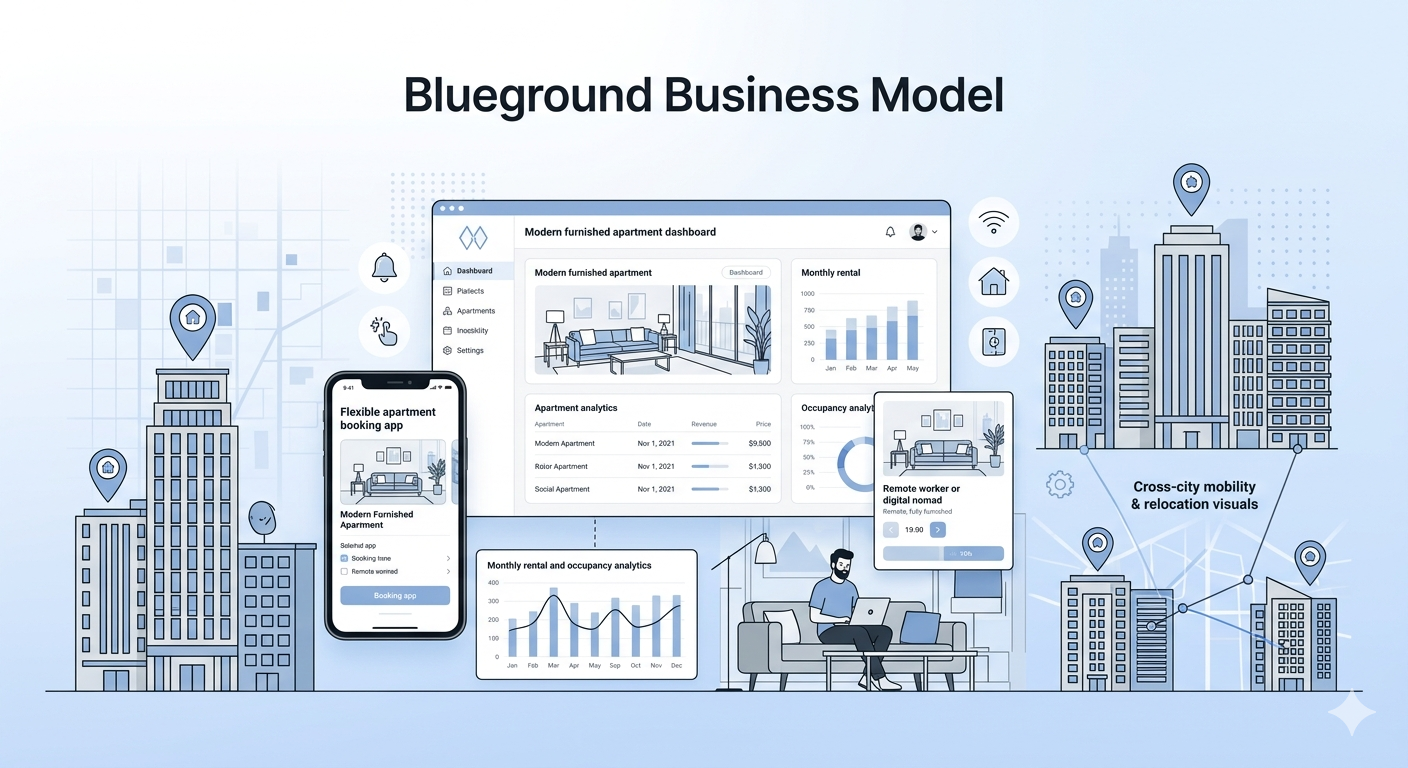
Tenants browse, book, and manage their stay entirely through Blueground’s website and mobile app. Features include virtual tours, digital contracts, automated onboarding, and in-app maintenance requests. The platform is designed to make the entire rental process feel more like a software experience than a real estate transaction.
Tenant Experience
Once moved in, tenants get ongoing cleaning services, 24/7 maintenance support, and flexible extension options. The model is built around retention. A tenant who starts with a two-month stay can easily extend, and many do.
Revenue Collection
Blueground collects monthly rental payments, service fees, and optional add-ons. Pricing is dynamic and adjusts based on location, season, and demand.
Blueground Business Model Explained
Blueground follows an asset-light hybrid real estate model where it monetizes furnished apartment rentals through technology-enabled operations and occupancy optimization.
The key phrase is asset-light. Blueground does not own the properties it rents out. It leases them from owners and subleases them to tenants at a higher rate. The margin sits between what it pays landlords and what it charges tenants, plus any ancillary service revenue.
This structure keeps capital requirements lower than traditional real estate while still generating recurring, subscription-like income. The technology layer allows Blueground to manage a large and growing inventory of apartments without proportionally scaling its operational headcount.
Blueground Revenue Streams
Blueground mainly earns through monthly rental income, premium pricing, corporate housing partnerships, and ancillary services.
Apartment Rental Income
This is the core. Blueground charges tenants monthly rent that exceeds what it pays property owners. The spread between the two is the gross margin on each unit. Occupancy optimization is critical here. The more consistently units are filled, the more profitable each one becomes.
Corporate Housing Partnerships
Companies that relocate employees or need temporary housing for project-based teams sign contracts with Blueground directly. These corporate accounts provide bulk, predictable revenue and often longer average stay durations, which improves unit economics.
Service Fees
Cleaning fees, pet fees, early termination fees, and utility markups add revenue on top of base rent. These fees also help Blueground cover variable costs without compressing its core margins.
Premium Location Pricing
Apartments in high-demand urban neighborhoods and luxury buildings command premium pricing. The margin on these units tends to be higher because the quality justifies it and the tenant is typically less price-sensitive.
Extended Stay Revenue
The longer a tenant stays, the more profitable the unit becomes. Acquisition costs are front-loaded. A tenant who extends their stay multiple times generates revenue without additional leasing or onboarding costs.
Blueground Business Model Canvas
Key Partners
- Property owners and landlords
- Real estate developers
- Furniture and appliance suppliers
- Third-party cleaning companies
- Smart home technology providers
Key Activities
- Property leasing and acquisition
- Furnishing and standardizing apartments
- Platform and app management
- Occupancy optimization
- Customer support and maintenance
Key Resources
- Rental property inventory
- Technology platform and data systems
- Brand reputation and trust
- City-based operations teams
- Corporate client relationships
Value Proposition
For tenants: Ready-to-move furnished homes, flexible lease terms, premium consistent experience, and no brokerage headaches.
For property owners: Guaranteed occupancy, professional property management, predictable income, and no tenant management burden.
Customer Relationships
- Self-service onboarding through the app
- In-app and chat-based support
- Membership-like experience with easy extensions
Channels
- Website and SEO-driven organic traffic
- Mobile app
- Corporate partnership and relocation channels
- Referral and loyalty programs
- Online rental marketplaces
Customer Segments
- Remote workers and location-independent professionals
- Business travelers and corporate employees on assignment
- Expats relocating internationally
- Digital nomads
- Professionals between permanent homes
Cost Structure
- Long-term lease payments to property owners
- Furniture purchase and replacement
- Operations and maintenance staff
- Cleaning and housekeeping services
- Technology infrastructure and development
- Marketing and customer acquisition
Revenue Streams
- Monthly rental income
- Service and amenity fees
- Corporate housing contracts
- Premium and luxury unit pricing
Blueground Value Proposition
Blueground simplifies urban living by combining hotel-like convenience with apartment-style comfort at mid-to-long-term rental prices.
The traditional furnished apartment experience was fragmented. Tenants had to find a broker, negotiate a lease, buy furniture, set up internet, coordinate utilities, and manage repairs themselves. Blueground removes every one of those friction points.
Why customers choose Blueground:
- No broker fees or complicated lease negotiations
- Fully furnished and move-in ready on day one
- Flexible contracts without long-term lock-in
- Consistent apartment quality across cities
- Bundled WiFi, utilities, and appliances
- Ongoing cleaning and maintenance support
- Single platform for booking, managing, and extending stays
For corporate clients, the value is even clearer. HR and operations teams can place employees in furnished apartments without coordinating with multiple vendors, managing leases, or dealing with reimbursement paperwork.
Blueground’s Technology Strategy
Technology helps Blueground automate bookings, manage occupancy, reduce operational costs, and improve the customer experience at scale.
Blueground is not just a real estate company. It is a technology-enabled real estate operator, and that distinction matters for how it scales.
Technology capabilities include:
- Dynamic pricing: Rental prices adjust automatically based on demand, seasonality, and local market conditions to maximize occupancy and revenue per unit
- Property analytics: Data on occupancy rates, maintenance costs, and tenant behavior helps optimize inventory decisions and identify underperforming units
- Mobile-first operations: Tenants complete the entire journey from search to move-in through the app, reducing manual touchpoints and operational overhead
- Smart lock systems: Keyless entry through smart locks allows self-guided tours and contactless check-ins without staff presence
- CRM automation: Automated communication workflows handle lease renewals, maintenance follow-ups, and tenant satisfaction touchpoints without manual intervention
The technology stack gives Blueground leverage. Adding more apartments to the platform does not require a proportional increase in staff, which is what enables the model to scale.
Blueground Marketing Strategy
Blueground uses digital marketing, SEO, relocation partnerships, and urban lifestyle branding to acquire customers.
The target audience is highly specific: mobile professionals who research online, make decisions quickly, and care about quality over price. Blueground’s marketing strategy reflects that.
Main Marketing Channels
Organic SEO drives a significant portion of inbound traffic. Blueground creates city-specific landing pages and content targeting searches like “furnished apartments in Dubai” or “monthly rentals in Chicago,” capturing high-intent traffic at the bottom of the funnel.
Paid search advertising fills in coverage gaps and accelerates growth in newer markets where organic rankings take time to build.
Corporate partnerships with HR departments, relocation management companies, and enterprise employers bring bulk accounts with high lifetime value and low acquisition cost per tenant.
Referral programs leverage satisfied tenants to bring in new ones. Given that Blueground’s customers are often plugged into professional networks of other mobile professionals, referral has strong compounding potential.
Content marketing around remote work, expat life, and urban living builds brand awareness with the exact audience most likely to convert.
Blueground Competitive Advantages
Blueground’s advantages come from operational scale, standardized apartments, strong technology infrastructure, and premium urban locations.
Competitors can replicate individual parts of Blueground’s model. Replicating the entire operational system across dozens of cities simultaneously is much harder.
Specific advantages:
- Consistent apartment quality creates trust and reduces pre-booking anxiety
- Multi-city presence allows tenants to stay within the Blueground ecosystem when they relocate
- Long-term landlord relationships provide stable, below-market lease rates that protect margins
- Operational playbooks built over years of execution are difficult to reverse-engineer quickly
- Brand recognition in the furnished rental space creates organic referral and repeat business
Competitors of Blueground
Direct Competitors
| Company | Focus | Key Difference |
|---|---|---|
| Airbnb | Short-term stays | Marketplace, not operator |
| Sonder | Short-to-mid-term | Hotels and apartments mixed |
| Zeus Living | Corporate housing | US-focused, B2B heavy |
| Anyplace | Remote workers | Lighter inventory model |
Indirect Competitors
- Extended-stay hotels and serviced apartments
- Traditional real estate brokers offering furnished units
- Co-living startups like Common and Quarters
- Corporate relocation management companies
Blueground vs Airbnb
Blueground focuses on mid-to-long-term furnished living, while Airbnb mainly focuses on short-term stays.
| Feature | Blueground | Airbnb |
|---|---|---|
| Stay Duration | Monthly and longer | Daily and weekly |
| Inventory Control | Fully managed apartments | Marketplace listings |
| Standardization | High and consistent | Variable by host |
| Target Audience | Mobile professionals | Leisure travelers |
| Operations | Centralized and managed | Decentralized by host |
| Pricing Model | Monthly subscription-like | Nightly dynamic pricing |
| Customer Support | Dedicated tenant support | Platform mediation |
The models are fundamentally different. Airbnb is a marketplace where supply and quality are inconsistent. Blueground is an operator where every apartment meets the same standard. They serve different needs, though there is some overlap in the one-to-four-week stay range.
Challenges in Blueground’s Business Model
Blueground faces challenges related to lease liabilities, occupancy fluctuations, operational complexity, and city-level regulations.
No business model is without risk, and Blueground’s has several structural ones worth understanding.
High fixed costs are the most significant. Blueground signs long-term leases with landlords regardless of whether apartments are occupied. In a downturn or sudden demand drop (as seen during the pandemic), those lease obligations continue while revenue shrinks.
Occupancy risk is tied to fixed cost exposure. If a city-level market softens or a new competitor undercuts pricing, occupancy drops and margins compress quickly.
Regulatory risk is real in many cities. Short-term and furnished rental regulations vary widely. Some cities have restricted subletting arrangements, which is core to Blueground’s supply model.
Operational complexity grows with each new city. Every market has different landlord norms, regulations, labor costs, and consumer expectations. Maintaining quality and margins across dozens of cities requires significant management infrastructure.
Expansion costs are front-loaded. Entering a new city means securing apartments, furnishing them, hiring local staff, and building a tenant base before generating meaningful revenue.
How Blueground Scales Globally
Blueground scales by entering major urban cities, building repeatable operational systems, and standardizing the apartment experience across markets.
Global scaling in this model is not just about adding more apartments. It requires building city-level operations that can function independently while following the same standards.
The scaling framework:
City selection focuses on markets with high concentrations of mobile professionals, strong corporate relocation activity, and demand for premium furnished housing. Think New York, London, Dubai, Amsterdam, and similar urban hubs.
Supply acquisition involves building relationships with local landlords, developers, and property managers to secure quality inventory at sustainable lease rates.
Operations playbook is the internal system Blueground uses to furnish, onboard, and manage apartments consistently. The playbook is what makes each new city launch faster and cheaper than the last.
Localization accounts for market-specific differences in tenant expectations, pricing norms, and regulatory requirements without compromising the core standard experience.
Blueground Funding and Growth
Blueground attracted investor funding because flexible urban living became a rapidly growing global market with clear recurring revenue potential.
The company raised significant capital across multiple rounds to fund city expansion, technology development, and inventory acquisition. Investors were drawn to the combination of recurring rental revenue, technology leverage, and exposure to secular trends like remote work and urban mobility.
What made Blueground fundable:
- Recurring, predictable monthly revenue from long-term tenants
- Asset-light model compared to traditional real estate ownership
- Technology infrastructure reducing operational cost per unit
- Large and growing addressable market across global cities
- Corporate housing as a stable, high-value revenue channel
Growth has involved both organic city expansion and strategic acquisitions of smaller furnished rental operators to accelerate market entry.
Lessons Entrepreneurs Can Learn From Blueground
Blueground shows how traditional industries like real estate can become scalable through technology and operational standardization.
Real estate was not broken, it was just friction-heavy. Blueground did not invent furnished rentals. It systematized them, wrapped them in software, and built recurring revenue on top of an existing behavior.
Key takeaways for founders:
Solve friction-heavy industries first. The more annoying and fragmented a process is, the bigger the opportunity to rebuild it cleanly. Furnished rentals involved brokers, deposits, utility setups, furniture purchases, and lease negotiations. Blueground removed every step.
Build for recurring revenue. Monthly rental income that compounds through extended stays and corporate contracts is far more valuable than one-time transaction revenue. Design the business model around retention from the start.
Standardize the customer experience. Consistency is a competitive advantage. When every Blueground apartment looks and feels the same, customers trust the product before they arrive. That trust reduces friction and increases conversion.
Use technology for operational leverage. Blueground’s growth would not be possible without technology automating pricing, bookings, communications, and maintenance. Technology is what allows the model to scale without linear headcount growth.
Identify and position for urban trends early. Remote work, digital nomad culture, and corporate mobility were visible trends years before they became mainstream. Blueground was already built to serve that demand when it exploded.
Future of Blueground
Blueground’s future depends on continued remote work adoption, urban mobility trends, and global demand for flexible housing options.
The macro tailwinds are still blowing in Blueground’s direction. Remote work has not reversed. Corporate mobility is recovering and growing. Digital nomad populations are expanding. The addressable market for flexible furnished living is larger today than when Blueground was founded.
Where the model goes next:
AI-powered property management will reduce operational costs further. Predictive maintenance, automated pricing adjustments, and AI-driven tenant support can cut costs and improve margins at scale.
Expansion into emerging markets where urbanization is growing rapidly and professional rental markets are underdeveloped creates new growth vectors beyond established Western cities.
Subscription living models that offer tenants a membership across multiple cities, similar to a gym or streaming subscription, could increase lifetime value and lock in mobile professionals long-term.
Smart apartment integration with connected devices, automated climate control, and app-managed home systems will enhance the premium positioning and justify higher price points.
Digital nomad economy growth continues to create new demand. As more countries introduce digital nomad visas and remote work becomes normalized globally, the pool of potential Blueground tenants expands.
Wrapping Up
Blueground built something genuinely useful at the intersection of proptech and hospitality. It is not a real estate company pretending to be a tech company, and it is not a hotel chain trying to be an apartment operator. It is a new category that happens to borrow from both.
The model works because it solves a real problem for a growing segment of professionals who need flexibility without sacrificing quality. The recurring revenue structure, technology leverage, and operational standardization make it defensible and scalable in ways that pure marketplaces or traditional operators cannot easily replicate.
For founders, the core lesson is that Blueground did not need to invent a new behavior. People were already renting furnished apartments. It just built a dramatically better system for doing it, and then scaled that system globally.
Flexible living is becoming the default for a growing share of the global professional class. Blueground positioned itself to capture that shift early, and the model it built is what makes that positioning durable.
FAQs
Blueground has not publicly disclosed profitability figures, but the model is structured around improving margins as occupancy rates stabilize and operational efficiency increases with scale. Long-term tenant retention and corporate contracts are the primary drivers of unit economics.
Blueground earns through monthly rental income from tenants, corporate housing contracts, service fees including cleaning and pet fees, and premium pricing on high-demand properties. The core margin sits between what it pays landlords and what it charges tenants.
They overlap at the edges but are fundamentally different models. Airbnb is a marketplace for short-term stays where hosts manage their own listings. Blueground is an operator that manages every apartment directly and targets monthly-plus stays for mobile professionals.
Primary customers are remote workers, expats, corporate employees on assignment, digital nomads, and professionals between permanent residences. Corporate clients including HR departments and relocation companies are also a significant customer segment.
Blueground uses an asset-light hybrid real estate model. It leases apartments from owners, furnishes them, and subleases them to tenants at a higher rate. Revenue is recurring and subscription-like through monthly rentals supplemented by service fees and corporate contracts.
Growth is driven by remote work normalization, corporate relocation demand, the digital nomad economy, and the broader shift away from traditional long-term leases among mobile professionals. Blueground’s technology infrastructure and multi-city presence position it well to capture that demand at scale.
Discover more from Business Model Hub
Subscribe to get the latest posts sent to your email.