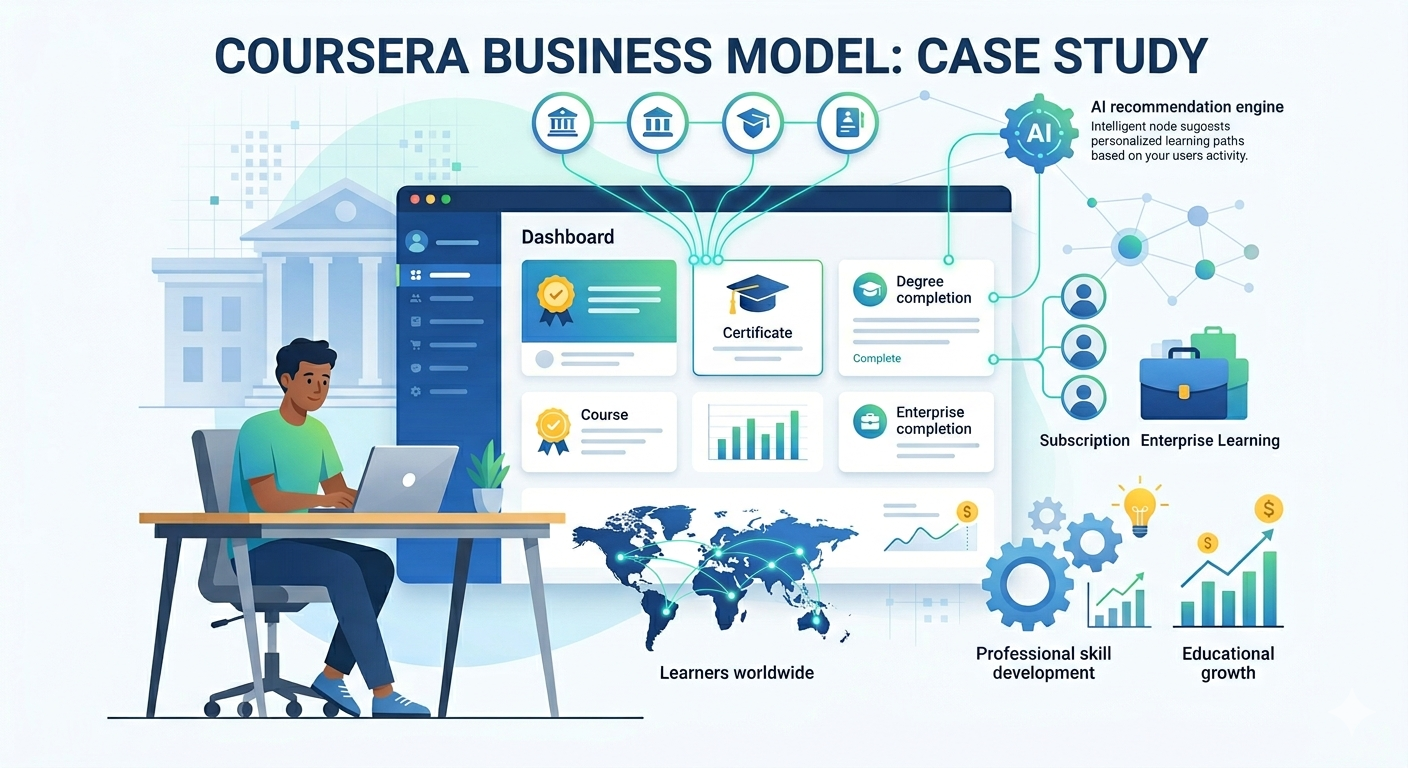

Coursera is one of the most recognized names in online education. It partners with top universities and companies to deliver courses, certificates, and even full degrees to learners worldwide.
What makes Coursera interesting from a business perspective is how it built a sustainable revenue model around free access while still generating hundreds of millions in annual revenue. It serves individual learners, large enterprises, and government agencies all at once.
This blog breaks down how Coursera works, how it makes money, and what entrepreneurs can learn from its growth.
What Is Coursera?
Coursera is an online learning platform that partners with universities, educators, and companies to provide courses, certificates, degrees, and professional training programs to learners globally.
Founded in 2012 by Stanford professors Andrew Ng and Daphne Koller, Coursera started as a platform to distribute free university lectures online. Those early courses were called MOOCs (Massive Open Online Courses).
Over time, Coursera evolved far beyond free video lectures. It added paid certifications, professional certificates from companies like Google and Meta, online degrees from accredited universities, and a full enterprise learning platform.
Today, Coursera serves over 148 million registered learners across 190+ countries. It has partnerships with more than 325 universities and industry partners including Yale, Duke, Google, IBM, and Amazon Web Services.
How Coursera Works
Coursera connects learners with universities and institutions through a digital education marketplace.
The platform operates on a three-sided model. It serves learners, universities, and businesses at the same time. Each group gets specific value from the platform.
For Learners
- Browse thousands of courses across tech, business, data science, arts, and more
- Enroll for free in audit mode or pay for a verified certificate
- Access full degree programs online from accredited universities
- Subscribe to Coursera Plus for unlimited course access
For Universities and Instructors
- Upload and distribute course content to a global audience
- Monetize academic content without building their own platform
- Reach learners who would never enroll in a traditional campus program
- Earn revenue through Coursera’s partnership sharing model
For Businesses
- Train employees at scale through Coursera for Business
- Access curated learning paths aligned to job roles
- Track workforce skill development through analytics dashboards
- Offer employees industry-recognized credentials
The platform handles hosting, payments, marketing, and certification delivery. Partners focus on creating the content. Coursera takes a cut of the revenue generated.
Coursera Business Model Explained
Coursera follows a multi-sided platform business model that earns through subscriptions, certifications, degrees, enterprise learning, and partnerships.
It is not a simple e-learning company. Coursera operates more like an education marketplace with several revenue layers stacked on top of each other.
B2C Model
Coursera sells directly to individual learners through course certificates, degree programs, and its Coursera Plus subscription.
B2B Enterprise Model
Coursera for Business sells corporate training solutions to companies. This segment is one of its fastest-growing revenue streams.
B2U (Business to University) Partnerships
Universities pay Coursera to host and distribute their content. In return, Coursera shares revenue from paid enrollments and certifications.
Marketplace Model
Like Airbnb or Uber, Coursera does not create all of its content. It aggregates content from partners and earns a platform fee on transactions.
SaaS-Style Subscription System
Coursera Plus functions like a software subscription. Learners pay a fixed fee for unlimited access, which drives predictable recurring revenue.
Coursera Revenue Streams
Coursera makes money through subscriptions, online degrees, certificates, enterprise learning, and university partnerships.
Course Certificate Fees
Auditing most courses on Coursera is free. But if you want a verified certificate to show employers or add to your resume, you have to pay.
Certificate fees typically range from $49 to $299 per course depending on the subject and institution offering it.
This freemium approach is a core part of the model. Learners try the content for free, get value from it, and then pay to formalize their achievement. The conversion from free to paid is driven by the career value of the certificate.
Coursera Plus Subscription
Coursera Plus is an annual or monthly subscription that gives learners unlimited access to over 7,000 courses and certificates.
- Annual plan: around $399 per year
- Monthly plan: around $59 per month
For learners who plan to complete multiple courses or earn several certificates, Coursera Plus offers better value than buying individual certificates. This subscription model drives predictable recurring revenue and increases learner engagement across the platform.
Coursera Plus also increases the average revenue per user since subscribers tend to enroll in more programs than one-time buyers.
Online Degree Programs
Coursera hosts fully accredited bachelor’s and master’s degree programs from partner universities. These are among Coursera’s highest-ticket products.
Degree programs typically cost between $9,000 and $45,000 depending on the university and program type. Compared to traditional on-campus programs, these prices are significantly lower, which makes them attractive to working professionals.
Coursera and the university split the tuition revenue. The exact split varies by partnership, but Coursera generally takes a platform fee while the university keeps the majority.
Popular degree programs include computer science, data science, MBA programs, and public health degrees.
Coursera for Business
Coursera for Business is the enterprise arm of the platform. It sells learning solutions to companies looking to train and upskill their workforce.
Companies pay for team or enterprise licenses that give employees access to Coursera’s full course library and curated learning paths. Pricing is based on the number of seats and the scope of the contract.
Features of Coursera for Business include:
- Role-based learning paths built around specific job functions
- Analytics dashboards to track employee progress
- Custom content integration alongside Coursera’s existing library
- Access to industry certifications from companies like Google, Salesforce, and AWS
Major enterprise clients include companies across tech, finance, healthcare, and manufacturing. This segment generates significant contract-based revenue and tends to have high retention rates since corporate buyers are on multi-year agreements.
Coursera for Governments
Coursera also partners with national and regional governments to deliver large-scale workforce development programs.
Governments pay for access licenses to train citizens, public sector employees, or unemployed workers in job-relevant skills. These partnerships have been especially active in the Middle East, Southeast Asia, and parts of Africa.
Programs like Coursera’s Skills for All initiative fall under this model. They are often funded through government grants or workforce development budgets. This is a B2G (Business to Government) revenue stream that operates similarly to the enterprise model but at a much larger scale.
Professional Certificates
Professional Certificate programs are short credential programs designed for specific job roles. They are not the same as individual course certificates.
These programs are developed in partnership with major companies and typically consist of a series of courses bundled together. Some of the most popular ones include:
| Certificate Program | Offered By |
|---|---|
| Google Data Analytics | |
| IBM Data Science | IBM |
| Meta Front-End Developer | Meta |
| AWS Cloud Practitioner | Amazon Web Services |
| Salesforce Sales Development | Salesforce |
Professional Certificates usually take three to six months to complete and cost a few hundred dollars unless the learner has Coursera Plus.
These are high-demand products because they carry brand recognition from major employers. They are positioned as alternatives to four-year degrees for people looking to enter the tech industry quickly.
Guided Projects
Guided Projects are short, hands-on learning experiences that take one to two hours to complete. Learners work inside a split-screen environment directly in their browser, applying skills in real time.
Prices range from $9.99 to $19.99 per project.
While these are a smaller revenue line compared to subscriptions and degrees, they serve as a low-friction entry point for new learners. They also complement longer certificate programs by giving learners practical experience alongside theory.
Coursera Business Model Canvas
Key Partners
- Top universities (Yale, Michigan, Duke, Johns Hopkins)
- Industry companies (Google, IBM, Meta, AWS, Salesforce)
- Enterprise clients and government agencies
- Cloud and technology infrastructure providers
Key Activities
- Platform development and maintenance
- Course content distribution and quality control
- Certification issuance and credential verification
- AI-based course recommendations
- Learner support and community management
Key Resources
- Brand reputation and university credibility
- Partnership network spanning 325+ institutions
- Proprietary learning infrastructure and LMS
- Learner data and behavioral analytics
- Content library of 7,000+ courses
Value Propositions
For Learners
- Affordable access to university-level education
- Career-relevant credentials recognized by employers
- Flexible self-paced learning from anywhere
For Universities
- Global distribution without platform investment
- New revenue streams from digital content
- Brand visibility in new markets
For Businesses
- Scalable workforce training solutions
- Measurable learning outcomes
- Recognized credentials for employees
Customer Segments
- Individual learners (students and career changers)
- Working professionals seeking upskilling
- Enterprise HR and L&D departments
- Government workforce development agencies
- Universities seeking digital distribution
Channels
- Coursera.org website and mobile app
- Google Search and organic SEO
- Email marketing and push notifications
- LinkedIn and social media advertising
- University and partner referral networks
Customer Relationships
- Self-service learning with on-demand access
- AI-powered personalized course recommendations
- Community forums and peer discussion
- Enterprise customer success teams
Cost Structure
- Cloud infrastructure and technology maintenance
- Revenue sharing payments to university partners
- Sales and marketing expenses
- Employee salaries across engineering, content, and support teams
- Certification and credentialing operations
Revenue Streams
- Coursera Plus subscriptions
- Individual course certificate fees
- Online degree tuition
- Enterprise and government contracts
- Professional certificate program fees
Coursera Pricing Strategy
Coursera uses freemium pricing with premium certifications and subscription-based access.
The free tier allows learners to audit most courses without paying anything. This removes the barrier to entry and brings millions of learners onto the platform.
Revenue is then generated through the upgrade path:
| Access Level | What You Get | Cost |
|---|---|---|
| Free Audit | Course videos and readings | $0 |
| Verified Certificate | Certificate of completion | $49-$299 |
| Coursera Plus | 7,000+ courses and certs | $399/year |
| Online Degree | Accredited university degree | $9,000-$45,000 |
| Enterprise | Team access and analytics | Custom pricing |
The freemium model works because learners experience the value before committing money. Once someone completes a course and sees the career benefit, paying for the certificate becomes an easy decision.
Coursera also uses financial aid to convert price-sensitive learners who want certificates but cannot pay upfront. Financial aid applications are available for most individual courses.
Degree programs are priced well below traditional universities, which gives Coursera a strong value proposition in the higher-education segment.
Why Coursera Became Successful
Several factors explain Coursera’s rise to one of the top edtech platforms globally.
University Credibility
Partnering with Yale, Duke, Michigan, and Stanford gave Coursera instant credibility that competitors like Udemy could not match early on. Learners trusted the content because they trusted the institutions.
Remote Learning Boom
COVID-19 dramatically accelerated online learning adoption globally. Coursera saw massive enrollment surges in 2020 and 2021. This brought in millions of new learners who had never considered online education before.
Career-Focused Education
Coursera positioned its certificates and degrees as career tools, not just learning experiences. This resonated with working professionals looking to switch careers or get promoted.
Global Accessibility
Offering courses in multiple languages and pricing degrees below traditional university costs made Coursera accessible to learners in developing markets.
AI-Powered Recommendations
Coursera uses machine learning to suggest relevant courses based on a learner’s history, job role, and goals. This increases time on platform and drives more paid enrollments.
Coursera Marketing Strategy
SEO-Driven Content
Coursera invests heavily in search engine optimization. Course and certificate landing pages are built to rank for high-intent queries like “best data science certificate” or “online MBA program.”
Google Search Advertising
Paid search captures demand from learners already searching for specific programs or career paths.
Professional Certification Branding
Partnering with Google and IBM to offer branded certificates creates marketing value beyond Coursera’s own ads. Millions of people search specifically for Google Career Certificates, which funnel directly into Coursera.
LinkedIn Marketing
LinkedIn is a natural fit for Coursera since most learners are professionals. Certificate completion posts and LinkedIn Learning badges increase organic visibility.
Email Nurturing
Coursera runs email sequences to convert free auditors into paying certificate earners. Abandoned enrollment reminders and course completion nudges are part of this system.
Partnership Marketing
Universities and enterprise partners promote Coursera to their own audiences, reducing Coursera’s customer acquisition cost.
Coursera Competitive Advantages
| Advantage | Why It Matters |
|---|---|
| University partnership network | Gives content instant credibility |
| Recognized certifications | Employers trust Coursera credentials |
| Enterprise ecosystem | High-value B2B revenue stream |
| Large course library | Reduces churn from learners switching platforms |
| Accredited online degrees | No major competitor offers this at scale |
| Brand recognition | Top-of-mind for professional online education |
Coursera Competitors
How Coursera Compares to Major Competitors
| Platform | Pricing Model | Degrees | Enterprise | Cert Value |
|---|---|---|---|---|
| Coursera | Freemium + subscription | Yes | Yes | High |
| Udemy | Pay-per-course | No | Yes | Medium |
| edX | Freemium + subscription | Yes | Yes | High |
| LinkedIn Learning | Subscription | No | Yes | Medium |
| Skillshare | Subscription | No | No | Low |
| Udacity | Nanodegrees (high cost) | No | Yes | Medium-High |
Coursera vs Udemy
Udemy wins on volume and price. It has more courses and cheaper per-course prices. But Coursera wins on credibility since it offers university-backed content and accredited degrees.
Coursera vs edX
edX is Coursera’s closest competitor. Both offer university partnerships and online degrees. edX was acquired by 2U in 2021, which changed its pricing model and caused some user backlash. Coursera has maintained stronger brand sentiment.
Coursera vs LinkedIn Learning
LinkedIn Learning targets corporate training with a clean subscription model. It lacks degree programs and university-backed certificates, which limits its appeal for career credential seekers.
Challenges in Coursera’s Business Model
High Competition
The edtech market is crowded. Competitors include Udemy, edX, Skillshare, Khan Academy, and a growing number of company-specific training platforms from Google, Microsoft, and AWS.
Low Course Completion Rates
MOOCs historically have completion rates below 15%. Low engagement means fewer certificate purchases and lower conversion from free to paid.
Partner Dependence
Coursera’s content quality depends on its university and corporate partners. If major partners pull content or build competing platforms, Coursera’s library weakens.
Certification Saturation
As more learners earn similar certificates, employer perception of their value may decline over time. This could reduce willingness to pay for individual certifications.
AI Disruption
AI-powered tools like personalized tutoring bots and auto-generated course content could disrupt the traditional course format. Coursera must evolve its product to stay relevant as AI changes how people learn.
Future of Coursera
AI-Based Personalized Learning
Coursera is investing in AI tools that create customized learning paths for each learner based on their goals, prior knowledge, and learning speed. This could significantly improve completion rates and learner satisfaction.
Global Workforce Upskilling
As automation reshapes the job market, demand for reskilling and upskilling will grow. Coursera is positioned to benefit from this through both its consumer and enterprise products.
Emerging Market Expansion
India, Southeast Asia, Africa, and Latin America represent large untapped learner bases. Lower-cost access models and local language content will be key to capturing these markets.
Corporate Training Growth
As companies invest more in employee development, the enterprise learning market will grow. Coursera for Business is well-positioned to capture larger contracts from Fortune 500 companies.
Skill-Based Hiring Ecosystem
There is a growing shift toward skills-based hiring over degree-based hiring. Coursera’s certificates and credentials align with this trend, which could increase the perceived value of its products.
Key Lessons Entrepreneurs Can Learn From Coursera
- Build trust before monetizing. Coursera offered free access first. That trust brought the scale needed to monetize effectively later.
- Partnerships create leverage. Coursera did not try to create all its own content. It partnered with universities and companies to scale its library fast.
- Freemium drives top-of-funnel growth. The free audit model brought in millions of learners at near-zero acquisition cost.
- Certifications increase monetization. Adding a paid certificate to a free course creates a natural upsell without forcing anyone to pay upfront.
- Credibility and community matter more than content volume. Coursera wins not because it has the most courses but because it has the most trusted courses.
- Build multiple revenue layers. Coursera earns from consumers, enterprises, and governments at the same time. No single segment makes or breaks the business.
Conclusion
Coursera transformed online education by combining university credibility, scalable technology, and subscription-based digital learning into a global education marketplace.
Its business model is strong because it serves multiple customer segments simultaneously, earns through multiple revenue streams, and leverages partnerships to scale content without carrying all the cost.
The real insight from Coursera is that trust is the core product. The courses, certificates, and degrees are delivery mechanisms. What learners and employers are actually buying is confidence that the credential means something.
For edtech founders and entrepreneurs watching this space, Coursera proves that education marketplaces can scale globally when credibility, accessibility, and career relevance are all present at the same time. That combination is hard to replicate, and it is the reason Coursera remains one of the most dominant platforms in online education today.
Discover more from Business Model Hub
Subscribe to get the latest posts sent to your email.