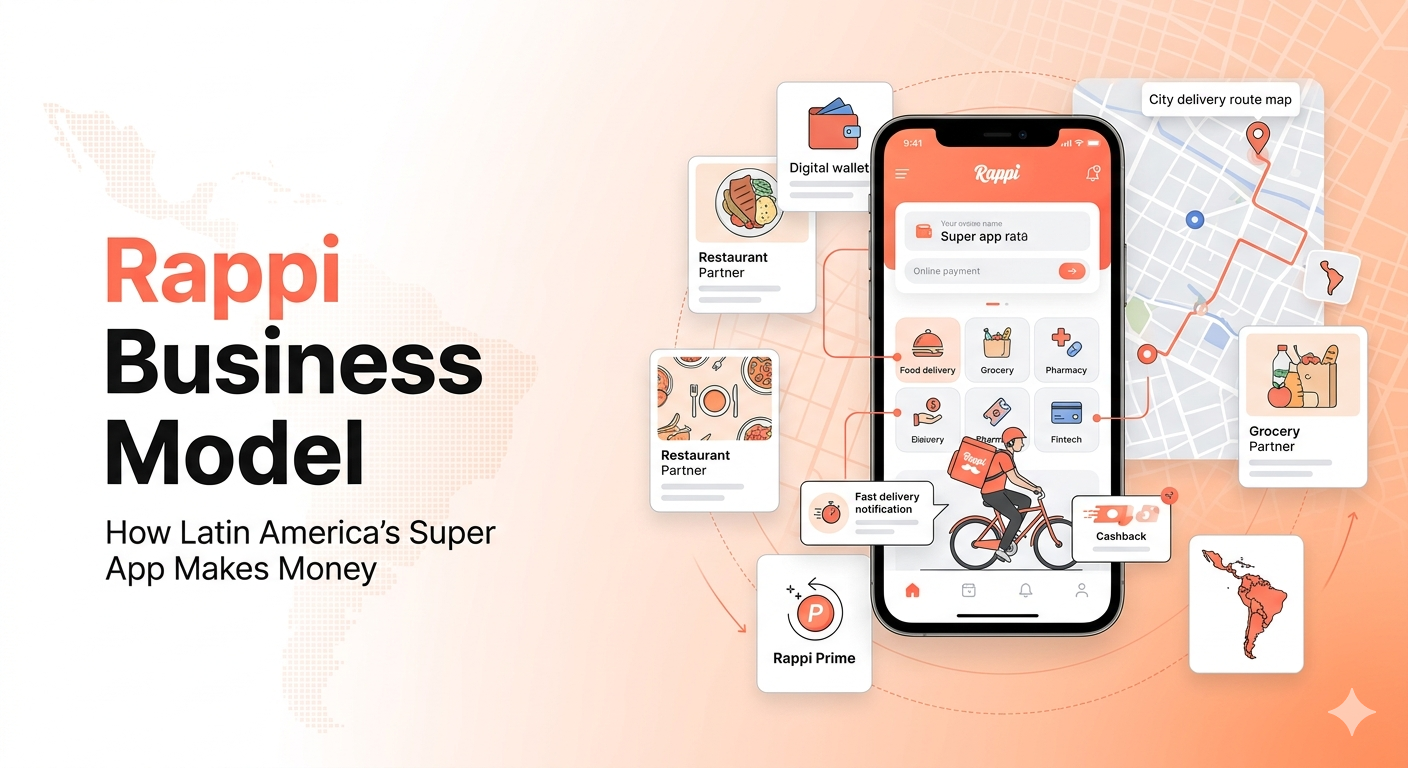

Rappi started as a simple delivery app in Colombia. Today, it operates across multiple countries, handles millions of orders, and competes with global tech giants. It is no longer just a delivery platform. It is a full-scale super app that touches food, groceries, payments, travel, and more.
Understanding how Rappi works and how it makes money gives a clear picture of why super apps are winning in emerging markets and what makes this business model so scalable.
What Is Rappi?
Rappi is a Latin American super app that offers food delivery, grocery delivery, fintech services, courier services, travel bookings, and more through one platform.
Founded in 2015 in Bogotá, Colombia, Rappi was created by Simón Borrero, Sebastián Mejía, and Felipe Villamarín. The founders saw a gap in the Latin American market where convenience-driven commerce was largely underserved. Their solution was an all-in-one app that could handle almost any delivery or service request.
Rappi now operates in countries including Colombia, Mexico, Brazil, Argentina, Chile, Peru, Ecuador, Uruguay, Costa Rica, and Panama. It serves tens of millions of users and partners with hundreds of thousands of merchants across the region.
The app started with food delivery but quickly expanded into groceries, pharmacy, courier errands, financial services, and travel. That shift from a single-use delivery tool to a multi-service platform is what defines Rappi today.
What Is Rappi’s Business Model?
Rappi uses a multi-service marketplace business model combined with subscription, delivery, advertising, fintech, and commission-based revenue streams.
At its core, Rappi is a three-sided marketplace. It connects customers who need products or services, merchants who want to sell, and delivery partners who fulfill orders. Each side of this ecosystem depends on the others, creating a tightly interconnected platform.
The marketplace structure allows Rappi to earn from multiple directions at the same time. It charges commissions to restaurants and stores, delivery fees to customers, subscription fees from members, and advertising fees from brands that want more visibility.
This layered revenue approach means Rappi is not dependent on any single income source. That flexibility makes the business model more resilient and more scalable compared to single-service delivery apps.
How Rappi Works
The user experience is built around speed and simplicity. Here is how the platform operates from start to finish:
- A user opens the Rappi app and browses categories including restaurants, grocery stores, pharmacies, and courier services
- The user selects items and places an order directly through the app
- The merchant receives the order notification and prepares it
- A nearby delivery partner (called a “rappitendero”) picks up the order
- The customer tracks delivery in real time through the app
- Payment is handled digitally through the app, including Rappi’s own payment system
Rappi uses hyperlocal logistics to make this process fast. Delivery partners are positioned in proximity to high-demand zones, which keeps delivery times short. Most orders in urban areas arrive within 30 to 45 minutes.
The platform also uses real-time data to monitor delivery routes, predict demand spikes, and optimize partner assignment. This backend intelligence is what keeps the logistics system running efficiently at scale.
Rappi’s Core Services
Rappi’s super app model is built on a wide range of services. Each category serves a specific customer need and adds another revenue layer to the business.
Food Delivery
Food delivery remains Rappi’s primary service by volume. The platform partners with restaurants ranging from local eateries to major fast-food chains. Restaurants pay a commission on each order processed through the app. Rappi handles the logistics and customer interface, while the restaurant focuses on food preparation.
Grocery Delivery
Rappi partners with major supermarkets and also operates its own dark stores, which are small fulfillment centers designed exclusively for fast delivery. These dark stores allow Rappi to stock commonly ordered items and fulfill grocery orders in under 15 minutes in some cities.
Pharmacy Delivery
Users can order over-the-counter medications, health products, and personal care items through the pharmacy section. This became especially important during the pandemic and helped Rappi expand its user base significantly.
Courier and Errand Services
One of Rappi’s most distinctive features is its “anything delivery” concept. Users can send packages, request errands, or ask delivery partners to pick up items from stores that are not formally on the platform. This flexibility sets Rappi apart from competitors focused only on restaurants and groceries.
RappiPay Fintech Services
RappiPay is the financial arm of the super app. It includes a digital wallet, peer-to-peer payments, QR-based payments at physical stores, and access to credit products. RappiPay targets both banked and unbanked users, which is a significant portion of the Latin American population.
Travel and Entertainment
Rappi also allows users to book flights, purchase event tickets, and make travel reservations directly within the app. This service category adds another reason for users to stay inside the Rappi ecosystem rather than switching to competitor platforms.
How Rappi Makes Money
Rappi earns through commissions, delivery fees, subscriptions, fintech services, advertising, and merchant solutions.
Here is a breakdown of each revenue stream:
Delivery Fees
Every order placed through Rappi includes a delivery fee paid by the customer. This fee varies based on distance, demand level, and whether the customer has a subscription. Delivery fees represent a consistent and high-volume income source.
Restaurant and Merchant Commissions
Rappi charges restaurants and stores a commission for each order fulfilled through the platform. Commission rates typically range from 15% to 30% depending on the merchant category, order volume, and negotiated agreements. This is one of Rappi’s largest revenue streams.
Rappi Prime Subscription
Rappi Prime is the platform’s paid membership program. Subscribers pay a monthly or annual fee in exchange for benefits like free deliveries, cashback on orders, and access to exclusive deals. Prime members also tend to order more frequently, which increases transaction volume.
The subscription model gives Rappi predictable recurring revenue and helps build long-term customer loyalty.
Advertising Revenue
Brands and restaurants can pay to appear in sponsored positions within the app. These promoted listings increase visibility during searches and on category pages. Rappi also offers promotional tools such as in-app banners, push notifications, and featured placements during peak hours.
As Rappi’s user base has grown, its advertising inventory has become increasingly valuable to consumer brands.
Fintech Revenue
RappiPay generates income through payment processing fees, interest on credit products, and financial service margins. As more users adopt RappiPay as their primary digital wallet, the fintech revenue stream becomes more significant.
Rappi has been pushing fintech expansion aggressively because financial services carry higher margins than delivery operations.
Merchant SaaS and Cloud Kitchens
Rappi offers business tools to restaurant and retail partners, including sales analytics dashboards, demand forecasting tools, and marketing insights. Some of these tools are sold as software-as-a-service products.
Rappi also operates cloud kitchens, which are shared cooking facilities where restaurant brands can prepare food for delivery-only orders. This allows Rappi to collect rent from kitchen operators while increasing the range of food options available on the platform.
Rappi’s Super App Strategy
A super app is a single platform that replaces multiple standalone apps by bundling many services into one experience. Rappi follows this model closely, and it works particularly well in Latin America for specific reasons.
Why super apps thrive in emerging markets:
- Smartphone penetration is high, but many users prefer to limit the number of apps they install
- Payment infrastructure is fragmented, so bundled fintech fills a gap
- Convenience economies are growing fast as urban populations expand
- Brand loyalty builds quickly when one app handles daily needs
Rappi’s super app strategy is often compared to WeChat and Gojek in Asia. The core logic is the same: if users can do everything in one app, they have no reason to leave. This ecosystem lock-in drives retention and increases the lifetime value of each customer.
The cross-selling opportunity is also significant. A user who comes to Rappi for food delivery can be introduced to RappiPay, then to Rappi Prime, then to grocery delivery. Each service adds value and deepens the user’s dependence on the platform.
Rappi’s Customer Segments
Rappi serves multiple distinct audiences, each with different needs and spending behaviors.
| Segment | Primary Need | Key Rappi Feature Used |
|---|---|---|
| Urban consumers | Fast, convenient delivery | Food, grocery, pharmacy delivery |
| Busy professionals | Time-saving services | Rappi Prime, express delivery |
| Local restaurants and stores | Digital sales channel | Marketplace listing, SaaS tools |
| Delivery gig workers | Flexible income | Rappitendero delivery network |
| Digital payment users | Cashless transactions | RappiPay wallet and credit |
Each segment generates revenue differently. End consumers drive transaction volume. Merchants pay commissions and advertising fees. Delivery partners provide the labor infrastructure that makes fulfillment possible.
Rappi’s Value Proposition
For customers:
- One app that handles food, groceries, pharmacy, payments, and travel
- Fast delivery times through hyperlocal logistics
- Savings through Rappi Prime membership and cashback offers
For merchants:
- Access to a large and active customer base
- Delivery infrastructure without building it independently
- Data and analytics to improve sales performance
- Cloud kitchen access for delivery-only brands
For delivery partners:
- Flexible work schedules with no fixed hours
- Consistent order volume in urban markets
- In-app tools to manage earnings and deliveries
Rappi’s Growth Strategy
Rappi’s growth has been built on several clear strategic pillars:
Aggressive geographic expansion. Rappi entered new markets quickly and focused on capturing urban centers where delivery demand was highest. Establishing a presence early gave Rappi a first-mover advantage in several countries.
Venture capital funding. Rappi has raised billions of dollars from investors including SoftBank, which led a major funding round. This capital allowed Rappi to subsidize delivery costs, invest in technology, and expand faster than locally funded competitors.
Discounts and cashback programs. Rappi used heavy discounting early on to acquire users at scale. Once users were inside the ecosystem and experiencing the platform’s convenience, retention rates improved.
Rappi Prime as a retention tool. Turning casual users into paying Prime subscribers dramatically increases order frequency. Subscriptions also reduce churn and create a financial incentive for users to stay on Rappi rather than switching to a competitor for a single order.
Hyperlocal logistics investment. Rappi built out its delivery infrastructure methodically, placing dark stores and logistics hubs in high-demand zones to reduce delivery times and improve reliability.
Technology Behind Rappi
Rappi’s technology stack is what makes its logistics model work at scale.
AI-based delivery optimization assigns orders to nearby delivery partners based on real-time location, traffic patterns, and predicted preparation times. This reduces idle time for partners and speeds up fulfillment for customers.
Route planning algorithms calculate the most efficient paths between pickup and drop-off points. In dense urban areas, even small routing improvements translate into significant time savings across millions of deliveries.
Real-time tracking systems let customers monitor their order from the moment it is placed to the moment it arrives. This transparency reduces customer service inquiries and builds trust.
Digital payments infrastructure through RappiPay handles transactions across multiple currencies and regulatory environments. Building payment technology in-house gives Rappi control over the financial layer and captures fee revenue that would otherwise go to third-party processors.
Data-driven personalization tailors the app experience to individual users. Rappi’s recommendation engine promotes restaurants, products, and deals based on past behavior, which increases order frequency and average basket size.
Rappi Competitors
Rappi operates in a competitive market with both global and regional rivals.
| Competitor | Type | Primary Market | Key Differentiator |
|---|---|---|---|
| Uber Eats | Global delivery app | Worldwide | Uber ecosystem integration |
| iFood | Regional delivery app | Brazil | Dominant Brazil market share |
| DoorDash | Global delivery app | US and Canada | Logistics technology |
| Glovo | Regional delivery app | Europe, Latin America | Similar super app model |
| DiDi | Rideshare and delivery | Mexico and Brazil | Mobility-first approach |
Rappi’s main competitive advantage is its super app scope. Most competitors focus primarily on food delivery. Rappi’s combination of delivery, fintech, subscriptions, and courier services creates a broader and stickier user experience.
In markets where iFood dominates, particularly Brazil, Rappi has had to compete aggressively on price and service range. In other Latin American markets, Rappi holds stronger positions due to its early entry and local partnerships.
Challenges in Rappi’s Business Model
Rappi’s model has real strengths, but it also carries significant challenges.
High operational costs. Running a hyperlocal delivery network across multiple countries is expensive. Fuel, partner incentives, logistics hubs, and technology maintenance all add up. Delivery businesses traditionally operate on thin margins, and Rappi is no exception.
Delivery profitability. Despite high order volumes, making each individual delivery profitable is difficult. Rappi has historically subsidized deliveries to drive growth, but this is not sustainable at scale without strong subscription and fintech revenue to offset losses.
Gig worker regulations. Latin American governments are increasingly scrutinizing the gig economy. New labor regulations in several markets could require Rappi to reclassify delivery partners as employees, which would significantly increase labor costs.
Intense competition. Global players like Uber Eats have deep pockets and established brand recognition. Regional players like iFood have entrenched positions. Staying competitive requires constant investment in technology, user experience, and pricing.
Customer retention costs. Acquiring customers through discounts and promotions is expensive. Converting those users into loyal, paying subscribers requires consistent service quality and ongoing value creation, which is operationally demanding.
Why Rappi Became Successful
Several factors explain Rappi’s growth from a Colombian startup to a regional super app.
First-mover advantage. Rappi entered multiple Latin American markets before major global competitors established strong footholds. That head start gave Rappi time to build brand recognition and logistics infrastructure.
Strong logistics network. Rappi invested early in its delivery infrastructure. Dark stores, logistics hubs, and partner density in urban centers created a reliable fulfillment system that competitors had to scramble to match.
Multi-service ecosystem. By expanding beyond food delivery into groceries, pharmacy, courier, fintech, and travel, Rappi made itself harder to replace. A user who depends on Rappi for five services is far less likely to switch than a user who uses it for one.
Heavy funding support. SoftBank’s investment gave Rappi the financial runway to operate at a loss while building market share. This is a common playbook for high-growth tech startups in emerging markets.
Local market adaptation. Rappi adjusted its features, partnerships, and pricing for each country it entered. Rather than applying a one-size-fits-all approach, it customized the experience to match local consumer behavior and infrastructure realities.
Lessons Startups Can Learn From Rappi
Build ecosystems, not single features. A single-function app is easy to copy and easy to replace. Rappi’s value comes from the combination of services, not any one of them individually.
Convenience is a durable competitive advantage. Customers who experience genuine convenience become loyal users. Rappi built its entire model around reducing friction in daily life.
Expand vertically over time. Rappi started with food delivery and used that foundation to layer on groceries, pharmacy, fintech, and travel. Vertical expansion deepens engagement and creates new revenue without starting from scratch.
Use data to personalize at scale. Rappi’s recommendation engine and demand forecasting tools allow it to serve each user more effectively as usage grows. Data makes the product better over time, which is a compounding advantage.
Retention beats acquisition. Getting a new customer is expensive. Rappi Prime and cashback programs are designed to keep existing users ordering more, which is far more efficient than continuously spending on new customer acquisition.
Future of Rappi
Rappi’s next phase is focused on several key areas.
Fintech expansion. RappiPay has the potential to become a standalone financial platform in markets where banking access is limited. Rappi is investing in credit products, insurance, and savings tools to deepen its financial services footprint.
AI-powered operations. Rappi is expanding its use of artificial intelligence for demand prediction, delivery routing, and personalized marketing. Smarter logistics means lower costs and faster delivery times.
Quick commerce growth. The 15-minute grocery delivery model is becoming a competitive standard. Rappi is expanding its dark store network to meet this expectation across more cities.
Profitability focus. After years of growth-at-all-costs spending, investor expectations are shifting toward sustainable unit economics. Rappi is under pressure to demonstrate that its business model can generate profits, not just revenue.
Deeper subscription penetration. Growing the Rappi Prime subscriber base is central to the company’s long-term strategy. Subscribers spend more, churn less, and generate predictable revenue that helps offset the volatility of delivery economics.
Wrapping Up
Rappi transformed from a delivery startup into a Latin American super app by combining logistics, fintech, subscriptions, and convenience into one scalable ecosystem.
The business model works because it serves all sides of the marketplace simultaneously. Customers get convenience. Merchants get reach. Delivery partners get income. And Rappi collects revenue from every transaction in the middle.
The super app model is still evolving in Latin America, and Rappi is at the center of that evolution. Whether the company can achieve long-term profitability while maintaining service quality and competitive pricing will determine its place in the global tech landscape.
For any startup looking to build in emerging markets, Rappi’s journey offers a clear framework: start with a high-frequency use case, build the infrastructure to do it well, then expand into adjacent services that deepen the relationship with your user base.
FAQs
Rappi uses a multi-service marketplace model that combines commission-based revenue, delivery fees, subscriptions, fintech services, and advertising into a single platform ecosystem.
Rappi earns through merchant commissions (typically 15% to 30% per order), customer delivery fees, Rappi Prime subscription fees, in-app advertising, RappiPay payment processing, and SaaS tools sold to merchant partners.
Rappi has not publicly confirmed consistent profitability. Like many high-growth super apps, it has prioritized market expansion over margins. The company is under increasing pressure from investors to move toward sustainable unit economics.
Rappi is a super app with services spanning food, groceries, pharmacy, courier, fintech, and travel. Uber Eats focuses primarily on food delivery. Rappi’s broader ecosystem creates stronger user retention and multiple revenue streams beyond delivery.
Rappi Prime is the platform’s paid subscription program. Members pay a monthly or annual fee and receive benefits including free deliveries, cashback on purchases, and access to exclusive in-app deals.
Rappi operates in Colombia, Mexico, Brazil, Argentina, Chile, Peru, Ecuador, Uruguay, Costa Rica, and Panama.
Rappi is called a super app because it bundles multiple services including food delivery, grocery delivery, pharmacy, courier services, digital payments, travel booking, and entertainment into a single app rather than requiring users to switch between separate platforms.
Rappi’s main competitors include Uber Eats, iFood, DoorDash, Glovo, and DiDi. iFood is its strongest rival in Brazil, while Uber Eats competes across multiple Latin American markets.
Discover more from Business Model Hub
Subscribe to get the latest posts sent to your email.

[…] Rappi went broader, building a super-app that covers food delivery, groceries, pharmacy, financial services, and more. This gave Rappi more cross-sell opportunities but made grocery delivery one of many priorities rather than the core focus. […]