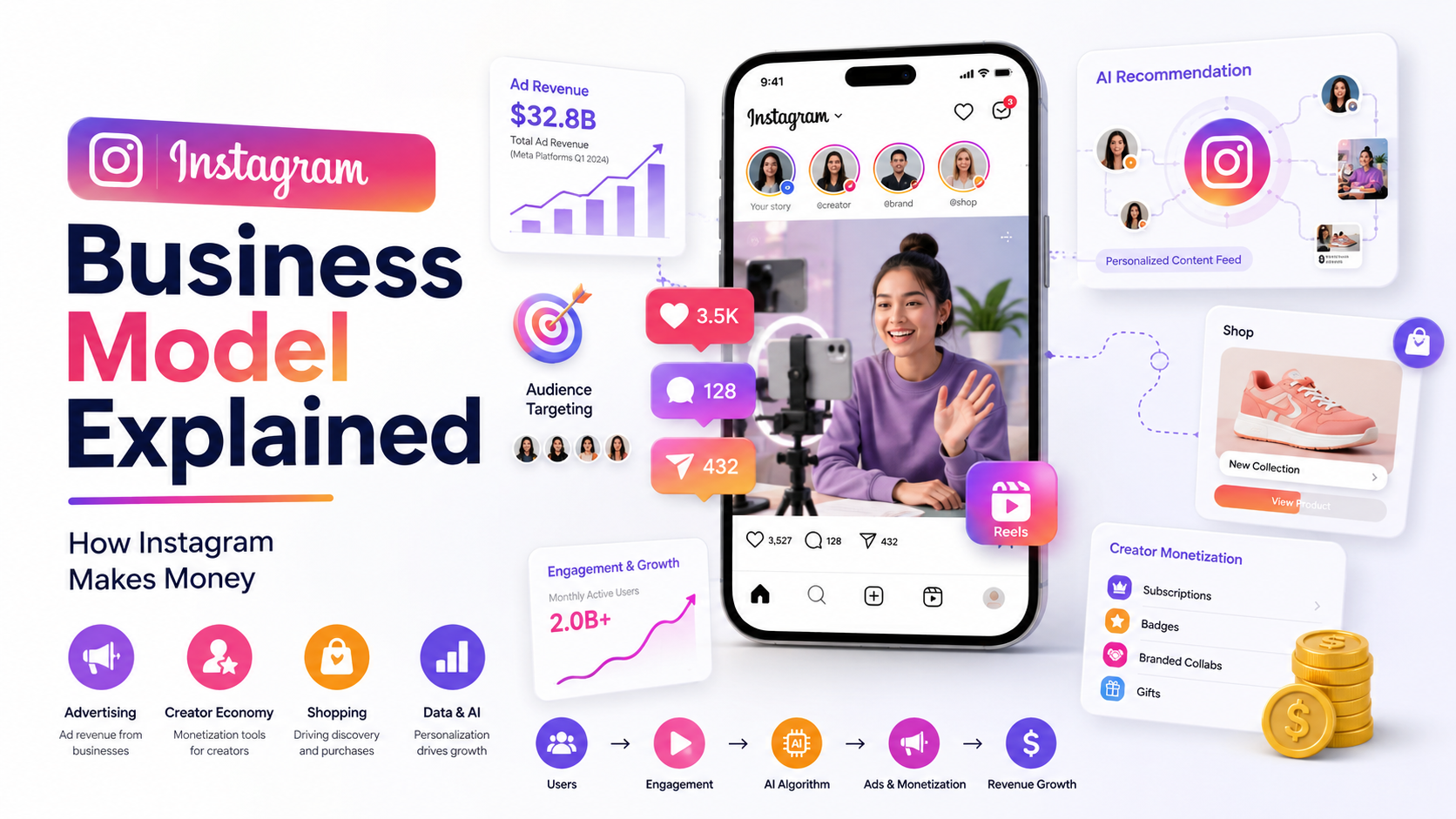

Instagram generates revenue primarily through advertising, which accounts for the vast majority of its income. The platform operates as a free service for users while charging businesses to reach its massive audience through targeted ads in feeds, Stories, Reels, and Explore pages. Instagram also earns money through creator monetization tools, shopping features, and sponsored content that connects brands with influencers and their followers.
The business model works because Instagram controls attention. With over 2 billion monthly active users spending an average of 30 minutes per day on the platform, Instagram has created an advertising ecosystem that rivals traditional media. The platform uses AI-driven recommendations to keep users engaged longer, which means more ad impressions and higher revenue for Meta, Instagram’s parent company.
Instagram’s strength lies in combining social networking with entertainment and commerce. Unlike traditional advertising platforms, Instagram leverages user-generated content, influencer marketing, and precise behavioral targeting to deliver ads that feel native to the user experience. This approach has made Instagram one of the most valuable advertising platforms in the world.
Introduction
Instagram started as a simple photo-sharing app in 2010. Today, it stands as one of the most powerful business platforms on the internet. The app transformed from a place to post filtered photos into a comprehensive ecosystem that includes short-form video, messaging, shopping, and creator monetization.
Founders, marketers, and business strategists study Instagram’s business model because it represents a masterclass in platform economics. The company built a multi-billion dollar business without charging users a single cent. Instead, it monetized attention, data, and social influence in ways that changed how brands connect with consumers.
Understanding how Instagram makes money reveals important lessons about network effects, creator economies, and the attention economy. The platform demonstrates how free consumer products can generate massive revenue through advertising while simultaneously empowering millions of creators and small businesses to build their own income streams.
What Is Instagram?
Instagram is a social media platform focused on visual content sharing and discovery. The app allows users to post photos, videos, and stories while following accounts that interest them. What began as a mobile photo app has evolved into a comprehensive content platform that competes with YouTube, TikTok, and traditional social networks.
Instagram Overview
Instagram offers multiple content formats that serve different user behaviors and business objectives.
Reels represent Instagram’s answer to TikTok. These short-form videos run up to 90 seconds and use AI-driven recommendations to surface content beyond users’ existing networks. Reels have become Instagram’s fastest-growing feature and a critical tool for creator discovery and ad revenue growth.
Stories allow users to share ephemeral content that disappears after 24 hours. This format encourages more casual, frequent posting and has become a major advertising surface. Businesses use Stories for promotions, product launches, and direct audience engagement.
Messaging through Instagram Direct enables private conversations between users. Meta has invested heavily in messaging features as part of its broader strategy to dominate private social communication. Messaging keeps users in the app longer and provides opportunities for commerce and customer service.
The creator ecosystem includes influencers, content creators, educators, and entertainers who build audiences on the platform. Instagram provides these creators with monetization tools, analytics, and features designed to help them grow. This creator economy drives content creation that keeps users engaged.
Shopping features transform Instagram into a commerce platform. Users can browse products, make purchases, and discover brands without leaving the app. This integration creates a seamless path from content consumption to transaction completion.
Who Owns Instagram?
Meta Platforms owns Instagram. Meta acquired the company in 2012 for approximately $1 billion, a deal that seemed expensive at the time but proved to be one of the most successful tech acquisitions in history.
Under Meta’s ownership, Instagram integrated with Facebook’s advertising infrastructure while maintaining its distinct brand identity. This integration allowed Instagram to tap into Meta’s advanced AI systems, advertising technology, and massive advertiser network. The ownership structure means Instagram’s revenue flows directly to Meta’s bottom line.
Instagram User Statistics
Instagram boasts over 2 billion monthly active users worldwide. The platform ranks among the top five most-used social media apps globally, with particularly strong penetration among users aged 18 to 34.
The creator economy on Instagram has exploded in recent years. More than 200 million businesses use Instagram, and millions of creators earn income through the platform. Creator accounts generate a disproportionate share of content and engagement compared to casual users.
Engagement statistics reveal why advertisers love Instagram. The average user spends approximately 30 minutes per day on the platform. Instagram’s engagement rate surpasses most other social networks, with users regularly liking, commenting, saving, and sharing content. This high engagement creates more advertising inventory and better ad performance.
Instagram Business Model Overview
Instagram operates multiple interconnected business models that work together to generate revenue and sustain growth. Understanding these models reveals how the platform creates value for different stakeholder groups while capturing that value for itself.
What Type of Business Model Is Instagram?
Instagram employs several overlapping business models that compound each other’s effectiveness.
The advertising business model forms Instagram’s primary revenue engine. Like Google and Facebook, Instagram provides free services to users while selling their attention to advertisers. This two-sided market approach has proven incredibly lucrative for platforms that can achieve scale and engagement.
Instagram functions as a platform business model by connecting multiple participant groups. The platform links users, creators, advertisers, and businesses in a network where each group enhances value for the others. Users provide attention and content, creators generate engaging material, advertisers pay for access, and businesses reach customers.
The creator economy model recognizes content creators as key partners rather than just users. Instagram invests in tools, features, and monetization options that help creators earn money. In return, creators produce the content that keeps users engaged and attracts advertisers.
Instagram’s social commerce model integrates shopping directly into the social experience. Instead of treating e-commerce as a separate function, Instagram embeds product discovery and purchasing into content consumption. This approach turns browsing into shopping and influencers into salespeople.
The AI-driven engagement model uses machine learning to personalize content recommendations. Instagram’s algorithms determine what each user sees based on their behavior, preferences, and engagement patterns. This personalization increases time spent on the platform and improves ad targeting effectiveness.
Instagram’s Core Revenue Logic
Instagram’s business model follows a simple but powerful logic chain.
Users join the platform to connect with friends, follow interests, and consume entertaining content. As users engage with posts, Stories, and Reels, they generate data about their preferences and behaviors.
Engagement signals feed into Instagram’s AI systems, which use this information to personalize each user’s experience. The algorithm shows users more of what they like, which increases engagement and session length.
AI recommendations keep users scrolling longer, which creates more opportunities to show advertisements. The longer users stay engaged, the more ads they see, and the more revenue Instagram generates.
Advertisers pay for access to Instagram’s engaged audience. They bid for ad placements based on targeting criteria, and Instagram uses auction dynamics to determine which ads appear to which users. This system maximizes revenue while attempting to maintain user experience quality.
The formula works because each element reinforces the others. Better engagement improves AI recommendations, which increases engagement further, creating more ad inventory and attracting more advertisers. This flywheel effect makes Instagram’s business model highly scalable and profitable.
Instagram Business Model Canvas
The Business Model Canvas provides a structured way to analyze Instagram’s business strategy across nine key dimensions. This framework reveals how different elements of the business model fit together to create and capture value.
Instagram Business Model Canvas Explained
Here’s how Instagram’s business model maps to the Business Model Canvas framework:
| Business Model Canvas Block | Instagram Strategy |
|---|---|
| Key Partners | Advertisers, content creators, influencers, small businesses, e-commerce brands, app developers, Meta ecosystem companies |
| Key Activities | Content recommendation and curation, ad targeting and delivery, platform development and maintenance, AI algorithm optimization, content moderation, creator support programs |
| Key Resources | User behavioral data, AI and machine learning systems, creator ecosystem and content, Meta’s technical infrastructure, brand reputation and network effects |
| Value Proposition | Free entertainment and social connection for users, massive audience reach for advertisers, monetization tools for creators, discovery and sales channels for businesses |
| Customer Relationships | Personalized content feeds, engagement tools like comments and DMs, creator support programs, business account features, customer service for advertisers |
| Channels | iOS and Android mobile apps, web platform, Meta’s cross-platform integrations, API access for developers |
| Customer Segments | General users seeking entertainment, content creators building audiences, small businesses reaching customers, large brands running campaigns, e-commerce sellers driving purchases |
| Cost Structure | Data center and infrastructure costs, AI system development and training, content moderation operations, research and development, creator incentive programs, employee compensation |
| Revenue Streams | Display advertising, video advertising, sponsored content, shopping transaction fees, creator monetization tool cuts, premium features for businesses |
This canvas shows how Instagram balances the needs of multiple customer segments while concentrating revenue generation primarily through advertising. The model works because Instagram can serve users and creators for free while monetizing their engagement through advertisers.
How Instagram Makes Money
Instagram generates revenue through several mechanisms, though advertising dominates all other income sources combined. Understanding these revenue streams reveals how the platform converts user attention into billions of dollars annually.
Advertising Revenue
Advertising accounts for the vast majority of Instagram’s revenue. Meta doesn’t break out Instagram-specific financials, but analysts estimate Instagram generates over $50 billion in annual ad revenue, making it one of the world’s most valuable advertising platforms.
Feed ads appear directly in users’ main content streams. These ads look like regular posts but include a “Sponsored” label. Feed ads can include single images, carousels with multiple images, or videos. Advertisers use feed ads to build brand awareness, drive website traffic, and generate conversions.
Story ads appear between users’ Stories from accounts they follow. These full-screen vertical ads last up to 15 seconds and can include interactive elements like polls, questions, or swipe-up links. Story ads perform particularly well for time-sensitive promotions and product launches because of their immersive format.
Reels ads represent Instagram’s fastest-growing ad format. These vertical video ads appear in the Reels feed and can run up to 60 seconds. Reels ads benefit from Instagram’s recommendation algorithm, which can show them to users beyond the advertiser’s existing followers. This discovery element makes Reels ads valuable for reaching new audiences.
Explore ads reach users browsing content related to their interests. When users tap into the Explore tab to discover new content, they encounter ads mixed with organic posts. These ads benefit from high purchase intent because users are actively seeking new content and ideas.
Sponsored content partnerships connect brands with influencers and creators. While not direct Instagram revenue in all cases, Instagram facilitates these partnerships through branded content tools that ensure transparency and tracking. Instagram takes a percentage of some creator-brand transactions facilitated through its platform.
Meta Ads Ecosystem
Instagram doesn’t operate as a standalone advertising platform. Instead, it integrates with Meta’s broader advertising infrastructure, which includes Facebook, Messenger, and the Meta Audience Network.
AI targeting powers Instagram’s advertising effectiveness. Meta’s machine learning systems analyze billions of data points to predict which users are most likely to engage with or purchase from specific ads. This targeting capability allows advertisers to reach precise audience segments based on demographics, interests, behaviors, and purchase intent.
Audience segmentation lets advertisers define their ideal customers using detailed criteria. Advertisers can target by age, location, interests, behaviors, and connections. They can also create custom audiences from their existing customer data or lookalike audiences that match their best customers’ characteristics.
The advertiser bidding system uses auction mechanics to determine ad placements and pricing. Advertisers set budgets and bid amounts, then Instagram’s system competes their ads against others targeting similar audiences. The auction considers both bid amount and ad quality to determine winners, ensuring users see relevant ads while Instagram maximizes revenue.
Why Instagram Ads Are So Effective
Instagram’s advertising platform outperforms many alternatives because of structural advantages built into the platform.
High engagement rates mean users actually pay attention to content on Instagram. Unlike passive media consumption, Instagram users actively scroll, like, comment, and share. This engagement mindset makes them more receptive to advertising messages, especially when ads match their interests.
Mobile-first usage aligns perfectly with modern consumer behavior. Nearly all Instagram access happens on mobile devices, where users are often in discovery mode or have immediate purchase intent. Mobile ads can drive instant actions through direct links to products or app downloads.
Influencer-driven purchasing leverages social proof and recommendation economics. When users see products endorsed by creators they follow and trust, they perceive those recommendations as more authentic than traditional advertising. Instagram’s integration of influencer content with shopping features creates seamless paths to purchase.
Instagram Creator Economy Business Model
Creators form the backbone of Instagram’s content ecosystem. The platform’s investment in creator tools and monetization options reflects Instagram’s understanding that professional content creators drive engagement and retention.
How Creators Help Instagram Grow
Creators contribute to Instagram’s business model in ways that extend far beyond their follower counts.
User-generated content from creators provides the raw material that keeps users engaged. Without creators consistently posting high-quality photos, videos, and Stories, Instagram would lack the content inventory needed to retain users. Creators essentially work as unpaid content producers whose output becomes Instagram’s product.
Viral loops created by popular creators attract new users to the platform. When creator content gets shared outside Instagram or referenced in other media, it drives signups from people who want to follow that creator. This organic growth reduces Instagram’s customer acquisition costs.
Retention effects keep users coming back regularly. Users develop habits around checking updates from their favorite creators. This habitual usage increases lifetime value and ad exposure per user. The more creators a user follows, the stronger their retention typically becomes.
Instagram Monetization Tools
Instagram offers several ways for creators to earn money directly through the platform, though advertising revenue sharing remains limited compared to YouTube.
Subscriptions allow creators to charge followers a monthly fee for exclusive content. Subscribers get access to special Stories, badges, and subscriber-only content. Instagram takes a percentage of subscription revenue, creating a direct income stream beyond advertising.
Brand collaborations facilitated through Instagram’s branded content tools help creators work with sponsors transparently. These tools let creators tag business partners in sponsored posts, ensuring proper disclosure while giving brands performance data. Instagram plans to take a percentage of transactions facilitated through these tools.
Gifts during live videos let viewers send virtual tips to creators. While currently a small revenue source, gifts represent Instagram’s attempt to replicate TikTok’s successful live-streaming monetization. Gifts create immediate, interactive monetization that rewards engaging live content.
Affiliate tools enable creators to earn commissions on products they recommend. Instagram’s shopping features integrate affiliate links directly into posts and Stories. When followers make purchases through these links, creators earn a percentage. This model aligns creator incentives with driving commerce on the platform.
Instagram Shopping Business Model
Instagram’s shopping features represent a strategic bet that social commerce will become a major revenue driver. By integrating e-commerce into social browsing, Instagram positions itself as more than just an advertising platform.
Instagram Shops Strategy
Instagram Shops transform the platform into a digital storefront where discovery and purchase happen in the same environment.
Product discovery happens organically as users browse content. When creators or brands post about products, users can tap tags to see product details, prices, and purchase options. This integration eliminates friction between inspiration and transaction.
Social commerce leverages the influence of peers and creators to drive purchasing decisions. Users can see what products their friends like, what influencers recommend, and what’s trending in their communities. This social layer adds trust and relevance to product recommendations.
Influencer-driven shopping connects creator content directly to product sales. When an influencer posts about a product, followers can purchase it immediately through in-app shopping features. This direct connection between content and commerce creates powerful conversion opportunities.
Why Shopping Matters to Instagram
E-commerce integration serves multiple strategic purposes beyond direct transaction fees.
Longer user sessions result when users browse products within Instagram instead of leaving for other shopping sites. Each additional minute spent in-app creates more advertising opportunities and stronger platform habits.
More ad spending comes from e-commerce brands that see direct ROI from Instagram. When brands can track sales generated through Instagram ads and shopping features, they increase budgets. This closed-loop measurement makes Instagram more valuable than awareness-focused advertising channels.
Better purchase intent data improves ad targeting effectiveness. When Instagram knows which products users browse, save, and purchase, it can show more relevant ads to those users and find similar high-intent audiences for advertisers. This data becomes increasingly valuable as privacy changes limit other targeting methods.
Instagram Algorithm and AI Strategy
Instagram’s algorithm determines what content each user sees and in what order. This AI-powered curation system directly impacts engagement, retention, and revenue generation.
How Instagram’s Algorithm Works
Instagram uses multiple algorithms for different parts of the app, but all share common principles based on engagement prediction.
Engagement signals tell the algorithm what users find interesting. When someone likes, comments, saves, or shares a post, that signals interest. The algorithm weighs these signals differently, with saves and shares often counting more than simple likes.
Watch time for video content strongly influences recommendations. Instagram tracks not just whether users watch videos, but how long they watch before scrolling away. Videos that retain attention get distributed more widely.
Saves indicate particularly high-value content that users want to reference later. The algorithm interprets saves as a strong interest signal and shows users more content similar to what they save.
Shares through DMs or Stories suggest content resonates enough that users want to spread it to others. This word-of-mouth behavior helps content go viral and signals high quality to the algorithm.
AI ranking combines these signals with timing, relationships, and user preferences to create personalized feeds. The algorithm constantly learns from each user’s behavior, adjusting predictions about what they’ll engage with next.
AI-Powered Recommendation Engine
Instagram’s recommendation systems extend beyond chronological feeds to actively discover content users might like even from accounts they don’t follow.
Reels recommendations use collaborative filtering and content analysis to surface videos from across Instagram. The system looks at which Reels similar users engaged with and what topics users show interest in. This recommendation approach helps new creators get discovered and keeps users watching longer.
Personalized feeds balance content from followed accounts with suggested posts from new accounts. Instagram tests how much suggested content users will tolerate and continuously optimizes this mix for engagement.
Content discovery systems in Explore analyze what topics and content types each user engages with most. The Explore page becomes a personalized content hub that introduces users to new accounts and ideas related to their interests.
How AI Improves Revenue
The relationship between AI performance and revenue generation creates a powerful improvement loop.
Better recommendations lead to more engagement as users see content that matches their interests more closely. Users spend more time in-app when the algorithm successfully predicts what they want to see.
More engagement creates more ad opportunities as users scroll through more content. Each additional minute on Instagram exposes users to more ads.
More ads viewed directly increases revenue as advertisers pay based on impressions and interactions. The more engaged the audience, the more valuable each ad placement becomes.
This improvement loop means Instagram’s investments in AI directly impact profitability. Even small improvements in recommendation accuracy compound into significant revenue increases across billions of users.
Instagram Growth Strategy
Instagram’s growth strategy focuses on defending its position against competitors while expanding into new use cases and user behaviors.
Reels vs TikTok Competition
Instagram launched Reels in direct response to TikTok’s explosive growth. TikTok proved that algorithmic content discovery based on short videos could dominate user attention and attract younger demographics.
Instagram’s advantage lies in its existing network effects and integrated ecosystem. Users already have friend networks on Instagram, which provides a built-in audience for their Reels. The platform also offers multiple content formats, letting users choose between Reels, Stories, and feed posts.
The competition with TikTok pushed Instagram to prioritize entertainment over social networking. The shift toward recommended content from strangers rather than friends represents a fundamental change in Instagram’s product strategy, driven by competitive pressure.
Creator Retention Strategy
Keeping top creators on Instagram requires continuous investment in monetization tools and audience growth features. Instagram knows that if major creators leave for other platforms, their audiences follow.
The platform offers benefits that YouTube and TikTok can’t easily match, including highly engaged audiences, strong shopping integration, and cross-promotion opportunities with Facebook. Instagram emphasizes these advantages while working to close gaps in areas like revenue sharing.
Meta Ecosystem Advantage
Instagram benefits from integration with Meta’s broader ecosystem of products and services. Users can cross-post content to Facebook, run unified ad campaigns across platforms, and access shared infrastructure like messaging and login systems.
This ecosystem integration creates switching costs that keep users and advertisers on Meta’s platforms. The technical infrastructure and data sharing across Meta properties give Instagram competitive advantages that standalone platforms struggle to match.
Instagram Target Audience
Instagram serves multiple distinct audience segments, each contributing differently to the business model.
Creators produce the content that keeps other users engaged. This segment includes influencers, professional photographers, videographers, educators, and entertainers. Creators drive engagement and attract followers, making them essential to the platform’s value proposition.
Businesses use Instagram for marketing, customer service, and sales. Small businesses particularly rely on Instagram as an affordable way to reach customers. This segment generates advertising revenue and uses shopping features to drive commerce.
Gen Z users represent Instagram’s future. This demographic grew up with Instagram and treats it as a primary communication and entertainment platform. Retaining young users ensures long-term platform relevance and growth.
Influencers occupy a special category between creators and businesses. They monetize their audiences through brand partnerships, affiliate marketing, and direct sales. Influencers drive significant commerce activity and create aspirational content that keeps followers engaged.
Brands both large and small use Instagram for awareness campaigns, product launches, and customer engagement. Major brands spend millions on Instagram advertising, while the platform’s self-service tools let businesses of any size participate.
Online sellers use Instagram as a discovery and sales channel. E-commerce businesses integrate their catalogs with Instagram shopping features, turning posts and Stories into shoppable storefronts. This segment benefits from Instagram’s visual format and engaged user base.
Why Instagram Became Successful
Instagram’s success resulted from multiple factors aligning at the right time with the right execution.
Strong network effects meant each new user made Instagram more valuable to existing users. As friends joined, the platform became essential for staying connected. This viral growth loop accelerated adoption and created barriers to competitors.
Visual-first design matched how people naturally communicate and share experiences. Photos convey emotion, status, and lifestyle more effectively than text. Instagram tapped into people’s desire to curate and share visual representations of their lives.
Mobile timing proved crucial to Instagram’s growth. The platform launched just as smartphones with good cameras became widespread. Instagram provided the perfect tool for doing something interesting with all those photos people were suddenly taking.
The influencer ecosystem emerged organically as users built audiences and brands recognized the marketing potential. Instagram became the primary platform where influence converted to income, attracting creators who produced engaging content.
AI personalization evolved over time to keep users engaged longer. As Instagram’s algorithms improved at predicting what each user wanted to see, time spent per session increased. This personalization created addictive feedback loops that kept users returning.
Challenges in Instagram’s Business Model
Despite its success, Instagram faces several structural challenges that threaten growth and profitability.
Privacy concerns limit targeting capabilities as Apple and regulators restrict data collection. Instagram’s advertising effectiveness depends on detailed user tracking, which privacy changes undermine. The platform must find new ways to target ads effectively with less data.
TikTok competition forces Instagram to evolve rapidly while risking alienating existing users. Copying TikTok’s features makes Instagram feel less differentiated, while not competing leaves it vulnerable to losing younger users entirely.
Ad fatigue occurs when users see too many ads or ads that feel intrusive. Instagram must balance revenue maximization against user experience quality. Too many ads drive users away, reducing long-term value.
Regulatory pressure increases as governments scrutinize social media platforms. Potential regulations could force changes to algorithms, advertising practices, or data usage that impact profitability.
Creator dissatisfaction with monetization options threatens the content supply that keeps users engaged. Many creators feel YouTube and TikTok offer better revenue sharing, creating risk that top talent shifts to competing platforms.
Instagram vs TikTok Business Model
Instagram and TikTok compete directly but approach the market with different business model priorities.
| Factor | TikTok | |
|---|---|---|
| Revenue Model | Primarily advertising with growing commerce integration | Advertising and live-streaming commerce with rapid growth |
| Discovery System | Blend of social graph and AI recommendations | AI-first algorithmic content discovery |
| Audience | Social networking with entertainment features | Pure entertainment and discovery focus |
| Monetization | Mature advertising tools with established brand relationships | Fast-growing creator monetization programs |
| Content Format | Multiple formats including photos, videos, Stories | Focused primarily on short-form vertical video |
| Creator Payouts | Limited revenue sharing, brand deals emphasized | Growing revenue sharing and creator fund programs |
| User Demographics | Broad age range with strong millennial presence | Skews younger with Gen Z dominance |
| Shopping Integration | Deep integration with product tagging and checkout | Growing live commerce and product links |
The key difference lies in content discovery philosophy. Instagram still emphasizes content from accounts users choose to follow, while TikTok pushes algorithmically recommended content from anyone. This affects how each platform generates engagement and retention.
Lessons Startups Can Learn from Instagram
Instagram’s business model evolution offers valuable lessons for founders building consumer platforms.
Build network effects before monetization. Instagram spent years growing users and engagement before implementing serious advertising. This patience allowed the platform to become essential before extracting value.
Prioritize creators as partners rather than just users. Instagram’s investment in creator tools, features, and monetization recognizes that professional creators produce the content that drives engagement. Platforms need content producers as much as content consumers.
Use AI for personalization to increase engagement and retention. Instagram’s algorithmic recommendations keep users engaged longer by surfacing content matched to their interests. Modern consumer platforms require sophisticated AI to compete.
Monetize after engagement becomes habitual. Instagram waited until users formed strong platform habits before introducing ads. This sequencing let the core product prove its value before commercialization potentially degraded experience.
Focus on retention loops that create habitual usage. Instagram’s combination of following relationships, recommended content, and Stories creates multiple reasons to check the app daily. Strong retention underlies all other business metrics.
Future of Instagram’s Business Model
Instagram’s business model will continue evolving as technology and user behavior change.
AI-generated content may become common as tools improve. Instagram will need to decide how synthetic content fits into the platform and whether AI-generated posts receive the same distribution as human-created content.
Social commerce growth could make Instagram a major e-commerce platform. If Instagram successfully converts browsing into buying at scale, transaction fees could become a meaningful revenue source alongside advertising.
Creator subscriptions may expand as creators seek reliable income beyond advertising and brand deals. Instagram could take a larger role in direct creator monetization, competing with Patreon and YouTube’s membership features.
AR and VR experiences represent Meta’s big bet on the next computing platform. Instagram could integrate augmented reality shopping, virtual hangouts, and immersive content as these technologies mature.
Automated advertising using AI to create, optimize, and target ads will make advertising more accessible to small businesses. Instagram’s ad platform could handle more of the creative and strategic work currently done by marketers and agencies.
Wrapping Up
Instagram evolved from a simple photo-sharing app into one of the world’s most sophisticated advertising platforms. The transformation happened because Instagram understood that attention, data, and influence could be converted into massive revenue without charging users directly.
The business model works because it creates value for multiple stakeholders simultaneously. Users get free entertainment and social connection. Creators get audiences and monetization tools. Businesses get access to engaged customers. Instagram captures value by sitting at the center of these exchanges and charging for access.
Instagram’s strength comes from the compounding effects of network effects, creator content, AI recommendations, and advertiser spending. Each element reinforces the others, creating a flywheel that becomes stronger over time. This structural advantage makes Instagram difficult to displace despite intense competition.
The platform faces real challenges from privacy changes, competitive threats, and creator demands. How Instagram navigates these challenges while maintaining user experience and advertiser effectiveness will determine whether it continues dominating social media or gradually loses ground to newer platforms with different approaches.
For now, Instagram remains a masterclass in platform business models, demonstrating how free consumer products can generate billions in revenue by monetizing attention, data, and social influence at scale.
FAQs
Instagram operates a platform business model that connects users, creators, and advertisers. The platform is free for users and creators but generates revenue by selling advertising access to its engaged audience. Instagram also facilitates creator monetization and social commerce, taking percentages of transactions where applicable.
Instagram makes money primarily through advertising. Businesses pay to show ads in feeds, Stories, Reels, and Explore pages. Instagram also earns from shopping features that enable e-commerce, creator monetization tools where it takes transaction fees, and branded content partnerships between creators and businesses.
Advertising represents Instagram’s largest revenue source by far, accounting for the vast majority of income. Analysts estimate Instagram generates over $50 billion annually from ads. Shopping and creator monetization contribute smaller amounts but represent growing opportunities.
Yes, Instagram earns from shopping through several mechanisms. The platform charges fees on transactions completed through Instagram Shops, takes percentages of affiliate sales, and benefits from increased advertising spending by e-commerce brands that see direct sales attribution from Instagram ads.
Creators earn through brand partnerships, sponsored content, affiliate marketing, subscriptions, gifts during live videos, and direct sales of products or services. Instagram provides tools to facilitate these income streams but takes a percentage of some transactions. Most creator income still comes from brand deals arranged independently.
The Instagram Business Model Canvas maps the platform’s strategy across nine elements including key partners like advertisers and creators, value propositions like free entertainment and audience reach, customer segments from general users to businesses, and revenue streams dominated by advertising. The canvas shows how Instagram balances free user access with advertiser monetization.
Discover more from Business Model Hub
Subscribe to get the latest posts sent to your email.