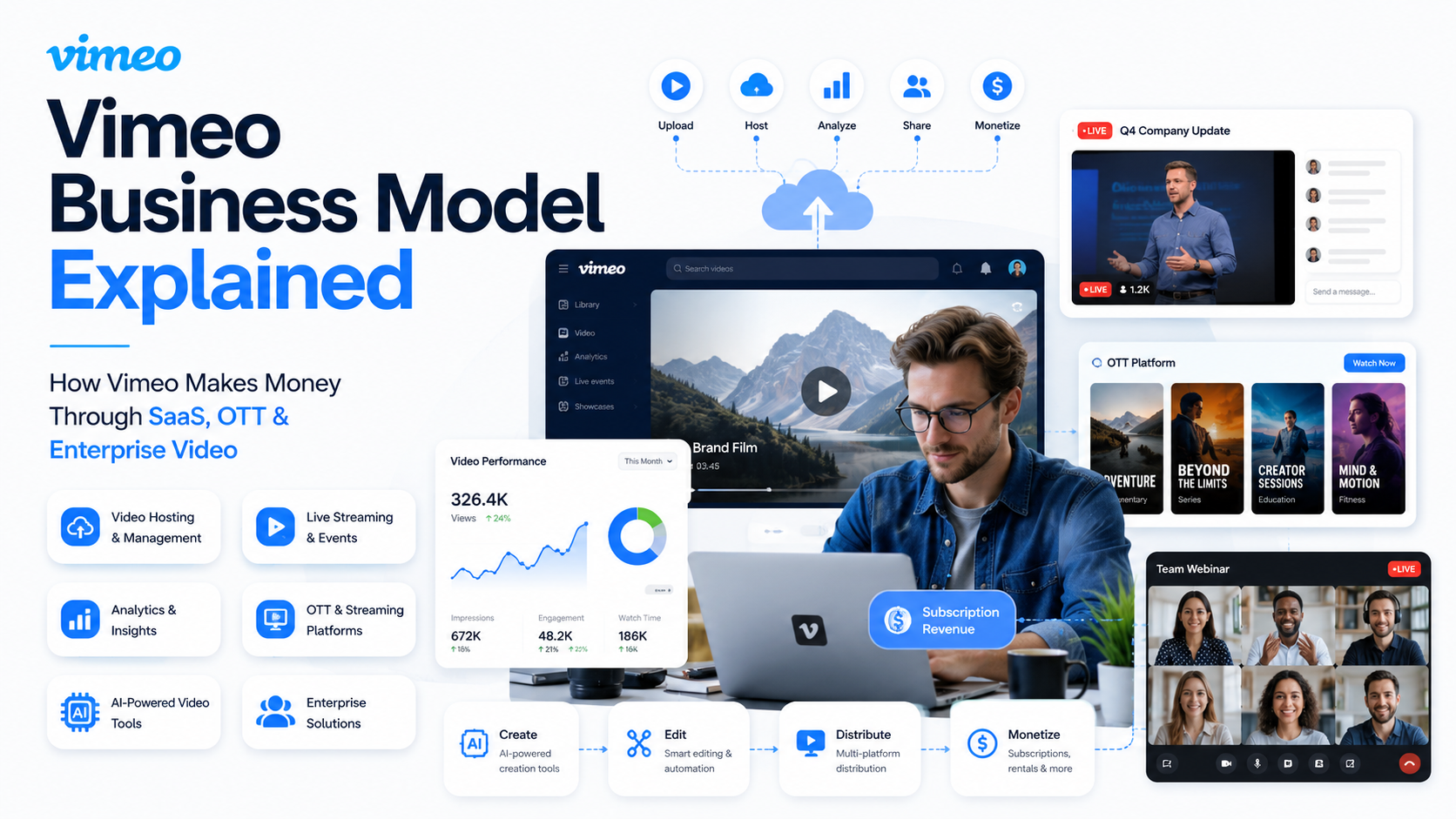
Vimeo Business Model Explained And How Vimeo Makes Money in the Creator Economy

Vimeo makes money through subscription plans, enterprise video tools, live streaming services, video hosting, OTT solutions, and creator-focused SaaS products. Unlike YouTube, Vimeo focuses on professional creators, businesses, and enterprise video infrastructure rather than ad-supported content consumption.
The platform generates revenue primarily from tiered subscription packages ranging from individual creators to Fortune 500 enterprises. Vimeo transformed from a simple video hosting alternative into a comprehensive B2B video software company serving professional users who need advanced tools, customization, and ad-free experiences.
Introduction
Most people think Vimeo competes with YouTube. In reality, Vimeo transformed itself into a business software company.
Vimeo started as an indie video platform beloved by filmmakers and creative professionals. Over the past decade, the company pivoted dramatically toward enterprise video infrastructure and creator economy tools. This shift turned Vimeo from a consumer entertainment platform into a SaaS company serving businesses and professional creators.
The creator economy now generates over $100 billion annually. Business video demand exploded with remote work. Vimeo positioned itself perfectly at this intersection by offering professional-grade video tools that YouTube never prioritized.
This strategic transformation makes Vimeo’s business model fundamentally different from traditional video platforms. While YouTube chases views and advertisers, Vimeo chases recurring subscription revenue from professionals who need reliable video infrastructure.
What Is Vimeo?
Company Overview
Vimeo launched in 2004, founded by Jake Lodwick and Zach Klein as a side project. The platform was originally created by filmmakers who wanted a better way to share creative work online.
IAC, the media conglomerate, acquired Vimeo early in its history and maintained ownership for years. In 2021, Vimeo spun off as an independent public company, trading on NASDAQ under the ticker VMEO.
Today, Vimeo serves over 260 million users globally. The company employs over 1,400 people and operates as a full-stack video technology provider rather than just a hosting platform.
Vimeo’s Main Products
Vimeo offers an integrated ecosystem of video tools designed for professional use.
Video Hosting
The core product remains premium video hosting with unlimited bandwidth on paid plans. Users get customizable video players, privacy controls, and portfolio-style presentation options that showcase work professionally.
Video Player
Vimeo’s embeddable player offers extensive customization. Users can match brand colors, remove Vimeo branding, add custom CTAs, and control every aspect of the viewing experience. This differs dramatically from YouTube’s standardized player.
Live Streaming
Professional live streaming infrastructure supports webinars, virtual events, and real-time broadcasts. The platform handles encoding, distribution, and interactive features like chat and Q&A.
Video Creation Tools
Built-in editing tools let users create videos directly in the browser. Screen recording, teleprompter features, and basic editing capabilities mean creators don’t need expensive software to produce content.
OTT Platform
Vimeo OTT enables creators to launch their own Netflix-style subscription services. Fitness instructors, educators, and media brands use this to build recurring revenue businesses with white-label streaming apps.
Enterprise Communication Tools
Video messaging, team collaboration features, and internal communication tools target corporate users. These products compete with Loom and async communication platforms.
AI Video Tools
Recent AI features include automated script generation, smart editing suggestions, caption generation, and video summarization. Vimeo invested heavily in AI to streamline video creation workflows.
Vimeo Business Model Overview
Core Business Model
Vimeo operates as a SaaS company built on recurring subscription revenue. This model provides predictable cash flow and higher profit margins than ad-supported platforms.
The freemium approach attracts users with limited free features, then converts them to paid plans as their needs grow. Free users get basic hosting with storage limits and Vimeo branding. Paid tiers unlock advanced features, analytics, customization, and collaboration tools.
Vimeo targets both individual creators and businesses. This B2B plus creator hybrid means the platform serves everyone from solo filmmakers to Fortune 500 enterprises with thousands of employees.
Revenue comes almost entirely from subscriptions rather than advertising. This creates alignment with users since Vimeo’s success depends on delivering value, not maximizing ad views.
Vimeo’s Positioning Strategy
Vimeo carved out a unique position by avoiding direct competition with consumer platforms.
| Platform | Focus |
|---|---|
| YouTube | Advertising plus mass audience |
| Vimeo | Professional video hosting |
| Loom | Workplace communication |
| Wistia | Video marketing |
YouTube dominates consumer entertainment and creator ad revenue. Vimeo serves professionals who need control, customization, and business features. Loom focuses specifically on async workplace communication. Wistia targets marketing teams with lead generation tools.
This positioning lets Vimeo avoid competing on content recommendation algorithms or ad revenue splits. Instead, the company competes on infrastructure quality, feature depth, and professional user experience.
How Vimeo Makes Money
Subscription Revenue
Subscriptions generate the majority of Vimeo’s revenue. The company offers tiered plans designed for different user segments.
Free Plan Limitations
The free tier provides basic video hosting with significant restrictions. Users get 5GB total storage, weekly upload limits, and mandatory Vimeo branding on all videos. The free plan works as a trial that pushes serious users toward paid options.
Paid Creator Plans
Individual creator plans start around $12 to $20 monthly. These plans include more storage, better analytics, customization options, and privacy controls. Mid-tier plans add features like video collaboration, advanced stats, and marketing integrations.
Business Plans
Business subscriptions range from $50 to several hundred dollars monthly. These include team collaboration tools, unlimited team members, centralized billing, advanced security, and priority support.
Enterprise Pricing
Large organizations get custom enterprise pricing based on their needs. Enterprise packages include dedicated account managers, SLAs, SSO integration, unlimited storage, and custom feature development.
Storage limits scale with plan tiers. Advanced analytics help businesses understand viewer behavior. Branding removal lets professionals present videos under their own identity. Collaboration tools enable teams to review, comment, and approve videos efficiently.
Enterprise Video Solutions
Enterprise customers represent Vimeo’s highest-value segment. Large organizations pay substantial fees for comprehensive video infrastructure.
Internal Communication
Companies use Vimeo for all-hands meetings, CEO updates, and internal announcements. Video messaging replaces lengthy email chains and improves remote team connection.
Corporate Training
Learning and development teams host training libraries, onboarding content, and skill development courses. Vimeo’s analytics show which employees watched required training and how much they engaged.
Virtual Events
Enterprise virtual event capabilities support company conferences, product launches, and customer events. Features include registration management, live Q&A, breakout rooms, and post-event analytics.
Video Management Systems
Large video libraries need organization, search, and permission controls. Vimeo provides enterprise content management with folders, tags, access controls, and centralized administration.
This enterprise focus positions Vimeo as a business video hosting platform and secure corporate video platform rather than a consumer entertainment service.
Live Streaming Services
Live streaming generates revenue through premium infrastructure and professional features.
Paid Livestream Infrastructure
Vimeo charges for professional live streaming beyond basic limits. High-quality encoding, low latency, simultaneous multi-platform streaming, and reliable delivery justify premium pricing.
Webinar Hosting
Business webinar features include registration pages, email reminders, interactive polls, and lead capture forms. Marketing teams pay for these professional webinar capabilities.
Virtual Events
Large-scale virtual conferences and hybrid events require robust infrastructure. Vimeo provides multi-stream support, breakout sessions, networking features, and white-glove event support.
Hybrid Events
Combining in-person and virtual audiences requires sophisticated technology. Vimeo helps event organizers reach global audiences while maintaining high production quality.
Industries using Vimeo live streaming include education institutions broadcasting lectures, corporate teams hosting town halls, media companies streaming live coverage, and event producers running conferences.
OTT Platform Revenue
Vimeo OTT represents a unique revenue stream where Vimeo takes a percentage of subscription revenue generated through creator streaming apps.
Subscription Video Apps
Creators build Netflix-style subscription services using Vimeo’s technology. Viewers pay monthly fees to access exclusive content libraries. Vimeo handles payment processing, app hosting, and streaming infrastructure while taking a commission.
White-Label Streaming Services
The white-label approach means creator brands stay front and center. Fitness instructors launch their own branded apps. Educators create member-only learning platforms. Media companies build direct-to-consumer subscription businesses.
Netflix-Style Creator Apps
Independent creators monetize loyal audiences without relying on ads or platform algorithms. This aligns with the broader creator economy trend toward owned audiences and direct monetization.
Examples include fitness creators charging $20 monthly for workout libraries, coaches offering exclusive training content, and media brands building niche subscription communities around specific topics.
Vimeo typically takes 10% to 30% of subscription revenue depending on the plan tier and services provided.
AI and Video Creation Tools
AI features represent Vimeo’s newest monetization opportunity and competitive differentiator.
AI Video Editing
Automated editing suggestions help users create polished videos faster. AI identifies best takes, suggests cuts, and applies professional transitions without manual editing expertise.
AI Script Generation
Content creators input topics and get AI-generated scripts. This speeds up content production and helps overcome creative blocks.
Automated Captions
AI-powered transcription generates accurate captions automatically. Accessibility compliance and improved engagement justify charging for this feature.
AI Summaries
Long videos get AI-generated summaries highlighting key points. Viewers can quickly decide if content is relevant before watching.
Future AI Monetization Potential
Vimeo will likely charge premium fees for advanced AI features. As AI video generation improves, Vimeo could offer text-to-video creation, automated content repurposing, and intelligent video search.
Vimeo Target Audience
Individual Creators
Filmmakers use Vimeo to showcase portfolios and share work with clients. The platform’s reputation for quality attracts creative professionals who want their videos presented beautifully.
Designers and creative agencies host client work, case studies, and project presentations. The customizable player matches brand aesthetics better than generic platforms.
Educators create course content, tutorials, and educational series. Privacy controls and organized libraries make Vimeo ideal for paid educational content.
Businesses
Startups use Vimeo for product demos, customer testimonials, and marketing videos. The professional appearance builds credibility with potential customers and investors.
SaaS companies rely on video for onboarding, tutorials, and feature announcements. Integration with marketing automation tools helps nurture leads through video content.
Enterprises need secure, scalable video infrastructure for internal and external communications. Compliance requirements, SSO integration, and admin controls make Vimeo enterprise-ready.
Media and Streaming Brands
OTT businesses launch subscription streaming services using Vimeo’s infrastructure. This includes fitness brands, cooking channels, and hobby-focused content networks.
Content publishers monetize archives and exclusive content through subscription models. Vimeo handles the technology while publishers focus on content creation.
Vimeo’s Shift From Consumer Platform to B2B SaaS Company
Why Vimeo Changed Strategy
Vimeo faced impossible odds competing with YouTube’s advertising ecosystem. YouTube benefits from Google’s advertising technology, massive scale, and algorithmic content discovery. These advantages create network effects that smaller platforms cannot overcome.
The company needed predictable recurring revenue rather than depending on advertising or viral content. Subscription businesses provide steady cash flow and higher valuations than ad-supported models.
Enterprise video demand exploded with remote work, digital transformation, and video-first communication trends. Businesses needed reliable video infrastructure and were willing to pay premium prices.
This market shift created an opportunity where Vimeo could dominate by serving professional needs YouTube ignored.
SaaS Transformation Strategy
The subscription-first model prioritizes recurring revenue over one-time payments or ads. Every product decision focuses on increasing subscriber lifetime value and reducing churn.
Enterprise expansion meant building features large organizations require. Security certifications, compliance tools, admin dashboards, and dedicated support became priorities.
The product ecosystem approach bundles multiple tools together. Rather than just hosting, Vimeo offers creation, editing, collaboration, analytics, and distribution in one platform. This increases switching costs and justifies higher prices.
Vimeo vs YouTube Business Model
Understanding these differences explains why Vimeo can succeed despite YouTube’s dominance.
| Feature | Vimeo | YouTube |
|---|---|---|
| Revenue Model | Subscription SaaS | Advertising |
| Audience | Professionals and businesses | Mass consumers |
| Monetization | Direct subscriptions | Ad revenue |
| Video Ownership | Creator-focused | Platform-focused |
| Branding | White-label options | YouTube branding |
YouTube makes money by selling ads against user-uploaded content. Vimeo makes money by selling video infrastructure to professionals who hate ads.
YouTube serves billions of casual viewers consuming entertainment. Vimeo serves millions of professionals who need video for business purposes.
YouTube creators monetize through ad revenue sharing, which requires massive view counts. Vimeo users monetize through direct sales, subscriptions, and business use cases.
YouTube owns the relationship with viewers through recommendations and the YouTube brand. Vimeo lets creators own the experience with customizable players and white-label options.
These fundamental differences mean the companies barely compete. They serve different markets with different value propositions.
Vimeo Marketing Strategy
Product-Led Growth
Free tools attract users who can explore Vimeo without sales conversations. The free plan lets people test video quality, player customization, and basic features.
The upgrade funnel guides users toward paid plans as they hit limitations. Storage caps, branding restrictions, and feature locks create natural upgrade moments.
Freemium strategy reduces customer acquisition costs since users discover value independently. Growth happens through product experience rather than expensive advertising.
SEO and Content Marketing
Vimeo invests heavily in educational content targeting professionals researching video solutions.
Topics include video marketing best practices, streaming technology guides, creator education about building audiences, and enterprise communication strategies.
This content ranks for high-intent keywords that potential customers search when evaluating video platforms. Educational content builds trust and positions Vimeo as an industry expert.
Creator Economy Positioning
Professional creator branding separates Vimeo from consumer platforms. The company markets itself as the choice for serious professionals rather than casual users.
Quality-focused platform image attracts users who care about presentation, control, and viewer experience. Vimeo emphasizes that its community values craft over viral stunts.
Vimeo Competitive Advantages
Ad-Free Experience
The cleaner viewing experience appeals to professionals who need distraction-free presentations. No pre-roll ads, banner ads, or suggested videos pulling attention away.
Professional positioning makes Vimeo acceptable in business contexts where YouTube feels inappropriate. Embedding Vimeo videos on corporate websites maintains brand integrity.
High-Quality Video Infrastructure
Better customization options let users control every aspect of the video experience. Player colors, controls, thumbnails, and end screens match brand requirements.
Branding control means videos can be fully white-labeled. Clients and viewers see your brand, not Vimeo’s.
Enterprise Focus
Security features include SSO, advanced permission controls, and compliance certifications. IT departments approve Vimeo for sensitive internal content.
Collaboration tools enable efficient video workflows. Teams can review, comment, approve, and publish videos without email chaos.
Scalability means enterprise customers can grow without platform limitations. Vimeo infrastructure handles everything from small team videos to company-wide broadcasts.
Challenges in Vimeo’s Business Model
Competition From Free Platforms
YouTube offers free hosting with unlimited storage. Many users choose free over premium, especially for non-commercial purposes.
TikTok dominates short-form video with massive reach and viral potential. Creators chasing large audiences gravitate toward algorithmic platforms.
Loom provides free workplace video messaging that competes with Vimeo’s communication tools. The focused use case and simpler pricing attract teams.
Wistia targets video marketing specifically with features Vimeo lacks. Marketing teams might choose specialized tools over general platforms.
Enterprise SaaS Competition
Microsoft Teams video integrates with the Office ecosystem most enterprises already use. Bundled solutions create competitive pressure on standalone tools.
Zoom ecosystem expanded beyond meetings into webinars, events, and video libraries. The brand trust and existing contracts give Zoom advantages in enterprise sales.
AI video startups like Synthesia and Descript innovate faster with AI-generated content and advanced editing. These tools could make traditional video hosting less important.
High Infrastructure Costs
Video storage costs money at scale. Unlimited storage plans compress margins since heavy users cost significantly more to serve.
Streaming bandwidth represents major ongoing expenses. Live streaming and high-quality video delivery require substantial infrastructure investment.
AI processing adds computational costs. As Vimeo adds AI features, processing expenses increase without guaranteed revenue increases.
Vimeo Growth Opportunities
AI Video Revolution
AI-generated video workflows will transform content creation. Vimeo can integrate tools that turn text into video, automatically edit footage, and personalize content at scale.
Automated editing capabilities help non-experts create professional results. Lowering the skill barrier expands Vimeo’s addressable market.
Business AI communication tools could make video the default format for updates, training, and collaboration. Vimeo is positioned to capture this shift.
Enterprise Video Expansion
Remote work demand continues growing. Distributed teams need better async communication tools, and video fills this need.
Internal communication tools remain underdeveloped at most companies. Vimeo can replace email and Slack messages with engaging video content.
Creator Subscription Economy
Paid communities around niche topics want video infrastructure. Membership sites, coaching programs, and educational platforms need hosting and monetization tools.
Independent streaming platforms help creators leave ad-supported platforms. Vimeo OTT enables this shift while taking a percentage of revenue.
Is Vimeo Profitable?
Vimeo generates over $400 million in annual revenue as of recent reports. The company transitioned from growth-at-all-costs to focusing on profitability.
SaaS margins can be excellent at scale. Once infrastructure is built, adding subscribers has low marginal costs. Vimeo targets 20% to 30% operating margins long-term.
Enterprise growth drives higher revenue per customer. Large contracts worth hundreds of thousands annually improve unit economics dramatically.
Market challenges include intense competition and economic sensitivity. Business video budgets get cut during recessions, impacting growth rates.
The company faced pressure as a public company to demonstrate clear paths to sustained profitability. Recent strategies focus on efficient growth rather than maximizing user counts.
Key Lessons Entrepreneurs Can Learn From Vimeo
Pivoting Can Save a Business
Vimeo transformed from a consumer platform into a SaaS business when the original model hit limits. This pivot unlocked a more valuable business model with better economics.
Recognizing when to change direction rather than fighting unwinnable battles separates successful companies from those that fade away. Vimeo had the courage to abandon its original identity.
Niching Beats Competing Broadly
Serving professional users instead of a mass audience let Vimeo avoid direct competition with YouTube. Narrowing focus actually expanded opportunities.
Specialized platforms can charge premium prices when they solve specific problems exceptionally well. Generalist platforms compete on price and scale.
Recurring Revenue Creates Stability
The subscription economy advantage shows in Vimeo’s improved business stability. Predictable revenue enables better planning and higher valuations.
One-time sales or ad revenue fluctuates wildly. Subscriptions compound over time as customers renew month after month.
Future of Vimeo
AI integration will define the next chapter. Video creation becomes accessible to everyone when AI handles technical complexity. Vimeo can monetize these capabilities through premium subscriptions.
Enterprise communication continues shifting toward video. Text-based tools feel outdated compared to rich video messages that convey tone and personality.
The video-first internet means more websites, apps, and communications rely on video. Vimeo infrastructure becomes essential as video replaces text across business contexts.
Creator-owned streaming ecosystems challenge platform dependency. More creators will launch direct-to-consumer subscription services using tools like Vimeo OTT.
The company sits at the intersection of multiple massive trends: remote work, creator economy, AI transformation, and video-first communication.
Wrapping Up
Vimeo makes money by selling professional video infrastructure to creators and businesses through subscription plans. The platform generates revenue from individual subscriptions, enterprise contracts, live streaming services, and OTT platform commissions.
The strategic pivot from consumer entertainment platform to B2B SaaS company saved Vimeo from irrelevance. Rather than fighting YouTube for views and ad dollars, Vimeo built a profitable business serving professionals who need reliable video tools.
This transformation matters because it proves niche focus beats broad competition. Vimeo carved out a valuable position by serving needs that mass-market platforms ignore.
The creator economy needs infrastructure providers who align with creators rather than advertisers. Vimeo built a business model where success depends on creator success, not maximizing ad impressions.
Vimeo’s biggest achievement was not becoming another YouTube. It was realizing that professional creators and businesses needed completely different video tools and building an entire subscription ecosystem around that demand.
FAQs
Vimeo makes money primarily through subscription plans sold to individual creators, businesses, and enterprises. The company also generates revenue from live streaming services, OTT platform commissions, and premium features like AI tools and advanced analytics.
The subscription model provides most revenue. Users pay monthly or annual fees for video hosting, customization, collaboration tools, and business features. Enterprise customers pay the highest amounts for dedicated support, unlimited usage, and advanced security features.
Yes, Vimeo and YouTube have fundamentally different business models and target audiences. YouTube makes money from advertising and serves mass consumer audiences. Vimeo makes money from subscriptions and serves professional creators and businesses.
YouTube prioritizes content discovery and viral reach. Vimeo prioritizes video quality, customization, and professional features. YouTube embeds ads in videos. Vimeo offers ad-free experiences.
The platforms barely compete because they serve different needs. Casual viewers and entertainment creators use YouTube. Professionals who need control, branding, and business features use Vimeo.
Vimeo OTT is a platform that lets creators build their own Netflix-style subscription services. Creators can launch branded streaming apps where fans pay monthly fees to access exclusive content libraries.
The service provides white-label technology for subscription video businesses. Fitness instructors, educators, and media brands use Vimeo OTT to monetize audiences directly rather than relying on ads or platform algorithms.
Vimeo handles payment processing, app hosting, content delivery, and streaming infrastructure. In exchange, Vimeo takes a percentage of subscription revenue, typically between 10% and 30% depending on the plan.
Vimeo shifted to SaaS because competing with YouTube’s advertising model was impossible. YouTube benefits from Google’s scale, technology, and advertising ecosystem. These advantages create unbeatable network effects.
Subscription revenue provides more predictable cash flow than advertising. SaaS businesses typically achieve higher valuations and better profit margins than ad-supported platforms.
Enterprise demand for professional video tools grew dramatically. Remote work, digital transformation, and video-first communication created opportunities to serve businesses willing to pay premium prices. This market shift let Vimeo dominate a segment YouTube ignored.
Vimeo generates over $400 million in annual revenue and has recently focused on achieving profitability. The company transitioned from prioritizing growth to focusing on sustainable unit economics.
SaaS businesses can achieve strong margins at scale. Enterprise customers paying large contracts improve profitability significantly. The company targets 20% to 30% operating margins long-term.
Challenges include high infrastructure costs for video storage and streaming. Competition from free platforms and enterprise tools creates pricing pressure. The company must balance growth investments with profitability requirements.
Vimeo serves three main user groups. Individual creators including filmmakers, designers, and educators use the platform to showcase work and host portfolios.
Businesses ranging from startups to Fortune 500 enterprises use Vimeo for marketing videos, product demos, internal communications, and training content. SaaS companies rely on Vimeo for customer onboarding and support.
Media and streaming brands build subscription businesses using Vimeo OTT. Fitness creators, coaches, and niche content publishers launch their own streaming services rather than depending on ad-supported platforms.
Discover more from Business Model Hub
Subscribe to get the latest posts sent to your email.