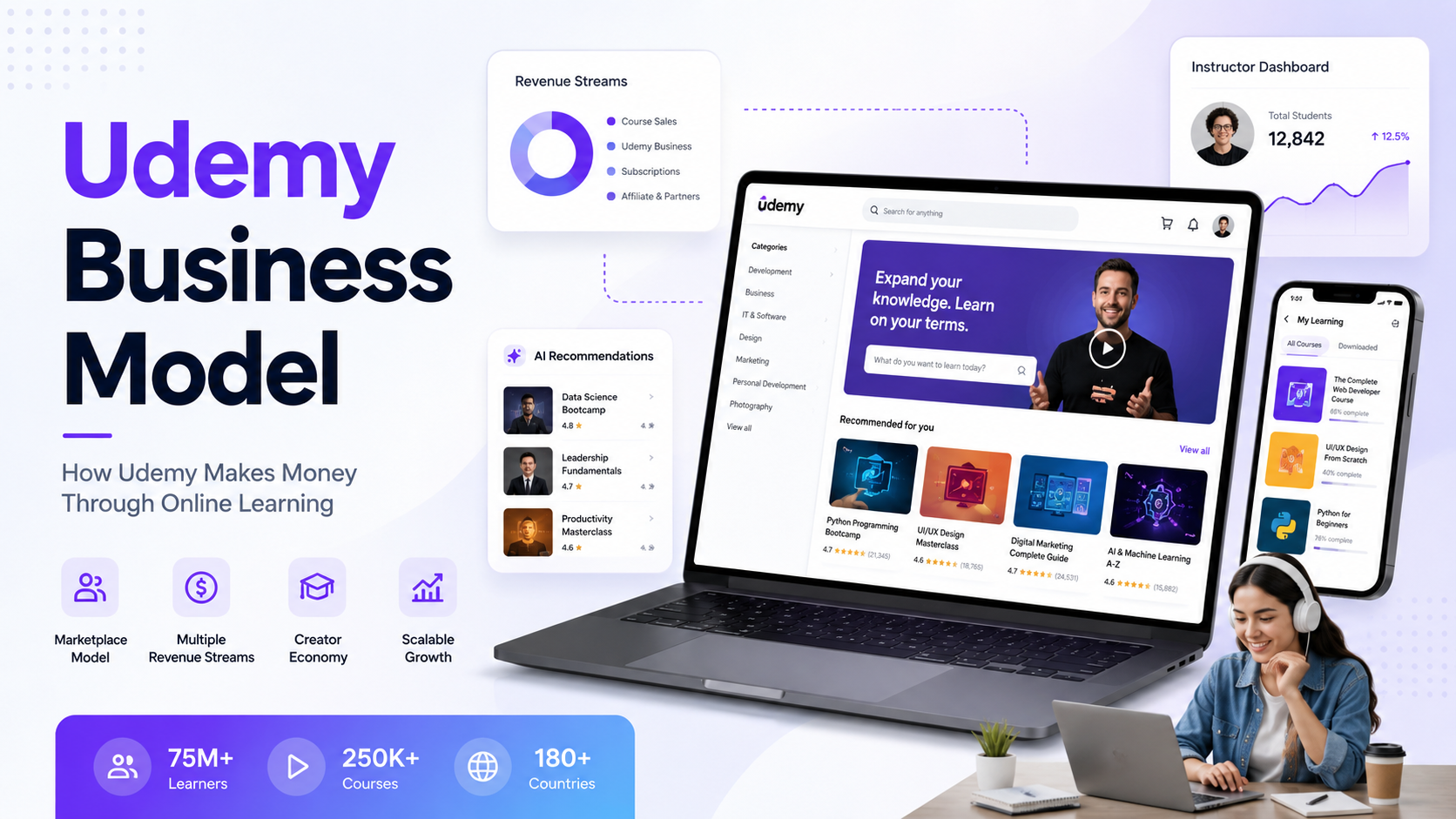
Udemy Business Model And How Udemy Makes Money and Scaled Online Learning Globally

Online education has transformed from a niche market into a multi-billion dollar industry. At the heart of this revolution stands Udemy, one of the world’s largest online learning platforms connecting millions of students with expert instructors across virtually every subject imaginable.
What is Udemy?
Udemy is a global online learning marketplace where anyone can create and sell courses, and anyone can buy them. Since its launch, the platform has democratized education by making it accessible, affordable, and available to learners worldwide.
The platform hosts over 213,000 courses taught in more than 75 languages, serving approximately 64 million students globally. From programming and data science to yoga and photography, Udemy covers practically every skill or hobby you can think of.
The Rise of Online Education
The eLearning industry has experienced explosive growth over the past decade. Remote work, career transitions, and the need for continuous skill development have pushed professionals to seek flexible learning options outside traditional educational institutions.
Udemy capitalized on this trend early. While universities were slow to adapt and corporate training remained expensive, Udemy created a marketplace where knowledge could flow freely between experts and learners at a fraction of traditional costs.
Why Udemy Became a Market Leader
Quick Answer: Udemy operates on a marketplace-based business model where instructors create courses and students purchase them individually. The platform earns revenue through course sales, subscriptions, enterprise learning, and partnerships.
Udemy’s success comes from solving multiple problems simultaneously. Students get affordable access to practical skills. Instructors gain a global platform to monetize their expertise. Businesses receive scalable training solutions. This three-way value creation built a flywheel that continues driving growth.
Company Background
Founding Story
Udemy was founded in 2010 by Eren Bali, Gagan Biyani, and Oktay Caglar. The idea emerged from Bali’s personal frustration with accessing quality education in his native Turkey. He envisioned a platform where anyone, anywhere could learn anything from expert instructors.
Mission and Vision
Udemy’s mission is straightforward: improve lives through learning. The company believes education should be accessible to everyone, regardless of location, background, or financial status.
This vision shaped every aspect of their business model. Rather than gatekeeping education behind degrees and credentials, Udemy opened the doors for anyone with knowledge to teach and anyone with curiosity to learn.
Global Footprint
Today, Udemy operates in over 180 countries. The platform supports multiple languages and currencies, making it truly global. Students in India can learn from instructors in the United States, while professionals in Brazil access courses created by experts in Germany.
Course Categories
Udemy organizes its massive course library into several major categories:
Development: Programming languages, web development, game development, mobile apps, databases
Business: Entrepreneurship, finance, sales, strategy, operations
IT and Software: Network security, hardware, operating systems, certifications
Design: Graphic design, UX/UI, design tools, game design, 3D modeling
Marketing: Digital marketing, SEO, social media, content marketing, branding
Personal Development: Productivity, leadership, career development, memory improvement
Photography and Video: Digital photography, video editing, commercial photography
Health and Fitness: Yoga, nutrition, sports, meditation, mental health
Music: Instruments, production, music fundamentals, vocal training
Teaching and Academics: Online education, test prep, math, science, humanities
Understanding the Udemy Business Model
Simple Explanation
Think of Udemy as the Amazon of online education. Instead of physical products, it sells knowledge packaged as video courses. Instructors are like sellers on Amazon, creating products (courses) and listing them on the platform. Students browse, purchase, and consume these courses at their own pace.
Udemy doesn’t create the courses itself. It provides the infrastructure, marketplace, payment processing, and customer acquisition. This asset-light model allows massive scalability without the overhead of content creation.
The Two-Sided Marketplace
Instructors (Supply Side)
Course creators are the lifeblood of Udemy. They bring expertise, create content, and continuously expand the platform’s offerings. Udemy provides them with:
Recording and upload tools to create professional courses without expensive equipment or technical knowledge. A global audience they couldn’t reach independently. Marketing and promotional support that drives student enrollments. Revenue sharing that rewards successful courses. Analytics showing how students engage with their content.
Anyone can become a Udemy instructor. There are no formal requirements beyond having knowledge to share and the ability to create video content. This low barrier to entry attracted thousands of creators, from industry professionals to hobbyists.
Students (Demand Side)
Learners come to Udemy seeking specific skills or knowledge. The platform offers them:
Individual course purchases rather than expensive degree programs. Lifetime access to purchased courses, allowing learning at their own pace. Preview videos to assess course quality before buying. Certificate of completion for finished courses. Mobile learning through dedicated apps. 30-day money-back guarantee reducing purchase risk.
Students don’t pay subscriptions to access the entire library. They buy individual courses that interest them, typically ranging from $10 to $200 depending on promotions.
Businesses (Third Customer Segment)
Udemy Business serves corporate clients separately from individual learners. Companies subscribe to curated course collections for employee training and development.
This B2B segment provides predictable recurring revenue, higher margins, and reduced dependence on the volatile consumer marketplace.
Udemy Business Model Canvas Breakdown
Key Partners
Course Creators: The foundation of Udemy’s content library. Without instructors, there’s no platform.
Payment Processors: Stripe, PayPal, and other payment gateways handle global transactions across multiple currencies.
Cloud Infrastructure Providers: AWS and similar services host massive video libraries and handle streaming to millions of users.
Enterprise Clients: Large corporations licensing Udemy Business for workforce training.
Affiliate Marketers: Partners who promote courses in exchange for commissions.
App Stores: Apple App Store and Google Play distribute Udemy’s mobile applications.
Key Activities
Platform Development: Continuous improvement of the learning management system, video player, search functionality, and user experience.
Course Hosting: Managing enormous video libraries, ensuring fast streaming globally, and maintaining uptime.
Marketing and Acquisition: Running campaigns to attract both students and instructors to the platform.
Instructor Support: Onboarding new teachers, providing resources for course creation, and maintaining creator community.
Content Moderation: Reviewing courses for quality, ensuring compliance with policies, and managing user-generated content.
Recommendation Systems: Using AI and machine learning to suggest relevant courses to students based on their interests and behavior.
Key Resources
Technology Platform: The proprietary learning management system that powers everything.
Brand Reputation: Udemy’s recognition as a trusted learning marketplace drives organic traffic and reduces customer acquisition costs.
Instructor Network: Thousands of active course creators continuously expanding the catalog.
User Data: Insights into learning behaviors, preferences, and outcomes that improve recommendations and marketing.
Mobile Applications: Native apps for iOS and Android extending reach beyond desktop users.
Algorithms: Machine learning models for search, recommendations, and personalization.
Value Propositions
For Students:
Affordability compared to traditional education or bootcamps. Courses often cost less than textbooks while providing video instruction, exercises, and resources.
Massive variety covering virtually any topic imaginable. If someone wants to learn it, there’s probably a Udemy course for it.
Flexibility to learn anytime, anywhere, at your own pace. No schedules, deadlines, or commutes required.
Lifetime access means you can revisit material whenever needed, unlike time-limited courses or expiring subscriptions.
Practical, skill-focused content created by practitioners rather than purely academic instruction.
For Instructors:
Global audience of millions impossible to reach independently without massive marketing budgets.
Monetization opportunity for expertise without building your own platform, payment processing, or customer acquisition.
Simple publishing system requiring only video content and basic setup. Udemy handles everything else.
Passive income potential as courses continue selling without additional work after creation.
For Businesses:
Workforce upskilling at scale without developing internal training programs from scratch.
Cost-effective compared to hiring external trainers or sending employees to conferences.
Measurable learning analytics showing course completion and skill development.
Curated content collections focused on business-relevant skills.
Customer Relationships
Self-Service Platform: Students and instructors interact with the platform independently without human support for most tasks.
Personalized Recommendations: Algorithms suggest courses based on browsing history, purchases, and similar user behavior.
Email Marketing: Regular communications promoting courses, sales, and encouraging engagement.
Community Features: Ratings, reviews, and Q&A sections create peer-to-peer interaction and social proof.
Support Systems: Help centers, chatbots, and customer service for issues requiring human intervention.
Channels
Website: The primary channel where most transactions occur. Udemy.com receives massive organic traffic from search engines.
Mobile Apps: Native applications for iOS and Android serve the growing mobile-learning demographic.
SEO: Organic search drives significant traffic as course pages rank for long-tail keywords.
YouTube: Free content and course previews attract potential students.
Affiliate Marketing: Partners promote specific courses earning commissions on sales.
Paid Advertising: Google Ads, Facebook Ads, and other platforms drive targeted traffic.
Email Lists: Regular promotions to existing users and subscribers.
Customer Segments
Individual Learners: People pursuing personal interests, hobbies, or casual skill development.
Career Changers: Professionals acquiring new skills to transition industries or roles.
Students: University students supplementing formal education with practical skills.
Freelancers: Independent workers expanding their service offerings.
Small Business Owners: Entrepreneurs learning marketing, finance, and operations.
Corporate Employees: Workers accessing courses through Udemy Business subscriptions.
Cost Structure
Cloud Infrastructure: Hosting and streaming massive video libraries globally requires significant computing resources.
Marketing Expenses: Customer acquisition costs through paid advertising, affiliates, and promotions.
Personnel Costs: Salaries for engineering, marketing, support, and administrative teams.
Payment Processing: Transaction fees on every course sale.
Technology Development: Continuous platform improvements, new features, and mobile app development.
Customer Support: Teams handling inquiries, refunds, and technical issues.
Content Moderation: Reviewing courses, managing quality, and ensuring policy compliance.
Revenue Streams
Course Sales Commissions: The primary revenue source. Udemy takes a percentage of every course sold.
Udemy Business Subscriptions: Monthly or annual fees from corporate clients accessing curated course libraries.
Affiliate Revenue: Commissions when partners drive course sales.
Promotional Partnerships: Revenue from featuring specific courses or instructors prominently.
How Udemy Makes Money
Marketplace Revenue Model
The core of Udemy’s business is taking commissions on course sales. However, the revenue split varies significantly based on how students discover and purchase courses.
Revenue Split Explained
Organic Sales (50/50 Split): When students find courses through Udemy’s website, search, or recommendations without external links, revenue splits evenly. The instructor receives 50%, Udemy keeps 50%. This reflects Udemy’s role in driving the discovery and facilitating the transaction.
Instructor Promotional Sales (97/3 Split): When instructors drive sales through their own marketing efforts using Udemy-provided coupon codes, they keep 97% while Udemy takes just 3%. This incentivizes instructors to promote their courses independently.
Affiliate or Partner Sales (50/50 or 75/25 Split): When third-party affiliates drive sales, revenue typically splits between Udemy, the instructor, and the affiliate. The exact split varies by partnership agreement.
This tiered structure balances multiple objectives. It rewards Udemy for marketplace discovery while incentivizing instructors to build their own audiences.
Discount Pricing Strategy
Udemy courses list at $50 to $200, but actual selling prices often drop to $10 to $30 during frequent promotions. This isn’t accidental but core to the business model.
High list prices create the perception of value. Deep discounts trigger urgency and psychological pricing effects. The “limited time offer” messaging drives conversions from browsers to buyers.
Volume compensates for lower margins. Selling courses at $15 to millions of students generates more revenue than selling at $100 to thousands. The marginal cost of an additional student is essentially zero since courses are digital products.
Udemy Business
Launched as a B2B offering, Udemy Business fundamentally changed the company’s revenue model by adding recurring subscription income.
How It Works
Companies pay monthly or annual subscriptions giving employees access to a curated collection of over 11,000 courses focused on business-relevant skills. Unlike the consumer marketplace, there are no individual purchases or heavily discounted sales.
Pricing typically starts around $360 per user annually for small teams, with volume discounts for larger organizations. A company with 100 employees might pay $30,000 to $40,000 annually.
Why It Matters
Predictable Revenue: Subscriptions create recurring income streams, unlike the volatile consumer marketplace dependent on promotions and seasonal fluctuations.
Higher Margins: Without heavy discounting and affiliate commissions, B2B revenue is more profitable per dollar.
Enterprise Scalability: Large corporate contracts can represent significant revenue from single customers.
Customer Lifetime Value: B2B customers typically maintain subscriptions for years, unlike consumers who may make occasional purchases.
Market Validation: Corporate adoption validates course quality and platform utility beyond hobbyist learning.
Udemy Business now represents a substantial portion of total revenue and continues growing as companies prioritize employee development and remote training.
Affiliate Marketing
Udemy operates an affiliate program allowing partners to earn commissions promoting courses. Bloggers, YouTubers, websites, and influencers can join the program and receive unique tracking links.
When someone clicks an affiliate link and purchases a course, the affiliate typically earns 15-20% commission. This performance-based marketing extends Udemy’s reach without upfront costs.
Affiliates benefit from Udemy’s brand recognition and conversion-optimized purchase flow. Udemy gains customer acquisition without paying for clicks or impressions that don’t convert.
Mobile App Revenue
Udemy’s mobile apps generate revenue through in-app purchases of courses. While the revenue split mechanics remain the same, mobile users represent a growing segment of learners.
The apps support offline downloads, allowing learning without internet connectivity. This feature particularly appeals to users in markets with unreliable internet or those who want to learn during commutes.
Mobile-first learning aligns with broader consumer behavior trends. Many users prefer learning on smartphones and tablets over desktop computers, making mobile optimization crucial for continued growth.
Pricing Strategy Deep Dive
The Psychology of Constant Discounts
Walk into Udemy any day, and you’ll likely see promotional banners advertising 80-90% off courses. This isn’t occasional marketing but a core pricing strategy.
Anchoring Effect: List prices of $100-$200 create mental anchors. When students see courses marked down to $15, the perceived value appears enormous.
Urgency and Scarcity: Flash sales and countdown timers create fear of missing out. Students purchase immediately rather than adding courses to wishlists.
Lower Purchase Barrier: At $10-$15, buying a course becomes an impulse decision rather than a considered investment. The low price point reduces decision anxiety.
Volume Over Margin: Digital products have zero marginal costs. Whether one student or one million enroll, delivery costs remain the same. Therefore, maximizing student numbers at lower prices generates more total revenue than higher prices with fewer sales.
Customer Acquisition Economics
The discount strategy also serves customer acquisition. A student who buys their first course at $15 might purchase additional courses at full price later. The initial low-cost sale acquires the customer and begins building lifetime value.
Additionally, satisfied students become organic marketers, recommending courses to colleagues and friends. The viral coefficient improves when entry barriers are low.
Challenges with Discount Dependency
The constant promotion strategy creates challenges. Students rarely pay full price, training them to wait for sales. The perceived “real” price becomes $15, not $100.
Some instructors feel their work is devalued when courses perpetually sell at 80-90% discounts. The list price becomes meaningless rather than reflecting actual course value.
Udemy has addressed this by maintaining the discount schedule consistently. Students know sales happen regularly, so waiting doesn’t create uncertainty. The predictable promotion calendar actually supports rather than undermines purchase behavior.
Growth Strategy and Market Expansion
SEO as a Growth Engine
Udemy’s SEO strategy is masterful. Every course creates a unique landing page optimized for search engines. With over 200,000 courses, that’s 200,000+ pages targeting different keywords.
Long-Tail Keywords: Course pages naturally rank for specific, low-competition search terms. Someone searching “Python for data science beginners” will likely find Udemy courses in top results.
User-Generated Content: Course descriptions, reviews, and Q&A sections create unique content that search engines value.
Domain Authority: Years of quality content and backlinks have built Udemy’s domain authority, helping new course pages rank quickly.
This organic traffic dramatically reduces customer acquisition costs compared to paid advertising. While competitors spend heavily on Google Ads, Udemy receives free traffic from organic search results.
Creator Economy Strategy
Udemy leveraged the creator economy before it became a buzzword. By allowing anyone to create and sell courses, they tapped into distributed content creation at minimal cost.
Traditional online education companies employ instructors or license content. Udemy pays nothing upfront. Instructors create courses hoping to earn revenue shares. This shifts content production costs and risks from Udemy to creators.
The model scales infinitely. Udemy can add thousands of courses without proportionally increasing costs. As the catalog grows, the platform becomes more valuable to students, attracting more instructors in a virtuous cycle.
Global Expansion
Udemy’s international strategy focuses on localization without losing global scale.
Multi-Language Support: Courses are available in over 75 languages, making content accessible to non-English speakers.
International Instructors: Teachers from any country can create courses in their native language, serving local markets.
Regional Pricing: Udemy adjusts pricing for different markets, making courses affordable in countries with lower purchasing power.
Payment Options: Support for local payment methods beyond credit cards, including mobile money and regional processors.
Subtitle and Translation Tools: Features helping instructors reach global audiences by adding subtitles in multiple languages.
This global approach dramatically expanded the addressable market beyond English-speaking countries.
Mobile Learning Trend
Mobile learning growth shaped Udemy’s product development. The mobile apps aren’t just responsive versions of the website but purpose-built learning experiences.
Offline Downloads: Students can download courses over Wi-Fi and watch without internet, crucial in markets with expensive or unreliable data.
Microlearning: Mobile interfaces encourage shorter learning sessions fitting into commutes or breaks.
Push Notifications: Reminders and updates keep students engaged with courses they’ve started.
Responsive Video Player: Optimized for smaller screens with adjustable playback speeds and quality settings.
Mobile users often have higher engagement and completion rates than desktop learners, making mobile optimization critical for growth.
Technology and Infrastructure
Video Hosting Infrastructure
Streaming millions of hours of video globally requires serious technical infrastructure. Udemy uses cloud services to ensure fast, reliable delivery regardless of user location.
Content Delivery Networks (CDNs): Videos are cached on servers worldwide, reducing latency and improving load times.
Adaptive Bitrate Streaming: Video quality automatically adjusts based on connection speed, preventing buffering.
Encoding and Compression: Uploaded videos are processed into multiple formats and qualities for different devices and bandwidths.
AI-Based Recommendations
Udemy’s recommendation engine uses machine learning to suggest courses. The system analyzes browsing behavior, purchase history, course ratings, and similar user patterns.
Collaborative Filtering: Recommends courses popular among students with similar interests.
Content-Based Filtering: Suggests courses related to topics you’ve previously studied.
Hybrid Approaches: Combines multiple algorithms for more accurate recommendations.
Effective recommendations increase course discovery and purchase rates while improving student satisfaction by surfacing relevant content.
Search Engine
The platform’s search functionality must handle queries across 200,000+ courses. The search algorithm considers:
Keyword relevance in course titles, descriptions, and content. Course ratings and review sentiment. Enrollment numbers and popularity. Instructor credibility and teaching ratings. Recent course updates and activity.
Search quality directly impacts revenue since students who can’t find relevant courses won’t buy.
Personalized Dashboards
Each student sees a customized dashboard showing:
Courses in progress with completion percentages. Recommended courses based on interests. New courses in followed categories. Achievements and learning streaks. Instructor announcements and course updates.
Personalization increases engagement and time spent on the platform, leading to more course purchases.
Analytics Systems
Comprehensive analytics serve both instructors and platform administrators.
Instructor Analytics: Show enrollments, revenue, student demographics, video completion rates, quiz performance, and review sentiment. This data helps instructors improve courses and marketing.
Platform Analytics: Track user acquisition, conversion rates, churn, course performance, search trends, and business metrics guiding strategic decisions.
Competitive Advantages
Network Effects
Udemy benefits from classic two-sided marketplace network effects. More instructors create more courses. More courses attract more students. More students incentivize more instructors. This flywheel becomes self-reinforcing.
Competitors starting today face chicken-and-egg problems. Without courses, they can’t attract students. Without students, instructors won’t create courses. Udemy’s established marketplace creates a significant moat.
Affordable Pricing
While platforms like Coursera offer university-backed courses at higher prices, Udemy’s discount strategy makes learning accessible to price-sensitive students.
The low cost removes barriers to trying new subjects. Students can experiment with courses in unfamiliar fields without significant financial risk.
Brand Recognition
Udemy has become nearly synonymous with online learning in many markets. This brand recognition reduces customer acquisition costs and increases conversion rates.
When someone thinks “I want to learn Python,” Udemy often comes to mind before competitors. This top-of-mind awareness is invaluable and difficult for new entrants to replicate.
Flexible Learning Experience
Self-paced learning appeals to busy professionals who can’t commit to scheduled classes. Udemy’s model accommodates irregular schedules, allowing people to learn during whatever time they have available.
Lifetime access means students can revisit material months or years later, providing ongoing value from a single purchase.
Challenges and Limitations
Content Quality Control
The open marketplace model creates quality inconsistency. Anyone can create a course regardless of teaching ability or subject expertise. This leads to significant variation in course quality.
While student reviews provide feedback, poor courses still get published and potentially purchased. Udemy has implemented quality review processes, but with thousands of new courses monthly, maintaining consistent standards is challenging.
Some students report courses with poor production quality, outdated information, or instructors with limited teaching skills. These experiences can damage platform reputation.
Intense Competition
Coursera: Partners with universities offering accredited courses and degrees. Focuses on formal education and professional certificates.
Skillshare: Subscription-based access to creative courses. Targets designers, creators, and artists.
LinkedIn Learning (Lynda): Professional development courses integrated with LinkedIn profiles. Serves career-focused learners.
Pluralsight: Technology and IT courses for developers and tech professionals. Depth over breadth.
MasterClass: Celebrity instructors teaching their crafts. Premium pricing and production quality.
Free Platforms: YouTube, Khan Academy, and freeCodeCamp offer zero-cost alternatives.
Each competitor targets different segments or employs different business models, fragmenting the market.
Revenue Dependence on Discounts
The constant discount strategy creates price perception challenges. Students trained to expect 80-90% off sales rarely purchase at list price. This limits pricing flexibility and trains customers to delay purchases until promotions.
If Udemy tried transitioning away from heavy discounts, they’d likely see significant revenue drops as customers resist higher prices.
Instructor Retention
Top instructors are essentially entrepreneurs building businesses on Udemy’s platform. As they gain audiences, some consider launching independent course sites to avoid revenue sharing.
Platforms like Teachable and Thinkific make it easy for instructors to create their own course websites. Successful instructors might leave Udemy once they’ve built sufficient personal brands.
Udemy mitigates this by providing marketing value instructors couldn’t replicate independently. The platform drives discovery and sales that would be difficult for individuals to achieve alone.
SWOT Analysis
Strengths
Massive Course Library: Over 200,000 courses covering virtually every topic creates comprehensive selection competitors can’t match.
Strong SEO Presence: Dominant organic search rankings drive free customer acquisition.
Global Reach: Operations in 180+ countries with multi-language support create truly international scale.
Established Network Effects: Large instructor and student bases create self-reinforcing marketplace dynamics.
Brand Recognition: Top-of-mind awareness in online learning market.
Dual Revenue Streams: Both B2C and B2B income sources reduce dependence on single customer segment.
Weaknesses
Quality Inconsistency: Open marketplace allows low-quality courses that damage reputation.
Heavy Discount Dependency: Revenue relies on constant promotions rather than sustainable pricing.
Limited Accreditation: Certificates lack recognition from employers compared to university credentials.
Instructor Churn: Successful creators may leave platform to avoid revenue sharing.
Course Piracy: Digital products are easily copied and distributed illegally.
Opportunities
AI-Powered Learning: Personalized learning paths, AI tutors, and adaptive content could differentiate platform.
Corporate Learning Growth: Remote work increases demand for scalable employee training solutions.
Emerging Markets: Growing internet access in developing countries creates new customer bases.
Skills Gap: Rapid technological change creates ongoing demand for upskilling and reskilling.
Professional Certifications: Partnerships with industry bodies for recognized credentials.
Live Learning: Interactive, scheduled courses could complement self-paced content.
Threats
Increased Competition: New platforms and established tech companies entering online education.
Free Content: YouTube, podcasts, and open educational resources offer zero-cost alternatives.
Economic Downturns: Recession could reduce discretionary spending on education.
Regulatory Challenges: Educational regulations or content moderation requirements in different countries.
Platform Risk: Instructors building businesses dependent on Udemy’s platform face policy and algorithm changes.
Technology Disruption: New learning modalities or technologies could make video courses obsolete.
Lessons for Startups
Build Marketplace Flywheels
Udemy demonstrates the power of network effects in two-sided marketplaces. Focus on creating virtuous cycles where each user group makes the platform more valuable for the other.
Early-stage marketplace startups should determine which side to prioritize first. Udemy initially focused on recruiting instructors before aggressively marketing to students, ensuring supply when demand arrived.
Focus on Scalability
The asset-light model allowed Udemy to scale without proportionally increasing costs. Startups should identify which functions can be outsourced to users or partners rather than built internally.
Udemy doesn’t create content, doesn’t employ instructors, and doesn’t manage most customer acquisition. They built infrastructure and let others populate it.
Use SEO as a Growth Engine
Paid acquisition becomes expensive as you scale. Organic search provides free customer acquisition at scale. Design your product to generate SEO-friendly content naturally.
Udemy’s course pages automatically create thousands of landing pages targeting different keywords. Startups should consider how their core product can generate discoverable content.
Monetize Multiple Customer Segments
Udemy’s B2B expansion through Udemy Business diversified revenue and reduced dependence on consumer sales. Startups should identify different customer segments that could value different product configurations.
The same core product (video courses) serves individual learners and corporate training needs with different pricing and packaging.
Balance Growth and Quality
Udemy’s rapid growth through open marketplace access created scale but challenged quality. Startups must balance growth velocity with maintaining standards that protect brand reputation.
Consider implementing quality gates that scale with volume rather than requiring manual review of everything.
The Future of Udemy
AI-Powered Learning
Artificial intelligence will likely transform Udemy’s platform in coming years.
Personalized Learning Paths: AI could analyze skill gaps and create customized course sequences rather than individual course recommendations.
AI Tutors: Chatbots answering student questions, providing explanations, and offering support between instructor interactions.
Smart Recommendations: More sophisticated algorithms predicting what students should learn based on career goals and market demand.
Automated Course Creation: AI tools helping instructors create content faster with automated video editing, caption generation, and quiz creation.
Adaptive Content: Courses that adjust difficulty and pacing based on individual student performance.
Corporate Training Expansion
The B2B segment represents Udemy’s highest-growth opportunity. Remote work and distributed teams increase demand for scalable training solutions.
Future development might include:
Company-specific course creation tools. Integration with HR systems and learning management platforms. Advanced analytics on workforce skill development. Custom certification programs for enterprises. Industry-specific course collections curated for different sectors.
Creator Monetization Evolution
Improving instructor economics could reduce churn and attract higher-quality creators.
Potential innovations include:
Subscription revenue sharing for Udemy Business. Better marketing tools for instructors to build personal brands. Premium instructor tiers with higher revenue shares. Live course options with higher price points. Coaching and consulting add-ons to courses.
Emerging Technologies
Virtual reality and augmented reality could enable new learning experiences. Imagine taking a cooking course with AR overlaying instructions in your kitchen, or learning architecture by walking through VR buildings.
Blockchain-based credentials might provide verifiable, portable learning records that employers trust more than current certificates.
Social learning features could create cohort-based experiences within the self-paced platform, combining flexibility with community support.
Conclusion
Udemy succeeded by democratizing education in ways traditional institutions couldn’t or wouldn’t. Instead of gatekeeping knowledge behind credentials and high prices, they created an open marketplace where anyone could learn and anyone could teach.
The business model works because it aligns incentives across multiple stakeholders. Students get affordable, accessible learning. Instructors monetize expertise with global reach. Businesses get scalable training. Udemy facilitates these exchanges and takes a cut.
Key Takeaway: Udemy’s combination of marketplace dynamics, subscription revenue, and creator economy created a scalable education platform that grew without the overhead of traditional educational institutions.
The genius wasn’t inventing online video courses. It was recognizing that education could operate as a marketplace rather than a school. By removing barriers to both teaching and learning, Udemy unlocked massive scale impossible under traditional models.
Want to Build an App Like Udemy?
Building a successful online learning platform requires expertise across multiple domains from video infrastructure to payment processing to recommendation algorithms.
At Business Model Hub, we help startups and businesses develop scalable online learning platforms with features including:
Course Marketplace Development: Two-sided marketplace architecture connecting instructors and learners with seamless discovery and transactions.
Instructor Dashboards: Tools for course creation, student management, analytics, and revenue tracking.
Video Learning Systems: Robust video hosting, streaming, and delivery infrastructure supporting global audiences.
Subscription Models: Flexible monetization supporting one-time purchases, subscriptions, and enterprise licensing.
Mobile App Development: Native iOS and Android applications with offline capabilities and push notifications.
AI-Powered Features: Recommendation engines, personalized learning paths, and intelligent search.
Payment Integration: Global payment processing supporting multiple currencies and payment methods.
Scalable Architecture: Cloud-based SaaS infrastructure designed to handle growth from hundreds to millions of users.
Ready to Launch Your eLearning Platform?
Planning to launch an eLearning platform like Udemy? Contact Business Model Hub to develop a scalable online learning app tailored for your business.
From LMS platforms to AI-powered course marketplaces, we help founders turn education startup ideas into scalable products.
Whether you’re building for corporate training, skill development, or hobbyist learning, we provide end-to-end development expertise to bring your vision to life.
FAQs
Udemy operates a two-sided marketplace connecting course creators with students. The company earns revenue through commissions on course sales, B2B subscriptions through Udemy Business, and affiliate partnerships. Instructors create and upload courses while Udemy provides infrastructure, marketing, and payment processing.
Udemy generates revenue from multiple sources. The primary income comes from taking 50% commission on course sales driven through the platform’s marketing. When instructors promote courses themselves, Udemy takes only 3%. The company also earns recurring revenue from Udemy Business subscriptions sold to corporations for employee training.
Udemy has faced profitability challenges despite strong revenue growth. As a public company since 2021, financial reports show increasing revenue but ongoing investments in growth, marketing, and platform development. The B2B segment (Udemy Business) is more profitable than the consumer marketplace due to higher margins and recurring revenue.
Major competitors include Coursera (university partnerships and degrees), Skillshare (subscription-based creative courses), LinkedIn Learning (professional development), Pluralsight (technology skills), and MasterClass (celebrity instructors). Free platforms like YouTube and Khan Academy also compete for learner attention.
Udemy Business is the company’s B2B offering providing corporate clients with subscription access to curated course libraries for employee training. Companies pay per-user annual fees giving employees access to over 11,000 business-relevant courses. This creates recurring revenue and serves the corporate learning and development market.
The constant discount strategy is intentional, not accidental. Frequent sales create urgency, reduce purchase barriers, and maximize volume. Digital products have zero marginal costs, so selling more courses at lower prices generates more total revenue than fewer sales at higher prices. The psychology of discounts from high list prices increases perceived value and conversion rates.
Discover more from Business Model Hub
Subscribe to get the latest posts sent to your email.