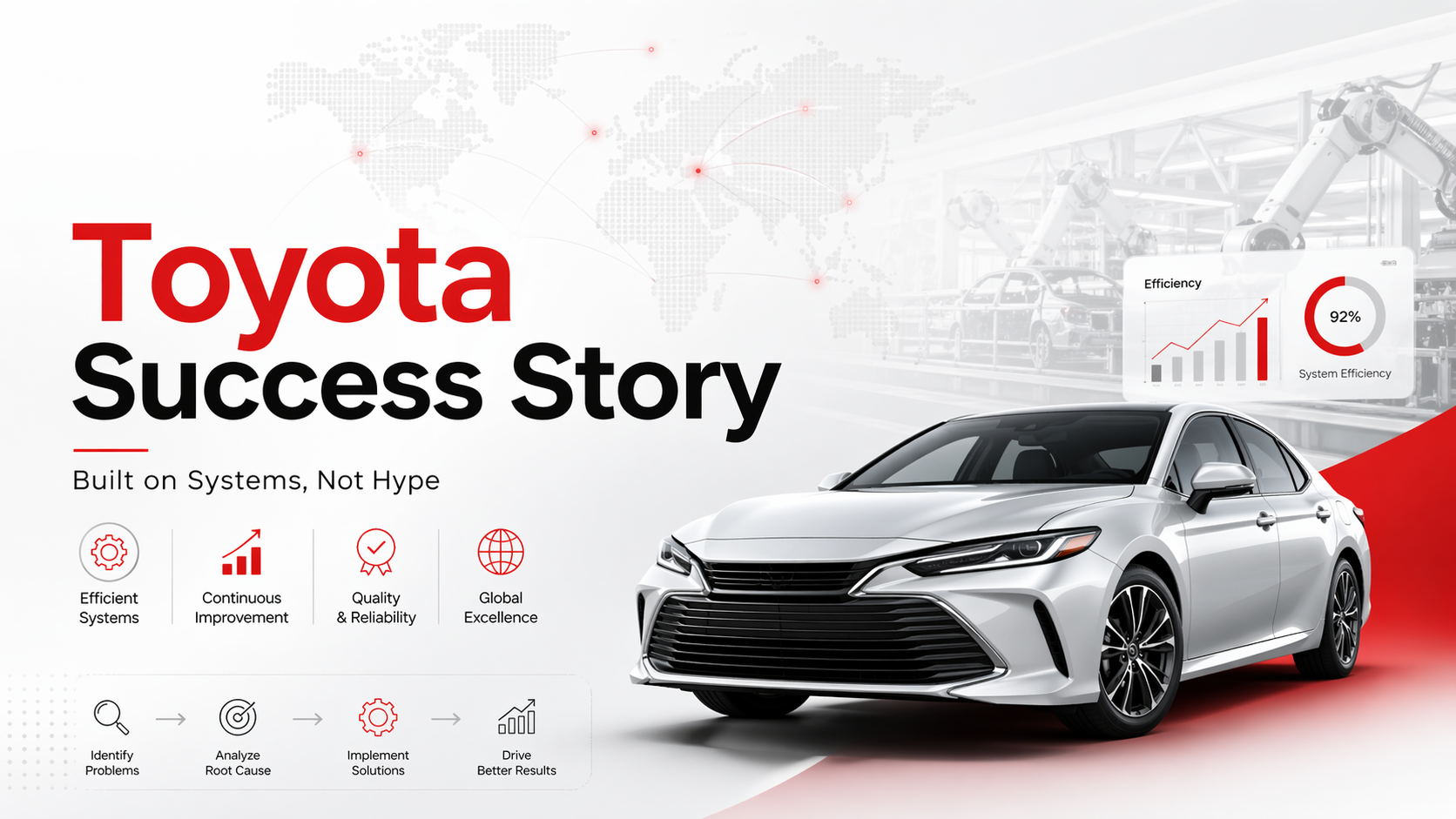
Toyota Success Story: How Toyota Motor Corporation Became the Most Reliable Car Brand in the World

Toyota became successful by focusing on quality, efficiency, and long-term thinking, powered by its famous Toyota Production System (TPS), global expansion strategy, and unmatched reliability.
Intro
Ask anyone which car brand lasts the longest. Nine times out of ten, they’ll say Toyota.
That answer isn’t random. It’s the result of decades of disciplined decision-making, smart manufacturing, and a company culture built around doing things right the first time.
Toyota Motor Corporation isn’t the flashiest brand. It doesn’t dominate headlines the way Tesla does. It doesn’t have the luxury appeal of BMW or the American nostalgia of Ford. But when it comes to trust, consistency, and long-term value, Toyota sits at the top of the list.
This blog breaks down exactly how Toyota got there. Not through hype or luck, but through systems, strategy, and a mindset that most companies talk about but few actually execute.
Where Toyota Actually Started
Most people don’t know that Toyota’s roots have nothing to do with cars.
Sakichi Toyoda, the founder’s father, was a textile inventor. He built automated looms and is credited with inventing one of the most important principles in modern manufacturing: stop the machine when something goes wrong, find the cause, fix it.
That principle didn’t stay in the textile factory. It became the foundation of an entire automotive empire.
Kiichiro Toyoda founded Toyota Motor Corporation in 1937. He took what his father understood about machines and applied it to automobiles. The early days were tough. Japan was resource-poor. Western automakers like Ford and GM had decades of head start. Capital was limited. Infrastructure was weak.
Toyota wasn’t born into strength. It was forged through constraint.
That early experience of doing more with less became a permanent part of how Toyota operates. It’s not a chapter in their history. It’s baked into their DNA.
Post-War Japan and the Moment Toyota Almost Collapsed
After World War II, Japan’s economy was in ruins. Companies across every industry were struggling to survive. Toyota was no different.
In 1949 and 1950, Toyota faced a financial crisis so severe that it nearly went bankrupt. Sales had dropped. Debt was piling up. The company had to lay off a large portion of its workforce, a painful and humiliating moment for leadership.
Kiichiro Toyoda resigned out of responsibility.
Most companies don’t come back from that kind of crisis. Toyota did, and the reason it came back stronger is the most important part of this story.
Constraints forced innovation. When you don’t have money to waste, you stop wasting it. When you can’t afford downtime, you build systems that prevent it. When you can’t compete on volume, you compete on quality.
That crisis forced Toyota’s engineers and leaders to rethink manufacturing from the ground up. The result was one of the most influential business systems ever created.
The Toyota Production System Explained Simply
The Toyota Production System, commonly called TPS, is the engine behind everything Toyota has achieved. It’s been studied in business schools, copied by manufacturers across every industry, and is the direct ancestor of what most companies call “lean manufacturing” today.
But what is it, actually?
The Core Goal of TPS
TPS is designed to eliminate waste. Not just physical waste like scrap metal or unused parts, but every form of waste: wasted time, wasted motion, wasted effort, wasted inventory.
The system is built on two main pillars.
Just-In-Time Manufacturing means producing only what is needed, when it is needed, in the amount needed. No excess. No stockpiling. No producing ahead of demand and hoping customers show up.
Before TPS, most manufacturers operated by producing large batches and storing inventory. That approach tied up cash, created storage costs, and meant defects often weren’t caught until thousands of units had already been built.
Toyota flipped that model. Produce less, more precisely, with immediate feedback if something goes wrong.
Jidoka is the second pillar. It comes from Sakichi Toyoda’s original loom invention. The principle is simple: when a problem is detected, stop everything, identify the root cause, and fix it before moving on.
This is the opposite of how most factories worked. Most systems were built to keep the line moving no matter what, deal with defects later. Toyota said no. Stop the line. Fix the problem now. Never let a defect move forward.
What Kaizen Means and Why It Matters
Kaizen is a Japanese word that means continuous improvement. Inside Toyota, it’s not a buzzword. It’s a daily practice.
Every worker on a Toyota factory floor is empowered and expected to identify problems and suggest improvements. This isn’t limited to managers or engineers. Assembly line workers, floor supervisors, everyone participates.
The idea is that the person doing the job knows the job better than anyone watching from a distance. So give that person the tools and the authority to improve their own work.
Over decades, thousands of small improvements compound into massive competitive advantages. That’s Kaizen in action.
TPS Is a Mindset, Not Just a Process
Many companies have tried to copy TPS. Most fail. The reason is that they copy the tools without adopting the thinking behind them.
TPS isn’t a checklist. It’s a belief system. It says that quality is not something you inspect for at the end of the line. It’s something you build into every single step of the process.
That mindset, more than any specific technique, is what separates Toyota from competitors.
Why Toyota Cars Became Known for Reliability
Toyota’s reputation for reliability didn’t come from marketing. It came from engineering decisions made long before anyone was writing ad copy.
Designing for Longevity
Toyota engineers have historically prioritized durability over novelty. When designing an engine, the goal isn’t to impress reviewers with a spec sheet. The goal is to build something that runs without major problems for 200,000 miles or more.
That means using proven components over experimental ones. It means extensive testing under real-world conditions. It means choosing simplicity when simplicity works, rather than adding complexity for its own sake.
Other automakers would sometimes rush new technology to market to generate buzz. Toyota would test that same technology for years before putting it in a production vehicle. Customers rarely noticed the difference upfront. They noticed it ten years later when their Toyota was still running and their friend’s car from another brand needed a third major repair.
Quality Control That Doesn’t Compromise
Toyota’s quality control process is exhaustive. Every vehicle goes through multiple inspection stages. Problems that surface during production are treated as urgent, not minor. The culture doesn’t reward people for keeping the line moving at the expense of quality.
That commitment to quality control isn’t just about avoiding recalls. It’s about building a reputation that money can’t buy.
What Toyota Actually Sells
Toyota doesn’t really sell cars. It sells peace of mind.
When a customer buys a Toyota, they’re buying the confidence that the car will start every morning, won’t strand them on the highway, and will still have value when they decide to trade it in five years later.
That intangible value is the result of decades of tangible decisions around engineering, testing, and quality. It’s also why Toyota owners often become repeat Toyota buyers, and why mechanics routinely recommend Toyota vehicles to customers who ask what to buy.
How Toyota Expanded Globally Without Losing Its Edge
Toyota’s global expansion is a case study in how to enter new markets intelligently.
The US Market Entry
Toyota first entered the United States in the late 1950s. The early attempts were rough. The initial model, the Toyopet Crown, wasn’t suited for American highways. It struggled at the speeds American drivers expected and didn’t sell well.
Most companies would have retreated. Toyota went back to the drawing board.
They studied the American market. They understood what American drivers wanted, things like comfort, highway performance, and reliability at a competitive price point. They came back with better products, starting with the Corona and later the Corolla.
The Corolla, introduced in 1966, became one of the best-selling cars of all time. It succeeded because it was simple, affordable, dependable, and well-suited to everyday American driving.
Localization as a Strategy
Toyota didn’t just ship Japanese cars to foreign markets. It built manufacturing plants in the countries where it sold vehicles.
In the United States, Toyota has major manufacturing facilities in Kentucky, Texas, Alabama, Indiana, and other states. This wasn’t just about reducing shipping costs. It was about embedding Toyota into local economies, understanding local customer preferences up close, and demonstrating long-term commitment to those markets.
Local manufacturing also gave Toyota the flexibility to adapt vehicles to regional needs faster than competitors who were building everything overseas.
Building Global Supply Chains
Toyota’s supply chain management is one of its greatest operational achievements. The company built relationships with suppliers around the world and applied TPS principles throughout the supply chain, not just on its own factory floors.
When suppliers improve their quality and efficiency, that improvement flows through to Toyota’s finished vehicles. Toyota works closely with suppliers to help them improve, creating a network of operational excellence, not just a list of vendors.
The Power of Brand Trust and Word-of-Mouth
Toyota’s marketing budget has never been the largest in the auto industry. Its brand power has come largely from word-of-mouth, and that’s a more valuable form of marketing than any ad campaign.
Why People Keep Buying Toyota
Toyota owners are among the most loyal in the automotive industry. The reason is simple. If a car doesn’t let you down, you buy another one from the same brand.
Trust is not built through advertising. It’s built through experience. When a Toyota owner drives their car for 150,000 miles with minimal problems, they tell their family, their coworkers, their neighbors. When someone asks them what car to buy, they recommend Toyota without hesitation.
That pattern, repeated millions of times over decades, is how Toyota built a global brand without relying on hype.
Resale Value as a Trust Signal
Toyota vehicles consistently hold their value better than most competitors. A five-year-old Toyota will often sell for significantly more on the used car market than a comparable vehicle from another brand.
This resale value advantage is both a reflection of and a reinforcement of Toyota’s reliability reputation. Buyers know that if they ever want to sell the car, it will still be worth something. That confidence makes the initial purchase easier to justify.
The Mechanic Effect
Here’s a signal most people overlook. Ask an independent mechanic, someone who profits from car repairs, what brand they recommend. Many will say Toyota.
That’s remarkable. Mechanics make money when cars break down. The fact that many mechanics recommend a brand known for not breaking down says something powerful about how Toyota is perceived by people who see every brand’s problems up close.
Toyota’s Hybrid Bet: Early Innovation Without the Noise
While most automakers in the 1990s were focused on making traditional internal combustion engines bigger, faster, and more powerful, Toyota was quietly developing something different.
The Toyota Prius
The Toyota Prius launched in Japan in 1997 and in the US in 2000. It was the world’s first mass-produced hybrid vehicle.
The reception was mixed at first. Some critics dismissed it as underpowered or gimmicky. Fuel prices in the late 1990s weren’t particularly high, so the economic argument for a hybrid wasn’t obvious to every consumer.
But Toyota wasn’t building the Prius for 1997. It was building it for the future it saw coming.
First-Mover Advantage
When gas prices spiked in the mid-2000s, the Prius became one of the most sought-after vehicles in the US market. Toyota had already worked out the engineering challenges, built up the supply chain, and trained dealers to service hybrid systems. Competitors scrambled to catch up.
That gap, the time advantage from investing early, is nearly impossible to buy once you’ve fallen behind.
Environmental Positioning
The Prius also gave Toyota a credible environmental identity before sustainability was a mainstream business priority. That positioning has compounded in value as climate concerns have become central to how consumers evaluate brands.
Toyota wasn’t performing environmentalism. It was engineering it.
The Business Model Behind Toyota’s Success
Toyota’s financial strength comes from more than selling cars. It’s built on a diversified, efficient business model.
Multiple Revenue Streams
Toyota Financial Services provides financing to customers buying Toyota vehicles. This generates significant revenue and keeps customers within the Toyota ecosystem.
After-sales services including spare parts, maintenance packages, and accessories add consistent revenue throughout the vehicle’s lifetime.
Toyota also has investments in robotics, aerospace, and other technology sectors, reflecting a long-term view that extends well beyond the automotive industry.
Manufacturing Efficiency as a Profit Driver
Toyota’s operational efficiency means it can generate profit at price points where competitors struggle. When production costs are lower because waste has been systematically eliminated, margins are healthier even without raising prices.
That efficiency advantage has allowed Toyota to price competitively in mass-market segments while still generating the cash flow needed to invest in research, development, and global expansion.
Scale That Compounds
Toyota is one of the largest vehicle manufacturers in the world by volume. That scale creates purchasing power with suppliers, drives down per-unit costs, and gives Toyota leverage in negotiations that smaller competitors simply don’t have.
Scale also funds the R&D that keeps Toyota ahead of the curve on technology, safety, and efficiency without betting the company on unproven ideas.
Challenges Toyota Faced and How It Responded
Toyota isn’t a perfect company. It has made significant mistakes, and how it handled those mistakes is as instructive as its successes.
The 2009 to 2010 Recall Crisis
Between 2009 and 2010, Toyota recalled millions of vehicles due to issues related to unintended acceleration and faulty floor mats. The crisis was a major blow to the brand’s reputation for quality and reliability.
Toyota’s response was criticized as slow and defensive at first. But the company eventually took accountability, overhauled its quality control processes in North America, improved communication between its American operations and Japanese headquarters, and invested heavily in safety systems.
The recall crisis was painful. But Toyota came through it because the foundation of trust it had built over decades was strong enough to withstand the damage. Sales recovered. The brand recovered.
The lesson: a strong reputation is a buffer, not a guarantee. But it matters enormously when things go wrong.
Competition from Electric Vehicle Companies
Tesla and other EV-focused companies have challenged Toyota’s position as a forward-thinking brand. Toyota’s cautious approach to battery electric vehicles has drawn criticism from analysts and environmental groups who argue the company is moving too slowly.
Toyota’s counter-argument is that hybrids and hydrogen fuel cell technology represent a more pragmatic path to reducing global emissions in the near term, given charging infrastructure limitations in many parts of the world.
Whether Toyota’s EV strategy is right is still being debated. What’s clear is that Toyota isn’t panicking or making reactive decisions based on short-term pressure. That discipline, for better or worse, is consistent with everything the company has done since 1937.
Toyota vs Competitors: What Actually Sets It Apart
Toyota vs Ford
Ford is America’s iconic automaker with a rich history and strong brand loyalty. Ford has strong products, particularly in trucks with the F-150 series, and has made aggressive moves in the EV space with the F-150 Lightning and Mustang Mach-E.
Where Toyota differs is in operational consistency. Toyota applies the same quality standards across its full lineup. Ford’s quality has historically been less consistent across different segments. Toyota’s manufacturing efficiency also gives it cost advantages that Ford has worked to match but hasn’t fully closed.
Toyota vs Volkswagen Group
Volkswagen Group is massive, encompassing brands from VW to Audi to Porsche to Lamborghini. By revenue and vehicle volume, it competes directly with Toyota at the top of the global market.
Volkswagen’s diesel emissions scandal in 2015 was a major credibility hit that Toyota never experienced at that scale. It highlighted the difference in company culture around compliance, quality, and transparency.
Toyota’s advantage over VW is rooted in operational philosophy. TPS creates accountability at every level of production. That kind of systemic accountability makes it harder for problems to hide until they become catastrophic.
The Real Differentiator
Toyota’s deepest advantage isn’t any single product or technology. It’s the way the company thinks about problems.
Long-term thinking over quarterly pressure. Process discipline over product hype. Root cause analysis over surface fixes. Consistency over novelty.
Those principles are harder to copy than any specific car design or manufacturing technique.
Key Lessons for Founders and Business Leaders
Toyota’s story is not just about cars. It’s about how to build something that lasts.
Systems Beat Talent
Toyota’s success was never dependent on one genius leader or one breakthrough invention. It was built on systems that any trained person could execute and improve over time. If your business only runs well when the right person is in the room, you don’t have a business. You have a dependency.
Consistency Builds Trust
Toyota didn’t become the world’s most trusted car brand from one great product launch. It built trust through consistent performance across millions of vehicles over decades. Trust is not a marketing outcome. It’s an operational outcome.
Solve Root Problems, Not Symptoms
Jidoka, the principle of stopping and fixing the root cause rather than patching and moving on, is applicable to every business. When a problem surfaces, the instinct is often to fix it quickly and get back to moving. Toyota’s approach says that quick fixes that don’t address the root cause will cost you more later.
Think Long-Term, Not Viral
Toyota invested in hybrid technology years before the market rewarded that investment. It entered foreign markets and absorbed early losses to build long-term presence. It made decisions that often didn’t pay off for years or even decades. That kind of thinking is rare and increasingly rare in an environment that rewards short-term results.
Efficiency Is a Competitive Advantage
Operational efficiency isn’t a back-office concern. At Toyota, it’s a strategic weapon. When you can produce high-quality products at lower cost than competitors, you have permanent pricing flexibility and margin advantage. That advantage compounds over time.
Why Toyota Still Wins Today
Despite challenges from Tesla, new EV entrants, and critics of its electrification pace, Toyota remains one of the strongest automotive brands on the planet.
Its global manufacturing footprint is unmatched. Its supply chain relationships are deep and resilient. Its brand trust with everyday consumers, particularly in markets like the United States, Japan, Southeast Asia, and Australia, remains extremely high.
The Corolla is still one of the best-selling cars in the world. The RAV4 is consistently one of the top-selling SUVs in the US. Trucks like the Tundra and Tacoma have loyal, passionate customer bases.
Toyota’s hybrid lineup has grown into one of the broadest in the industry. The company is investing in solid-state battery technology that could give its EVs significantly better range and faster charging than current lithium-ion packs.
Toyota is not standing still. But it’s also not chasing trends. It’s following a long-term roadmap that looks different from what Wall Street might want in any given quarter but has proven resilient across recessions, supply chain disruptions, and industry upheavals.
Conclusion
Toyota’s success didn’t come from one big idea. It came from doing small things perfectly, for decades.
From a near-bankrupt Japanese automaker in 1950 to one of the most valuable and trusted brands in the world, Toyota’s rise is a masterclass in discipline, systems thinking, and long-term commitment.
The Toyota Production System isn’t just a manufacturing method. It’s a philosophy about how to approach any complex problem: eliminate waste, fix root causes, improve continuously, and never let short-term pressure override long-term judgment.
That philosophy built reliable cars. It also built an unshakeable brand. And it produced a company that, more than 85 years after its founding, still leads one of the most competitive industries on earth.
For any founder, executive, or business leader looking for a model to follow, Toyota doesn’t just build great cars. It shows you how to build something that lasts.
FAQs
Toyota’s reliability comes from its engineering philosophy, strict quality control, and the Toyota Production System, which emphasizes fixing problems at the source rather than moving past them. Toyota also prioritizes durability in its design decisions, choosing proven components over experimental ones.
The Toyota Production System, or TPS, is a manufacturing approach built around eliminating waste, producing only what is needed through Just-In-Time manufacturing, and stopping to fix problems at their root cause through a principle called Jidoka. It also includes Kaizen, a practice of continuous improvement involving every level of the workforce.
Toyota Motor Corporation was founded by Kiichiro Toyoda in 1937. His father, Sakichi Toyoda, was a famous inventor whose principles around automated machinery heavily influenced the way Toyota approaches manufacturing and quality control.
Toyota first attempted to enter the US market in the late 1950s, but early models weren’t well-suited to American driving conditions. The company studied the market, adapted its vehicles, and returned with the Corolla in 1966, which became one of the best-selling cars in history.
Toyota has taken a cautious approach to full battery electric vehicles, focusing more heavily on hybrids and hydrogen fuel cell technology. The company is investing in solid-state battery technology for future EV development. Whether its strategy proves correct long-term depends on how global infrastructure and consumer preferences evolve.
Discover more from Business Model Hub
Subscribe to get the latest posts sent to your email.