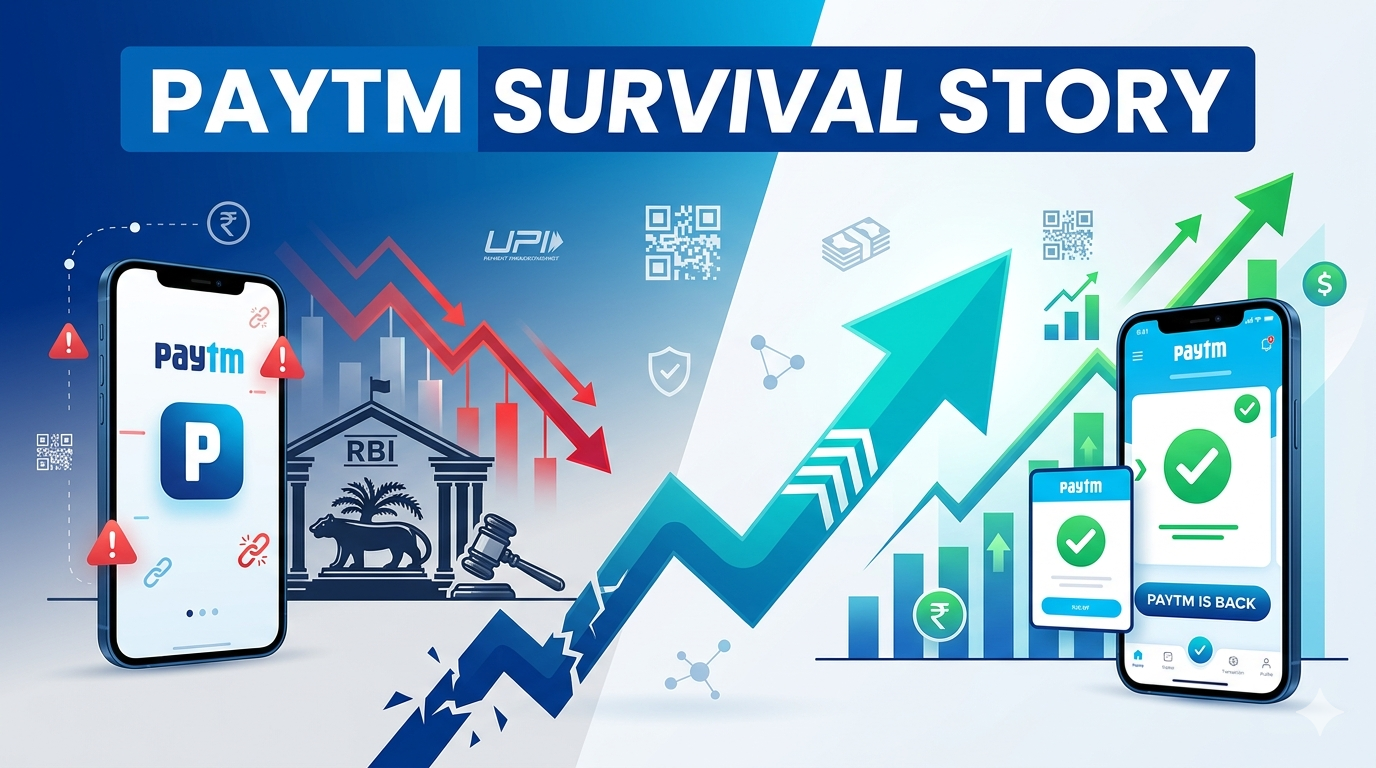
Paytm’s Survival Story: How India’s Payment Giant Reinvented Its Business After RBI Crackdown

The Reserve Bank of India restricted Paytm Payments Bank from accepting new deposits and onboarding users in early 2024, effectively cutting off a key revenue stream. User trust took a hit, investor sentiment dropped, and the business faced a real identity crisis. But Paytm didn’t fold. It shifted its focus back to core payments, leaned into its merchant network, and rebuilt through third-party banking partnerships instead of trying to own the full stack itself.
This Was Not Just a Setback
When RBI’s action against Paytm Payments Bank dropped, it wasn’t a routine regulatory fine. It was a direct hit on the operational engine powering a company that had spent years building toward becoming India’s first true financial super app.
Paytm had survived demonetization chaos, survived the UPI disruption, and had survived a brutal IPO aftermath. But this was different. This time, the regulator was telling it: stop.
The question wasn’t whether Paytm could recover. The question was whether the business underneath the banking layer was actually strong enough to stand on its own.
What Paytm Actually Is
Paytm was founded by Vijay Shekhar Sharma in 2010, initially as a mobile recharge and bill payment platform. Over the years it expanded into a multi-product financial ecosystem covering digital wallets, UPI payments, buy-now-pay-later, insurance, stock broking, and its own payments bank.
The 2016 demonetization was its breakout moment. Almost overnight, India needed digital payments to function, and Paytm was the most recognizable name in that space. Downloads surged, merchant adoption exploded, and the company became synonymous with digital payments in India.
The vision was a super app — a single platform where users could pay, save, invest, borrow, and insure. Paytm Payments Bank was central to that vision because it gave the company direct control over the financial rails.
What the RBI Action Actually Meant
The Reserve Bank of India is India’s central banking regulator. It oversees payment systems, banking licenses, and financial compliance across the country.
In January 2024, RBI directed Paytm Payments Bank to stop accepting fresh deposits, credit transactions, and top-ups in customer accounts after February 29, 2024. New customer onboarding was also halted. Existing balances could still be used, but the bank could no longer grow.
The official reason pointed to persistent non-compliance issues — concerns around KYC (know your customer) norms, data sharing with parent entities, and regulatory reporting gaps. RBI had flagged these issues before. This time, it acted decisively.
The Immediate Impact on Paytm
Business Impact
Paytm Payments Bank was not just a feature. It was the backbone of the wallet ecosystem. Every wallet top-up, every savings account, every fastag recharge ran through it. When the bank was restricted, the entire wallet infrastructure was thrown into uncertainty.
Merchants and consumers who had integrated deeply with Paytm’s payment stack now had questions with no clear answers.
User Trust Impact
The public messaging around the RBI action created significant confusion. Many users were unsure whether their money was safe, whether their wallets still worked, and whether they should move to another platform.
This kind of uncertainty is damaging in payments. Trust is the product. Once users start second-guessing a platform’s stability, the switching cost drops fast.
Revenue and Investor Impact
Paytm Payments Bank had been contributing meaningfully to Paytm’s financial services revenue through float income, deposit balances, and wallet-linked transactions. Losing that contribution meant a direct revenue hole.
Investor sentiment reflected this harshly. Paytm’s stock took a significant beating in the days following the RBI announcement — one of the steepest single-week drops in its post-IPO history.
The Core Problem: A Hidden Dependency
What the RBI action exposed was structural.
Paytm had built a vertically integrated model where the payments bank was the center of gravity. Wallets lived inside the bank. Merchant settlements flowed through the bank. Financial products were distributed through the bank. This seemed like a strength — full control, seamless experience, no revenue leakage to partners.
But vertical integration has a flip side. When one layer fails, everything built on top of it is at risk.
Paytm had essentially bet that it could operate both as a licensed bank and as a consumer technology platform simultaneously, while scaling both quickly. The compliance infrastructure didn’t keep pace with that scale. And when the regulator pulled the thread, the whole structure felt the tension.
How Paytm Rebuilt: The Real Strategy
Shift Back to Core Payments
The first and most important move was strategic clarity. Paytm stopped trying to be everything and doubled down on what it was genuinely good at: payments distribution.
UPI had become the dominant payment rail in India, and Paytm had one of the largest merchant and consumer bases on it. Instead of competing against UPI with its own bank-linked infrastructure, it leaned into the UPI ecosystem fully. This meant migrating its wallet users to UPI-linked accounts through partner banks rather than its own payments bank.
Strengthening the Merchant Ecosystem
Paytm’s real moat was never the bank. It was the merchant network.
Millions of small and medium merchants across India had Paytm QR codes, soundboxes, and point-of-sale devices deployed at their shops. This offline distribution network is genuinely hard to replicate. Paytm accelerated investment here — more soundbox deployments, deeper integrations with merchant workflows, and subscription-based device revenue.
The merchant SaaS angle became a real focus. When a merchant buys a soundbox or a POS device, they’re not just buying hardware — they’re entering a data relationship that enables credit underwriting, analytics, and financial product distribution later.
Partner-Led Banking Model
This was the biggest structural shift. Instead of owning the banking infrastructure, Paytm moved toward a distribution-first model.
Tie-ups with Axis Bank, HDFC Bank, and other regulated entities allowed Paytm to continue offering financial products — wallets, UPI, lending — without being the regulated entity itself. It became a channel rather than a bank. This is actually a more capital-efficient model, though it does reduce control.
The irony is that the RBI action forced Paytm into a business model that many fintech analysts had argued was more sustainable in the first place.
Cost Optimization and Focus
Paytm had been running a sprawling operation — commerce, ticketing, gaming, gold, insurance, loans, and more. The crisis became a forcing function for prioritization.
The company cut headcount, reduced non-core experiments, and pushed hard toward operational breakeven. The goal shifted from growth-at-all-costs to sustainable unit economics.
Rebuilding Trust Through Communication
Paytm’s leadership — particularly Vijay Shekhar Sharma — was more public and direct about the company’s path forward than many expected. Investor calls, public statements, and regulatory updates were handled with more transparency than the initial crisis communication.
This matters in financial services. Silence and ambiguity after a regulatory event tend to accelerate user churn. Paytm’s choice to communicate its pivot clearly helped stabilize the narrative.
Before vs After: The Business Model Shift
The pre-RBI Paytm was a closed ecosystem play. Everything was supposed to flow through Paytm infrastructure — the bank, the wallet, the merchant settlement stack. The super app vision required owning all layers.
The post-RBI Paytm is an open ecosystem play. It sits on top of regulated banking infrastructure owned by partners. It distributes financial products rather than manufacturing them. Its revenue comes from payments processing fees, device subscriptions, and a cut of the financial products it originates.
This is a fundamentally different — and arguably more defensible — business. Paytm’s value is now in distribution, merchant relationships, and data. Not in banking licenses.
What Paytm Got Right
Paytm did not panic into a fire sale or dramatic pivot. It identified its actual strengths — merchant network, brand recognition, UPI volume — and structured a recovery around them.
It moved quickly on the banking transition, migrating wallet infrastructure to partner banks faster than many expected. It kept merchant churn low by continuing to service devices and QR infrastructure through the disruption. And it used the cost-cutting period to get closer to profitability, which changed the investor conversation meaningfully by mid-2024.
What Paytm Got Wrong
The RBI action did not come without warning. There had been previous regulatory flags around Paytm Payments Bank’s compliance posture. The company underestimated how seriously those flags would eventually be acted upon.
More broadly, Paytm built too much of its core business on an infrastructure it controlled but couldn’t fully protect from regulatory risk. Owning the bank felt like a strength. In practice, it was a single point of failure.
The super app ambition also led to resource diffusion — too many products, not enough depth in any one of them. The crisis forced the kind of focus the company probably needed anyway.
Lessons for Founders and Operators
The Paytm story is a practical case study in fintech risk that applies well beyond India.
Single revenue stream dependency is dangerous. When Paytm Payments Bank got restricted, there was no clean fallback because the entire model was built around it. Redundancy in revenue architecture is not optional in regulated industries.
Regulatory compliance is not a legal checkbox. In fintech especially, compliance failures are existential. The companies that treat regulation as a strategic priority — not a back-office function — tend to survive these moments. The ones that treat it as overhead tend not to.
Distribution is a more durable moat than product ownership. Paytm’s merchant network survived the banking crisis. Its bank did not. The network had physical presence, habit, and switching cost embedded in it. The bank had none of those things once trust eroded.
Partner-led models are not a fallback. Paytm is stronger now as a distributor of third-party financial products than it was as a vertically integrated bank-plus-app. The partnership model is often more scalable, more capital-efficient, and lower-risk in regulated markets.
Is Paytm Still Relevant?
Yes though differently than in 2021.
UPI transaction volumes in India have continued to grow dramatically, and Paytm still processes a meaningful share of that volume. Its merchant base remains one of the largest in the country. The soundbox business real-time audio confirmation for payments has grown into a genuinely sticky product with subscription economics.
The competitive picture is tough. PhonePe holds the largest UPI market share. Google Pay is deeply embedded in the consumer market. Jio Financial Services is entering aggressively. Paytm is not the default anymore the way it was in 2017.
But it is not irrelevant either. It has a real merchant network, a growing device revenue line, and a clearer business model than it had three years ago.
What Comes Next for Paytm
The areas where Paytm has the most upside are lending and merchant SaaS.
Merchant lending underwriting small business loans based on transaction data is a high-margin product that Paytm is well-positioned to distribute. It has the data, the merchant relationships, and now the partner banking infrastructure to originate loans responsibly.
Merchant SaaS tools analytics dashboards, inventory integrations, loyalty programs are the next layer of value Paytm can extract from its existing device network without taking on additional regulatory risk.
The question of whether Paytm can rebuild dominance is probably the wrong question. The right question is whether it can build a profitable, growing business on the assets it still has. The answer to that looks increasingly like yes.
Conclusion
Paytm did not survive the RBI shock because it found a clever workaround. It survived because the underlying distribution network the merchants, the QR codes, the soundboxes, the consumer brand — was genuinely valuable independent of the banking layer.
The crisis stripped away the complexity and forced the company to be honest about where its actual value lived. What emerged is a leaner, more focused business with a clearer reason to exist.
The lesson is not that regulation is the enemy. It is that resilient businesses do not build their core revenue on infrastructure they cannot fully control. Paytm had to learn that the hard way.
Paytm did not just survive the RBI shock. It was forced to become a smarter business.
Discover more from Business Model Hub
Subscribe to get the latest posts sent to your email.