
Building an app like Instacart means creating a three-sided marketplace that connects customers, retail stores, and delivery partners in real time.
Here is what it takes at a high level:
Start with a validated idea and a clearly defined geography. Build only the features your MVP needs. Choose a reliable tech stack. Launch in one city, learn fast, then expand.
Timeline: A basic MVP takes 3 to 6 months. A full-scale product with advanced features takes 9 to 18 months.
Cost: MVP development starts around $15,000 to $50,000. A full-featured platform runs $80,000 to $250,000 or more depending on complexity and team location.
What Is Instacart and Why Does It Work
Instacart is an on-demand grocery delivery platform that operates as a marketplace. It does not own warehouses or employ full-time shoppers. Instead, it connects customers with nearby grocery stores and independent contractors who shop and deliver orders.
The business model in simple terms:
Instacart charges customers a delivery fee and earns a commission from partner retailers. It also runs a subscription plan called Instacart+ (formerly Instacart Express), which gives users free deliveries for a monthly or annual fee. Retailers pay for advertising and featured placement within the app.
Why it works:
Consumer behavior shifted permanently toward convenience. Post-pandemic shopping habits solidified a preference for same-day and next-day delivery. People value time more than the small premium they pay for delivery.
The grocery delivery market is projected to exceed $800 billion globally by 2027. This is not a niche, it is a mainstream expectation. Instacart captures that demand without carrying inventory risk, which keeps margins manageable.
Types of Grocery Delivery Apps You Can Build
Before writing a single line of code, you need to decide which model fits your market and resources.
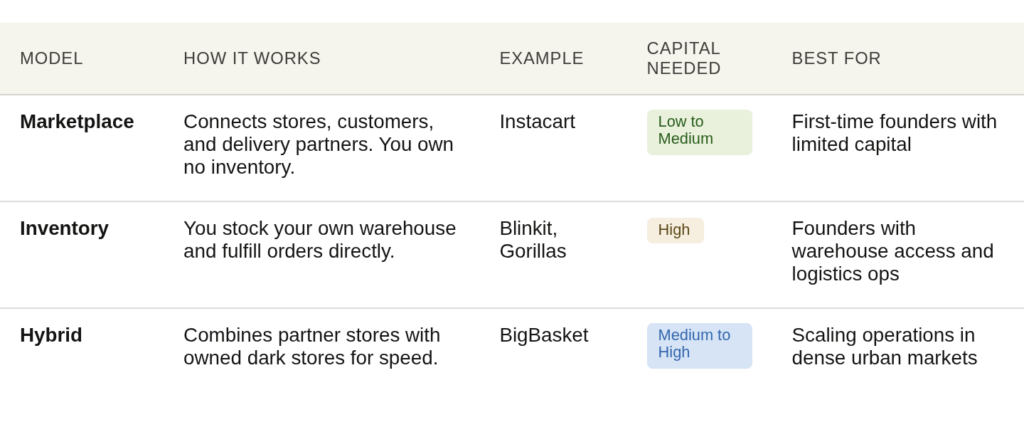
The marketplace model is recommended for most founders. It lets you launch fast, test demand, and scale without heavy upfront infrastructure costs.
Core Features of an App Like Instacart
You need three separate interfaces: one for customers, one for delivery partners, and one for admins. Each has distinct functionality.
Customer App Features
User registration and login. Support email, phone, and social login options. Include OTP verification for security. Keep the onboarding flow under 60 seconds.
Product search and smart filters. Customers need to search by name, category, brand, and dietary preference. Filters for organic, gluten-free, price range, and store availability are essential.
Real-time inventory display. Show what is actually in stock. Stale inventory data destroys trust fast. Sync with store systems via API.
Cart and checkout. One-page checkout. Support promo codes, delivery slots, and address selection. Minimize steps between cart and confirmation.
Order tracking. Live map-based tracking showing shopper location and estimated arrival time. Push notifications at every status change.
Multiple payment options. Credit and debit cards, digital wallets like Apple Pay and Google Pay, and buy-now-pay-later integrations for higher cart values.
Delivery Partner App Features
Order notifications. Real-time push alerts with order details, store location, estimated batch size, and payout amount before acceptance.
Route optimization. In-app navigation with optimized routes for multi-stop orders. Integrates with Google Maps or Mapbox APIs.
Earnings dashboard. Daily, weekly, and monthly earnings breakdown. Payment history, tips tracking, and performance metrics.
Admin Panel Features
Store and vendor management. Onboard and manage retail partners. Set commission rates, review performance, and manage store listings.
Inventory control. Sync product catalogs from partner stores. Manage substitution rules for out-of-stock items.
Order operations. View and manage all active orders. Assign shoppers manually when automation fails.
Analytics dashboard. Track GMV, average order value, delivery success rate, customer retention, and partner performance in one place.
Advanced Features That Make You Stand Out
Once your MVP is live and validated, these features drive differentiation.
AI-based product recommendations. Use purchase history and browsing behavior to suggest items at the right moment. This increases average order value meaningfully.
Smart substitutions. When an item is out of stock, the app automatically suggests the closest alternative based on brand, size, and price. Customers approve or reject with one tap.
Real-time chat with shoppers. Customers can message their assigned shopper directly during the order. This reduces cancellations and builds trust.
Scheduled deliveries. Let customers plan weekly grocery orders in advance. This smooths demand spikes and improves logistics efficiency.
Subscription delivery plans. Modeled after Instacart+, this gives frequent users free or discounted delivery for a flat monthly fee. It locks in retention and increases order frequency.
Step-by-Step Process to Build an App Like Instacart
Step One: Market Research
Do not go broad. Pick one city or one neighborhood and understand it deeply.
Talk to 30 to 50 potential customers. Ask about their current grocery shopping behavior, pain points, and what would make them switch to an app. Identify which stores are popular locally. Understand delivery infrastructure in your target area.
Validate that your target market has both demand and willingness to pay. Delivery fees only work when customers see the value clearly.
Step Two: Choose Your Business Model
Three revenue approaches work well for this type of app:
Commission-based: charge partner stores 10% to 25% per order. This scales with volume.
Delivery fee model: charge customers $3 to $9 per order based on distance and basket size.
Subscription hybrid: offer free delivery for subscribers while charging non-subscribers per order. This is the most proven long-term model.
Most successful apps combine all three. Start with one and add others as you scale.
Step Three: Define Your MVP Features
Your MVP should include exactly what is needed to complete one transaction end to end.
That means: user registration, product browsing, cart, checkout, order assignment to a shopper, order tracking, and delivery confirmation.
Everything else is a phase two feature. Launch fast. Learn from real users.
Step Four: Design UI and UX
Speed of checkout is your biggest conversion lever. Every extra tap loses users.
Focus on:
A clean home screen with categories and a prominent search bar. A product detail page that loads fast and shows stock availability. A cart that is always one tap away. A checkout that requires minimal input. An order tracking screen that updates in real time.
Use Figma to prototype and test flows before development starts. Run usability tests with five to ten real people. You will catch 80% of friction points that way.
Step Five: Choose Your Tech Stack
Frontend (Mobile App): Flutter or React Native for cross-platform development. Both let you build iOS and Android from one codebase, which cuts development time and cost significantly.
Backend: Node.js or Django (Python) are strong choices. Node.js handles real-time data well, which matters for live tracking and inventory sync. Django is excellent for data-heavy admin panels.
Database: PostgreSQL for structured data like orders, products, and users. Redis for caching and real-time features. Firebase is a simpler option for early-stage MVPs.
Real-time tracking: Google Maps Platform or Mapbox. Google Maps has better coverage; Mapbox offers more customization.
Payments: Stripe is the standard for US-based apps. It supports cards, wallets, ACH, and subscriptions out of the box.
Cloud hosting: AWS, Google Cloud, or DigitalOcean. Start with a managed service to reduce DevOps overhead.
Step Six: Build and Test
Build in short sprints. Two-week cycles work well for early-stage products.
Test the logistics flow before anything else. Order placement to shopper assignment to delivery confirmation is the critical path. If that breaks, nothing else matters.
Run a closed beta with 50 to 100 users in your target geography before public launch. Real usage reveals problems that no internal QA will catch.
Step Seven: Launch and Scale
Launch in one zip code. Seriously.
Onboard 5 to 10 local grocery stores. Recruit 15 to 20 delivery partners. Put the app in front of 500 to 1,000 potential customers.
Get to 100 completed orders before thinking about expansion. Learn your unit economics. Know your cost per order, average delivery time, and refund rate. Fix what is broken. Then expand to the next neighborhood.
Tech Stack Breakdown
Here is a beginner-friendly breakdown of what each layer does and why it matters.
Mobile app framework is what your customer and delivery partner sees. Flutter and React Native let one team build apps for both iPhone and Android simultaneously.
Backend infrastructure is the engine. It handles user accounts, order logic, store connections, payment processing, and data storage. Think of it as the rules layer that decides what happens when a customer places an order.
Payment gateway is the bridge between your app and the banking system. Stripe handles the complexity of card processing, fraud detection, and payouts to delivery partners.
Maps and real-time tracking are powered by APIs from Google Maps or Mapbox. These handle geocoding (turning addresses into map coordinates), route calculation, and live location updates.
Push notifications are sent via Firebase Cloud Messaging (FCM) or OneSignal. Every status update, new order alert, and promotional message goes through this layer.
Cost to Build an App Like Instacart
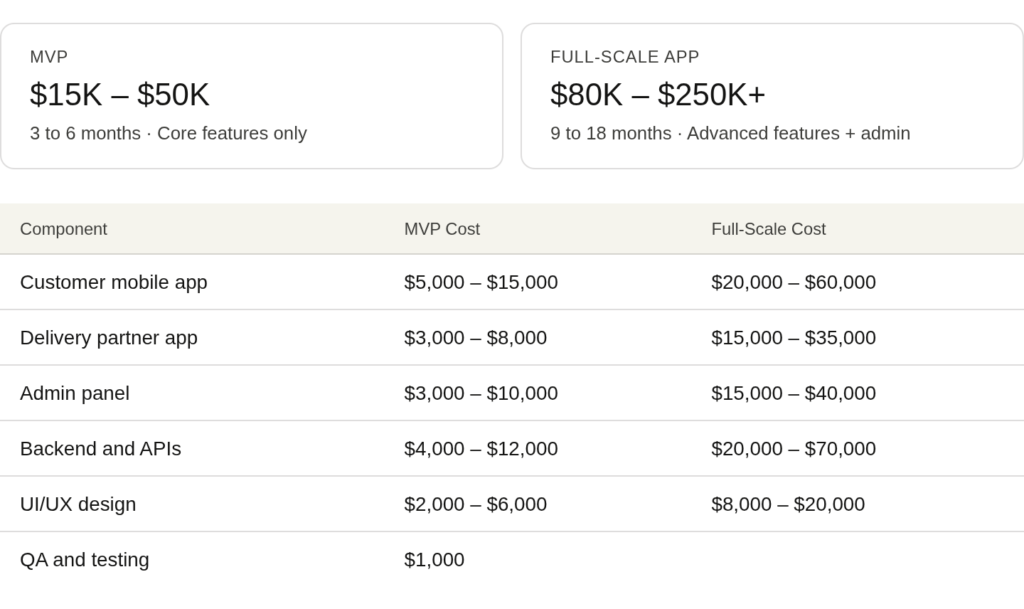
Factors that affect cost the most:
Location of your development team matters significantly. US-based developers charge $100 to $200 per hour. Eastern European teams run $40 to $80 per hour. South and Southeast Asian teams typically charge $20 to $50 per hour.
Feature complexity is the second biggest factor. Real-time tracking, AI recommendations, and multi-store inventory sync all add significant development time.
Whether you build in-house or outsource changes the cost structure. An outsourced team has higher hourly rates but lower overhead. An in-house team has lower per-hour cost but adds salaries, benefits, and management overhead.
Monetization Strategies
Commission per order. The core revenue driver. Charge stores 10% to 25% of each order value. Higher volume stores get better rates in exchange for exclusivity or promotion.
Delivery fees. Charge customers directly per delivery. Range from $3 to $9 depending on distance, basket size, and demand. Surge pricing during peak hours can increase this significantly.
Subscription plans. Offer free delivery for $9.99 to $14.99 per month. Subscribers order more frequently, which increases lifetime value substantially.
Surge pricing. Automatically increase delivery fees during high-demand periods like evenings, weekends, and holidays. Transparent to users and widely accepted.
Sponsored listings and ads. Charge brands and stores for premium placement in search results and category pages. This becomes a major revenue stream at scale. Instacart generates hundreds of millions from its advertising business annually.
Biggest Challenges and How to Solve Them
Logistics complexity. Managing shopper availability, order assignment, and on-time delivery is operationally difficult. Solution: start with a small pool of vetted shoppers and manually oversee assignments until you can automate with confidence.
Inventory sync. Grocery inventory changes throughout the day. Showing out-of-stock items kills the customer experience. Solution: integrate directly with store POS systems or use real-time inventory APIs where available. Build a solid substitution flow as backup.
Customer retention. First-order retention in grocery delivery is often under 40%. Solution: loyalty programs, fast delivery times, and a frictionless return experience matter more than acquisition spending.
Unit economics. Grocery delivery has thin margins by nature. Solution: optimize delivery routes aggressively, batch multiple orders per shopper, and use surge pricing to manage demand. Know your cost per order from day one, not month six.
Store onboarding. Getting local stores to integrate is slow and often manual. Solution: start with stores that already have basic digital infrastructure. Offer a simple CSV-based catalog import as a low-friction entry point.
Growth Strategy
Early Stage
Pick one neighborhood. Spend three months getting it right before expanding. Partner with three to five stores that have strong local loyalty. Recruit shoppers from local gig worker communities and Facebook groups.
Offer aggressive first-order discounts to acquire initial users. Free delivery on the first three orders is a proven conversion tactic.
Scaling
Once you hit consistent order volume in one area, expand city-by-city rather than spreading thin across regions.
Run referral programs with clear incentives: $10 credit for the referrer and $10 off for the new user. Referral is the highest quality acquisition channel in delivery apps.
Paid advertising on Meta and Google works well for geographic expansion. Target by ZIP code and optimize for first purchase conversions, not just installs.
Retention
Fast delivery is the single biggest retention driver. If you deliver in under 45 minutes consistently, users come back without any incentive.
Subscriptions lock in your best customers. Once someone subscribes, their monthly order frequency typically doubles.
Personalized recommendations via push notification or email keep users engaged between orders.
Real-Life Examples to Learn From
Instacart built its marketplace model by focusing purely on connecting existing stores with customers. It avoided warehouse ownership until later. This asset-light approach allowed fast geographic expansion. Lesson: validate demand before owning infrastructure.
Blinkit (formerly Grofers) pivoted from a slow delivery model to a 10-minute delivery model using dark stores placed densely across cities. It sacrificed product breadth for speed. Lesson: pick a core promise and engineer your entire operation around it.
BigBasket started as a pure inventory model with next-day delivery, then added express delivery using a hybrid model. It built supplier relationships that gave it pricing power. Lesson: long-term defensibility in grocery delivery often comes from supply chain advantages, not just the app.
Mistakes to Avoid
Scaling before product-market fit. Opening five cities before you understand unit economics in one is how delivery startups die. Stay hyperlocal until your numbers make sense.
Ignoring logistics costs. Many founders focus on app features and underestimate the operational cost of delivery. Know your cost per delivery before setting your fee structure.
Overbuilding the MVP. Launching with 100 features instead of 10 delays your feedback loop by months. Real learning only happens after real users.
Poor vendor onboarding. If stores struggle to list products or update inventory, your catalog quality suffers immediately. Build a simple, guided onboarding flow for store partners from the start.
Underpricing to compete. Subsidizing every delivery to win on price is a race to zero. Compete on reliability and speed instead. Users pay for trust, not just low fees.
Wrapping Up
The idea of building a grocery delivery app is not rare. Execution is what separates the apps that survive from the ones that shut down after six months.
Start small. Launch in one neighborhood. Learn what your users actually need. Fix the unit economics early, before you scale.
The founders who succeed in this space are not the ones with the most features or the biggest funding rounds at launch. They are the ones who obsess over delivery time, shopper quality, and customer trust, and who build systems that improve those things week over week.
Pick a geography. Partner with local stores. Build the simplest version that works. Then scale with proof.
Ready to build your MVP? Start with a free consultation to scope your grocery delivery app, define your feature set, and get a realistic development roadmap tailored to your market and budget.
FAQs
An MVP with core features takes 3 to 6 months with a dedicated team. A full-scale product with advanced features, admin tools, and third-party integrations takes 9 to 18 months. Timeline depends heavily on team size, feature scope, and how quickly you iterate based on user feedback.
Yes, but unit economics need to be managed carefully. The most profitable apps combine commission revenue from stores, delivery fees from customers, and subscription income. Advertising revenue from brands becomes significant at scale. Profitability typically requires dense order volume in a given geography to justify delivery costs.
No. The marketplace model works with independent contractor drivers, similar to how DoorDash and Uber Eats operate. This keeps labor costs variable. As you scale, some operators add a small employed fleet for reliability during peak hours, but starting with contractors is the right call for an MVP.
The marketplace model. It requires the least capital, avoids inventory risk, and lets you test demand quickly. Once you prove the concept works in one area, you can explore hybrid or inventory models if the business case supports it.
Yes, but you need either a technical co-founder or a reliable development partner. The operational complexity of a delivery marketplace requires competent engineering from the start. Cutting corners on tech early creates expensive problems later. Prioritize finding trustworthy developers over finding cheap ones.
Discover more from Business Model Hub
Subscribe to get the latest posts sent to your email.