Via Business Model And How This Transit-Tech Startup Built a Smarter Alternative to Uber

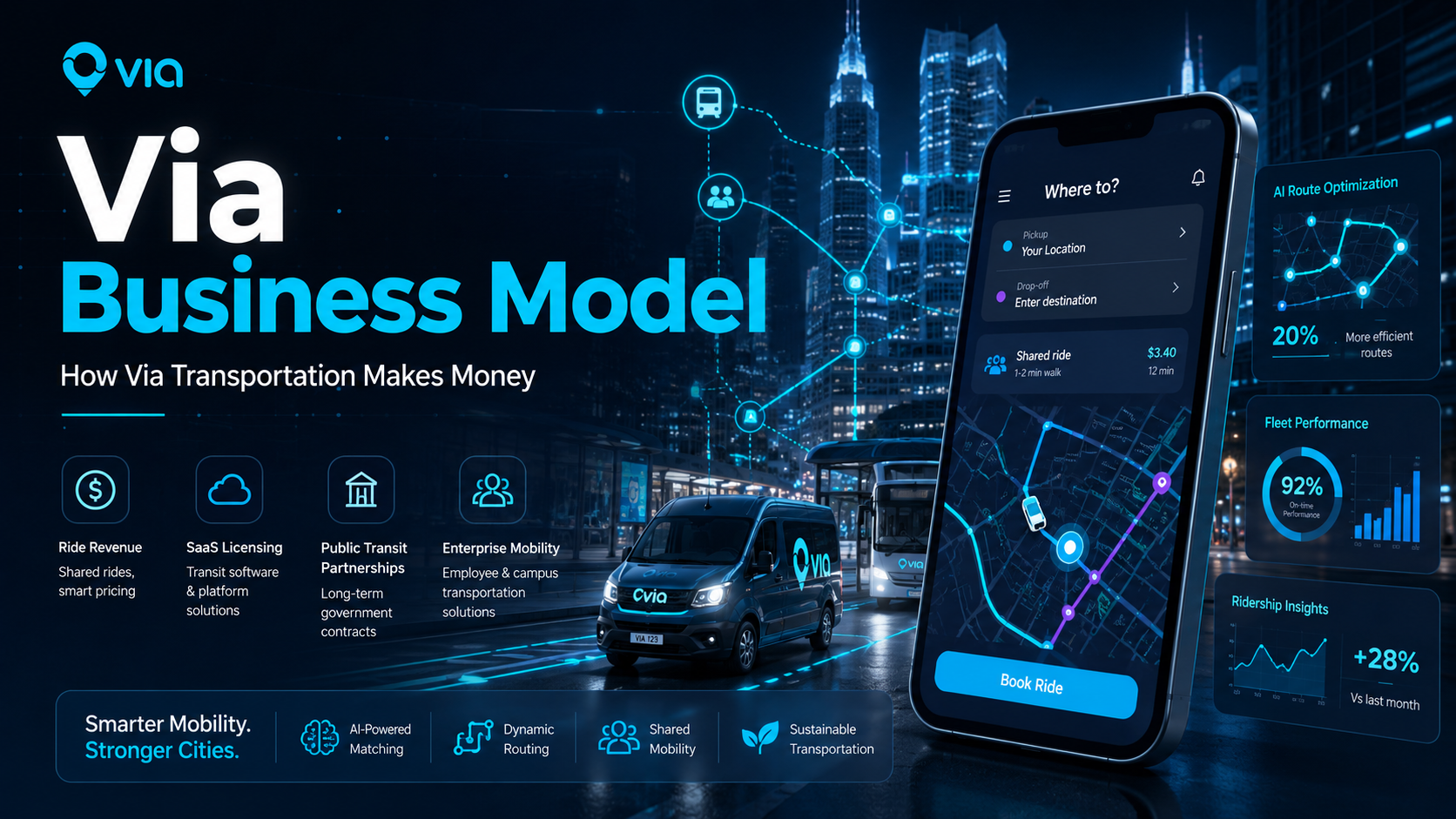
Via operates on a Mobility-as-a-Service (MaaS) business model where it earns revenue through ride fares, SaaS licensing, government transit partnerships, and enterprise mobility solutions. Unlike traditional ride-sharing companies that focus solely on individual trips, Via has carved out a unique position by combining shared rides with transit technology software.
The company makes money by serving three distinct customer segments: everyday riders who book shared trips through the app, cities and transit agencies that license Via’s routing technology, and corporations that need employee transportation solutions.
This hybrid approach has made Via one of the most interesting mobility startups because it doesn’t just compete with Uber and Lyft. Instead, it’s building the infrastructure layer for modern urban transportation.
What Is Via?
Via Transportation is a transit-tech company that launched in 2012 with a simple mission: make shared rides work as efficiently as public buses but with the convenience of on-demand apps.
The company was founded by Daniel Ramot and Oren Shoval in New York City. Both founders saw an opportunity to use technology to solve a fundamental urban problem: the gap between expensive private rides and inflexible public transit.
Via’s app works differently than typical ride-sharing. When you book a ride, the algorithm matches you with other passengers heading in similar directions. Instead of picking you up at your exact location, Via directs you to a nearby virtual bus stop, usually within a short walk.
The company now operates in over 20 countries and 500 cities worldwide. Major markets include New York, Washington DC, London, Berlin, and dozens of cities that have contracted Via to power their public transit systems.
Why Via Became Popular
Traditional ride-sharing has three major problems that Via set out to fix.
First, Uber and Lyft rides got expensive. What started as an affordable alternative to taxis became just as costly, especially during surge pricing. Many urban commuters couldn’t justify spending $15-25 per trip twice a day.
Second, public transportation runs on fixed routes and schedules that don’t adapt to real demand. Buses might be empty during off-peak hours and overcrowded during rush hour. Many neighborhoods get poor service because traditional transit planning can’t justify the cost.
Third, cities were struggling with congestion. More ride-sharing meant more cars on the road, making traffic worse instead of better.
Via positioned itself as the solution to all three problems by using technology to create dynamic shared rides that rival the efficiency of buses but offer more convenience than traditional transit.
The Core Idea Behind Via’s Business Model
What Problem Is Via Solving?
Via targets the inefficiency at the heart of urban transportation.
Ride-sharing is convenient but expensive because each trip dedicates an entire vehicle to one passenger or small group. The math doesn’t work for daily commuters who need affordable transportation.
Public buses are cheap but inflexible. Routes get planned years in advance and rarely change, even as neighborhoods evolve and demand patterns shift. This leads to underutilized buses on some routes and overcrowding on others.
Via saw that technology could bridge this gap. By using AI to match riders and optimize routes in real-time, they could deliver public-transit pricing with ride-sharing convenience.
Via’s Positioning
Via operates in the space between traditional public transport and private ride-sharing.
For riders, it’s cheaper than Uber but more flexible than the bus. For cities, it’s a way to extend transit service to underserved areas without buying more buses or hiring more drivers.
But Via’s real innovation is positioning itself as a smart transit infrastructure company, not just another ride-sharing app. This shift transformed Via from a consumer app competing with Uber to a B2B platform that cities and enterprises actually want to work with.
How Via Works
User Experience
Booking a Ride
The Via app feels familiar to anyone who’s used Uber or Lyft. You enter your destination, and the app shows you available options and pricing.
The key difference is that Via books you on a shared ride by default. The algorithm looks for other passengers with similar routes and groups you together. This happens in seconds, using real-time data about traffic, demand, and available vehicles.
Most Via rides cost between $3-8, significantly cheaper than solo ride-sharing.
Dynamic Routing System
Via’s technology continuously analyzes thousands of potential route combinations to find the most efficient grouping of passengers.
When you book a ride, the AI considers your pickup location, destination, and timing. It then checks for other riders who could share your route without adding significant time to anyone’s trip.
The system optimizes constantly. If a better route combination becomes available, Via can redirect vehicles in real-time. This means shorter wait times and more efficient rides.
Ride Experience
Via doesn’t pick you up at your exact location like Uber does. Instead, it directs you to walk to a nearby corner or designated spot, called a virtual bus stop. This is usually less than a two-minute walk.
This small compromise is what makes the shared model work efficiently. By having passengers meet vehicles at optimized locations, Via reduces the zigzagging that would happen if it picked up everyone at their doorstep.
You’ll share the ride with other passengers, but Via’s algorithm ensures you rarely have more than one or two additional stops before reaching your destination. Most trips include two to four passengers total.
Via Business Model Explained
Via’s Main Business Model
Via operates on a Mobility-as-a-Service model that generates revenue from multiple sources rather than relying solely on ride fares.
The company has evolved from a pure B2C ride-sharing app to a predominantly B2B and B2G (business-to-government) platform. Today, Via licenses its transportation software to cities, transit agencies, and corporations while still operating consumer-facing ride services in select markets.
This hybrid model creates multiple revenue streams and reduces the risk that comes from depending on a single income source.
Why This Model Is Smart
Via’s business model is asset-light, meaning the company doesn’t need to own vehicles, employ drivers directly, or build expensive physical infrastructure in most markets.
Instead, Via provides the software layer that makes shared transportation efficient. Cities and partners provide the vehicles and operations while Via supplies the technology and expertise.
This approach allows Via to scale faster and more profitably than traditional ride-sharing companies. Each new city partnership adds recurring SaaS revenue without proportionally increasing Via’s costs.
Government contracts also provide stability. While consumer ride demand fluctuates with seasons and economic conditions, multi-year transit contracts offer predictable income.
How Via Makes Money
Ride Fare Revenue
Via’s original business model centered on collecting fares from passengers who book shared rides through the app.
In markets where Via operates its own service, the company takes a percentage of each fare. Riders pay $3-10 per trip depending on distance and demand, and Via keeps a commission while paying drivers and covering operational costs.
The economics of shared rides work differently than solo trips. Because multiple passengers split the journey, Via can charge less per person while still generating meaningful revenue per vehicle hour. A car carrying three passengers at $5 each generates $15 in total fares, more than a single passenger paying $12.
SaaS Licensing Revenue
Selling Transit Software
Via’s most important revenue stream is licensing its mobility platform to cities and transit agencies.
Cities pay Via a subscription fee to use the routing software, driver apps, passenger apps, and dispatch systems. Via provides the complete technology stack needed to run a modern on-demand transit service.
This white-label approach means cities can launch their own branded transit apps powered by Via’s technology. Residents might use an app called “Arlington Transit” without knowing Via powers the backend.
Licensing fees vary based on city size and service scope but typically involve multi-year contracts worth hundreds of thousands to millions of dollars annually.
Why SaaS Is Important for Via
Software revenue is crucial because it offers higher profit margins than operating rides.
When Via runs its own service, it must pay drivers, maintain quality standards, handle customer service, and manage all operational complexity. Margins are thin because transportation is operationally intensive.
When Via licenses software, the city or transit agency handles operations while Via simply maintains the platform. This creates recurring revenue with minimal incremental cost as Via adds new clients.
SaaS revenue is also more predictable. Ride demand varies daily, but software contracts provide steady monthly or annual payments.
Government and Public Transit Partnerships
Via has partnered with over 500 cities and transit agencies worldwide to modernize public transportation.
These partnerships take several forms. Some cities use Via to replace underperforming bus routes with on-demand microtransit. Others use Via to extend service to areas that traditional fixed-route transit doesn’t cover efficiently.
Transit agencies pay Via through multi-year contracts that combine licensing fees with per-ride subsidies. For example, a city might pay Via $500,000 annually for the software platform plus $2 per ride to cover operational costs.
This model works because Via can often provide better service at lower cost than traditional transit. A fixed bus route might cost $150-300 per hour to operate while serving only a handful of passengers. Via’s dynamic routing ensures vehicles stay fuller and more efficient.
Enterprise Mobility Services
Corporations, universities, and large campuses contract Via to provide employee and student transportation.
These enterprise clients need reliable shuttle systems but want the flexibility of on-demand routing. Via’s technology allows companies to offer employees convenient transportation without running expensive fixed-route shuttles that might be empty during off-peak hours.
A corporate campus might pay Via $200,000 per year to provide unlimited rides for employees between offices, transit stations, and parking areas. This is often cheaper than maintaining a private shuttle fleet while offering better service.
Universities use Via for campus circulation and late-night safety transportation. Hospitals contract Via to move staff between buildings and parking structures. These B2B contracts provide high-margin recurring revenue.
Fleet Optimization Services
Via also sells standalone dispatch and routing software to private fleet operators.
Companies that run their own vehicles like hotel shuttles, corporate fleets, or paratransit services can license Via’s optimization algorithms to make their operations more efficient.
This software-only model requires minimal support from Via but generates steady licensing revenue. Fleet operators get better utilization from their vehicles, and Via adds another revenue stream without operational responsibility.
Via Business Model Canvas
Key Partners
Via’s ecosystem depends on strong partnerships across multiple sectors.
Cities and municipalities provide contracts, regulatory approval, and often subsidies that make shared transit economically viable. These government partners are crucial for Via’s growth strategy.
Fleet operators and vehicle providers supply the cars and drivers in many markets. Via focuses on the technology layer while partners handle vehicle operations.
Public transit agencies integrate Via’s services with existing bus and rail networks, creating seamless multimodal transportation systems.
Corporate clients provide enterprise contracts that diversify Via’s revenue beyond pure transit services.
Key Activities
Via’s core activities center on developing and maintaining sophisticated routing technology.
The company invests heavily in AI and machine learning to improve route optimization algorithms. Better algorithms mean shorter wait times, fewer empty seats, and more efficient operations.
Platform development includes building and updating the passenger app, driver app, dispatch systems, and analytics dashboards that cities use to monitor service performance.
Fleet coordination involves working with partners to ensure vehicles are positioned optimally, drivers are trained, and service quality meets standards.
Key Resources
Via’s most valuable asset is its proprietary routing algorithms.
The company has spent years refining AI systems that can group passengers, optimize routes, and predict demand patterns. This technology creates a significant competitive advantage because routing efficiency directly impacts both cost and user experience.
The mobility software platform that Via licenses to cities represents another critical resource. This includes the complete technology stack from apps to backend systems.
Transportation data collected from millions of rides provides insights that improve the algorithms and help Via pitch new partnerships. Cities want to work with the partner that has the most experience and best data.
Value Proposition
For Riders
Via offers affordable transportation that costs significantly less than solo ride-sharing while being more convenient than traditional public transit.
Riders get faster shared rides compared to buses because Via’s routing adapts in real-time. You’re not stuck taking an indirect route just because that’s where the bus line goes.
The app experience is modern and user-friendly, making shared transit feel more like a tech service than traditional public transportation.
For Cities
Via helps cities reduce transit costs per ride by optimizing vehicle utilization.
Cities also get smarter transportation systems backed by data and analytics. Via’s dashboard shows exactly where demand exists, helping transit agencies make better planning decisions.
The technology enables cities to extend service to neighborhoods that traditional transit couldn’t serve efficiently, improving equity and access.
For Businesses
Corporations get efficient employee mobility without the capital expense of buying vehicles or the operational burden of managing a transportation department.
Via’s flexible on-demand model means companies only pay for rides that actually happen, not for empty shuttles running on fixed schedules.
Customer Segments
Via serves three primary customer segments with different needs and revenue models.
Urban commuters represent the B2C segment. These are everyday riders who use Via like any other ride-sharing app, typically for daily commutes or regular trips.
Governments and transit agencies form the B2G segment. These customers contract Via to modernize public transportation infrastructure.
Enterprises including corporations, universities, hospitals, and campuses make up the B2B segment. They need managed transportation solutions for employees, students, or visitors.
Revenue Streams
Via generates revenue through multiple channels that reinforce each other.
Ride commissions from consumer trips in markets where Via operates directly.
SaaS subscriptions from cities and agencies that license Via’s technology platform.
Public contracts that combine software licensing with operational service delivery.
Enterprise partnerships providing corporate transportation solutions.
This diversified revenue structure insulates Via from over-dependence on any single income source.
Why Via’s Business Model Is Different From Uber
Shared Mobility vs Individual Ride-Hailing
The fundamental difference between Via and Uber is that Via optimizes for shared rides while Uber optimized for individual convenience.
Uber’s model prioritizes getting you a private car as fast as possible. You pay a premium for not sharing your ride or making any detours.
Via’s model prioritizes cost efficiency and urban sustainability. You accept a short walk to your pickup spot and possibly sharing with other passengers in exchange for significantly lower fares.
This difference might seem small, but it changes everything about the economics. Shared rides allow Via to charge less while generating more revenue per vehicle. A Via car carrying three passengers at $5 each earns $15 in total fares. An Uber carrying one passenger at $15 generates the same gross revenue but uses the vehicle less efficiently.
B2G Advantage
Via’s focus on government partnerships creates competitive advantages that Uber can’t easily replicate.
Cities prefer working with Via because shared rides reduce congestion rather than adding to it. When Uber enters a market, vehicle miles traveled typically increase. When Via enters, efficient shared rides often reduce the number of cars needed.
Government contracts also operate on longer time horizons. While consumer ride-sharing demand fluctuates, a three-year transit contract provides stable revenue and time to optimize operations.
Public sector relationships give Via access to transit subsidies and integration opportunities. Many cities will pay to subsidize Via rides in underserved areas, something they’d never do for Uber or Lyft.
SaaS Focus Instead of Pure Ride Revenue
Via treats transportation as a software problem, not just a service marketplace.
Uber makes money by connecting riders with drivers and taking a cut of fares. This model scales by adding more markets and more rides, but it’s operationally intensive and capital-hungry.
Via makes money by licensing technology that makes any transit operation more efficient. This model scales by adding more software clients, which requires less capital and offers better margins.
A city that adopts Via’s platform might generate $1 million in annual licensing revenue with minimal ongoing costs for Via. That same city might represent $5 million in ride revenue for Uber, but Uber’s costs and operational complexity would be proportionally higher.
Via’s Growth Strategy
Expansion Through Partnerships
Via grows by partnering with entities that already have authority, resources, and demand.
Cities provide the regulatory environment, often subsidize rides, and can integrate Via with existing transit infrastructure. Each new city partnership can represent millions in contract value.
Transit authorities are actively looking to modernize aging systems. Via positions itself as the technology partner that can help them deliver better service at lower cost.
Enterprises provide concentrated demand. A single corporate campus might generate thousands of rides monthly, and landing one enterprise client requires less customer acquisition cost than landing thousands of individual riders.
Technology-Led Scaling
Via invests heavily in AI and routing algorithms to create a technical moat.
The company’s growth strategy depends on having the best optimization technology. Better routing means happier riders, more efficient operations, and stronger economics, which makes Via more attractive to potential partners.
Data advantages compound over time. Via has operated millions of rides, and every trip generates data that trains the algorithms. This creates a competitive advantage that’s hard for new entrants to overcome.
International Expansion
Via pursues global opportunities in cities that are investing in smart transportation infrastructure.
The company has expanded across Europe, Asia, and Australia by partnering with cities that want to reduce car dependence and improve transit access.
International growth focuses on developed markets with existing transit infrastructure that needs modernization. Via isn’t trying to build transportation systems from scratch but rather to optimize and extend what already exists.
Via’s Competitive Advantages
Strong Transit Technology
Via has built specialized expertise in shared mobility routing that general ride-sharing companies haven’t prioritized.
The algorithms required to efficiently group passengers are fundamentally different from the technology that matches individual riders with the nearest driver. Via has spent years refining this specific problem while Uber and Lyft focused on optimizing solo rides.
Public Sector Relationships
Via understands how to work with government, which requires different approaches than serving consumers.
The company knows how to navigate procurement processes, demonstrate ROI to city councils, and integrate with existing transit agency operations. This institutional knowledge creates barriers for competitors who are used to the simpler consumer market.
Flexible Mobility Infrastructure
Via’s platform adapts to different operational models in different markets.
Some cities want Via to handle everything from vehicles to drivers. Others just want the software. Via’s flexible approach allows it to say yes to more opportunities because it can customize solutions for each partner’s needs and resources.
Operational Efficiency
Via’s business model achieves better unit economics than traditional ride-sharing in many scenarios.
By focusing on shared rides, optimized routing, and partnerships that reduce operational burden, Via can deliver transportation more efficiently than competitors who prioritize individual convenience above all else.
Challenges in Via’s Business Model
Regulatory Challenges
Working with government means navigating complex regulations, procurement rules, and political considerations.
Public sector deals take longer to close than private sector contracts. Cities move slowly, and transit decisions often face public scrutiny and debate.
Via must also work within existing transportation regulations that were written for traditional taxis and transit, not dynamic shared mobility. This can limit operational flexibility.
Competition From Uber and Lyft
Uber and Lyft have launched their own shared ride products and could leverage their larger user bases to compete.
Both companies have more brand recognition and bigger marketing budgets. If they decided to seriously prioritize shared rides and transit partnerships, they could challenge Via’s position.
However, Via maintains advantages in specialized transit technology and deeper relationships with the public sector.
Operational Complexity
Running transportation services is inherently complicated, even with great technology.
Via must ensure vehicles are available, drivers show up, routes work efficiently, and customers stay happy. Any operational hiccup damages relationships with city partners who are politically accountable for transit performance.
Public Sector Dependency
Via’s growth strategy relies heavily on government contracts, which come with risks.
Budget cuts, political changes, and shifting priorities can endanger existing contracts or slow new partnerships. If cities face fiscal crises, transportation technology might face budget pressure.
SWOT Analysis of Via
Strengths
Via has built proprietary routing technology specifically optimized for shared mobility that competitors would need years to replicate.
The company’s relationships with hundreds of cities create strong network effects. Each new partnership provides data, case studies, and credibility that makes the next partnership easier to win.
Via’s diversified revenue model across B2C, B2B, and B2G reduces dependence on any single segment.
Weaknesses
Via has lower brand recognition among consumers compared to Uber and Lyft.
The company’s focus on shared rides means the product appeals to cost-conscious riders but may not attract customers who prioritize privacy and convenience.
Public sector dependency creates revenue concentration risk if government priorities shift.
Opportunities
The global trend toward sustainable urban mobility plays to Via’s strengths. Cities worldwide are looking for alternatives to car-centric transportation.
Autonomous vehicle technology could transform Via’s economics by removing driver costs while keeping the shared-ride efficiency model.
Expanding into adjacent services like freight, medical transportation, or school busing could leverage Via’s routing technology in new markets.
Threats
Uber or Lyft could pivot toward Via’s model with shared rides and transit partnerships, leveraging their larger scale.
Cities might develop in-house technology capabilities rather than relying on external platforms.
Economic downturns could pressure transit budgets and reduce willingness to invest in new technology.
What Startups Can Learn From Via
Solve Expensive Infrastructure Problems
Via succeeded by tackling urban transportation, a massive problem with broken economics.
Traditional transit is expensive to operate and inflexible. Ride-sharing solved convenience but made congestion worse. Via found the gap in the middle where technology could deliver both efficiency and usability.
Startups should look for similar infrastructure challenges where software and AI can deliver step-change improvements over legacy approaches.
Combine SaaS With Services
Via’s hybrid model generates revenue from both software licensing and service delivery.
This approach offers more opportunities than pure SaaS or pure services alone. Cities that aren’t ready for software-only solutions can start with full-service partnerships. Clients that want control can license the technology and run operations themselves.
The flexibility to serve customers with different needs and different levels of operational maturity accelerates growth.
Use Partnerships for Growth
Via scaled by partnering with cities, transit agencies, and enterprises rather than trying to build everything alone.
This strategy reduced capital requirements and allowed Via to expand faster. Partners provided vehicles, drivers, local knowledge, and regulatory relationships while Via provided technology.
Startups in capital-intensive industries should consider how partnerships can provide resources and credibility while conserving cash.
Focus on Recurring Revenue
Via’s pivot toward SaaS contracts transformed its business from transactional ride revenue to recurring platform fees.
This shift improved both valuation multiples and business predictability. Investors value recurring revenue more highly than transactional income because it’s more stable and scalable.
The Future of Via
Smart Cities and AI Mobility
Via is positioning itself as essential infrastructure for the smart cities of the future.
As urban areas use data and AI to manage everything from traffic to energy, transportation becomes a critical system to optimize. Via’s platform could serve as the mobility layer that integrates with broader smart city initiatives.
The company’s routing algorithms will only get better as AI technology advances. Better predictions about demand patterns, traffic, and rider preferences will drive more efficient operations.
Autonomous Transportation Potential
Self-driving vehicles could dramatically improve Via’s economics by eliminating driver costs.
Via’s shared-ride model might work even better with autonomous vehicles because the routing efficiency matters more without a human driver. The technology that groups passengers efficiently becomes the key differentiator.
Via has been testing autonomous vehicle integrations and positioning itself to be ready when the technology matures.
Sustainable Urban Mobility
Climate change and congestion are pushing cities toward more sustainable transportation.
Via’s model reduces vehicle miles traveled compared to solo ride-sharing and private cars. Each shared Via ride potentially replaces multiple single-occupancy trips.
As cities get more serious about reducing emissions and congestion, Via’s value proposition gets stronger.
Transit-as-a-Service Expansion
Via sees opportunity in becoming the operating system for all forms of urban mobility.
The company could expand from passenger transit into freight delivery, medical transportation, school buses, and other use cases where routing optimization creates value.
Each new vertical leverages Via’s core technology while diversifying revenue and reducing competitive threats.
Wrap Up
Via has built something genuinely different in the crowded mobility space by recognizing that the future of urban transportation isn’t about private rides or fixed bus routes but about intelligent, flexible, shared mobility.
The company’s SaaS and mobility hybrid model works because it addresses the needs of multiple customer segments with complementary revenue streams. Riders get affordable transportation, cities get smarter transit systems, and enterprises get efficient employee mobility.
Via’s approach offers important lessons for startup founders. The company succeeded by finding a large infrastructure problem with broken economics, building specialized technology that delivers measurable improvements, and scaling through partnerships rather than pure capital deployment.
The shift from pure ride-sharing app to transit infrastructure company transformed Via’s growth potential and business model sustainability. Instead of competing with Uber and Lyft for individual rides, Via is building the platform that powers next-generation public transportation.
Whether Via becomes the dominant player in urban mobility depends on execution, competition, and how quickly cities adopt flexible transit technology. But the model itself demonstrates how startups can carve out valuable positions even in markets that seem dominated by incumbents.
FAQs
Via generates revenue through four main streams: ride fares from passengers who book trips through the app, SaaS licensing fees from cities and transit agencies that use Via’s routing technology, government transit contracts that often include both software and operational services, and enterprise mobility solutions for corporations and institutions.
Via is both. The company started as a consumer ride-sharing app but has evolved into primarily a B2B and B2G software platform. Today, Via generates significant revenue from licensing its transit technology to cities while still operating consumer-facing services in select markets.
Via focuses on shared rides optimized for efficiency and cost rather than individual trips optimized for speed and convenience. Via also generates substantial revenue from government and enterprise partnerships, selling transit technology to cities rather than just operating a consumer marketplace.
In most markets, Via does not own vehicles. The company partners with fleet operators, transit agencies, or vehicle providers who supply cars and drivers. Via provides the technology platform that makes the service work efficiently. However, in some markets Via does contract directly with drivers and vehicles.
Via operates in over 500 cities across 20 countries. Major markets include New York, Washington DC, Chicago, London, Berlin, Amsterdam, and Singapore. Many cities use Via’s white-label technology, so residents might use a locally branded transit app powered by Via without knowing it.
Via is a private company and doesn’t publicly disclose profitability. The company has raised significant venture capital funding and continues to grow. The shift toward higher-margin SaaS revenue and away from capital-intensive ride operations has likely improved unit economics compared to Via’s early years as a pure ride-sharing service.
Discover more from Business Model Hub
Subscribe to get the latest posts sent to your email.