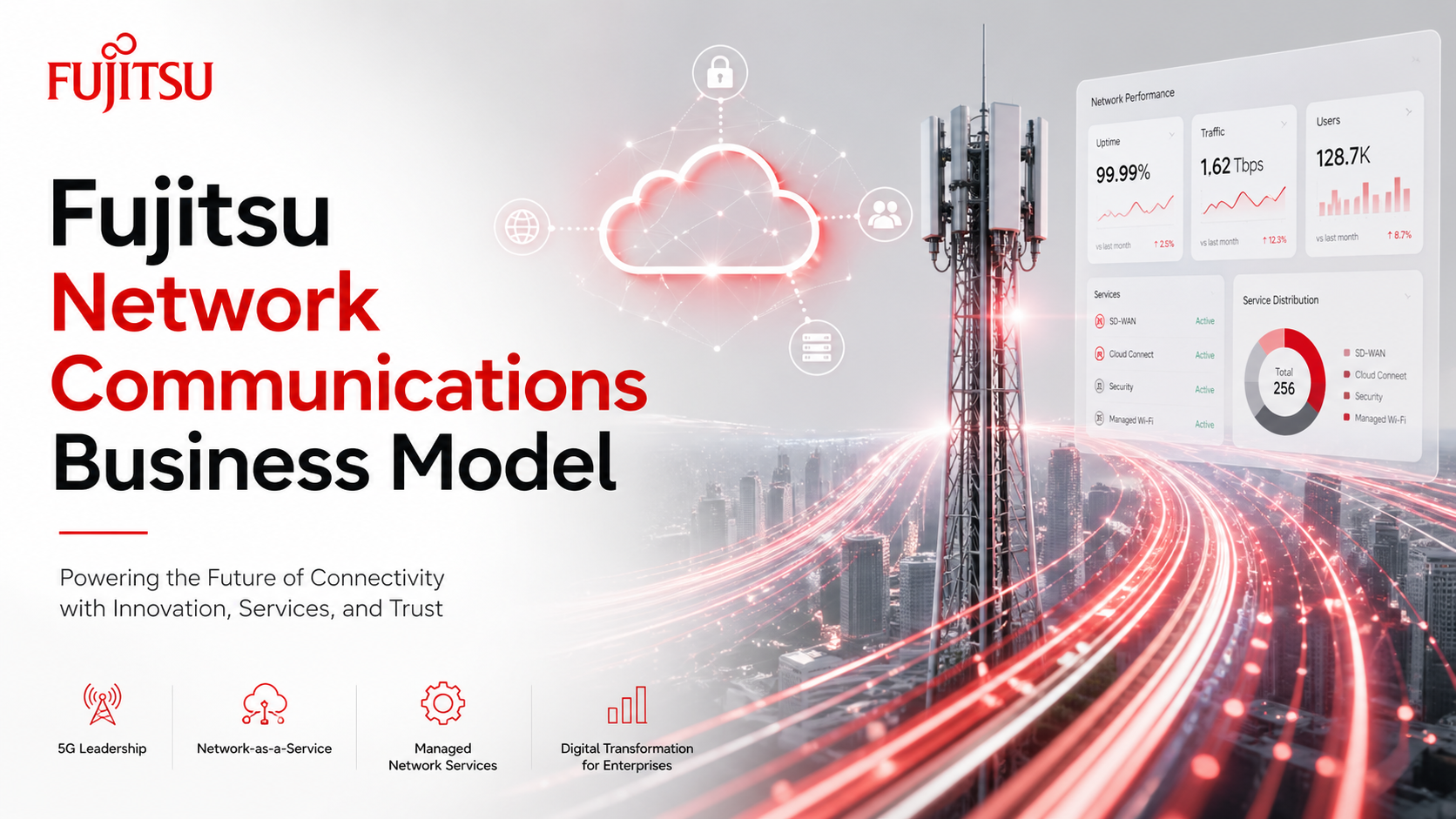

Fujitsu Network Communications (FNC) runs a hybrid B2B technology and service-based business model. It generates revenue through network hardware sales, managed services, and Network-as-a-Service (NaaS) solutions. Its primary customers are telecom operators, enterprises, and government agencies.
FNC does not just sell products. It builds, manages, and optimizes complete network ecosystems for large-scale clients who need carrier-grade reliability.
Quick Answer
Fujitsu Network Communications makes money through three core channels: selling network infrastructure hardware, delivering long-term managed network services, and offering subscription-based NaaS platforms. It targets telecom operators, enterprises, and governments that need end-to-end network solutions backed by deep technical expertise.
What Is Fujitsu Network Communications?
Fujitsu is a Japanese multinational technology company with operations spanning IT services, hardware, software, and telecommunications infrastructure. Its network communications division sits at the intersection of telecom and enterprise technology.
FNC operates as a technology partner, not just a vendor. It works alongside telecom carriers and large enterprises to design, deploy, and run modern network infrastructure.
Core focus areas include:
- Optical transport networks
- 5G infrastructure and Open RAN solutions
- Network automation powered by AI
- Cloud-based networking platforms
- Enterprise connectivity and managed services
FNC’s positioning is straightforward. It serves clients who cannot afford network downtime, who operate at massive scale, and who need a single partner capable of handling hardware, software, and services under one roof.
Core Business Model Overview
Fujitsu Network Communications runs on three distinct revenue pillars.
Product-based revenue comes from selling physical network equipment including optical systems, routers, and 5G hardware. These are high-value B2B contracts with telecom carriers and large enterprises.
Service-based revenue comes from ongoing contracts for network design, deployment, monitoring, and management. These are long-term relationships that generate predictable recurring income.
Platform-based revenue comes from as-a-service offerings where clients pay based on usage rather than ownership. This is the fastest-growing segment and reflects a broader industry shift away from capital-heavy infrastructure spending.
The smartest part of this model is how each pillar feeds the next. Hardware sales open the door. Services lock in the relationship. Platforms create recurring revenue streams that compound over time.
Revenue Streams: How Fujitsu Network Communications Makes Money
Network Hardware and Infrastructure
FNC sells optical systems, enterprise-grade routers, 5G radio access equipment, and related infrastructure to telecom operators and large enterprises. These are not consumer products. They are high-margin, highly engineered systems built for carrier-grade performance.
Telecom operators need this equipment to build out and upgrade their networks. Enterprises need it to run private networks, data centers, and distributed office environments. Both segments involve large contracts that take months to close but deliver significant revenue over multi-year timelines.
Hardware is the entry point, not the end game. Once a client installs Fujitsu infrastructure, they are much more likely to purchase deployment services, maintenance contracts, and eventually platform subscriptions from the same vendor.
This is a classic land-and-expand strategy executed at enterprise scale.
Managed Network Services
Managed services represent one of FNC’s most stable and valuable revenue streams. Instead of just selling hardware and walking away, Fujitsu handles network design, deployment, performance monitoring, troubleshooting, and lifecycle management on behalf of its clients.
Services include SD-WAN deployment, LTE network management, enterprise Wi-Fi solutions, and full end-to-end network operations. Clients sign long-term contracts, often spanning three to five years, which creates predictable recurring revenue for Fujitsu and reduces operational burden for the customer.
This is where FNC differentiates from pure-play hardware vendors. A company like a mid-size bank or a national retailer does not want to hire and retain a full team of network engineers. They want a trusted partner who handles it. Fujitsu steps into that role.
The value here is not just technical. It is operational. FNC becomes deeply embedded in a client’s infrastructure, which makes switching vendors costly and time-consuming. That is a strong competitive moat.
Network-as-a-Service
NaaS is the most forward-looking part of Fujitsu’s revenue model. Under this approach, clients do not purchase and own network infrastructure. Instead, they subscribe to network capabilities and pay based on usage.
Think of it like moving from buying servers to using cloud computing. The same logic applies to networking. Instead of spending millions upfront on hardware that depreciates and requires constant maintenance, clients pay a monthly or annual fee for the network capacity they need.
This model benefits clients in several ways. It reduces capital expenditure. It scales up or down based on actual usage. It offloads technical complexity to Fujitsu. And it keeps clients on modern infrastructure without requiring them to manage upgrade cycles themselves.
For Fujitsu, NaaS creates predictable subscription revenue that is far more stable than one-time hardware sales. It also deepens customer relationships because the client is continuously relying on Fujitsu infrastructure and support.
The shift from ownership to usage economy is happening across every major tech sector. FNC’s NaaS offering positions it well for that transition in the telecom and enterprise networking space.
Consulting and Digital Transformation Services
Beyond building and running networks, Fujitsu offers advisory services that help telecom operators and enterprises navigate major technology transitions.
These consulting engagements cover network modernization strategy, migration from legacy infrastructure to cloud-native architectures, AI integration into network operations, and 5G readiness assessments.
This is high-margin work. It does not require manufacturing or large physical delivery teams. It requires deep expertise, which Fujitsu has built over decades in the telecom space.
Digital transformation consulting also serves as a pipeline for larger contracts. A company that hires Fujitsu to develop a network modernization roadmap is very likely to then hire Fujitsu to execute it. The consulting relationship creates trust and sets the stage for implementation work.
For enterprises moving from on-premise networks to hybrid cloud environments, Fujitsu acts as a guide through that complexity. That advisory role is increasingly valuable as network architecture grows more complicated.
Software and Automation Platforms
Fujitsu has invested heavily in software tools that make network operations more efficient. These platforms use AI and machine learning to monitor network performance, predict failures before they happen, automate routine management tasks, and optimize traffic routing in real time.
For telecom operators managing thousands of network nodes across wide geographic areas, these tools are not optional. They are essential. Manual network management at that scale is not practical or cost-effective.
Fujitsu also develops Open RAN compatible software, which is a big deal in the current telecom landscape. Open RAN breaks apart the traditional tightly integrated radio access network architecture, allowing carriers to mix and match hardware and software from different vendors. Fujitsu’s software platforms are built to work within that open ecosystem, which makes them attractive to carriers who want to reduce dependence on any single vendor.
Automation platforms also create recurring software license revenue and support contracts, adding another layer to the service-based revenue model.
Customer Segments
Fujitsu Network Communications focuses almost exclusively on large-scale B2B clients. It does not sell to individual consumers or small businesses in any meaningful way.
Telecom operators are the core customer segment. Mobile carriers, fixed-line providers, and cable companies all need the kind of infrastructure and services Fujitsu provides. These clients operate massive networks and need partners with carrier-grade expertise.
Enterprises represent a growing segment. Large companies in banking, manufacturing, retail, healthcare, and logistics all run complex private networks. They need reliable connectivity, security, and increasingly, cloud-integrated networking solutions.
Governments and public sector organizations are another major segment. Public safety networks, military communications infrastructure, and municipal broadband projects all require the kind of reliable, secure networking that Fujitsu provides.
Cloud and data center providers need high-performance optical networking and interconnect solutions. As data center traffic continues to grow, this segment becomes increasingly important.
Each of these customer types shares a common characteristic. They need proven, enterprise-grade solutions, they have large budgets, and they have low tolerance for failure. That is exactly where Fujitsu competes.
Value Proposition: Why Customers Choose Fujitsu
End-to-End Network Solutions
The biggest selling point Fujitsu offers is the ability to handle everything. Hardware procurement, network design, deployment, integration, ongoing management, and technology upgrades can all come from a single partner.
For large enterprises and telecom operators, managing multiple vendors across all of those functions is expensive and complicated. Vendor coordination, contract management, and integration troubleshooting all consume time and resources. Having one capable partner simplifies that significantly.
Fujitsu’s end-to-end capability also means accountability is clear. There is no finger-pointing between vendors when something goes wrong. One partner owns the outcome.
Cost Efficiency and Scalability
Fujitsu’s pay-as-you-go and managed service models help clients reduce upfront capital expenditure. Instead of buying and maintaining their own infrastructure, clients pay for what they use and let Fujitsu handle the operational burden.
At scale, this is financially attractive. It converts large unpredictable capital costs into predictable operating expenses. For CFOs and finance teams, that is a meaningful shift in how technology spending is structured.
Scalability is also a major factor. As a business grows or as network demand fluctuates, Fujitsu’s platforms and managed services can adjust. Clients do not need to over-provision expensive hardware to handle peak demand that only occurs occasionally.
Deep Telecom Expertise
Fujitsu has been building and supporting telecommunications infrastructure for decades. That experience is not something a startup or a general-purpose IT vendor can replicate quickly.
Carrier-grade network reliability means the network needs to operate at very high uptime levels, often measured in the number of minutes of downtime per year rather than hours. Achieving that level of reliability requires deep engineering expertise, proven processes, and experience managing complex failure scenarios.
Fujitsu’s reputation in telecom is built on that track record. Carriers and enterprises that need mission-critical networks are willing to pay a premium for a vendor they trust.
Open and Flexible Ecosystem
Open RAN adoption is accelerating across the telecom industry. Carriers are increasingly pushing back against proprietary, closed architectures that lock them into a single vendor’s ecosystem. Open RAN standards allow carriers to build networks using interoperable components from multiple vendors.
Fujitsu is a strong supporter and participant in the Open RAN ecosystem. Its hardware and software solutions are designed to work within multi-vendor environments. That flexibility is a significant selling point for carriers who want to reduce vendor dependency while still working with a reliable, experienced partner.
Multi-vendor compatibility also means Fujitsu can work alongside other technology providers rather than competing against them for every dollar of the client’s budget. That cooperative positioning makes Fujitsu easier to work with in complex enterprise environments.
Key Business Strategies
Focus on Next-Generation Networks
Fujitsu is making substantial investments in 5G infrastructure, AI-powered network operations, and edge computing capabilities. These are not optional bets. They are the core of where telecom and enterprise networking is heading.
5G networks are significantly more complex than previous generations. They require more hardware nodes, more sophisticated software management, and much tighter integration between the radio network and the core network. Companies that have built expertise and product lines around 5G will be well positioned as global deployment continues to accelerate.
Edge computing brings processing power closer to where data is generated rather than routing everything to a centralized data center. For applications like industrial automation, autonomous vehicles, and real-time analytics, edge computing is essential. Fujitsu’s network infrastructure is a foundational component of edge computing deployments.
Shift Toward Service-Based Revenue
Fujitsu is deliberately moving away from relying on hardware sales as its primary revenue source. The strategy is to build recurring revenue through managed services, software subscriptions, and NaaS offerings.
This is a financially sound direction. Hardware revenue is lumpy and tied to capital spending cycles. When enterprises or carriers freeze capital budgets, hardware orders dry up. Service and subscription revenue is far more stable because it is embedded in how clients operate their networks every day.
The transition also improves profit margins over time. Well-run managed services and software platforms carry better margins than manufactured hardware, and they compound as the client base grows.
Partnerships and Ecosystem Building
Fujitsu does not try to do everything alone. It builds partnerships with telecom operators, hyperscale cloud providers, AI technology companies, and other hardware vendors to create integrated solutions that are more valuable than what any single company could deliver.
These partnerships expand Fujitsu’s reach and capabilities without requiring it to build everything from scratch. They also make Fujitsu’s solutions more attractive to clients who are already working with those partner companies.
Ecosystem plays are increasingly common in enterprise technology. Clients want solutions that integrate cleanly with their existing tools and platforms. Fujitsu’s partnership network helps it deliver that kind of compatibility.
Sustainability and Energy Efficiency
Network infrastructure consumes significant amounts of energy. As data traffic continues to grow, energy costs for running networks are becoming a major concern for both carriers and enterprises.
Fujitsu develops energy-efficient hardware and uses AI-powered optimization to reduce power consumption across network operations. This is both a cost-reduction strategy and an environmental responsibility play.
For large enterprises and government clients with sustainability commitments, working with a vendor that prioritizes energy efficiency is increasingly important. Fujitsu’s focus on this area aligns with broader corporate sustainability trends and helps differentiate its offerings from competitors who have not prioritized it as heavily.
Cost Structure
Running a business at Fujitsu’s scale requires significant ongoing investment across several areas.
Research and development is one of the largest cost centers. Staying competitive in 5G, AI, and open network technologies requires continuous engineering investment. This is not optional in a fast-moving industry where competitors are also spending heavily on R&D.
Hardware manufacturing and supply chain costs are substantial. Network equipment involves complex components, global supply chains, and sophisticated manufacturing processes. Managing those costs while maintaining quality and reliability is a constant operational challenge.
Global service delivery requires a large workforce of network engineers, project managers, and support staff distributed across the markets where Fujitsu operates. Labor costs in the managed services business are significant, and maintaining the right talent pipeline is an ongoing priority.
Talent acquisition and retention in network engineering, software development, and AI research is expensive and competitive. Fujitsu competes with hyperscale tech companies, other telecom vendors, and consulting firms for the same pool of skilled engineers.
Competitive Advantage
Fujitsu’s strongest competitive advantages are interconnected and difficult to replicate quickly.
Decades of telecom expertise mean Fujitsu understands carrier-grade reliability requirements at a deep level. That institutional knowledge is embedded in its products, processes, and people.
End-to-end service capability at scale is genuinely rare. Very few companies can handle hardware, software, and managed services across the full lifecycle of a complex network at the level of quality carriers and large enterprises require.
Global partnership network gives Fujitsu access to customers, technologies, and markets that it could not reach efficiently on its own.
Open network ecosystem positioning is increasingly valuable as the industry moves toward Open RAN and multi-vendor architectures. Fujitsu is well positioned to benefit from that trend rather than being threatened by it.
The combination of these factors creates a meaningful moat. It is not an unassailable position, but it is one that takes years to build and requires competitors to match on multiple dimensions simultaneously.
Challenges in the Fujitsu Business Model
Intense Competition
The telecom infrastructure market is dominated by well-resourced competitors. Huawei offers highly competitive pricing backed by significant Chinese government support. Nokia and Ericsson have deep relationships with global carriers built over decades. Cisco is a dominant force in enterprise networking.
Fujitsu has to compete across multiple fronts simultaneously, often against companies with larger scale or lower cost structures in specific segments.
Capital Intensity
Building and maintaining the hardware manufacturing, R&D, and global service delivery operations required to compete in this market is expensive. Fujitsu must continuously invest capital to stay current, even during periods when revenue is under pressure.
This capital intensity creates financial risk, particularly if the telecom industry goes through a downcycle or if major clients defer spending.
Rapid Technology Change
The pace of change in telecom and networking technology is fast. 5G deployment is still in progress, and 6G research is already underway. AI capabilities are evolving rapidly. Cloud-native network architecture is replacing traditional approaches.
Staying ahead of these shifts requires constant investment and organizational agility. Missing a major technology transition can permanently damage a company’s competitive position in this industry.
Telecom Industry Cyclicality
Telecom operators go through investment cycles. When carriers are in heavy capital expenditure phases, business is strong. When they pull back to digest previous investments or manage debt, orders slow down significantly.
Fujitsu’s hardware business is directly exposed to this cyclicality. The shift toward managed services and recurring revenue helps buffer it, but the hardware business remains sensitive to carrier spending patterns.
The Future of Fujitsu Network Communications
Several major trends are set to drive growth in FNC’s core markets over the coming years.
5G expansion is still in relatively early stages globally. Many markets are still in the process of deploying 5G infrastructure, and the upgrade from 5G to more advanced 5G architectures will require additional investment. Fujitsu is positioned to capture a share of that ongoing spending.
6G research and standardization is already underway. Companies that invest now in 6G technology development will be better positioned when commercial deployment begins later this decade. Fujitsu’s R&D investments in next-generation wireless technology are laying groundwork for future revenue.
AI-powered network operations are moving from optional to essential. As networks grow more complex, human operators cannot manage them effectively without AI assistance. Fujitsu’s investments in network automation and AI-powered management tools align directly with this need.
Cloud-native telecom infrastructure is replacing traditional hardware-centric architectures. Network functions that previously ran on dedicated hardware are moving to software running on general-purpose computing infrastructure. Fujitsu’s software and platform capabilities position it to serve this transition.
Edge computing deployment will require significant networking investment as processing moves closer to end users and devices. Fujitsu’s expertise in both network infrastructure and edge computing puts it in a strong position to serve clients navigating this architectural shift.
The through-line in all of these trends is that networks are becoming more complex, more software-defined, and more critical to how organizations operate. Companies that can help clients manage that complexity reliably will have strong business for the foreseeable future.
Conclusion
Fujitsu Network Communications has built a business model that goes well beyond selling network equipment. It has positioned itself as a full-spectrum technology partner for telecom operators, enterprises, and governments that need reliable, modern network infrastructure.
The model works because it layers multiple revenue streams on top of each other. Hardware creates the initial relationship. Services deepen and extend it. Platform subscriptions convert it into predictable recurring revenue. Consulting keeps Fujitsu relevant as clients navigate technology transitions.
The shift from being primarily a hardware company to being a service and platform company is the most important strategic evolution Fujitsu is executing. That transition improves revenue stability, expands profit margins over time, and makes client relationships harder to disrupt.
Challenges are real. Competition is intense. The capital requirements are significant. Technology is changing fast. But Fujitsu’s depth of expertise, end-to-end capability, and open ecosystem positioning give it credible tools to compete effectively.
The networks that Fujitsu builds and manages are increasingly the infrastructure on which entire industries run. That makes FNC’s business model not just commercially interesting, but strategically important in the broader context of digital transformation.
In practical terms, Fujitsu is not just building networks anymore. It is building the infrastructure layer that the digital economy depends on.
Discover more from Business Model Hub
Subscribe to get the latest posts sent to your email.