BeReal Business Model The Anti-Social Media Strategy That Challenged Instagram

What Is BeReal?
BeReal is a social media app built on one simple premise: post once a day, no filters, no edits, no curated content.
The app was founded in 2020 by Alexis Barreyat and Kévin Perreau. Before launching BeReal, Barreyat worked in media production at GoPro, while Perreau served as Chief Project Officer at Opteamis.
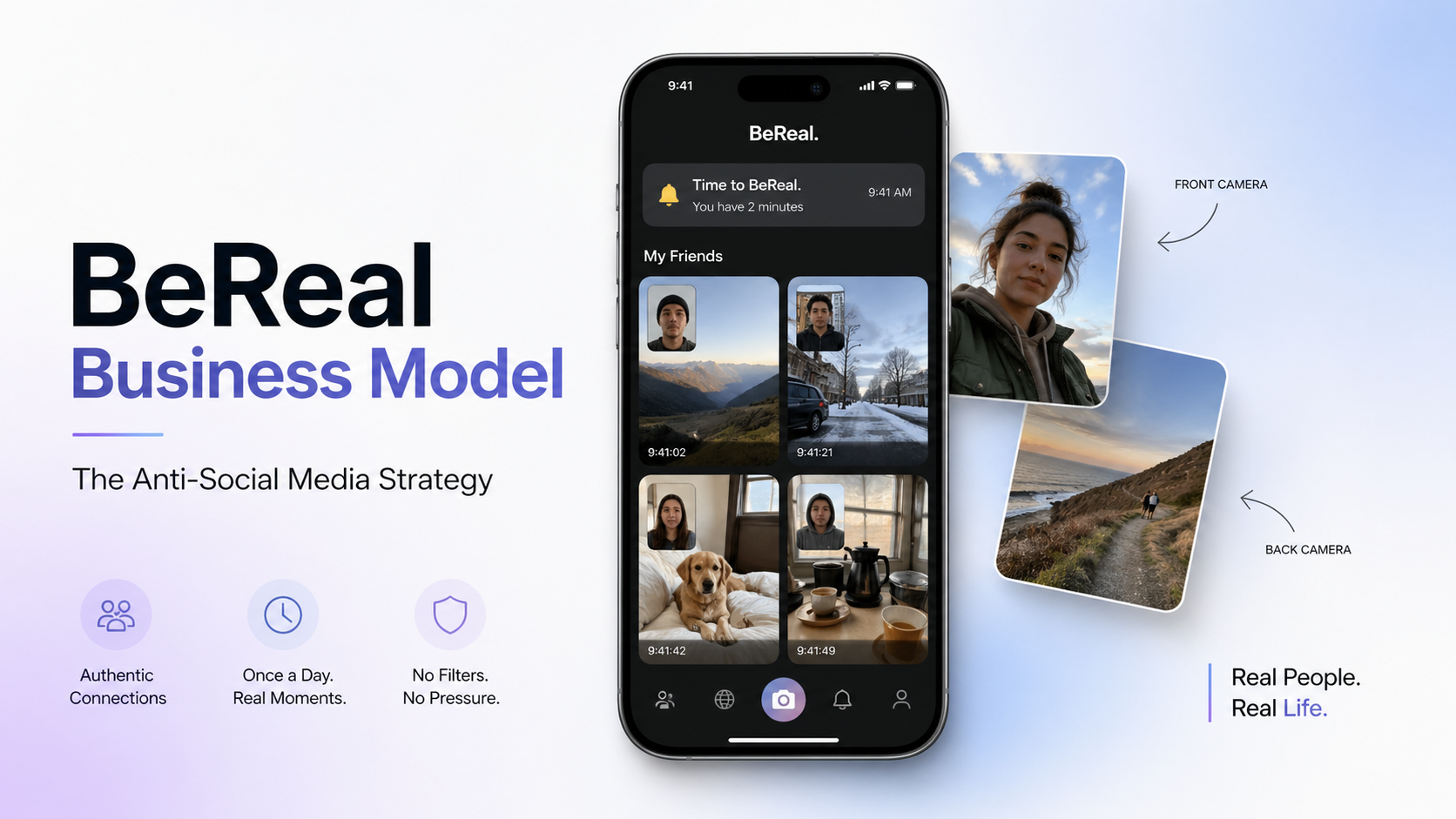
The product is deceptively simple. At a random time each day, BeReal sends every user a notification. You have two minutes to respond. The app simultaneously fires both your front and rear cameras, capturing what you’re actually doing, not what you want people to think you’re doing.
That’s it. That’s the whole product.
Unlike most social platforms, BeReal is not designed for users to grow their following. It focuses on building existing relationships by removing the opportunity to stage, filter, and edit photos.
No follower counts. No explore pages. No algorithm pushing viral content into your face. Just your friends, in real time, being real.
The Problem BeReal Was Built to Solve
To understand BeReal’s business model, you first have to understand why it exists.
Social media in 2020 was a highlight reel economy. Instagram rewards beautiful photos. TikTok rewards viral performance. Twitter rewards hot takes. Every platform is optimized for engagement, which really means every platform is optimized for making you feel like your life is less interesting than everyone else’s.
The downstream effects are well documented. User anxiety. Comparison culture. Content burnout. An entire generation of people performing their lives instead of living them.
BeReal took a direct swing at that problem.
The company’s platform fosters genuine connections among users and promotes a more realistic, unvarnished view of daily life. BeReal’s mission is to disrupt the conventional social media paradigm, which often promotes curated and unrealistic portrayals of life.
The bet was simple: there is a massive audience of people who are exhausted by performance-driven social media and would trade algorithmic reach for authentic connection.
That bet turned out to be correct, at least in the short term.
How BeReal Works
The product flow is straightforward.
You get a random notification once per day. The time changes every day so you can’t prepare or stage anything. You open the app and have two minutes to post. The app captures both cameras at once, so your friends see your face and whatever you’re looking at simultaneously.
Here’s the key design decision: you cannot see your friends’ BeReals until you post your own.
That one rule is what drives behavior. It creates accountability. It removes passive lurking. It forces everyone to participate, not just consume.
Apart from sharing a photo with friends, users can also publicly share a BeReal, allowing them to discover what people around them are up to. All BeReal photos uploaded throughout a user’s lifetime can be accessed in a dedicated Memories section.
The product intentionally removes everything that makes traditional social media addictive. No infinite scroll. No recommended content. No engagement metrics designed to keep you on the app longer than you intended.
It creates engagement without addiction, which is a fundamentally different design philosophy than anything else in the market.
BeReal’s Business Model Breakdown
BeReal’s business model in its early years was unusual by any standard. The company chose to delay revenue almost entirely in favor of building trust and user density first.
This is not a new playbook. Many platforms prioritize growth over monetization early on. But BeReal took it further than most by building authenticity into the product architecture itself, which created a direct tension with traditional ad-based revenue models.
Let’s break down every component.
The Anti-Ad Strategy (Early Stage)
BeReal publicly stated: “BeReal is free to use, and we don’t have ads. You may be wondering if we’ll have ads or how we think about monetizing the app. First, we want to stick around for as long as you’ll have us, but working with brands is not our priority.”
This was a deliberate positioning move. BeReal was not just avoiding ads. It was making a public commitment to users that the product would not be weaponized for advertiser interests.
The short-term cost was zero revenue. The long-term benefit was deep user trust, particularly with Gen Z, a demographic that is historically skeptical of brand-heavy platforms.
The logic: acquire users through anti-ad positioning, then find monetization paths that don’t break that trust.
It worked for a while. Then it didn’t.
Network Effect Growth
BeReal’s growth model was almost entirely peer-driven.
The product only works if your friends are on it. Posting a BeReal to zero followers is pointless. This creates a natural viral loop where every new user has a strong incentive to recruit their friend group.
College campuses were a primary growth vector. Friend circles adopted the app together. One person downloaded it, shared it with five friends, and those five each shared with their own circles.
The US now has the most users on BeReal, representing 27% of the total user base.
The network effect also acts as a retention mechanism. Once your friend group is active on BeReal, leaving means losing access to that authentic daily window into their lives. The switching cost is real.
Low Content Supply Model
Most social platforms face an infrastructure challenge: more users means more content means more server costs. Video-heavy platforms like TikTok and YouTube pay enormous costs to store and serve billions of hours of video.
BeReal’s one-post-per-day limit creates a fundamentally different cost structure.
One photo per user per day. No video hosting at scale. No algorithm needing to process and rank billions of content pieces. The infrastructure overhead is significantly lower than any video-first competitor.
This keeps operational costs manageable even at tens of millions of users, which is critical for a company that deliberately chose not to generate revenue in its early years.
No Algorithm Dependency
This is one of BeReal’s most radical design choices and one of its most significant competitive differentiators.
There is no content ranking system. No recommendation engine deciding what you see or when you see it. No engagement optimization loop deciding which friends’ posts get surfaced over others.
You see your friends’ BeReals in reverse chronological order. That’s it.
The absence of an algorithm has multiple downstream effects. It reduces tech complexity, which reduces engineering costs. It eliminates the “content arms race” where creators have to constantly chase algorithmic signals. It removes the engagement-bait content that dominates algorithm-driven platforms.
It also makes the product far less addictive, which is either a bug or a feature depending on how you look at it.
The BeReal Business Model Canvas
Customer Segments
BeReal’s primary audience is Gen Z. More specifically, it is Gen Z users who feel alienated by the performance culture of Instagram and TikTok.
Secondary segments include:
Millennials who are burned out on traditional social media. Social media minimalists who want connection without content overload. Private friend groups who prioritize real connection over public broadcast.
Notably absent: influencers. BeReal was not designed for them, does not reward them, and does not need them. This is a conscious exclusion, not an oversight.
Value Propositions
The core value proposition is authenticity on demand.
BeReal removes performance pressure because you physically cannot stage your shot in two minutes. It removes social comparison because there are no likes, follower counts, or engagement metrics visible. It creates real-time connection that feels closer to a text message than a social media post.
For users burned out by traditional platforms, this is deeply compelling. You get to see what your friends are actually doing right now, not the best version of their weekend they spent an hour curating.
The secondary value proposition is simplicity. No algorithm to understand. No content strategy needed. No learning curve. You open the app, take a photo, and you’re done.
Channels
BeReal’s primary distribution channel is word of mouth.
The product is inherently social. When one person joins, they immediately want their friends to join so the experience becomes richer. The notification system creates daily touchpoints that prompt users to recruit others.
BeReal’s rise to prominence came in 2022 after early investment rounds from a16z and Accel. The app’s popularity peaked with 53 million downloads by late 2022, and its influence was solidified by cultural references such as a sketch on Saturday Night Live.
Campus virality was another key channel. College students adopted it in clusters, creating high-density friend networks that made the app immediately valuable.
App store discoverability played a smaller role. The product’s word-of-mouth velocity was so high in 2022 that paid acquisition was essentially unnecessary during its peak growth phase.
Customer Relationships
BeReal operates on a peer-to-peer relationship model, not a creator-consumer model.
On Instagram, there are creators and there are audiences. The creator-follower hierarchy is the core social architecture. On BeReal, there is no hierarchy. Everyone is equal. Everyone posts the same format, at the same cadence, with the same constraints.
This eliminates the status dynamics that drive both engagement and anxiety on traditional platforms. Nobody on BeReal has more than anyone else, except more friends, which is the only metric that matters on the platform.
Revenue Streams
This is where BeReal’s model gets complicated. And where the original vision eventually ran into a wall.
Early Stage: Zero Revenue
Prior to being acquired, the only money BeReal had made was through investments.
The company raised approximately $90 million in venture funding across its seed, Series A, and Series B rounds before selling. It generated no meaningful product revenue during that period. The strategy was to build user trust and network density before introducing any monetization.
Post-Acquisition: Voodoo Takes Over
Without a sustainable business income, BeReal’s owners had to sell the app in 2024 to Voodoo for 500 million euros. As of July 2024, BeReal’s new owner Voodoo introduced in-app advertisements as a way to generate sustainable income.
BeReal officially launched an advertising platform in the US. The move followed its acquisition by French mobile publisher Voodoo for €500 million, and came after limited ad testing with brands like Nike, Netflix, Levi’s, and Amazon. BeReal’s new ad offerings include in-feed ads that mirror the platform’s signature dual-camera format, as well as full-day brand takeovers.
RealBrands Program
In 2025, BeReal published its Advertising Guidelines and launched RealBrands, a program that lets brands post like users within the same two-minute window. Brands must post authentic, un-staged content. All paid partnerships are labeled clearly. No algorithmic boosting is applied.
This is the most on-brand monetization approach BeReal could have chosen. Instead of inserting traditional ads, it invites brands to participate in the same authentic posting experience as regular users. A brand on BeReal is not buying impressions. It is joining a behavior.
Revenue Results
In April 2025, BeReal introduced in-feed ads and brand takeovers, helping it transition from $0 to over $30 million in revenue by the end of 2025.
That’s a significant revenue ramp from a standing start. But the bigger question, which we’ll address later, is whether this monetization approach preserves the authenticity that made BeReal valuable in the first place.
Key Resources
BeReal’s most valuable resources are not technical. They are behavioral and cultural.
The mobile platform itself is relatively simple. The real competitive advantages are:
The user base and its network density. Once friend groups are embedded, the switching cost is high. The brand identity built around authenticity. This is a soft asset but an incredibly powerful one. The behavioral design system, specifically the two-minute window, the dual camera, and the post-to-view mechanic, which creates habitual daily engagement without algorithmic manipulation.
Key Activities
The core operational activities at BeReal are focused on product and experience, not marketing.
App development and maintenance. The product needs to be reliable. A failed notification or a buggy camera ruins the one daily moment BeReal promises its users.
User experience optimization. The product’s simplicity is its greatest strength. Every feature decision is a tradeoff between adding value and adding complexity.
Community moderation. The open sharing format creates potential for abuse. Keeping the platform safe and authentic requires active moderation.
Feature experimentation. Under Voodoo, BeReal has introduced a Friends-of-Friends feed, Nearby posts, and is testing ads and brand partnerships in the US. These expansions are attempts to grow engagement and revenue without breaking the core product promise.
Key Partnerships
BeReal’s partnerships are relatively limited compared to other social platforms, which reflects its minimalist product philosophy.
Apple App Store and Google Play Store are the primary distribution partners. Without them, BeReal does not reach users.
Brand partners under the RealBrands program are an emerging category. Early partners have included Nike, Netflix, Levi’s, and Amazon, all testing how to participate in BeReal’s format authentically.
Cost Structure
BeReal’s cost structure is leaner than most social platforms because of its low content supply model.
Primary costs include:
Server infrastructure for photo storage and delivery. Engineering team for product development and maintenance. Product design and experience optimization. Marketing, which has historically been low given the word-of-mouth growth model.
The absence of video content, recommendation algorithms, and creator monetization tools keeps costs significantly lower than competitors like TikTok or YouTube.
Why BeReal Went Viral
The 2022 growth spike that took BeReal from obscurity to global attention was not accidental. It was the result of several converging factors.
Timing
Post-pandemic Gen Z was burned out. Zoom calls, curated Instagram feeds, and TikTok performance had created a backdrop of intense digital exhaustion. BeReal arrived at a moment when a significant portion of the market was actively looking for something different.
Scarcity Creates Value
One post per day sounds like a limitation. In practice, it functions as a value driver. Because BeReal content is rare and time-limited, it feels more meaningful than the thousandth post in an Instagram grid.
The scarcity also creates daily ritual. Users open the app at the notification, check their friends’ posts, and move on. It slots into daily life without consuming it.
Social Accountability
The post-to-view mechanic creates a reciprocity norm that keeps friend groups engaged. If your friends are all posting and you’re not, you’re opting out of a shared ritual. Social accountability drives participation in a way that no algorithm can replicate.
Zero Learning Curve
There is no strategy to learn, no algorithm to optimize for, no content format to master. You take a photo and post it. That’s it. The simplicity lowered the barrier to adoption to almost nothing, which accelerated word-of-mouth growth.
BeReal vs Traditional Social Media
| Feature | BeReal | Instagram / TikTok |
|---|---|---|
| Content | Real, unfiltered | Curated, edited |
| Algorithm | None | Heavy, engagement-optimized |
| Posting Frequency | Once per day | Unlimited |
| Revenue Model | Ads (post-acquisition) | Massive ad revenue |
| Primary Goal | Authenticity | Engagement maximization |
| Creator Economy | No | Core to the platform |
| Follower Counts | Minimal emphasis | Central social currency |
The table makes it clear: BeReal is playing a fundamentally different game. Whether that game is sustainable at scale is a separate question.
Strengths of BeReal’s Business Model
Strong Differentiation
In a market dominated by algorithm-heavy, engagement-optimized platforms, BeReal occupies a genuinely distinct position. There is no other mainstream platform that enforces a one-post-per-day limit with a random notification trigger.
High Trust Factor
By explicitly avoiding ads in its early years and building a product around authenticity, BeReal built an unusually high level of user trust. That trust is an asset. It is also the thing most at risk as the platform moves toward monetization.
Low Infrastructure Overhead
The photo-first, one-post-per-day model keeps server and infrastructure costs well below video-heavy competitors. This extends the runway and makes profitability more achievable at lower revenue levels.
Viral Growth Engine
The peer-to-peer growth model is a structural advantage. Every user who joins becomes a recruiter for their friend group. There is no paid acquisition needed when the product sells itself through social accountability.
Weaknesses and Risks
Monetization Threatens the Core Value Proposition
This is the central tension. Any monetization that violates BeReal’s belief system kills the product. BeReal today operates as a hybrid: part participation-based model through RealBrands, and part traditional ad network. BeReal’s transformation under Voodoo is a fascinating experiment in whether you can scale authenticity without killing it.
The question is not whether BeReal can generate revenue. It clearly can. The question is whether users will accept commercial intrusion in a product they chose specifically because it felt free of commercial intrusion.
Declining User Numbers
Download figures have declined. Analytics firm Appfigures estimates that global downloads dropped from 31.5 million in 2023 to 12.7 million in 2024, a 60% year-over-year decrease.
BeReal currently has 16 million monthly active users, a sharp decrease from the 25+ million daily active users the app had in early 2024.
That is a significant contraction in a short time. The platform retained users who love the concept, but it has struggled to grow beyond the early adopter cohort.
Easy to Replicate Features
The app was the first mainstream social platform to leverage a dual camera, a feature that Instagram, TikTok, and Snapchat have since replicated.
Large platforms can copy the format. They cannot copy the authenticity brand, but they can eliminate the feature differentiation by offering the same posting mechanic inside a much larger network. Instagram’s Dual feature did exactly this.
Engagement Time Is Limited by Design
BeReal’s deliberate avoidance of infinite scroll means users spend less time in the app. That’s better for mental health. It is worse for traditional advertising metrics. Advertisers pay for attention, and BeReal’s design philosophy minimizes the amount of attention it captures per user.
What Happened After the Voodoo Acquisition
The Voodoo acquisition in 2024 was both a lifeline and a turning point.
Without sustainable business income, BeReal’s owners were forced to sell the app in 2024 to Voodoo for 500 million euros.
Voodoo is a French gaming and app publisher with a very different operating philosophy than BeReal’s founders. Where the founders prioritized authenticity above revenue, Voodoo prioritized making the business viable.
The changes came quickly. In-feed ads. Brand takeovers. The RealBrands program. A US advertising team hired from TikTok. These moves generated real revenue fast, going from zero to over $30 million in 2025. But they also marked the end of BeReal’s original anti-ad positioning.
The “no-ads, no-feed” BeReal no longer fully exists.
Whether that matters to users in the long run is the defining question for BeReal’s future.
Key Lessons for Founders
BeReal’s story contains several lessons that apply well beyond social media.
Constraints Can Be a Feature
The two-minute window and the one-post limit are not restrictions. They are the product. BeReal proved that removing optionality can create more value than adding it. When users cannot curate, the content becomes trustworthy. When content is trustworthy, connection becomes real.
If you’re building a product, ask yourself what you should remove rather than what you should add.
Behavior Design Is the Real Innovation
BeReal did not invent a new technology. Cameras existed. Social networks existed. What BeReal invented was a behavioral mechanic: the random notification, the two-minute window, the post-to-view unlock.
The technical moat was shallow. The behavioral design moat was genuinely novel. For founders, that’s the lesson. Your competitive advantage is more likely to live in how people use your product than in what your product technically does.
Trust Is a Long-Term Strategy
BeReal delayed monetization to build user trust first. In the short term, that looked like leaving money on the table. In the medium term, it created a brand and user relationship that no amount of marketing spending could have manufactured.
Trust compounds. BeReal’s founders understood that. The challenge they faced was that trust also has to eventually translate to a business that can sustain itself.
Simplicity Scales
There is no onboarding tutorial for BeReal because none is needed. Simplicity accelerates adoption. It reduces support costs. It makes word-of-mouth easier because the product is easy to describe.
If a user cannot explain your product in one sentence, your product is probably too complex.
Delaying Revenue Has a Ceiling
This is the lesson the original founders learned the hard way. Building trust before monetizing is smart. Building trust indefinitely without a credible path to revenue is a company you eventually have to sell.
Without a sustainable business income, BeReal’s owners had to sell the app in 2024 to Voodoo for 500 million euros.
The exit was successful by most metrics. But it also meant that someone else would decide how BeReal’s values would be balanced against its revenue targets. For founders, that is worth thinking about before you make the same call.
Is BeReal’s Business Model Sustainable?
The honest answer is: it depends on what “BeReal” means going forward.
If BeReal is a product that holds firm on its core authenticity promise, the monetization options are limited but real. RealBrands-style participation advertising. Premium features that add value without compromising the experience. Geographic expansion to grow the user base.
If BeReal becomes another ad platform that uses authenticity as a marketing message while operating like a traditional social network, the differentiation disappears. And when the differentiation disappears, so does the reason to use BeReal instead of just using Instagram.
With Voodoo’s backing, BeReal began testing in-feed ads inside the new Friends of Friends stream and limited brand takeovers. Voodoo’s strategy bets on reach. The harder path, betting on meaning, is the one that made BeReal special in the first place.
The platform is currently navigating that tension in real time. The revenue numbers are moving in the right direction. Whether the user trust numbers are moving in the same direction is less clear.
Final Take
BeReal built something genuinely rare in tech: a product that users trusted because the product design itself demonstrated that trust.
No ads. No algorithm. No infinite scroll. No performance pressure. Just a daily two-minute window into your friends’ actual lives.
That product generated enormous goodwill with a generation of users who had grown exhausted by social media as performance. It proved you could grow without algorithms and engage without addiction.
The harder part, the part that ultimately required selling the company, was proving you could also sustain a business without breaking the promise that made the product compelling in the first place.
For founders building today, that is the real lesson BeReal teaches.
Align your business model with your product philosophy early. Build a monetization strategy that fits your value proposition, not one that contradicts it. And do not wait until you’re forced to sell to figure out how you’re going to survive.
BeReal’s original vision was correct. Its financial planning just didn’t match the ambition.
Discover more from Business Model Hub
Subscribe to get the latest posts sent to your email.