Carta Business Model And How It Makes Money from Equity, Startups and Ownership

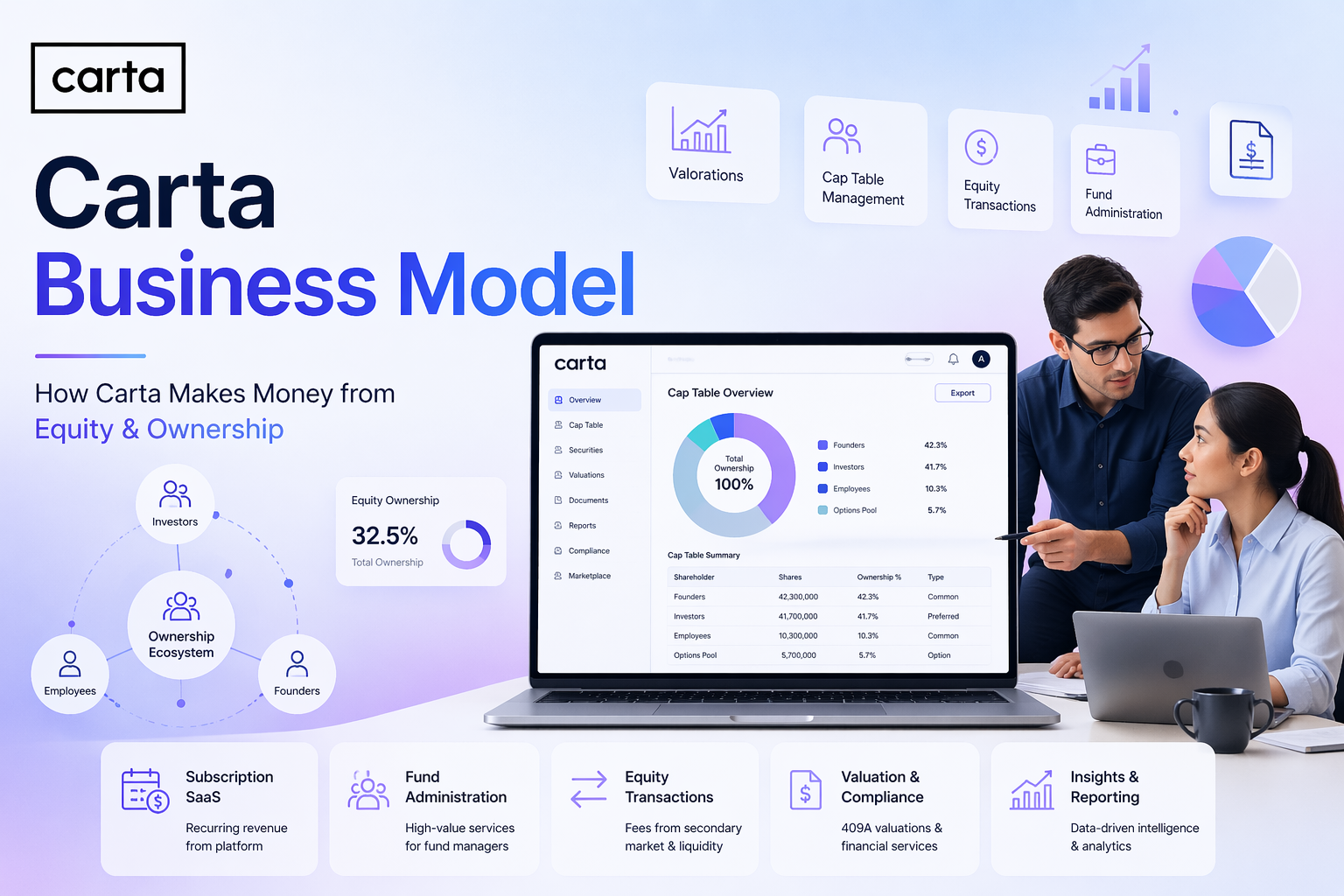
Carta has quietly become one of the most important infrastructure companies in the startup world. It started as a simple cap table management tool. Today it sits at the center of how startups, investors, and employees manage equity, ownership, and financial compliance.
This guide breaks down exactly how Carta works, who pays for it, and why its business model is one of the smartest in enterprise SaaS.
What Is Carta?
Carta is a platform that helps companies manage ownership. At its core, it answers one question: who owns what?
Every startup that issues equity needs to track that equity somewhere. For a long time, that meant spreadsheets, lawyers, and a lot of manual reconciliation. Carta replaced all of that with a centralized, automated platform.
Here is what Carta does in plain terms:
Cap table management keeps a real-time record of who owns shares, options, and warrants in a company.
Equity plan administration handles stock option grants, vesting schedules, and exercises for employees.
Fund administration helps venture capital firms manage investor relationships, capital calls, and compliance.
Valuations provides 409A valuations, which are legally required for US startups that issue stock options.
Liquidity and secondary markets lets employees and early investors sell private shares before a company goes public or gets acquired.
The simplest way to understand Carta: it is where startup equity lives digitally.
The Core Problem Carta Solves
To understand why Carta has grown so fast, you need to understand the pain it eliminates.
What Startups Dealt With Before Carta
Startups issuing equity faced serious operational headaches. Cap tables lived in spreadsheets that became outdated the moment a new round closed. Errors crept in. Legal documents piled up. Founders had no easy way to show investors a clean, accurate breakdown of who owned what.
Every time a startup raised money, hired employees with equity, or ran an option exercise, the process was manual, slow, and expensive.
What Investors Dealt With Before Carta
Venture capital firms managed dozens of portfolio companies. Getting clean portfolio data meant emailing founders and waiting. Fund administration required external firms and significant overhead. Compliance reporting was painful.
What Carta Actually Fixed
Carta centralized everything. Instead of scattered spreadsheets and documents, every stakeholder sees the same data in real time. Investors get clean portfolio views. Employees understand their equity. Founders can run complex scenarios in minutes.
The platform also handles legal compliance automatically, which is a huge deal. A 409A valuation that once cost thousands of dollars and weeks of back-and-forth now runs faster and cheaper through Carta’s system.
Carta’s Business Model Breakdown
Carta operates a hybrid model that combines SaaS subscriptions with financial services. This is what makes it unusually powerful from a revenue standpoint.
SaaS Subscription Revenue
Companies pay annual subscription fees to use Carta’s platform. Pricing scales based on company stage, number of stakeholders, and which features the company needs.
An early-stage startup with a handful of founders and investors pays much less than a Series D company with hundreds of employees, dozens of investors, and complex equity structures.
This subscription layer gives Carta predictable, recurring revenue. It is the foundation of the business model. Companies do not cancel Carta when they raise their next round. They upgrade.
The retention here is unusually strong because moving off Carta is genuinely difficult. Your cap table is not just data stored in a database. It is legal ownership records, historical transactions, and compliance documentation going back years. Switching costs are extremely high.
Fund Administration
This is Carta’s highest-value revenue segment and one that often flies under the radar.
Venture capital firms and private equity funds use Carta to manage their fund operations. This includes:
Capital calls when a fund draws down committed capital from limited partners.
Investor reporting that shows LPs how their capital is performing.
Compliance and tax documentation that funds are legally required to produce.
Waterfall calculations that determine how proceeds are distributed when a portfolio company exits.
These are high-ticket contracts. A fund with hundreds of millions in assets under management pays significantly more than an early-stage startup. And the work is operationally sticky. Once a fund’s financial data lives in Carta’s system, moving it out is an enormous undertaking.
This segment has grown substantially as more emerging fund managers choose modern tooling over legacy fund administrators.
Equity Transactions and Secondary Markets
Carta built a secondary market for private company shares. This is a significant monetization layer on top of the core platform.
Private company employees often hold meaningful equity but cannot access it until their company goes public or gets acquired. Carta’s secondary marketplace lets them sell shares to investors before a liquidity event.
On the investor side, funds and institutional buyers can acquire stakes in high-growth private companies without waiting for a public offering.
Carta generates revenue through transaction fees and platform commissions on these trades. As private companies stay private longer, this market has grown significantly.
Valuation Services
409A valuations are not optional for US startups. The IRS requires them before any company can set strike prices for employee stock options. Getting it wrong creates legal and financial risk for both the company and its employees.
Carta turned a compliance requirement into a revenue stream. Companies pay for 409A valuations through the platform. The process is faster and often cheaper than working with an independent firm, and the data Carta already holds makes their analysis more accurate.
Beyond 409A, Carta offers financial modeling tools and reporting dashboards that help CFOs and finance teams understand their equity structure and make better decisions.
Enterprise Add-Ons
Larger companies pay for additional features that smaller startups do not need. These include advanced reporting, white-glove onboarding, custom integrations, and priority support.
As a company scales from seed to Series C to pre-IPO, its needs on the platform change dramatically. Carta captures more revenue at each stage.
Who Pays Carta: The Customer Segments
Carta serves multiple distinct customer groups, each with different needs and different price points.
Early-stage startups use Carta to set up their cap tables correctly from the beginning. Getting this right early prevents expensive cleanup later. These are lower-revenue customers individually, but there are a lot of them and they tend to stay.
Growth-stage companies use Carta for more complex equity administration, including large employee option pools, multiple share classes, and investor reporting. These companies pay more and use more features.
Pre-IPO and late-stage companies have sophisticated needs around compliance, 409A valuations, and liquidity programs for employees. These are high-revenue accounts.
Venture capital funds and emerging managers use Carta’s fund administration tools. This is the segment where revenue per customer is highest.
Private equity firms use Carta for portfolio management and reporting.
Employees with equity interact with Carta to view their grants, run exercise scenarios, and access the secondary marketplace. They are not always direct revenue sources, but their presence on the platform creates network effects.
The Business Model Flywheel
Carta’s real competitive advantage is not any single product. It is how each part of the platform feeds every other part.
A startup joins Carta to manage its cap table. As it grows, it needs 409A valuations. When it raises a venture round, the investors onboard to Carta for portfolio visibility. Those investors eventually use Carta’s fund administration tools for their own funds. The company hires employees who want to understand and eventually liquidate their equity, driving them to the secondary marketplace.
Each step in this lifecycle creates more value and more revenue. The startup that joined Carta for a free or low-cost cap table eventually becomes a high-paying account with complex fund administration and liquidity needs.
The flywheel also works in reverse. Investors who use Carta recommend it to their portfolio companies. Funds that manage on Carta ask their portfolio companies to adopt the platform for reporting consistency. The network grows in both directions.
Why Carta Is Hard to Displace
Carta has a genuine moat built on several interlocking advantages.
High Switching Costs
This cannot be overstated. Carta holds legal ownership records for companies. Moving those records off the platform requires expensive legal work and creates significant operational risk. Most companies that adopt Carta keep using it for the life of the company.
Data Depth
Carta has seen more cap tables, more valuations, and more fund structures than any other platform in the market. That data makes their valuations more accurate, their benchmarks more meaningful, and their product recommendations more useful.
Network Effects
When both startups and their investors are on the same platform, the experience gets better for everyone. Investors can see real-time portfolio data. Founders can share updates without spreadsheet exports. This shared data layer is hard to replicate without the existing network.
Compliance Lock-In
Carta is not just a software tool. It is part of a company’s legal and financial compliance infrastructure. Switching has legal implications, not just operational ones.
Competitive Landscape
Carta operates in a market with real competition, but no single competitor covers the same ground.
Pulley targets early-stage startups with a simpler, often cheaper cap table product. It competes directly with Carta at the bottom of the market but lacks Carta’s fund administration depth.
Shareworks by Morgan Stanley serves larger, more established companies and has a strong enterprise customer base. It benefits from Morgan Stanley’s institutional relationships but is less nimble on product.
AngelList covers the fund formation and management side and is strong with emerging managers. It overlaps with Carta’s fund administration segment.
Ledgy is a European alternative that has gained traction outside the US, where Carta’s market penetration is lower.
None of these competitors offer the full lifecycle coverage that Carta does. Most compete in one segment while Carta spans all of them.
Risks and Challenges in Carta’s Business Model
No business model is without real vulnerabilities, and Carta has several worth understanding.
Trust and Data Sensitivity
Carta holds some of the most sensitive financial data a private company produces. Any breach or mishandling of that data would be catastrophic for the business. Trust is the foundation of the entire model.
In 2023, Carta faced significant controversy when it was reported that the company was using customer data to solicit investors in secondary transactions. This created a serious trust issue and led to customer backlash. The incident highlighted how data sensitivity is not just a security question but an ethics and governance question.
Regulatory Exposure
Carta operates at the intersection of software and financial services. As it has expanded into secondary markets and fund administration, it has taken on more regulatory complexity. Changes in securities law, tax regulations, or broker-dealer requirements could affect its operations significantly.
Dependency on Startup Ecosystem Health
Carta’s revenue grows when startups raise money, hire employees, and eventually exit. During downturns in venture funding, new startups form more slowly, fewer rounds close, and companies tighten budgets. This creates cyclical revenue risk.
Competition From Specialized Tools
As individual segments of Carta’s market mature, specialized tools become more competitive. A fund administrator that only does fund administration can potentially serve that segment better and more cheaply than a generalist platform.
Future Growth Opportunities
Carta’s current revenue is large, but the market it is addressing is larger still.
Global Expansion
Carta’s penetration outside the United States is still early. The equity management problem exists everywhere that startups operate. Europe, Southeast Asia, and Latin America all have growing startup ecosystems that need the same infrastructure. Carta has made moves into Europe but has not yet replicated its US market position internationally.
Private Market Liquidity
The secondary market for private shares is still small relative to what it could be. As more companies choose to stay private longer and employee equity compensation becomes more common, the demand for liquidity mechanisms will grow. Carta is positioned to capture a significant share of this market.
AI-Driven Financial Insights
Carta sits on an unusually rich dataset of equity structures, valuations, and funding history. Using that data to surface better benchmarks, predictions, and recommendations for founders and CFOs is a natural product extension. AI tools that help founders model dilution scenarios, benchmark their equity against similar companies, or optimize their option pool could become significant value drivers.
Deeper Fintech Integration
Carta has the data and the trust relationships to expand into adjacent financial services. This could include startup banking products, insurance, or more sophisticated financial modeling tools.
The Strategic Logic Behind Carta’s Business Model
Carta is often described as a SaaS company, but that framing undersells what it has built.
The more accurate description: Carta is ownership infrastructure for private companies.
SaaS companies sell access to software. Carta sells access to a critical layer of how companies function legally, financially, and operationally. Equity records are not optional. 409A valuations are not optional. Fund reporting is not optional.
By making itself the place where these things live, Carta created something that companies depend on to operate. That dependency generates subscription revenue, transaction fees, and upsell opportunity at every stage of a company’s growth.
The lesson for founders studying this model: if you can own a critical compliance or operational layer early, you build in switching costs that protect you as the market matures. Carta did not win by building the most beautiful software. It won by becoming the place where equity lived, and then expanding from that position.
Final Takeaway
Carta’s business model works because it combined three things that rarely come together cleanly.
First, it solved a universal, recurring problem for a large and growing market. Every startup needs to manage equity. Every fund needs to report to LPs. These are not niche use cases.
Second, it built in retention at the data layer, not just the product layer. Moving off Carta is not just a product decision. It is a legal and financial operation. That creates the kind of retention that most SaaS companies can only dream about.
Third, it layered revenue across the entire ownership lifecycle. Subscriptions give predictable base revenue. Valuations capture compliance spending. Fund administration captures higher-value contracts. The secondary marketplace captures transaction volume. No single revenue stream makes or breaks the model.
The result is a business that grows with its customers, captures more value as they scale, and gets harder to displace the longer they stay.
Discover more from Business Model Hub
Subscribe to get the latest posts sent to your email.