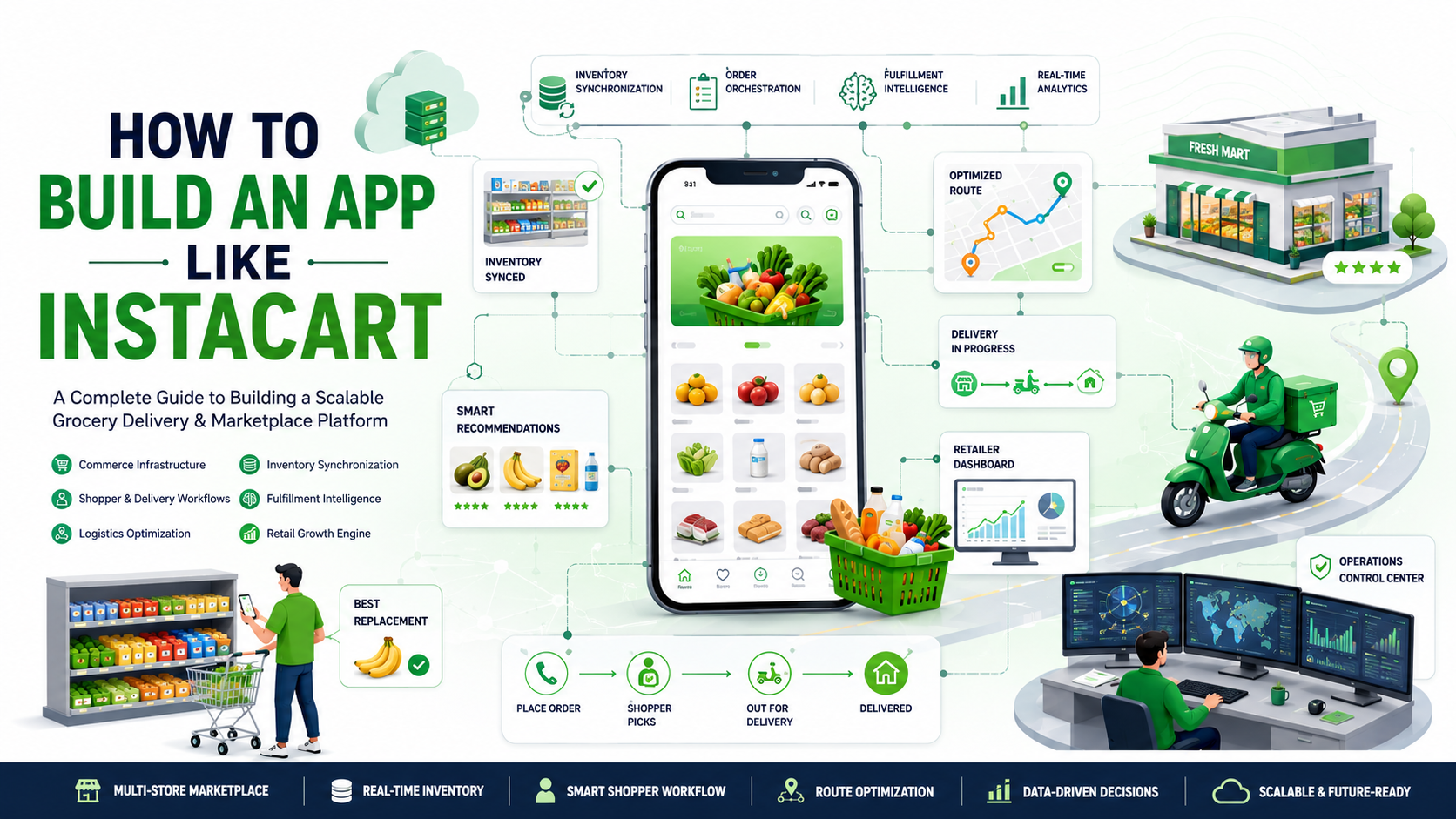

Building an app like Instacart is not a simple delivery app project. It is a full-scale commerce orchestration platform that connects customers, shoppers, retailers, inventory systems, and logistics networks into one seamless operation.
This guide breaks down every layer you need to build a grocery delivery platform that actually works at scale.
What Makes Instacart Different From a Regular Delivery App
Instacart is not a grocery delivery app. It is a retail infrastructure platform.
Most founders look at the customer-facing app and think that is the product. The actual product is the coordination engine running underneath it. That engine manages thousands of moving parts simultaneously across multiple cities, store partners, shoppers, and drivers.
The visible layer is the app. The real business is the infrastructure.
The six core entities Instacart connects:
- Grocery stores and retail partners
- Customers placing orders
- Personal shoppers fulfilling orders in-store
- Delivery partners transporting orders
- Inventory and catalog systems
- Advertising and retail media networks
Miss any one of these, and the platform breaks down.
What Are the Core Layers of a Grocery Delivery Platform
Every successful platform in this space is built on four operational layers working in sync.
Consumer Commerce Layer This is what customers interact with. It handles product discovery, search, cart management, checkout, payment processing, and order tracking. It needs to feel fast and frictionless.
Retail Partner Layer This is what grocery stores use to manage their presence on your platform. It handles catalog management, inventory updates, promotional pricing, and order visibility.
Shopper Operations Layer This is what personal shoppers use inside the store. It handles order acceptance, smart picking sequences, barcode scanning, replacement suggestions, and fulfillment confirmation.
Logistics Coordination Layer This runs in the background and manages delivery assignments, route planning, ETA calculations, and driver matching. This layer is what determines whether your platform is profitable or not.
Which Business Model Should You Choose
Not every grocery app should copy Instacart’s exact model. There are three proven structures to choose from.
| Model | How It Works | Best For |
|---|---|---|
| Aggregator Marketplace | Partner with existing stores, act as the commerce layer | Fast scaling, lower inventory risk |
| Dark Store | Own your own inventory and micro-warehouses | Faster delivery, better margin control |
| Hybrid Commerce | Combine partner stores with owned fulfillment centers | Large-scale multi-market expansion |
Aggregator Marketplace is the Instacart model. You do not own inventory. You connect stores that already exist with customers who want delivery. The advantage is speed to market. The disadvantage is dependence on partner store inventory accuracy.
Dark Store is the Blinkit and Zepto model. You own the inventory, control the fulfillment, and promise 10 to 30-minute delivery windows. The advantage is speed and reliability. The disadvantage is capital intensity.
Hybrid Commerce combines both. You use partner stores for regular grocery orders and owned micro-warehouses for fast-moving essentials. This model suits platforms that are expanding into multiple cities and need flexibility.
How Do You Build the Product Data Infrastructure
The product catalog is the foundation of everything. Get this wrong and search fails, inventory fails, and recommendations fail.
A mid-sized grocery marketplace can hold anywhere from 50,000 to 500,000 SKUs across multiple store partners. You need a centralized product intelligence system to manage all of it.
What your product database needs to store:
- Product name, brand, and category
- Barcode and weight
- Nutritional information
- Images and descriptions
- Store-specific pricing
- Inventory status per location
What Is Catalog Normalization and Why Does It Matter
Catalog normalization is the process of recognizing that different stores may list the same product under different names.
One store may call it “Coca-Cola 500ml.” Another may list it as “Coke Bottle 500ml.” A third may enter it as “Coca Cola 500 ml Pet Bottle.”
Your system needs to identify all three as the same product. Without this, your search results are fragmented, your inventory data is inaccurate, and your recommendation engine breaks.
Catalog normalization directly improves search quality, cross-store inventory matching, and personalization accuracy.
How Does Real-Time Inventory Synchronization Work
Inventory accuracy is the single biggest challenge in grocery delivery platform development. It is not the app itself.
The most common reason customers abandon grocery delivery platforms is seeing items marked available during checkout only to receive a substitution or cancellation after the order is placed. Every time that happens, trust erodes.
Three inventory synchronization methods:
POS Integration Connect directly to the store’s point-of-sale system. Every scan at checkout automatically updates inventory in your platform. This is the most accurate method and the hardest to implement because every retail partner uses different POS technology.
Scheduled Inventory Refresh The store pushes inventory updates to your platform on a set schedule, every five, fifteen, or thirty minutes. Easier to implement but creates gaps where items go out of stock between refresh cycles.
Inventory Confidence Scoring Assign a confidence score to each product’s availability based on sales velocity, time since last update, and historical stockout patterns. Show customers lower confidence items with a warning or hide them from search results entirely.
Most mature platforms use all three methods together depending on the partner store’s technical capabilities.
What Does the Shopper System Need to Include
The shopper network is more operationally critical than the delivery driver network in grocery platforms. A shopper who picks incorrectly or slowly breaks the entire fulfillment chain.
The shopper workflow at each step:
Order Acceptance Shopper receives a batched order on their app. The system shows expected earnings, store location, number of items, and estimated fulfillment time.
Store Arrival Detection GPS detects when the shopper enters the store geofence. The order becomes active and the timer starts.
Smart Picking Sequence The app generates an optimized picking route based on the store’s digital layout. Items are grouped by aisle and department. The shopper does not wander. They follow a path.
Replacement Recommendation Engine When an item is out of stock, the app instantly suggests ranked alternatives based on brand similarity, price, and customer purchase history. The shopper can select the best replacement without contacting the customer every time.
Checkout and Confirmation The shopper uses a dedicated checkout lane or in-store self-checkout. Barcode scanning confirms every item. The order is sealed and marked ready for pickup.
How Should Grocery Search Be Built
Grocery search behaves differently from standard e-commerce search. Customers rarely search for exact product names. They search for categories, intentions, and meal components.
Someone searching “milk” might want whole milk, oat milk, almond milk, or lactose-free milk. The search engine needs to understand intent, not just match keywords.
The components of a high-performing grocery search engine:
Intent-Based Search Understands product categories, brand preferences, dietary filters, and purchase history. Returns results that match what the customer actually needs, not just what they typed.
Pantry-Aware Search Tracks what a customer regularly buys and predicts when they are likely running low. Surfaces those products proactively before the customer even searches.
Meal-Oriented Discovery Groups products around meal occasions. Searching “taco night” returns ground beef, tortillas, salsa, shredded cheese, sour cream, and jalapeños together rather than sending the customer on a product-by-product hunt.
Semantic Search Layer Uses embeddings and vector search to connect related products even when the exact keyword is not present. A search for “dairy-free butter” should surface coconut oil, vegan butter, and plant-based spreads even if those words are not in the customer’s query.
What Is Order Orchestration and Why Does It Matter
Order orchestration is the system that takes over after the customer hits place order. This is where most development guides stop. This is actually where the platform begins.
The orchestration engine must coordinate inventory validation, shopper assignment, payment authorization, and delivery assignment simultaneously. Any delay or failure at any step creates a cascade of problems.
Dynamic Order Routing Decisions:
- Which store should fulfill this order based on inventory, proximity, and capacity?
- Which shopper is closest to that store with the right skills and ratings?
- Which driver should be assigned based on location, current load, and delivery zone?
- What is the optimal delivery sequence if the driver is batching multiple orders?
These decisions happen in seconds. The system has to process location data, inventory data, shopper availability, and traffic conditions simultaneously to route correctly.
Order states the orchestration engine manages:
- Pending validation
- Shopper assigned
- Picking in progress
- Ready for pickup
- Driver en route
- Delivered and confirmed
Each state transition triggers a different set of actions across the platform.
How Does Delivery Route Optimization Work
Route optimization is what separates profitable grocery delivery platforms from ones that burn cash on every order.
Delivery efficiency impacts driver earnings, customer satisfaction, and platform margins all at once.
Variables the route engine processes:
- Real-time traffic conditions
- Distance between stops
- Order delivery time windows
- Driver vehicle capacity
- Delivery density by neighborhood
- Weather conditions affecting travel time
Batch Delivery Logic
One driver picks up multiple orders from the same store or nearby stores and delivers them in an optimized sequence. This dramatically reduces cost per delivery and improves driver earnings per hour.
The batch size and sequence is calculated dynamically based on order weight, delivery distance, and customer time preferences. A customer who paid for a two-hour window gets different batching treatment than a customer who paid for express delivery.
How Should Grocery Pricing Be Structured
Grocery pricing on delivery platforms is more complex than standard retail pricing. Prices change constantly, vary by store, and adjust based on demand and fulfillment conditions.
| Pricing Type | What It Covers |
|---|---|
| Store-Specific Pricing | Different partner stores charge different prices for the same product |
| Dynamic Service Fees | Adjust based on delivery distance, basket size, and demand |
| Surge Fulfillment Pricing | Applied during holidays, weekends, and peak hours |
| Promotional Pricing | Store-funded or platform-funded discounts on specific items |
| Membership Pricing | Reduced or waived fees for subscription members |
Pricing automation must handle:
- Real-time price updates from partner stores
- Applying the correct promo codes and loyalty discounts at checkout
- Surge fee calculations during high-demand windows
- Transparent fee breakdowns that maintain customer trust
What Does the Recommendation Engine Need to Do
Basic AI recommendations are table stakes. Mature grocery platforms go significantly deeper.
Basket Expansion Engine When a customer adds pasta to their cart, the system recommends pasta sauce, parmesan, garlic bread, and olive oil. These are not random upsells. They are contextual complements based on what customers who buy pasta actually purchase together.
Household Consumption Modeling The system estimates how long a product lasts based on purchase frequency and household size. A family that buys a gallon of milk every five days gets a reorder suggestion on day four. This drives repeat purchases without requiring the customer to remember.
Substitution Confidence Scoring When a product is unavailable, the recommendation engine ranks substitutes by likelihood of customer acceptance. Organic whole milk as a substitute for regular whole milk scores higher than switching to a different brand at a different price point.
Seasonal Demand Modeling The recommendation layer adjusts based on weather, local events, and seasonal patterns. Charcoal, hot dogs, and buns get promoted during summer weekends. Soup, cold medicine, and citrus get surfaced during cold season.
How Does Retail Media Generate Revenue
This is the revenue stream most grocery delivery guides do not cover. It is one of Instacart’s largest and fastest-growing income sources.
Retail media turns your platform into an advertising network. Brands pay to appear in search results, category pages, and product recommendations. Your platform becomes a performance marketing channel for CPG companies.
Retail media components to build:
Sponsored Product Listings Brands bid for placement in search results and category pages. A search for “orange juice” surfaces Tropicana first because Tropicana paid for that position. The customer still sees organic results. The brand gets priority placement.
Brand Analytics Dashboard Give brands data on impressions, clicks, add-to-cart rates, and completed purchases attributed to their sponsored placements. This data is what justifies their advertising spend and keeps them buying more placements.
Targeted Campaign Tools Let brands run campaigns that target specific customer segments. A new protein bar brand can target customers who regularly buy fitness supplements. A premium olive oil brand can target customers with high average order values.
Retail media revenue model:
- Cost-per-click on sponsored listings
- Cost-per-thousand impressions for brand awareness campaigns
- Performance-based fees tied to attributed sales
- Subscription tiers for brand analytics access
What Apps Does the Full Platform Require
A grocery delivery platform is not one app. It is a multi-app ecosystem where each user type gets a dedicated interface.
Customer Application Search, browse, cart, checkout, real-time tracking, order history, and account management. Optimized for speed and minimal friction from browse to purchase.
Shopper Application Order acceptance, picking workflow, barcode scanning, item replacement, in-store navigation, and earnings tracking. Built for use in a busy store environment with one hand free.
Driver Application Route guidance, multi-stop sequencing, proof of delivery capture, earnings dashboard, and support access. Optimized for use while stopped at a delivery location.
Store Partner Dashboard Inventory management, order visibility, promotional management, and sales reporting. Used by store managers and their teams.
Admin Control Center Full operational visibility across all markets. Includes user management, shopper and driver performance, order monitoring, fraud detection, and financial reporting.
What Advanced Features Separate Leading Platforms
These are the capabilities most development guides skip entirely.
Store Digital Twin Technology A virtual map of each partner store’s physical layout. The shopper app uses this to generate picking routes that match actual store organization. This reduces average fulfillment time significantly and cuts the number of items shoppers miss.
Predictive Demand Clusters Forecast demand by neighborhood, time of day, and external conditions like weather and local events. Pre-position shoppers and inventory capacity before demand spikes hit. This reduces wait times and improves fulfillment rates during high-demand periods.
Fulfillment Risk Engine Identify orders that are likely to experience problems before those problems occur. An order with five low-confidence inventory items and no shopper within a fifteen-minute radius is a high-risk order. Flag it and intervene proactively.
Grocery Availability Graph A data structure that maps relationships between stores, products, inventory levels, and delivery zones. When a product is unavailable at the nearest store, the availability graph can instantly surface which other partner store has it in stock within a viable delivery range.
Hyperlocal Commerce Intelligence Analyze buying patterns at the neighborhood level. A grocery platform serving a neighborhood with a high concentration of South Asian households should surface different default recommendations than one serving a neighborhood with predominantly Latin American households.
What Does It Cost to Build a Grocery Delivery Platform
Cost depends entirely on scope, team location, and which features you build first.
| Build Stage | What Is Included | Estimated Cost |
|---|---|---|
| MVP | Customer app, shopper app, admin panel | $30,000 to $80,000 |
| Growth Platform | Real-time inventory, advanced logistics, AI recommendations | $100,000 to $300,000 |
| Enterprise Ecosystem | Retail media, predictive analytics, dynamic fulfillment | $500,000 to $2,000,000 |
What drives costs up:
- Real-time inventory sync requiring direct POS integration with multiple retail partners
- Route optimization engines using live traffic and batch delivery logic
- Machine learning recommendation and substitution systems
- Multi-market expansion infrastructure
- Retail media ad serving and analytics systems
What keeps MVP costs down:
- Starting with scheduled inventory refresh instead of live POS integration
- Using third-party mapping APIs for delivery routing before building a proprietary engine
- Launching in one city or one neighborhood before expanding
How Should You Scale a Grocery Delivery Platform
Most platforms fail not because of bad technology but because they scale geography before they achieve order density.
Order density means having enough orders per square mile to make batch delivery economically viable and shopper availability consistently high.
Scale sequence that works:
Start with one fulfillment zone. Get orders per square kilometer high enough that shoppers are busy and drivers can batch multiple deliveries per run. Then expand to an adjacent zone. Repeat.
Metrics that tell you when you are ready to expand:
- Orders per square kilometer per day
- Average shopper utilization rate
- Driver batch rate percentage
- Inventory fulfillment accuracy rate
- Customer reorder rate within thirty days
Expanding too early means shoppers sit idle, drivers take single-order runs, and unit economics collapse. Stay dense before going wide.
Key Takeaways
- Instacart is a commerce orchestration platform, not a delivery app
- The four core layers are consumer commerce, retail partner, shopper operations, and logistics coordination
- Inventory accuracy is the highest-impact technical challenge
- The shopper system is more operationally critical than the driver network
- Retail media is a major revenue stream that most platforms ignore at launch
- Route optimization and batch delivery logic determine platform profitability
- Start with one dense market before expanding geographically
- MVP cost starts at $30,000 to $80,000 and scales to $2,000,000 for a full enterprise ecosystem
The platforms that win in grocery delivery are not the ones with the best-looking apps. They are the ones with the strongest inventory synchronization, most efficient shopper workflows, and most intelligent logistics infrastructure running underneath.
Discover more from Business Model Hub
Subscribe to get the latest posts sent to your email.