Kajabi Business Model And How It Built an All-in-One Creator Business

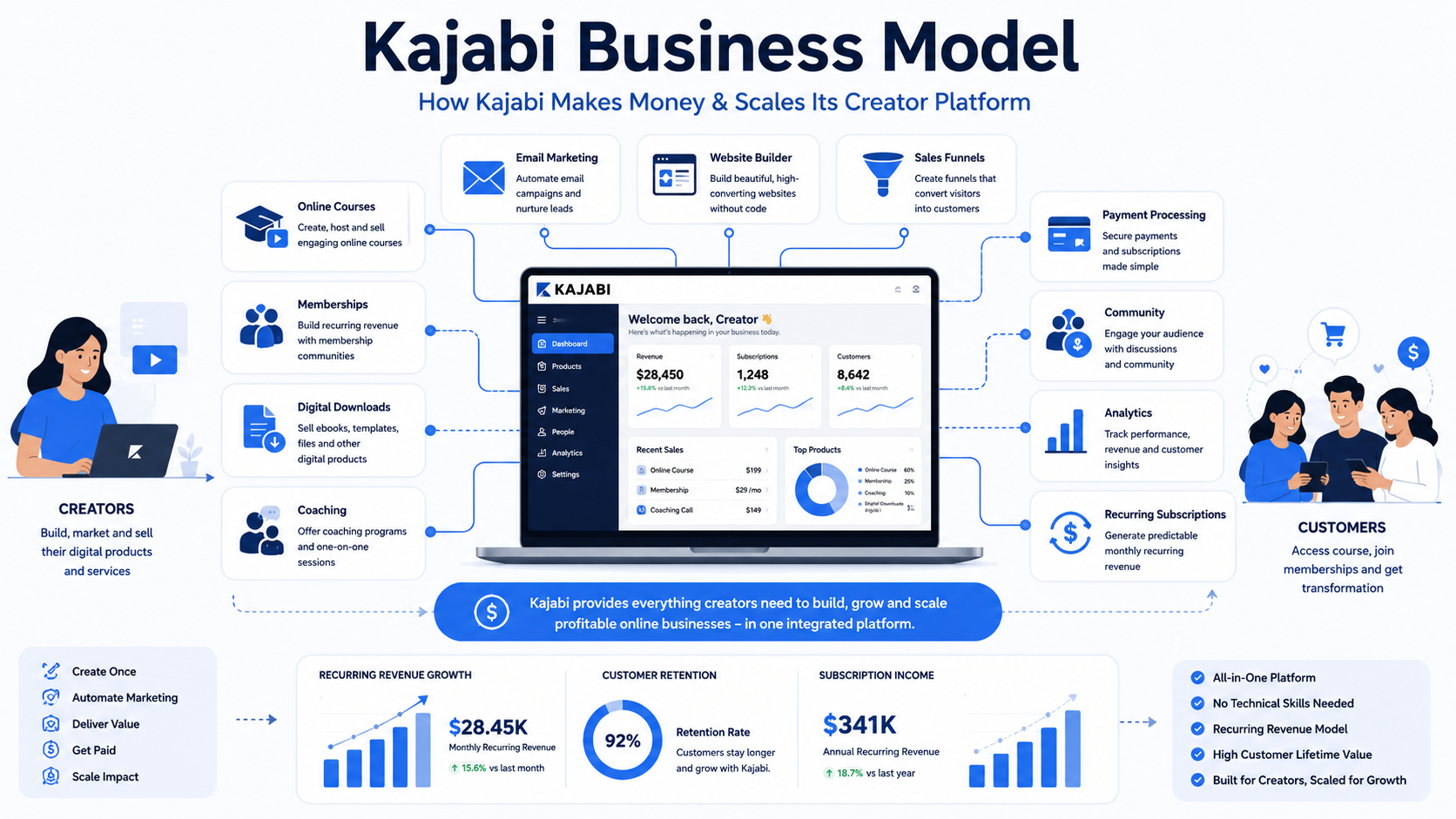
Kajabi is a subscription based software platform that helps creators sell online courses, coaching programs, memberships, and digital products through one integrated system. The company makes money through recurring monthly and annual subscription plans rather than transaction fees, which gives it predictable revenue and strong customer lifetime value. This structure has made Kajabi one of the most studied platforms in the creator economy.
Introduction
Kajabi is one of the most recognized platforms in the creator economy. It allows coaches, educators, and content creators to build, market, and sell digital products without stitching together multiple separate tools.
The platform became popular because it solved a real pain point. Creators were using five or six different tools to run their online business. Kajabi combined website hosting, email marketing, course delivery, and payment processing into a single ecosystem.
Founders and operators study Kajabi because its business model shows how to build a sticky, high retention SaaS product in a crowded market. This analysis breaks down how Kajabi works, why it grows, and what lessons apply to other founders building subscription businesses.
This article covers Kajabi’s company structure, business model canvas, revenue streams, growth strategy, competitive advantages, and the startup lessons hidden inside its approach.
What Is Kajabi?
Kajabi is a software as a service platform built specifically for creators, coaches, and online educators. It was designed to remove the technical friction of building an online business.
Company Overview
Kajabi positions itself as an all-in-one platform rather than a single purpose tool. Instead of just hosting courses, it also handles marketing, sales funnels, and customer communication.
Founders
Kajabi was founded by Kenny Rueter and Travis Rosser. Kenny Rueter, who has a background in software engineering, leads the company as CEO.
Launch History
Kajabi launched in 2010 as a course hosting platform and has expanded steadily into a broader business operating system for creators.
Mission
Kajabi’s stated mission centers on helping people turn their knowledge and expertise into a sustainable business without needing a technical or marketing background.
Target Audience
Kajabi primarily serves online educators, coaches, consultants, membership site owners, and content creators who want to monetize expertise.
Business Category
Kajabi operates in the creator economy and education technology space, competing directly with course platforms, membership tools, and funnel builders.
Kajabi at a Glance
| Attribute | Details |
|---|---|
| Founded | 2010 |
| Founders | Kenny Rueter, Travis Rosser |
| Headquarters | Irvine, California |
| Industry | Creator economy, EdTech, SaaS |
| Business Type | Privately held |
| Revenue Model | Subscription based SaaS |
| Customers | Coaches, educators, consultants, creators |
| Funding | Venture backed, including growth equity investment |
Kajabi Business Model Explained
What Is the Core of Kajabi’s Business Model
Kajabi runs on a subscription revenue model that bundles multiple tools into one ecosystem, increasing both convenience and switching costs for its customers.
The Core Business Model
Kajabi blends several proven SaaS strategies into one platform.
- Software as a service with monthly or annual billing
- Subscription based pricing tiers
- Creator economy positioning, not generic software positioning
- Integrated ecosystem instead of a single feature tool
- Recurring revenue rather than one time purchases
This combination allows Kajabi to capture more value per customer compared to single purpose tools.
Business Model Canvas of Kajabi
Who Are Kajabi’s Customer Segments
Kajabi serves people who want to package expertise into digital products and sell them online.
- Online educators
- Coaches
- Consultants
- Membership site creators
- Influencers and content creators
- Small businesses selling digital training
What Is Kajabi’s Value Proposition
Creators pay a premium for Kajabi because it replaces multiple tools with one system. Instead of paying separately for a website builder, email platform, course host, and payment processor, users get all of it in one subscription.
This reduces technical complexity and saves time, which matters more to creators than saving a few dollars on a cheaper, fragmented tech stack.
What Channels Does Kajabi Use
Kajabi reaches customers through several channels.
- Organic search and SEO content
- YouTube tutorials and creator interviews
- Affiliate marketing programs
- Strategic partnerships
- Paid advertising
- Word of mouth and customer referrals
How Does Kajabi Manage Customer Relationships
Kajabi relies on a mix of self-service tools and high touch support.
- Self-service onboarding and templates
- Dedicated customer success teams for higher tiers
- An active creator community
- Educational resources and certification programs
- Live webinars and training events
What Are Kajabi’s Revenue Streams
Kajabi generates revenue primarily through tiered subscription plans. Customers pay recurring fees based on the plan level, contact limits, and feature access. Higher tiers unlock advanced automation, more admin seats, and lower or no transaction fees.
What Are Kajabi’s Key Resources
- The core software platform
- Engineering and product teams
- Brand reputation in the creator space
- An engaged creator community
- Marketing and educational content assets
- Customer and usage data
What Are Kajabi’s Key Activities
- Continuous product development
- Customer acquisition and marketing
- Platform infrastructure and reliability
- Customer support and success
- Ongoing feature innovation
Who Are Kajabi’s Key Partners
- Payment processors
- Cloud infrastructure providers
- Technology integration partners
- Affiliate and referral partners
What Is Kajabi’s Cost Structure
- Product development and engineering
- Server and infrastructure costs
- Marketing and advertising spend
- Payroll and team operations
- Customer support
- Security and compliance
How Kajabi Makes Money
Does Kajabi Make Money Through Subscription Plans
Yes. The majority of Kajabi’s revenue comes from monthly or annual subscription fees. Customers choose a plan based on the number of contacts, products, and admin users they need.
How Does Kajabi Price Its Premium Plans
Kajabi uses tiered pricing, where higher plans unlock more contacts, more products, advanced automations, and lower transaction fees. This tiered structure increases average revenue per user as customers scale their business and need more capacity.
Does Kajabi Offer Add-On Services
Kajabi has expanded into additional monetization layers over time, including payment processing fees on certain plans and premium app marketplace integrations, which add incremental revenue beyond the base subscription.
How Does Kajabi Serve Enterprise Customers
Kajabi also targets larger creators and businesses that need more bandwidth, team seats, and customization. These higher tier customers generate more revenue per account and tend to have lower churn due to deeper platform integration.
Why Kajabi’s Business Model Works
What Makes Kajabi’s Model Sustainable
Several structural factors make Kajabi’s business model durable.
- High switching costs once a creator builds their business on the platform
- Predictable recurring revenue from subscriptions
- Product bundling that increases perceived value
- Strong retention from community and support
- A large and growing creator economy market
- Ecosystem lock-in across content, email, and payments
These factors combine to create a defensible position rather than relying on one single advantage.
Kajabi Growth Strategy
How Did Kajabi Grow Its Customer Base
Kajabi used several complementary growth channels rather than depending on one acquisition method.
Product Led Growth
The product itself acts as a growth engine. Templates, automation, and ease of use help new users launch products quickly, which encourages referrals and organic word of mouth.
Content Marketing
Kajabi invests heavily in educational content that helps creators understand how to build and grow an online business, positioning the brand as an authority rather than just a software vendor.
SEO Strategy
Kajabi targets high intent keywords related to course creation, membership sites, and online business building, capturing demand from people actively searching for solutions.
Affiliate Marketing
Kajabi runs an affiliate program that incentivizes existing customers and partners to refer new users, turning its user base into a distribution channel.
Creator Success Stories
Kajabi showcases real creator revenue and growth stories, which builds trust and demonstrates the platform’s ability to support serious business outcomes.
Brand Positioning
Kajabi positions itself as a premium, all-in-one solution rather than competing purely on price, which helps justify higher subscription costs.
Community Building
An active user community supports onboarding, peer learning, and long term retention, reducing the burden on formal customer support alone.
What Is Kajabi’s Competitive Advantage
Why Is Kajabi Hard to Compete With
Kajabi’s moat comes from a combination of factors rather than a single feature.
- An all-in-one platform that reduces tool fragmentation
- Premium brand positioning in the creator space
- Strong brand trust built over more than a decade
- High customer retention due to switching costs
- Ecosystem advantages across multiple connected tools
- Strong customer lifetime value relative to acquisition cost
Kajabi’s Biggest Competitors
| Competitor | Where Kajabi Wins | Where Competitor Has an Edge |
|---|---|---|
| Teachable | Broader all-in-one feature set | Often simpler and cheaper for beginners |
| Thinkific | Stronger marketing and funnel tools | More flexible course only pricing |
| Podia | More robust automation and ecosystem | Lower starting price point |
| Circle | Deeper course and funnel integration | Stronger pure community features |
| Mighty Networks | More complete sales and marketing stack | Better native community experience |
| LearnWorlds | Broader business tool integration | Stronger course interactivity features |
SWOT Analysis of Kajabi
Strengths
- All-in-one platform reduces tool switching
- Strong brand recognition in the creator economy
- High customer retention
- Diverse revenue streams within subscriptions
Weaknesses
- Higher price point than many single purpose tools
- Learning curve for new users due to feature depth
- Smaller niche features compared to specialized competitors
Opportunities
- Growth of the global creator economy
- Expansion into AI powered content tools
- International market expansion
- Mobile first creator tools
Threats
- Increasing competition from AI native platforms
- Pricing pressure from lower cost alternatives
- Feature parity from competitors over time
- Rising customer acquisition costs across the industry
Challenges Facing Kajabi
What Risks Does Kajabi Face Going Forward
- Intense competition in the creator software market
- Emergence of AI powered course and content platforms
- Pressure to keep pricing competitive without losing margin
- Constant need for feature expansion to retain power users
- Rising costs to acquire new customers in a crowded market
Key Metrics That Drive Kajabi’s Business
What Metrics Matter Most for a Subscription Business Like Kajabi
- Monthly Recurring Revenue, which shows predictable income each month
- Annual Recurring Revenue, which shows long term business scale
- Customer Lifetime Value, which shows total revenue per customer over time
- Customer Acquisition Cost, which shows efficiency of growth spending
- Churn Rate, which shows how many customers leave each period
- Net Revenue Retention, which shows revenue growth from existing customers
- Average Revenue Per User, which shows how pricing tiers affect overall revenue
Each of these metrics matters because subscription businesses depend on retention and expansion as much as new customer acquisition. A platform can grow new signups and still struggle if churn is high or expansion revenue is weak.
What Startups Can Learn from Kajabi
What Lessons Apply to Founders Building Subscription Businesses
- Build recurring revenue instead of relying on one time sales
- Solve an entire workflow for the customer, not just one isolated problem
- Reduce tool fragmentation to increase perceived value
- Increase switching costs through thoughtful ecosystem design
- Invest in customer education and onboarding from day one
- Prioritize retention alongside new customer acquisition
- Use premium pricing when the product delivers premium value
These lessons apply beyond the creator economy and can guide any founder building a subscription or platform business.
Future Outlook for Kajabi
How Might Kajabi Evolve
- Deeper integration of AI powered content creation tools
- Continued growth alongside the broader creator economy
- Expansion into international markets
- Greater focus on community first learning experiences
- Improved mobile experiences for creators on the go
- Increased automation across marketing and sales workflows
Conclusion
Kajabi has built a durable software business by combining subscription revenue, ecosystem lock-in, and a clear focus on creator workflows. Rather than competing as a single feature tool, it positioned itself as the operating system for a creator’s entire business.
For founders, Kajabi is a useful case study in how bundling, retention focused design, and premium positioning can create a defensible business model in a competitive market.
FAQs
Kajabi uses a subscription based software as a service model, generating recurring revenue through tiered monthly and annual plans.
Kajabi makes money primarily through subscription fees, with additional revenue from payment processing and premium integrations on certain plans.
Kajabi has built a strong recurring revenue base, though specific profitability figures are not publicly disclosed since the company is privately held.
Kajabi was founded by Kenny Rueter and Travis Rosser and has received venture backing while remaining privately held.
Kajabi’s main competitors include Teachable, Thinkific, Podia, Circle, Mighty Networks, and LearnWorlds.
Kajabi’s competitive advantage comes from its all-in-one platform design, brand trust, and high switching costs once creators build their business on the system.
Kajabi’s fee structure depends on the plan level, with lower tier plans sometimes including transaction fees that are reduced or removed on higher tiers.
Creators choose Kajabi to reduce tool fragmentation, simplify their tech stack, and manage their entire online business from one platform.
Yes. Kajabi operates as a software as a service company built specifically for the creator economy.
Startups can learn the value of recurring revenue, ecosystem design, customer retention, and premium positioning when building a scalable subscription business.
Discover more from Business Model Hub
Subscribe to get the latest posts sent to your email.