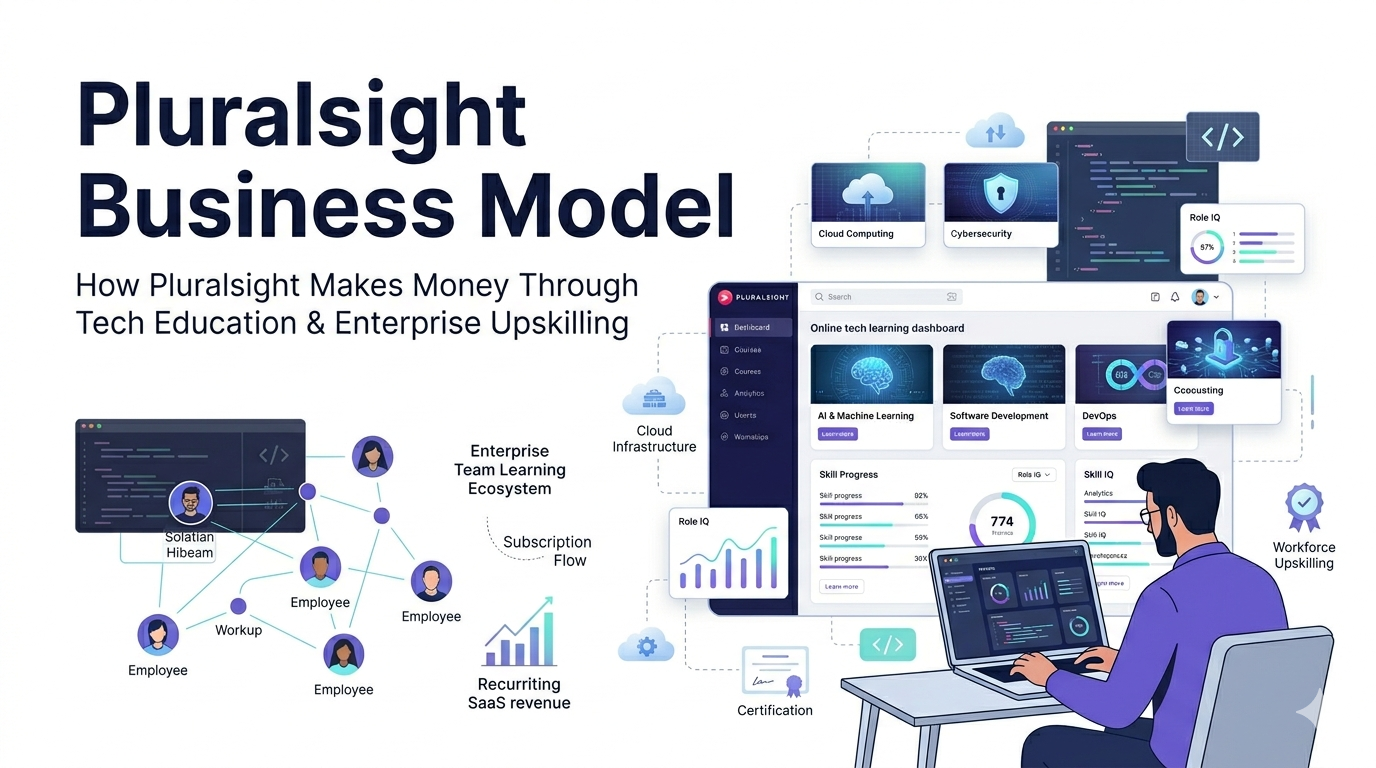
Inside the Pluralsight Business Model How It Built a Billion-Dollar Tech Learning Platform

Pluralsight uses a subscription-based SaaS business model built around tech skill development for individuals and enterprises. The company generates recurring revenue through monthly and annual subscriptions, enterprise learning solutions, skill assessments, cloud labs, and workforce upskilling tools.
Tech upskilling exploded into a multi-billion dollar market because software is eating every industry. Companies can’t hire fast enough to keep pace with digital transformation, so they train the talent they already have. Pluralsight saw this gap early and built its entire model around it.
Unlike general learning platforms, Pluralsight went deep into technical content. It doesn’t try to teach everything to everyone. It focuses on software development, cloud computing, cybersecurity, AI, and IT operations, and it builds enterprise-grade tools on top of that content library.
What Is Pluralsight?
Pluralsight is an online technology learning platform focused on software development, cloud computing, cybersecurity, AI, and enterprise IT training. It serves both individual professionals and large enterprise teams.
Founded: 2004 Headquarters: Draper, Utah Primary Market: B2B enterprise learning, with B2C individual subscriptions
Core products include:
- Skills Platform — The main learning hub with thousands of courses and structured paths
- Flow — Developer productivity and workflow analytics tool
- Cloud Labs — Hands-on sandbox environments for real-world practice
- Skill IQ — Assessments that measure a learner’s current skill level
- Role IQ — Benchmarks skill levels against industry-defined roles
Pluralsight is fundamentally different from platforms like Udemy or Coursera. Udemy sells individual courses a la carte. Coursera leans into academic partnerships and degree programs. Pluralsight sells access to a full technical learning ecosystem with enterprise analytics baked in. It’s a workforce intelligence platform, not just a course marketplace.
How the Pluralsight Business Model Works
Pluralsight operates a recurring subscription model where users pay for continuous access to technical courses, assessments, learning paths, and enterprise workforce analytics.
Here’s the step-by-step flow:
Experts Create the Courses
Pluralsight works with industry practitioners and subject-matter experts, not academics. Instructors go through a vetting process before their content goes live. Pluralsight runs a revenue-sharing model with authors, so instructors earn based on content consumption.
This approach keeps content technically current and practitioner-driven rather than theoretical.
Content Gets Organized Into Learning Paths
Individual courses aren’t sold in isolation. Pluralsight stacks them into structured learning paths that take a learner from beginner to advanced across specific skills or technologies.
Paths are designed around:
- Specific technologies like AWS, Python, or Kubernetes
- Certification prep for exams like AWS Solutions Architect or CompTIA Security+
- Role-based progressions for developers, cloud engineers, or security analysts
Users Subscribe
Learners choose from individual, team, or enterprise subscription tiers. Once they subscribe, they get access to the full library, assessments, and platform tools based on their plan level.
Enterprise Teams Use Analytics
This is where Pluralsight separates itself. Enterprise customers get dashboards that show which skills their teams have, where the gaps are, and how individual employees are progressing. Managers can assign learning paths and track completion.
This data-driven layer is what makes Pluralsight sticky for large organizations.
Recurring Revenue Scales
Enterprises sign multi-year contracts. As headcount grows, seat counts grow. Pluralsight upsells premium features like labs and analytics tools on top of base subscriptions. The model compounds over time.
Value Proposition of Pluralsight
For Individual Learners
Pluralsight gives individual tech professionals a structured way to build and validate skills fast.
Key benefits:
- Curated learning paths instead of random course browsing
- Skill IQ assessments so learners know exactly where they stand
- Certification-aligned content for career advancement
- Cloud labs for hands-on practice without setting up local environments
- Flexible self-paced learning that fits around a work schedule
For Enterprises
Pluralsight gives companies a measurable system for workforce upskilling, not just access to videos.
Key benefits:
- Skill gap visibility at the team and individual level
- Role IQ benchmarking against industry standards
- Centralized dashboards for L&D managers
- Cloud sandbox environments for safe, real-world practice
- Integration with enterprise HR and workflow systems
- Reporting tools that justify L&D spend with actual data
The enterprise value prop is the analytics layer. Most learning platforms just deliver content. Pluralsight delivers content plus intelligence about whether that content is actually working.
Revenue Streams of Pluralsight
Pluralsight mainly earns from subscription revenue, enterprise licensing, and workforce learning solutions.
Individual Subscriptions
Individual plans are the entry point for solo learners. They offer:
- Monthly billing for flexibility
- Annual plans at a discounted rate
- Access to the core course library, assessments, and learning paths
This segment drives brand awareness and acts as a pipeline into enterprise deals when individual subscribers bring Pluralsight into their companies.
Enterprise Licensing
Enterprise licensing is the primary revenue driver. Large organizations buy seat-based licenses, often in multi-year contracts. Pricing is negotiated based on:
- Number of seats
- Contract length
- Features included (standard vs. premium analytics, labs access)
Fortune 500 companies and large IT departments represent the highest-value customer segment. These contracts create stable, predictable recurring revenue.
Team Plans
Team plans sit between individual and enterprise. Mid-sized companies and department-level buyers use these. Team plans include:
- Group access at a lower per-seat cost than individual plans
- Basic team analytics and progress tracking
- Centralized billing and administration
Skill Assessments and Labs
Skill IQ, Role IQ, and Cloud Labs are available as premium features or bundled into higher-tier plans. These tools add tangible value beyond passive video learning and justify higher pricing.
Labs specifically give learners access to real cloud environments for hands-on practice. This is a differentiated product that general platforms don’t offer at the same quality level.
Professional Services
Pluralsight offers custom enterprise training engagements, onboarding support, and consulting for large implementations. These services help enterprises deploy Pluralsight at scale and drive adoption internally.
Professional services revenue is smaller than subscription revenue but improves enterprise retention by ensuring customers actually get value from the platform.
Certification Preparation
Certification prep is embedded throughout the platform. Dedicated learning paths aligned to major vendor certifications (AWS, Google Cloud, Microsoft Azure, Cisco, CompTIA) attract a large segment of self-directed learners who are willing to pay for structured prep content.
Pricing Strategy of Pluralsight
Pluralsight uses tiered subscription pricing with premium enterprise upselling.
| Plan | Target User | Key Features |
|---|---|---|
| Starter | Individual learners | Core course library, Skill IQ |
| Professional | Advanced individual learners | Full library, labs, projects |
| Team | Small to mid-sized teams | Group analytics, admin tools |
| Enterprise | Large organizations | Custom pricing, advanced analytics, integrations |
Annual billing advantage: Annual plans offer significant savings compared to monthly billing, pushing subscribers toward longer commitments and improving revenue predictability.
Enterprise custom pricing: Enterprise contracts are negotiated directly with sales teams. Pricing depends on seat count, features, and contract length. This approach lets Pluralsight maximize revenue from large accounts.
Upsell mechanics: Customers enter at a lower tier and get upsold to labs, advanced analytics, or higher seat counts as their usage grows. This expansion revenue model is standard SaaS best practice and increases customer lifetime value without heavy acquisition cost.
Target Customer Segments
Individual Developers and IT Professionals
- Software engineers building new skills
- Cloud engineers pursuing certifications
- Cybersecurity professionals staying current
- IT operations staff learning new platforms
Enterprise and Corporate Buyers
- Fortune 500 IT departments
- Corporate Learning & Development teams
- Technology companies upskilling engineering teams
- Consulting firms training client-facing technical staff
Students and Career Switchers
- Beginner developers learning foundational skills
- Career changers moving into tech
- Certification seekers targeting specific credentials
Pluralsight’s growth strategy is clearly enterprise-first. Individual subscribers matter for top-of-funnel brand awareness, but enterprise contracts drive the revenue that scales the business. The company invests heavily in enterprise sales, account management, and the analytics tools that make Pluralsight indispensable to corporate L&D teams.
Business Model Canvas of Pluralsight
| Component | Details |
|---|---|
| Key Partners | Course creators and instructors, cloud providers (AWS, Azure, GCP), enterprise HR platforms |
| Key Activities | Content production and curation, platform and analytics development, enterprise sales |
| Key Resources | Course library, instructor network, SaaS infrastructure, Skill IQ and Role IQ engines |
| Value Proposition | Technical upskilling at scale with measurable skill intelligence |
| Customer Relationships | Self-serve subscriptions, enterprise account management, professional services |
| Channels | Website and organic search, direct enterprise sales, channel partnerships |
| Customer Segments | Individual developers, enterprise IT teams, corporate L&D departments |
| Cost Structure | Content creation and author payments, cloud infrastructure, R&D, sales and marketing |
| Revenue Streams | Individual subscriptions, enterprise licensing, team plans, labs, professional services |
Why the Pluralsight Business Model Scales
Its SaaS structure allows recurring revenue with low incremental distribution cost.
Once a course is produced, Pluralsight can distribute it to thousands of subscribers at near-zero marginal cost. A single AWS course can generate value for individual learners in 50 countries and enterprise teams across hundreds of companies simultaneously.
Factors that drive scalability:
- Digital distribution removes geographic limits and shipping costs
- Enterprise retention creates long-term revenue stability through multi-year contracts
- High-margin subscriptions improve unit economics as the customer base grows
- B2B contract structure means revenue is predictable, not dependent on daily transactional sales
- Content compounding means the library grows in value over time as more paths are added
The enterprise analytics layer also increases switching costs. When a company has 18 months of skill data, learning path assignments, and benchmarking tied to Pluralsight, moving to a different platform means losing all of that institutional intelligence. That stickiness is a major retention driver.
Competitive Advantages
Specialized Technical Content
Pluralsight goes deeper into technical topics than any general learning platform. The content is practitioner-built, not professor-built. For a developer trying to learn Terraform or Kubernetes, Pluralsight’s depth is a clear differentiator.
Enterprise Analytics
Skill IQ and Role IQ are not just marketing features. They give L&D managers and engineering leads actual data about team capabilities. No other major platform has built this layer as thoroughly. This is the moat.
Instructor Ecosystem
Pluralsight’s instructor vetting and revenue-sharing model attracts working professionals, not just educators. This keeps content grounded in real-world usage rather than theoretical frameworks.
Strong B2B Focus
Enterprise contracts create predictable, recurring revenue with high lifetime value per customer. Pluralsight’s entire sales motion, product roadmap, and feature development prioritizes enterprise needs. This focus creates compounding advantages in product-market fit for the corporate buyer.
Challenges in the Pluralsight Business Model
The biggest challenges are content freshness, rising competition, and maintaining technical relevance.
Fast-Moving Technology
Tech stacks change fast. A React course from three years ago may cover outdated patterns. A Kubernetes course from two years ago may not reflect current tooling. Keeping thousands of courses current is expensive and operationally complex.
Community discussions consistently surface complaints about outdated courses as a top user frustration. This is a structural challenge for any library-based model.
Competition
Pluralsight operates in a crowded market:
| Competitor | Positioning |
|---|---|
| Udemy Business | Lower cost, large course volume, broad topics |
| Coursera for Business | Academic credentials, university partnerships |
| LinkedIn Learning | Integrated with professional network, broad soft skills |
| A Cloud Guru | Specialized cloud training (now owned by Pluralsight) |
| YouTube / Free Resources | Zero cost, huge volume of technical tutorials |
Free content on YouTube and developer blogs is a persistent threat to the lower tiers of Pluralsight’s audience. Individual learners have more free alternatives than ever. This pushes Pluralsight to double down on enterprise, where the analytics and structured paths create value that free content can’t replicate.
High Content Production Costs
Quality technical content requires skilled practitioners, production resources, and frequent updates. As the library grows, maintenance costs scale alongside it. This is a structural cost that doesn’t decrease with scale the way pure software costs do.
Marketing Strategy of Pluralsight
Content Marketing
Pluralsight publishes industry reports, skill benchmarking data, and certification guides that attract organic search traffic. The annual “State of Tech Learning” type reports generate press coverage and position Pluralsight as a thought leader in workforce development, not just a course vendor.
Free Trials
Trial-driven acquisition is a core top-of-funnel tactic. Free trial access lets individual learners and team leads evaluate the platform before committing to paid subscriptions. This reduces the friction of buying a subscription without seeing the content quality.
Enterprise Sales
Dedicated B2B sales teams target corporate L&D buyers and IT department heads. Account executives manage multi-year relationships with key accounts. This is a high-touch, relationship-driven sales motion common in enterprise SaaS.
Community Positioning
Pluralsight brands itself as part of the developer and IT professional ecosystem. Sponsorships, developer community partnerships, and certification community engagement keep the brand visible to technical audiences.
Acquisitions and Expansion Strategy
Pluralsight’s biggest strategic move was acquiring A Cloud Guru, a specialized cloud training platform with strong content in AWS, Azure, and GCP. This acquisition:
- Expanded the cloud content library significantly
- Added A Cloud Guru’s cloud sandbox and lab infrastructure
- Brought in a loyal base of cloud certification learners
- Strengthened Pluralsight’s positioning in one of the fastest-growing skill categories
Pluralsight also expanded its enterprise workflow tools through Flow, which gives engineering leaders visibility into developer productivity metrics. This move took Pluralsight beyond learning into broader workforce intelligence, positioning it as a strategic platform for engineering leadership, not just L&D.
AI-driven learning personalization is the current expansion frontier. Adaptive learning paths that adjust based on a learner’s Skill IQ score and progress are already part of the product roadmap.
SWOT Analysis
| Strengths | Weaknesses |
|---|---|
| Deep technical content library | Higher pricing vs. competitors |
| Enterprise analytics differentiation | Course freshness challenges |
| Predictable SaaS revenue model | Heavy dependence on B2B sales cycles |
| Strong cloud and certification content | Brand awareness lower than Udemy or Coursera for consumers |
| Opportunities | Threats |
|---|---|
| AI and machine learning skill demand | Free learning content on YouTube |
| Cloud certification market growth | Fast-changing technology stacks |
| Corporate upskilling mandates | Creator-led education platforms |
| Skills intelligence market expansion | LinkedIn Learning’s distribution advantage |
Future of Pluralsight
Pluralsight’s future depends on AI-powered learning, enterprise workforce analytics, and cloud skill training demand.
AI-Generated Learning Paths
Adaptive learning is the next evolution. Instead of static paths, Pluralsight can generate personalized learning sequences based on a learner’s current Skill IQ, role, and career goals. AI makes this scalable without proportional increases in content production cost.
Enterprise Automation Training
As companies automate more workflows, demand for cloud, DevOps, and AI engineering skills will compound. Pluralsight is positioned to capture this demand if it keeps its content current and its enterprise sales motion tight.
Skills Intelligence Market
The broader category Pluralsight is building toward is skills intelligence, where enterprise buyers use the platform not just to train workers but to make strategic workforce decisions. Which skills does our team lack? Where are we vulnerable if one engineer leaves? Which roles should we hire for versus train into? These are high-value questions that Pluralsight’s data is positioned to answer.
Developer Workforce Transformation
The nature of developer work is shifting. AI coding assistants are changing what skills developers need. Pluralsight has an opportunity to lead in training developers to work alongside AI tools, a category that barely existed two years ago and is now among the fastest-growing learning needs in enterprise tech.
Key Takeaways
- Pluralsight runs on a subscription SaaS model with enterprise licensing as the primary revenue driver
- Enterprise customers generate the most stable and high-value revenue through multi-year contracts
- Skill IQ and Role IQ analytics create switching costs and differentiate the platform from content-only competitors
- Technical specialization in software, cloud, and cybersecurity builds content authority
- Recurring subscription revenue improves unit economics as the customer base scales
- Content freshness is the most persistent operational challenge given how fast technology evolves
- The A Cloud Guru acquisition significantly strengthened the cloud training product
- Future growth hinges on AI-powered personalization and the skills intelligence market
Conclusion
Pluralsight built a subscription-led SaaS business by going narrow and deep in technical education, then layering enterprise analytics on top to create a sticky, high-value product for corporate buyers.
The enterprise-first strategy is what separates Pluralsight from the crowded online learning market. Content is the entry point. Analytics are the retention engine. And recurring subscription revenue is what makes the model scale.
The workforce upskilling economy is not slowing down. As AI reshapes developer roles, cloud adoption accelerates, and companies face persistent technical talent shortages, demand for what Pluralsight sells will compound. The question is whether the platform can stay current enough, innovative enough, and competitively priced enough to capture that demand over the next decade.
Pluralsight didn’t just build an online course platform. It built a technical workforce intelligence ecosystem around continuous learning.
FAQs
Pluralsight makes money through individual subscriptions, enterprise licensing, team plans, cloud labs, skill assessments, and professional services. Enterprise contracts are the largest revenue contributor.
Yes. Pluralsight is a SaaS company that delivers its learning platform, analytics tools, and assessments through a cloud-based subscription model.
The main competitors are Udemy Business, Coursera for Business, LinkedIn Learning, and free alternatives like YouTube and developer documentation. In cloud-specific training, it competes with the content it absorbed through A Cloud Guru.
Pluralsight focuses exclusively on technical and enterprise learning with structured paths, analytics, and assessments. Udemy is a marketplace model with broad consumer-facing content across every topic. Pluralsight sells workforce intelligence; Udemy sells individual courses.
Pluralsight is primarily B2B. Enterprise and team subscriptions drive the majority of revenue. Individual B2C subscriptions serve as top-of-funnel awareness and a pipeline into enterprise adoption.
Enterprises use Pluralsight for the analytics layer. Skill IQ, Role IQ, and team dashboards give L&D managers and engineering leaders measurable visibility into workforce capabilities and skill gaps. The structured learning paths and certification-aligned content also make it easier to deploy at scale than managing individual course purchases.
Pluralsight went private in 2021 after being taken private by Vista Equity Partners in a deal valued at approximately $3.5 billion, so detailed public financials are not available. The company has faced pressure like most EdTech SaaS businesses around growth vs. profitability tradeoffs.
Technology companies, financial services firms, healthcare IT departments, consulting firms, and government contractors are among the heaviest Pluralsight users. Any organization with a large technical workforce is a core customer segment.
Discover more from Business Model Hub
Subscribe to get the latest posts sent to your email.