Cornershop Business Model And How the Grocery Delivery Platform Made Money Before Uber Acquisition

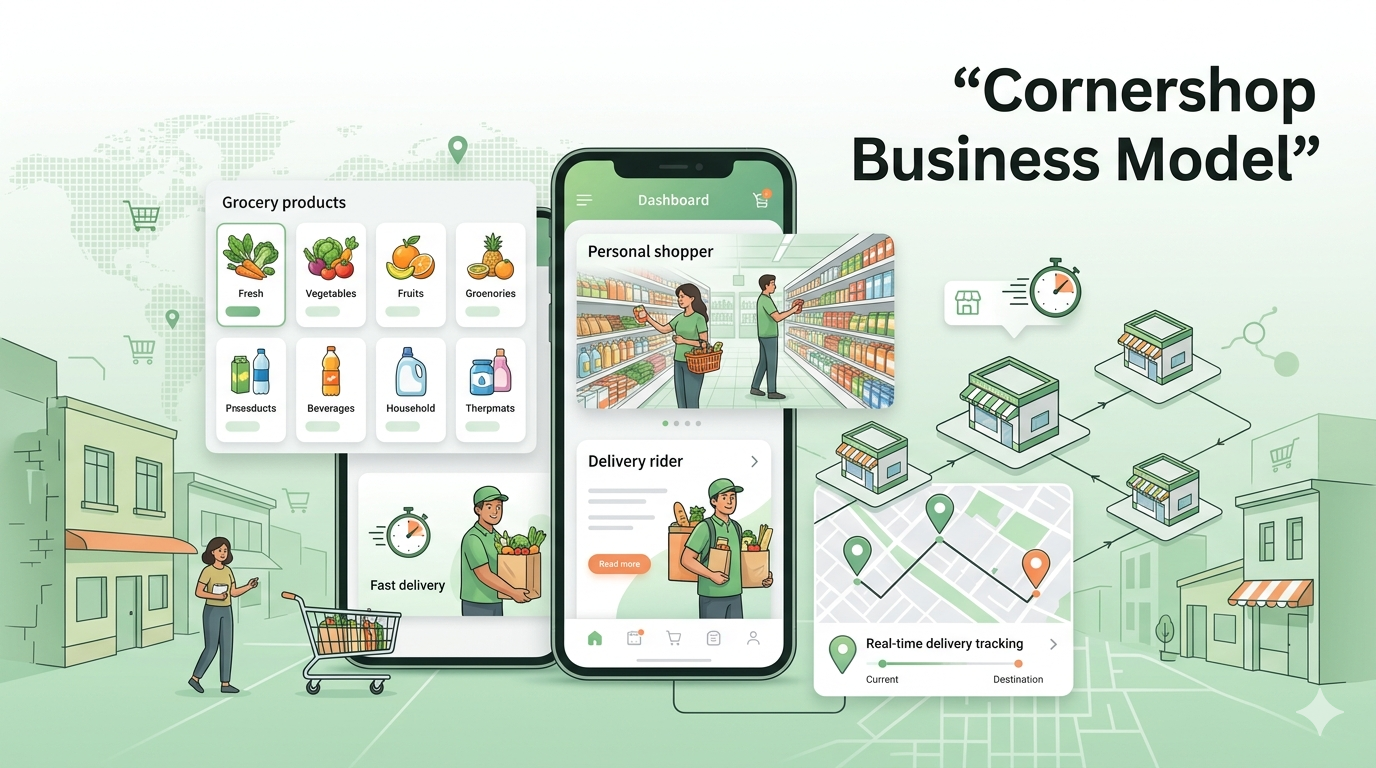
Cornershop was a Latin American grocery delivery platform that let customers order from local supermarkets through an app. A personal shopper would physically go to the store, pick the items, and deliver them to the customer’s door.
What made it different was the personal shopper model. Instead of relying on retailers to pack and hand off orders, Cornershop used independent shoppers who communicated directly with customers during the shopping process.
Uber acquired Cornershop in 2021, validating the model and integrating it into the Uber Eats ecosystem. The acquisition was a signal that hyperlocal grocery delivery in emerging markets was worth serious investment.
What Is Cornershop?
Cornershop was an on-demand grocery delivery platform founded in Chile in 2015. It connected customers with personal shoppers who physically went to local grocery stores and supermarkets to fulfill orders.
The platform operated across Latin America, including Mexico, Peru, Colombia, and also expanded into Canada. It worked with major retail chains, local supermarkets, and specialty food stores to give customers access to a wide product catalog.
The core idea was hyperlocal delivery. Instead of building warehouses or fulfillment centers, Cornershop used existing retail infrastructure and put human shoppers in the middle of every order.
History and Growth of Cornershop
Cornershop was founded by Oskar Hjertonsson, Daniel Undurraga, and Juan Pablo Chadwick. The team identified a gap in Latin America: grocery shopping was still overwhelmingly offline, and no major player had cracked the on-demand delivery market for everyday essentials.
Early Funding and Expansion
The company raised early funding and grew rapidly through 2016 and 2017 by focusing on Mexico and Chile. It expanded to other Latin American cities by partnering with well-known retail chains rather than trying to build its own inventory infrastructure.
The Walmart Acquisition Attempt
Walmart attempted to acquire Cornershop in 2018, but the deal was blocked by Mexico’s Federal Economic Competition Commission (COFECE) over antitrust concerns. This regulatory block ended up being a turning point.
The Uber Deal
Uber stepped in and acquired a majority stake in Cornershop in 2019 and completed the full acquisition by 2021. The deal gave Uber a ready-made grocery delivery operation to integrate with Uber Eats across Latin America.
The timing was strong. COVID-19 accelerated grocery delivery adoption across all markets, and Cornershop was already positioned in the right geographies.
How Cornershop Works
The workflow is straightforward and built around speed and communication:
- Customer opens the Cornershop app
- Searches for products from nearby stores
- Adds items to cart and places order
- A personal shopper accepts the order and heads to the store
- The shopper purchases items and communicates with the customer about substitutions or unavailable products
- A delivery partner brings the order to the customer’s address
- Customer tracks the order in real time throughout the process
Real-Time Inventory Handling
One of the platform’s biggest technical challenges was inventory. Cornershop didn’t control store stock, so it built a system where shoppers updated availability on the go. If an item was out of stock, the shopper could message the customer and suggest alternatives.
Product Substitution System
Customers could pre-set substitution preferences before an order was placed. This reduced friction and meant fewer canceled orders. The shopper used in-app chat to confirm changes before checking out.
Multi-Store Shopping
Cornershop allowed customers to order from multiple stores in a single session, though delivery was typically consolidated or timed to reduce wait times.
Cornershop Business Model Explained
Cornershop operated a multi-sided marketplace. It connected three groups: customers who needed groceries, retail partners who wanted digital sales channels, and personal shoppers who earned income through gig work.
The platform made money from multiple directions simultaneously, which gave it a diversified revenue base and more pricing flexibility than single-revenue delivery apps.
Revenue Streams of Cornershop
Delivery Fees
Customers paid a delivery fee per order. The fee varied based on distance, store, and demand. During peak hours or bad weather, surge pricing applied. This was the most direct and visible revenue stream for the platform.
Commission From Retailers
Cornershop charged grocery stores and retail partners a commission on every sale made through the platform. This gave retailers a digital storefront without building their own logistics, and it gave Cornershop a cut of the transaction value.
Subscription Model
Cornershop offered membership plans that gave subscribers free or discounted deliveries over a set period. This model improved customer retention and created predictable recurring revenue. Frequent users had a strong incentive to subscribe.
Product Markups
On certain items, Cornershop applied a markup above the in-store price. This was common in grocery delivery broadly and helped offset the logistics cost of same-day fulfillment. Not all items carried markups, but the practice added margin.
Sponsored Listings and In-App Advertising
Retailers and brands could pay to have their products featured more prominently in search results and category pages inside the app. This worked similarly to how retail media operates in grocery e-commerce. It was a growing revenue stream as the platform scaled.
Partnership Revenue
Cornershop built strategic partnerships with major supermarket chains. Some of these included revenue-sharing arrangements, co-marketing deals, or exclusive availability windows. These partnerships also served as customer acquisition tools for the platform.
Cost Structure of Cornershop
Running a hyperlocal grocery delivery platform is expensive. Here is where the money went:
- Delivery logistics — routing, last-mile fulfillment, and fuel costs for shoppers and drivers
- Shopper incentives — bonuses and promotional pay rates to keep shoppers active during high-demand periods
- Technology infrastructure — app development, real-time tracking, inventory sync systems
- Customer acquisition — paid marketing, referral programs, and promotions to attract new users
- Operational support — customer service teams to handle order issues, substitutions, and complaints
- Payment processing — transaction fees on every order processed through the platform
Thin margins were a constant pressure. The cost of keeping shoppers available and customers satisfied while competing on price made profitability difficult at scale.
Value Proposition of Cornershop
For Customers
- Same-day grocery delivery from nearby stores
- Real-time communication with the personal shopper
- Access to multiple retailers in one app
- No need to physically go to the store
- Live order tracking from shopping to doorstep
For Retail Partners
- Instant digital presence without building logistics infrastructure
- Access to a new customer segment that prefers online ordering
- Order data and customer analytics
- Higher average basket sizes driven by app browsing behavior
For Personal Shoppers
- Flexible work with no fixed schedule
- Gig-based income with the ability to take multiple orders
- Incentive programs for high performance and peak hours
Cornershop’s Technology Strategy
Technology was what separated Cornershop from informal delivery services and local competitors.
AI-Powered Delivery Routing
The platform used route optimization algorithms to reduce delivery times. Shoppers were directed through stores efficiently, and drivers were matched with orders based on proximity and capacity.
Order Batching
In high-density urban areas, Cornershop batched multiple orders to reduce per-order delivery cost. This required real-time coordination between shoppers and delivery partners.
Real-Time Inventory Sync
The platform worked with retail partners to build partial inventory visibility. It was never perfectly accurate, but over time it improved substitution predictions and reduced the rate of out-of-stock surprises.
Shopper-Customer Communication System
In-app messaging between shoppers and customers was a core feature. It reduced order abandonment caused by missing items and built trust through transparency.
Mobile-First Architecture
The platform was designed for mobile from day one. This mattered in Latin America, where mobile internet penetration was high but desktop usage for shopping was lower than in North American markets.
Why Cornershop Became Successful
Deep Understanding of the Latin American Market
Cornershop was built by founders who understood how grocery shopping worked locally. They knew that Latin American consumers were loyal to specific supermarket chains and expected fresh produce and regional products. The platform integrated with stores people already trusted.
Personal Shopper Model as a Differentiator
Rather than automating the shopper out of the equation, Cornershop leaned into the human element. Customers felt more confident placing orders knowing a real person was checking produce freshness and communicating back about issues.
Strong Retailer Relationships
By positioning itself as a partner rather than a competitor to grocery chains, Cornershop built integrations and exclusivity arrangements that competitors couldn’t easily replicate. Retailers got digital distribution. Cornershop got inventory access and legitimacy.
High-Quality Customer Experience
Order accuracy, real-time tracking, and human communication created a customer experience that drove repeat usage. In a market where trust in online transactions was still developing, this mattered.
Timing and Market Conditions
The rise of smartphone penetration in Latin America, combined with increasing urban density in cities like Mexico City and Santiago, created the ideal conditions for a delivery platform to scale. Cornershop entered at the right moment.
Cornershop vs Instacart vs Rappi
| Feature | Cornershop | Instacart | Rappi |
|---|---|---|---|
| Primary Market | Latin America | North America | Latin America |
| Delivery Model | Personal shoppers | Gig shoppers | Super-app model |
| Revenue Sources | Commissions + delivery fees + markups | Subscriptions + delivery fees + ads | Multi-service monetization |
| Retailer Partnerships | Strong, exclusive | Very strong | Moderate |
| App Approach | Grocery-focused | Grocery-focused | Multi-category super app |
| Acquisition | Acquired by Uber | Independent (IPO filed) | SoftBank-backed |
Key Differences
Instacart operates in a more mature e-grocery market with higher consumer spending power and stronger logistics infrastructure. Its subscription model (Instacart+) drives more predictable revenue than Cornershop’s transaction-heavy approach.
Rappi went broader, building a super-app that covers food delivery, groceries, pharmacy, financial services, and more. This gave Rappi more cross-sell opportunities but made grocery delivery one of many priorities rather than the core focus.
Cornershop stayed focused on grocery and supermarket delivery. That focus helped it build deeper retailer relationships and a better grocery-specific experience, but it also limited diversification.
Challenges Faced by Cornershop
Operational Challenges
Delivery Delays Managing last-mile delivery in congested Latin American cities was consistently difficult. Traffic unpredictability made accurate ETAs hard to guarantee.
Inventory Mismatch Without direct control over store inventory, Cornershop faced regular issues with out-of-stock items that weren’t flagged until a shopper was already in the store. This created frustration for customers and extra work for shoppers.
High Logistics Costs The cost of maintaining a shopper network with enough density to fulfill orders quickly was significant. Low-order-value grocery deliveries made unit economics challenging.
Business Challenges
Thin Profit Margins Grocery delivery is notoriously low-margin. Competing on delivery fees while absorbing logistics costs kept profitability out of reach during growth phases.
Gig Worker Management Keeping shoppers engaged, fairly compensated, and reliable required constant attention. High shopper turnover hurt order quality and customer satisfaction.
Competition From Super Apps Rappi and other multi-category platforms tried to absorb grocery delivery as one of many services. Competing against better-funded super apps in shared markets was a sustained pressure.
Regulatory Challenges
Labor Classification Like most gig economy platforms, Cornershop faced regulatory scrutiny over whether shoppers should be classified as employees rather than independent contractors. This had direct cost implications.
Antitrust Issues The failed Walmart acquisition showed how regulatory environments in Latin America could block or complicate consolidation in the grocery space.
Uber Acquisition of Cornershop
Uber’s decision to acquire Cornershop was strategic on multiple levels.
Why Uber Wanted Cornershop
Uber was aggressively expanding Uber Eats into grocery and convenience delivery. Building a Latin American grocery operation from scratch would have been slow and expensive. Cornershop gave Uber an established network, retailer partnerships, and a trained shopper base overnight.
Strategic Benefits for Uber Eats
Grocery delivery has higher average order values than restaurant delivery. Adding grocery to Uber Eats increased revenue per active user and created more frequent usage occasions. Someone who orders dinner twice a week might also order groceries twice a week.
Integration With the Uber Ecosystem
Post-acquisition, Cornershop began appearing inside the Uber Eats app in Latin American markets. The integration gave Uber a competitive tool against Rappi and local players while giving Cornershop access to Uber’s massive driver network.
Impact on Cornershop
The Uber acquisition provided capital, infrastructure, and a much larger audience. However, it also meant Cornershop’s independent identity gradually merged into the Uber Eats brand in many markets.
Lessons Startups Can Learn From Cornershop
Solve Local Problems With Local Knowledge
Cornershop didn’t copy Instacart for Latin America. It built a model that matched how Latin American consumers actually shopped and which stores they already trusted. Understanding cultural and market nuance beats a copy-paste strategy.
Hyperlocal Logistics Can Scale
Starting in one city and proving unit economics before expanding is a more durable growth strategy than rapid multi-city launches. Cornershop’s city-by-city approach gave it operational depth that was hard to replicate quickly.
Human Touchpoints Build Trust in Developing Markets
In markets where e-commerce trust was still being established, putting a human shopper in the loop reduced anxiety around ordering groceries online. Technology should enable human connections, not always replace them.
Retailer Partnerships Are a Competitive Moat
By making grocery chains partners rather than disruption targets, Cornershop built access and relationships that were genuinely difficult for competitors to replicate. In marketplace businesses, supply-side relationships are often the real moat.
Operational Excellence Is the Product
In convenience businesses, the user experience is the logistics. Customers don’t just buy the app. They buy the speed, accuracy, and communication quality of the delivery. Cornershop’s investment in shopper training and in-app communication directly translated to retention.
Future of Grocery Delivery Business Models
The space Cornershop helped define is evolving fast.
Quick Commerce Growth
Ten to thirty minute delivery windows are becoming a consumer expectation in dense urban markets. Platforms that can’t hit those windows are losing ground to quick-commerce specialists.
Dark Stores and Micro-Fulfillment Centers
Rather than relying on retail store inventory, newer models use dedicated mini-warehouses inside cities. This solves the inventory accuracy problem Cornershop dealt with but requires significant upfront capital.
AI-Powered Logistics
Machine learning is improving route optimization, demand forecasting, and inventory prediction. These capabilities will compress delivery times and reduce operational waste over the next several years.
Autonomous Delivery
Drone and robot delivery pilots are active in multiple markets. Full-scale autonomous grocery delivery is still years away in most cities, but the direction is clear.
Subscription-Driven Ecosystems
Following the Instacart+ and Amazon Fresh model, grocery delivery platforms are moving toward subscription revenue. Subscriptions improve retention, increase order frequency, and create more predictable revenue streams.
Conclusion
Cornershop built something that was genuinely hard to copy: a grocery delivery platform with real retailer trust, a human-centered shopper model, and deep roots in the Latin American market.
The Uber acquisition wasn’t a rescue. It was a validation. Uber paid for something it couldn’t have built as quickly or as credibly on its own.
For Latin American e-commerce, Cornershop proved that on-demand grocery delivery could work at scale in a region where logistics infrastructure was uneven and consumer trust in online shopping was still developing. That proof changed how investors, retailers, and entrepreneurs thought about the market.
The broader lesson for hyperlocal delivery startups is that market understanding and operational depth beat aggressive expansion and feature parity. Cornershop won its market by going deep, not wide.
FAQs
Cornershop operated a multi-sided marketplace connecting customers, retail partners, and personal shoppers. It earned revenue through delivery fees, retailer commissions, product markups, subscriptions, and in-app advertising.
Cornershop made money from delivery fees charged to customers, commission percentages from grocery retailers, subscription memberships, markup pricing on select products, and sponsored listings inside the app.
Uber acquired Cornershop to enter the grocery delivery market in Latin America quickly, leveraging Cornershop’s existing retailer partnerships, shopper network, and brand recognition without building from scratch.
Cornershop was not publicly reported as profitable as an independent entity. Grocery delivery margins are thin across the industry, and growth-stage investment typically prioritizes expansion over profitability.
Cornershop’s main competitors included Rappi in Latin America and Instacart in the broader grocery delivery space. Local delivery startups in individual markets also posed competition.
Cornershop focused on Latin American markets with a deep understanding of local retail chains and consumer behavior. Instacart is primarily a North American platform with a stronger subscription model and larger retailer network.
Following Uber’s full acquisition in 2021, Cornershop was progressively integrated into Uber Eats. In most markets, it no longer operates as a fully independent brand.
Startups can learn to solve local problems with local knowledge, build retailer partnerships as a competitive moat, prioritize operational excellence in logistics, and prove unit economics in one market before expanding.
Discover more from Business Model Hub
Subscribe to get the latest posts sent to your email.