Top Multi-Vendor Marketplace Examples (With Real Business Insights You Can Copy)

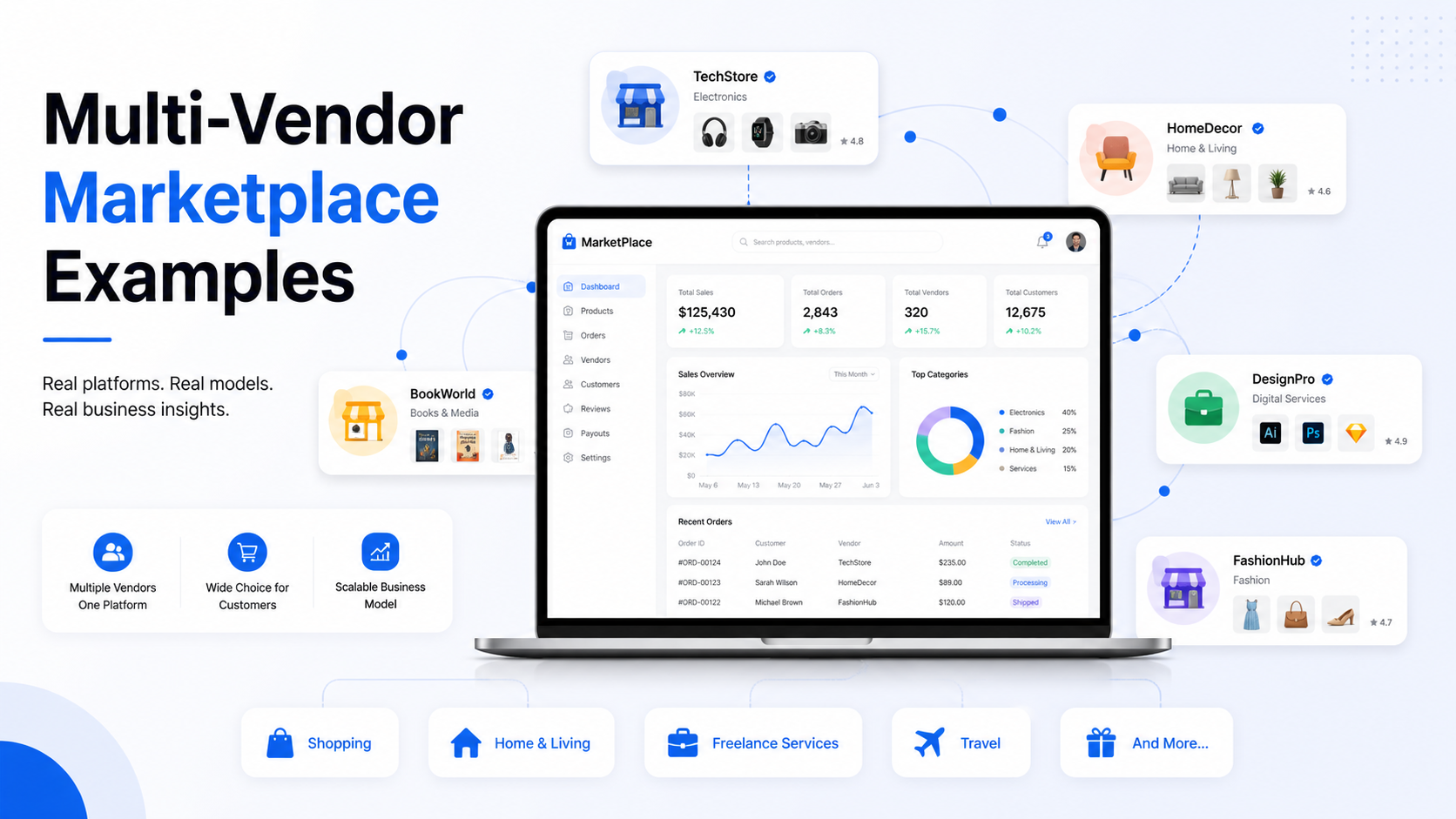
A multi-vendor marketplace is a platform where multiple sellers list and sell products or services to buyers, while the platform owner earns through commissions, listing fees, or subscriptions. Popular examples include Amazon, Etsy, Airbnb, Fiverr, and Flipkart.
Almost Every Successful Startup Today Is Becoming a Marketplace
Look around. Uber doesn’t own cars. Airbnb doesn’t own hotels. Amazon doesn’t manufacture most of what it sells. Yet these companies are worth hundreds of billions of dollars combined.
That’s the marketplace model at work.
Marketplaces are dominating because they carry almost zero inventory risk, scale faster than traditional businesses, and grow stronger as more buyers and sellers join. That last part is called the network effect, and it’s the closest thing to a business superpower.
This guide breaks down real multi-vendor marketplace examples, what makes each one work, and what you can actually apply if you’re building or thinking about building your own platform.
What Is a Multi-Vendor Marketplace?
A multi-vendor marketplace is an online platform where independent sellers offer products or services to customers, and the platform facilitates the transaction.
Think of it like a shopping mall. The mall owner doesn’t sell anything directly. They provide the space, the foot traffic, and the infrastructure. Individual store owners handle their own inventory, pricing, and customers. The mall earns rent (or in digital terms, a commission).
Here’s how it works in three steps:
Step one: Sellers create accounts and list their products or services on the platform.
Step two: Customers browse, search, compare, and make a purchase through the platform.
Step three: The platform takes a cut of the transaction (or charges sellers a subscription or listing fee) and handles payments.
That’s it. Simple in concept, complex in execution.
Types of Multi-Vendor Marketplaces
Before diving into examples, it helps to understand the four main types. Each has a different business model, buyer behavior, and growth strategy.
Product-Based Marketplaces
These platforms sell physical or digital goods. Sellers list items, customers buy them, and the platform handles the payment layer. Examples include Amazon, Flipkart, and eBay. These are the most common type and tend to have the highest transaction volumes.
Service-Based Marketplaces
Instead of physical products, these platforms sell skills and time. A freelancer lists their service, a client buys it, and the platform takes a percentage. Fiverr, Upwork, and Toptal operate in this space. The main challenge is quality control since services are harder to standardize than products.
Rental and Sharing Marketplaces
These platforms let owners rent out assets they already have. A homeowner rents their apartment on Airbnb. A car owner rents their vehicle on Turo. The key is that no one is buying anything outright. These platforms rely heavily on trust infrastructure because strangers are temporarily sharing physical assets.
Niche Marketplaces
These focus on a specific category, audience, or interest. Etsy focuses on handmade and vintage goods. Reverb focuses on musical instruments. StockX focuses on sneakers. The narrower the focus, the more loyal and passionate the user base tends to be.
Top Multi-Vendor Marketplace Examples With Breakdown
Amazon: The Platform That Controls the Experience
Amazon started as an online bookstore. Today it is the largest product marketplace in the world, with millions of third-party sellers accounting for more than 60% of all units sold on the platform.
What Amazon does differently:
Amazon built its own logistics network. FBA (Fulfilled by Amazon) lets sellers ship inventory to Amazon warehouses, and Amazon handles storage, packing, shipping, and returns. This gives Amazon control over delivery speed and customer experience, regardless of which seller the product comes from.
Revenue model:
Amazon earns through multiple streams simultaneously. It charges sellers a referral fee (usually 8 to 15 percent depending on the category). Sellers using FBA pay storage and fulfillment fees on top of that. Amazon also sells advertising, where sellers pay to appear at the top of search results. Then there’s Amazon Prime, which is a subscription that drives buyer loyalty and increases purchase frequency.
Key insight:
When you control logistics, you control the customer experience. Sellers on Amazon don’t just benefit from the customer base. They hand over fulfillment and trust Amazon to deliver. That’s what allows Amazon to maintain consistent service quality across millions of sellers.
Etsy: Niche Dominance Through Community and Emotion
Etsy launched in 2005 with a simple premise. Give independent creators a place to sell handmade, vintage, and unique goods. That focus has never changed.
What Etsy does differently:
Etsy didn’t try to compete with Amazon on breadth. It went deep into a specific category and built a community around it. Buyers on Etsy aren’t just looking for a product. They’re looking for something with a story behind it. Sellers aren’t just vendors. They’re makers and artists with a personal brand.
Revenue model:
Etsy charges a listing fee of $0.20 per item. It also takes a 6.5% transaction fee on every sale, plus payment processing fees. Sellers who want more visibility can pay for Etsy Ads, which promotes their listings in search results.
Key insight:
Niche marketplaces win with emotion, not scale. Etsy customers don’t shop there because it’s the cheapest or the fastest. They shop there because they care about what they’re buying and who made it. If you’re building a marketplace, emotional connection to the category is a powerful moat that large generalist platforms struggle to replicate.
Airbnb: A Trust System Built Around Strangers Sharing Space
Airbnb is a marketplace for short-term rentals. Hosts list their homes, apartments, or spare rooms. Guests book stays. The platform handles payments, messaging, and the review system that holds everything together.
What Airbnb does differently:
The core problem Airbnb had to solve wasn’t technology. It was trust. Convincing someone to let a stranger sleep in their home, and convincing another person to pay to stay in a stranger’s home, required a trust infrastructure that didn’t exist before.
Airbnb built that infrastructure through verified profiles, two-way reviews, host guarantees, and secure payments. Every feature on the platform is designed to reduce the perceived risk of the transaction.
Revenue model:
Airbnb takes a service fee from both sides. Guests pay a service fee of around 14 percent on top of the listing price. Hosts pay a separate host-only fee of around 3 percent per booking. The platform earns on every successful stay without owning a single property.
Key insight:
Trust is the product. Airbnb isn’t really selling accommodation. It’s selling the confidence that the experience will be as described. In any marketplace where strangers transact, trust infrastructure is the actual product. Get it wrong and the marketplace collapses.
Fiverr: Making Buying Decisions Effortless
Fiverr launched in 2010 with a radical idea for the time. What if you could buy a service for exactly five dollars? That starting price is mostly a relic now, but the philosophy behind it has stayed.
What Fiverr does differently:
Most freelance platforms ask buyers to post a project and wait for proposals. Fiverr flipped it. Sellers create pre-packaged service listings called “Gigs,” with fixed pricing, clear deliverables, and defined timelines. Buyers browse and buy directly, with no negotiation required.
This makes buying feel more like shopping for a product than hiring someone. That simplicity dramatically reduces friction.
Revenue model:
Fiverr charges buyers a service fee of around 5.5% per order (with a minimum of $2.50 on smaller orders). Sellers pay a 20% commission on every completed order. Fiverr also offers Seller Plus, a paid subscription for sellers that includes advanced analytics and priority support.
Key insight:
Simplifying buying decisions increases conversions. When you make it easier for a customer to say yes, more customers say yes. Fiverr’s productized service model took the open-ended, time-consuming process of hiring a freelancer and turned it into a few clicks.
Flipkart: The Localization Playbook
Flipkart is India’s largest e-commerce marketplace and one of the most important case studies in how global marketplace models have to be rebuilt for local markets.
What Flipkart does differently:
When Flipkart launched in 2007, India was not a credit card country. Most people paid in cash. Internet penetration was low. Logistics infrastructure outside major cities was unreliable.
Flipkart built for these realities. It introduced cash on delivery at scale. It partnered with local courier services and built its own delivery network where existing infrastructure failed. It invested heavily in mobile-first design years before the rest of the industry caught up.
Revenue model:
Flipkart earns through commissions from sellers, advertising, Flipkart Plus (its loyalty subscription), and fulfillment services for sellers who use its warehousing and logistics. Its festive sale events like Big Billion Days generate a significant portion of annual GMV in a short window.
Key insight:
Local market understanding beats global playbooks. Copying Amazon’s model and dropping it into India would have failed. Flipkart succeeded because it understood the specific constraints and behaviors of Indian consumers and built around them. If you’re building a marketplace in an emerging market, localization is not optional. It’s the entire strategy.
Key Patterns You’ll Notice Across All These Marketplaces
These five platforms look very different on the surface. But zoom out and the same patterns appear across all of them.
Supply usually comes before demand. Before buyers show up, sellers have to be there first. Every marketplace on this list focused on recruiting supply first, then drove buyers to meet it.
Trust systems are non-negotiable. Reviews, ratings, verification, dispute resolution. Every platform has all of these. Without them, buyers won’t convert and sellers won’t stick around.
Commission-based monetization dominates. Taking a percentage of each transaction aligns the platform’s incentives with its users. The platform earns more when transactions go well and at higher values.
Search and discovery are core product investments. A marketplace with 10 million listings is useless if a buyer can’t find what they want in under 30 seconds. Every platform here has invested heavily in search, filters, and recommendation algorithms.
Network effects create long-term defensibility. More buyers attract more sellers. More sellers improve selection. Better selection attracts more buyers. Once this loop gets spinning, it becomes very hard for a competitor to break in.
How These Marketplaces Actually Make Money
The revenue model behind a marketplace is usually a combination of multiple streams working together.
Commission per transaction is the foundation for almost every marketplace. It scales with platform growth and aligns incentives between the platform and its sellers.
Seller subscriptions give sellers access to additional tools, visibility, or support in exchange for a recurring monthly or annual fee. Etsy has this with its Etsy Plus plan. Fiverr has it with Seller Plus.
Featured listings and advertising let sellers pay to appear higher in search results or on category pages. This is a significant revenue driver for Amazon, Etsy, and Flipkart. For large-scale platforms, ad revenue can rival or exceed commission revenue.
Logistics and fulfillment fees apply when the platform also handles warehousing and shipping. Amazon’s FBA fees are a major revenue category. Flipkart has a similar model through its logistics arm.
To give a sense of scale: Amazon’s third-party seller services revenue was over $140 billion in 2023. Etsy’s revenue was around $2.7 billion in 2023. Fiverr’s revenue was approximately $361 million in 2023. These aren’t small numbers, and they all come primarily from these same revenue streams.
What You Can Learn If You’re Building a Marketplace
If you’re in the early stages of building a marketplace, these examples point to a clear set of principles.
Start niche, not broad. Every successful marketplace found a specific category and owned it before expanding. Etsy didn’t try to compete with eBay on day one. It went narrow and deep.
Solve the liquidity problem first. A marketplace with no sellers is useless to buyers. A marketplace with no buyers is useless to sellers. You have to solve both sides, but you usually have to start with one. Most marketplaces start on the supply side because supply is willing to take a chance on a new platform if the upside is access to buyers.
Build trust early and deliberately. Reviews, verification, seller policies, dispute resolution. These feel like features you can add later. They’re not. They’re the foundation that makes the first 100 transactions possible.
Don’t overbuild. A marketplace needs a listing page, a search function, a checkout, and a way to communicate. That’s it to start. Every additional feature before you have product-market fit is a distraction.
Common Mistakes to Avoid
Trying to be Amazon for everything. “We’re building a marketplace for everything” is not a strategy. It’s a way to run out of money and motivation before you ever find an audience.
Ignoring seller experience. Sellers are your supply. If onboarding is painful, payouts are slow, or support is non-existent, your supply dries up and your marketplace collapses.
No clear monetization plan. Taking a commission sounds obvious, but many early-stage marketplaces delay monetization to grow faster. That’s fine temporarily. But you need a clear model from the start, even if you don’t activate it immediately.
Weak onboarding. If a seller can’t list their first product in under 10 minutes, or a buyer can’t complete their first purchase with confidence, you lose them. Onboarding friction compounds quickly.
No differentiation. Why would a seller choose your marketplace over an established one? Why would a buyer shop on your platform instead of Amazon? If you can’t answer those questions clearly, your positioning needs work.
How to Choose the Right Marketplace Model
The right model depends on a few key factors specific to your situation.
Who is your target audience? B2C, B2B, or peer-to-peer? Each requires a different trust model and a different seller acquisition strategy.
Products or services? Physical products need logistics thinking from day one. Services need quality control and dispute resolution built in early.
Geography matters. Local marketplaces have different network effect dynamics than global ones. Local means you might be able to achieve density in one city before expanding. Global means you’re competing with entrenched platforms from day one.
What’s the competition doing? If a category already has a dominant marketplace, you need a specific reason to exist. Lower fees, better seller tools, a more specific audience, or a better experience in a specific niche.
The Future of Multi-Vendor Marketplaces
Several trends are reshaping how marketplaces work and where the next opportunities are.
AI-driven recommendations and search are becoming the default. Marketplaces that can surface the right product or service at the right moment will convert significantly better than those relying on traditional keyword search.
Hyper-niche platforms are emerging in categories that general marketplaces serve poorly. A marketplace specifically for vintage watches, sustainable fashion, or independent music equipment has an audience that a generalist platform can never fully serve.
Vertical SaaS and marketplace combinations are a growing pattern. A software tool for a specific industry (say, restaurant management or salon booking) adds a marketplace layer on top of the existing user base. The software creates supply and the marketplace monetizes it.
Faster logistics expectations are raising the bar. Same-day or next-day delivery is no longer a premium feature. If your marketplace involves physical goods, logistics infrastructure is a competitive variable.
Conclusion
Marketplaces are one of the most powerful business models ever built. Low inventory risk, network effects, and scalable monetization make them attractive to founders and investors alike.
But they’re also hard. The chicken-and-egg problem of building supply and demand simultaneously trips up a lot of teams. Trust infrastructure takes time to build. And scaling a marketplace without losing quality on either side requires constant attention.
The pattern across every example in this guide is the same. Start small. Pick a specific audience or category. Solve one real problem for sellers. Get them listed. Then get buyers to find them. Validate that cycle before you think about expanding.
The platforms worth a hundred billion dollars today all started with one transaction between two people. That’s still where it starts.
FAQs
A multi-vendor marketplace is an online platform that allows multiple sellers to list and sell products or services to buyers. The platform owner earns revenue through commissions, listing fees, subscriptions, or advertising rather than selling products directly.
The most common model is a commission on each transaction, typically ranging from 3 to 20 percent depending on the category. Platforms also earn from seller subscriptions, promoted listings, logistics services, and payment processing fees. Most mature marketplaces use a combination of these streams simultaneously.
Yes, but it takes time. Marketplace businesses often operate at a loss while they build the supply and demand sides. Once network effects kick in and transaction volume grows, margins can be very strong because the platform isn’t carrying inventory or delivery costs. The path to profitability is usually longer than a traditional product business, but the ceiling is higher.
Start by picking a specific niche and solving a real problem for sellers in that space. Build the minimum product needed to list, search, and transact. Recruit your first sellers manually. Drive your first buyers through direct outreach, content, or paid channels. Validate that transactions happen before building additional features. Add trust infrastructure (reviews, verification, policies) early. Monetize once you have consistent transaction volume.
Discover more from Business Model Hub
Subscribe to get the latest posts sent to your email.