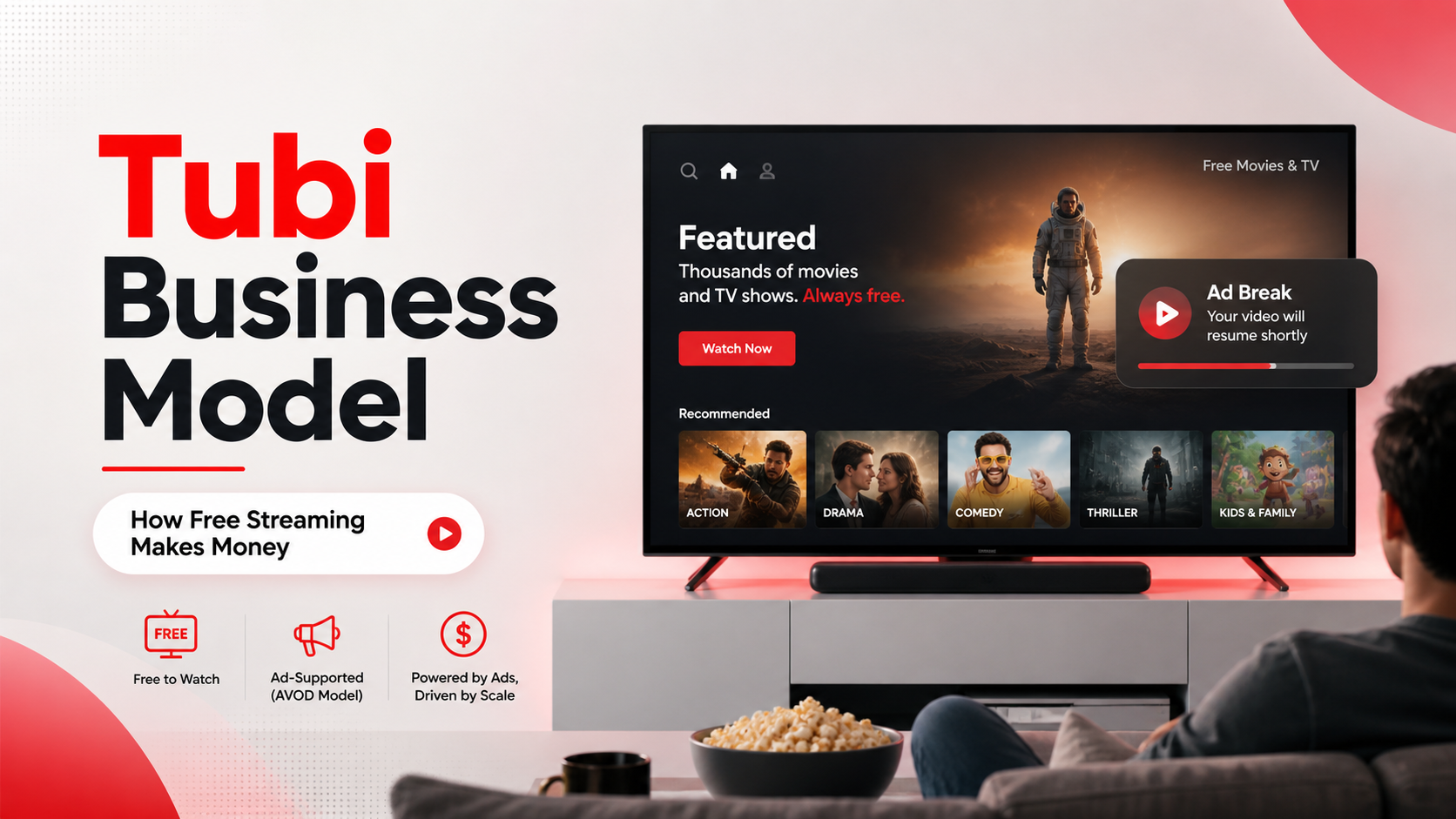
Tubi Business Model And How This Free Streaming Platform Makes Money Without Subscriptions

Tubi is one of the most quietly successful streaming platforms in the U.S. right now. No subscription fee. No credit card required. No original content budget in the billions. Yet it pulls in hundreds of millions in revenue every year.
The question most people ask is simple: how?
This breakdown covers everything, including Tubi’s AVOD model, its Business Model Canvas, how it stacks up against Netflix and YouTube, and what founders can actually learn from it.
What Tubi Actually Is
Tubi is a free, ad-supported streaming platform. It launched in 2014 and was acquired by Fox Corporation in 2020 for $440 million.
Unlike Netflix or Disney+, Tubi does not produce its own content at scale. It licenses existing movies and TV shows, hosts them on its platform, and lets anyone watch them for free in exchange for sitting through ads.
You do not need to log in. You do not need a subscription. You just hit play.
That simplicity is the whole strategy.
Tubi is available on:
- Smart TVs (Roku, Fire TV, Samsung, LG, Vizio)
- iOS and Android
- Web browsers
- Gaming consoles
The focus is mass accessibility. It wants to be on every screen, in every household, with zero barrier to entry.
The Tubi Core Business Model: AVOD
AVOD stands for Advertising Video On Demand.
It is the business model behind Tubi’s entire operation. Here is how it works in plain terms:
- Users watch free content
- Ads play during that content
- Advertisers pay Tubi for those ad placements
- Tubi keeps the revenue
The user never pays. The advertiser does.
This is not a new concept. Linear TV has worked this way for decades. What makes Tubi interesting is that it has applied this model to on-demand streaming at scale, in an era when most streaming platforms have conditioned consumers to expect either paid tiers or bloated hybrid models.
Tubi kept it clean. Free content, ad-supported, no confusion.
Why AVOD Is Growing Fast
Subscription fatigue is real. Consumers are managing four, five, sometimes six different streaming subscriptions and cutting back. AVOD platforms benefit directly from that.
According to industry data, AVOD viewership in the U.S. has been growing year over year as consumers look for ways to cut costs without losing entertainment access.
Tubi is positioned exactly at that intersection.
How Tubi Makes Money
Tubi’s revenue comes almost entirely from advertising. Here is how that breaks down.
Programmatic Advertising
Programmatic advertising means ad placements are bought and sold automatically through software platforms, in real time. Advertisers set targeting parameters, bid on impressions, and ads get served without manual negotiation.
Tubi plugs into programmatic ad exchanges, which means it can monetize every viewer, at scale, without a massive direct sales team for every deal.
Direct Brand Campaigns
Beyond programmatic, Tubi sells direct ad packages to brands and agencies. These tend to be larger deals with more premium placement, often around specific content categories or high-traffic periods.
Direct campaigns typically command higher CPMs (cost per thousand impressions) than programmatic inventory.
Data-Driven Targeting
Tubi collects user data including what content is watched, how long sessions last, what devices are used, and behavioral patterns. That data is used to improve ad targeting.
Better targeting means higher value inventory. Advertisers pay more to reach the right audience. Tubi earns more per impression.
This is a core lever in the AVOD model. The more precise the targeting, the stronger the monetization.
Connected TV (CTV) Inventory
Tubi has a large presence on connected TVs, which is one of the most valuable ad formats in the market right now.
CTV advertising commands premium CPMs because it combines the lean-back attention of traditional TV with the targeting precision of digital advertising. Brands pay a significant premium to reach audiences on the big screen with measurable results.
Tubi’s dominance on smart TV platforms gives it a disproportionate share of this high-value inventory.
Tubi Business Model Canvas
This is where the pieces come together. The Business Model Canvas maps out how Tubi creates, delivers, and captures value. Understanding this is more useful than any surface-level overview.
Customer Segments
Tubi serves two fundamentally different customer groups.
Viewers:
- Budget-conscious consumers who do not want to pay for streaming
- Casual viewers who do not need a curated, premium experience
- Cord-cutters replacing cable without adding subscription costs
- Users in emerging markets with lower disposable income for entertainment
Advertisers:
- National brands running awareness campaigns
- Regional businesses targeting specific geographies
- Agencies managing multi-channel media buys
- Direct-to-consumer brands seeking measurable performance
The critical insight here is that Tubi has two customers, not one. Viewers provide the attention. Advertisers pay for access to that attention. Both sides of this marketplace need to be served well for the model to work.
If the content is bad, viewers leave. No audience means no ad revenue.
If the targeting is weak or the inventory is low quality, advertisers spend elsewhere. No ad revenue means no content budget.
Tubi has to balance both constantly.
Value Propositions
For Viewers:
- Zero cost, no credit card, no commitment
- Large content library across genres
- No login required to start watching
- Available on virtually every device they already own
- No decision fatigue around subscription tiers
The value proposition is frictionless access. The barrier to start watching Tubi is as close to zero as any digital product can get.
For Advertisers:
- Access to a large, measurable audience
- Connected TV inventory at scale
- Data-driven targeting across demographics
- Performance measurement and attribution
- Reach into audiences who have cut the cord and are no longer reachable on linear TV
Tubi gives advertisers something genuinely valuable: access to viewers who are no longer watching traditional television and may not be reachable through cable buys.
Channels
How Tubi reaches and serves its audiences.
Smart TVs are the most important channel. Samsung, LG, Vizio, Roku, and Fire TV all have Tubi pre-installed or easily accessible. This gives Tubi living room presence without the user having to seek it out.
Mobile apps on iOS and Android extend reach to on-the-go viewing. Mobile inventory is valuable but commands lower CPMs than CTV.
Web platform serves desktop and laptop users, adding another access point with minimal incremental cost.
App stores on gaming consoles (PlayStation, Xbox) and streaming sticks (Chromecast, Apple TV) round out distribution.
The key insight is that smart TV dominance is a competitive moat. Pre-installed apps on major TV platforms mean Tubi gets discovered passively. Users turn on a new TV, see Tubi in the app row, and try it without any acquisition cost on Tubi’s end.
Customer Relationships
Tubi keeps its relationship with viewers intentionally low-friction.
- No mandatory account creation
- Minimal onboarding steps
- Algorithm-based content recommendations for logged-in users
- Passive, lean-back experience that mirrors traditional TV
The platform is designed for casual engagement. Unlike Netflix, which is built around binge sessions and social sharing of original content, Tubi is positioned as a background companion, something you put on without thinking too hard about it.
This is intentional. Casual viewers have lower expectations and higher tolerance for ad loads than premium content subscribers. That makes them easier to monetize without churn.
Revenue Streams
Tubi’s revenue model is focused but layered.
Ad Impressions (CPM model): Revenue is generated based on how many ads are served per thousand views. More viewers, longer sessions, more impressions, more revenue.
Programmatic Advertising: Automated ad buying fills inventory at scale without requiring manual sales for every placement.
Direct Brand Campaigns: Premium deals with brands and agencies for targeted, high-visibility placements.
There is no subscription revenue. No licensing revenue from other platforms. No merchandise. Advertising is the single engine.
This is a focused bet, and it works because Tubi has the audience scale to support it.
Key Resources
Content library: Tubi’s library reportedly includes over 200,000 movies and TV episodes. Critically, almost all of it is licensed rather than produced. Licensing is cheaper than production by an enormous margin.
Ad tech infrastructure: The plumbing behind programmatic advertising, real-time bidding, targeting, and measurement is what makes the revenue model function. Tubi has invested significantly in this layer.
User data: Behavioral data from viewers informs targeting, which drives ad value. Data is an asset that compounds over time.
Fox Corporation backing: Fox provides financial stability, distribution leverage, and synergies with linear broadcast assets. Tubi can cross-promote content and share infrastructure across Fox’s broader media operations.
Key Activities
What Tubi actually has to do well to make the model work.
Content licensing: Negotiating rights deals with studios, distributors, and content owners. Finding the right mix of catalog depth and genre breadth that keeps viewers engaged without overpaying for rights.
Platform optimization: Keeping the streaming experience smooth across dozens of device types and operating systems. Buffering, crashes, and poor UX drive users away and reduce ad impressions.
Ad serving and targeting: Running the real-time systems that match the right ads to the right viewers at the right moment. This is both a technical and a commercial function.
User acquisition: Getting new viewers onto the platform. Tubi’s low-friction model helps here, but ongoing marketing, app store optimization, and smart TV placement negotiations are all part of maintaining growth.
Key Partnerships
Content studios and distributors: Without a massive content library, there is no audience. Tubi’s licensing relationships with studios are foundational to the business.
Advertisers and agencies: Revenue depends on brands and media buyers choosing Tubi for their budgets. Tubi’s ad sales team and agency relationships are core commercial assets.
Smart TV manufacturers: Pre-installation deals with Samsung, LG, Vizio, and others give Tubi distribution at the point of device activation. These partnerships are a significant moat.
Ad tech platforms: Programmatic partners, DSPs (demand-side platforms), SSPs (supply-side platforms), and measurement vendors all plug into Tubi’s ad ecosystem.
Cost Structure
Where Tubi spends money.
Content licensing costs: The single largest operating expense. Licensing rights for a broad library requires ongoing investment and renegotiation as deals expire.
Infrastructure: Streaming at scale requires significant server, CDN (content delivery network), and bandwidth investment. More viewers means higher infrastructure costs.
Marketing and user acquisition: Paid advertising, app store fees, and promotional campaigns to grow the user base.
Ad tech investment: Building and maintaining the targeting, serving, and measurement systems that underpin the revenue model.
People: Engineering, content acquisition, ad sales, and operations teams.
The Canvas Insight Every Founder Should Take Away
Tubi is not a content company. It is not competing with Netflix on creative output.
Tubi is an attention and distribution business, monetized through advertising.
The content is infrastructure. The audience is the product. The advertiser is the customer.
Once you see it that way, the whole model makes sense. Tubi does not need to win Emmy awards. It needs to keep people watching long enough to serve them ads. A deep library of licensed catalog content does that job at a fraction of the cost of original production.
Why Tubi’s Model Actually Works
Several structural advantages make Tubi’s approach viable at scale.
Zero-cost user acquisition from the user side. Because Tubi is free, it removes every barrier to trial. There is no risk for the viewer. This dramatically lowers acquisition cost and increases top-of-funnel volume.
Scalable revenue without proportional cost increases. Once the content library is licensed and the ad tech is running, adding more viewers increases revenue (more impressions) without a linear increase in cost. The marginal cost of an additional viewer is mostly just bandwidth.
No content production risk. Netflix spends billions on original content that may or may not find an audience. Tubi licenses proven catalog content. The creative and commercial risk has already been absorbed by someone else. Tubi pays for rights after the content is already made and tested with audiences.
Connected TV premium. Tubi’s strong presence on smart TVs puts it in a high-CPM environment that punches above its weight in revenue relative to total viewership hours.
Tubi vs Netflix vs YouTube
| Platform | Model | Primary Revenue | User Pays |
|---|---|---|---|
| Tubi | AVOD | Advertising | No |
| Netflix | SVOD | Subscription | Yes |
| YouTube | Hybrid | Ads + Premium | Optional |
Netflix operates on a pure subscription model (SVOD: Subscription Video On Demand). It charges users directly and invests heavily in original content to justify that charge. High revenue per user, but requires constant content investment to prevent churn.
YouTube runs a hybrid model. The vast majority of its revenue comes from advertising, but it also offers YouTube Premium as a paid, ad-free tier. YouTube also shares ad revenue with creators, which is a cost structure Tubi does not carry.
Tubi sits in the purest AVOD position. All revenue from advertisers, nothing from users, no revenue-sharing obligations to content creators.
The comparison that matters most is not Netflix vs. Tubi in terms of content quality or subscriber count. It is the underlying business logic.
Netflix bets on content to drive subscriptions. Tubi bets on accessibility to drive audience scale, which drives ad revenue. These are fundamentally different businesses that happen to both involve streaming video.
Tubi’s Growth Strategy
How Tubi grows without the budget of a Netflix or Amazon.
Content Expansion Through Low-Cost Licensing
Tubi acquires content rights at prices well below what major streamers pay for originals. Catalog content, older films, international titles, and niche genre libraries all fill out the platform affordably.
The strategy is breadth over prestige. A viewer looking for a specific type of movie is more likely to find something in a library of 200,000 titles than in a curated library of 5,000.
Smart TV Distribution as a Growth Channel
Securing pre-installation or prominent placement on smart TV home screens is one of Tubi’s most important growth levers. When a consumer buys a new TV, sees Tubi already there, and tries it out, that is a zero-cost acquisition.
Fox’s relationships with TV manufacturers help here. Being part of a major media conglomerate gives Tubi leverage in distribution negotiations that an independent startup would not have.
Ad Tech Improvement
Better targeting means higher CPMs, which means more revenue per viewer. Tubi continually invests in improving the precision of its ad serving.
This creates a compounding effect: better data leads to better targeting, which leads to higher ad rates, which funds more content licensing, which attracts more viewers, which generates more data.
SEO and App Discovery
Tubi invests in being discoverable. Search rankings for specific movies and shows can drive direct traffic to its web platform. App store optimization ensures it appears prominently when users search for free streaming apps.
Organic discovery is cost-effective at scale and compounds over time.
The Real Challenges in Tubi’s Model
No business model is without tradeoffs. Tubi faces several real structural challenges.
Ad Fatigue
Viewers who experience too many ads, or ads that are poorly targeted and irrelevant, tune out or abandon the platform. Tubi has to calibrate ad load carefully. Too many ads and the free value proposition falls apart because the watching experience becomes intolerable.
This is an ongoing balancing act between viewer experience and advertiser revenue.
Content Quality Perception
Tubi’s library skews toward older catalog content, B-movies, and lesser-known titles. That perception of lower quality content can limit its appeal to more discerning viewers who gravitate toward premium originals on Netflix or HBO Max.
Tubi has been addressing this with more curated collections and selective content partnerships, but the perception gap with premium platforms remains real.
Competition Is Intensifying
AVOD is no longer a niche strategy. Amazon’s Freevee (now folded into Prime Video’s free tier), Peacock’s free tier, Pluto TV (owned by Paramount), and The Roku Channel all compete in the same space.
As more major players enter AVOD, competition for both content rights and advertiser budgets increases. Tubi has first-mover advantages and Fox’s backing, but the competitive environment is getting tougher.
Content Licensing Costs Are Rising
As AVOD grows in value, studios and content owners recognize the opportunity and price their licensing deals accordingly. The era of extremely cheap catalog licensing may compress as more platforms compete for the same titles.
Where Tubi Is Headed
The structural tailwinds behind Tubi’s model are strong.
AVOD is a growing category. As subscription fatigue accelerates and consumers rationalize their spending, free ad-supported streaming becomes more attractive. This is not a temporary pandemic trend. It reflects a durable shift in how consumers approach entertainment spending.
Connected TV advertising is one of the fastest-growing segments in digital advertising. Brands that previously spent on linear TV are shifting budgets to CTV because it offers better targeting and measurement. Tubi sits directly in the path of that budget migration.
Hybrid monetization may emerge. Tubi has remained committed to its pure AVOD model, but there is a potential path toward an optional ad-free tier for users who want it, similar to YouTube Premium. This would add a secondary revenue stream without abandoning the core free model.
International expansion is a logical next step. Tubi has been primarily a U.S.-focused platform. As the AVOD model matures domestically, international markets with strong free-to-air TV cultures represent significant growth opportunities.
What Founders Can Learn From Tubi
The Tubi model contains several lessons that apply well beyond streaming.
Free can scale faster than paid. Removing the payment barrier eliminates the single biggest source of friction in consumer adoption. If your model can support monetization through advertising or other indirect means, free access is a powerful growth mechanism.
Monetization does not have to be direct. Tubi does not charge the person receiving the value. It charges a third party (advertisers) for access to that person’s attention. This two-sided market approach opens up business models that purely transactional thinking misses.
Distribution beats product in many categories. Tubi’s smart TV pre-installation strategy is arguably more valuable than any content decision it has made. Being where people already are, without requiring them to seek you out, is a competitive advantage that compounds.
Attention is a genuine asset. Every minute a viewer spends on Tubi is a commercial asset. That reframe changes how you think about product decisions, content strategy, and user experience. You are not just building something people use. You are building an attention stock that can be monetized.
Focused business models outperform diffuse ones. Tubi did not try to compete with Netflix on originals. It did not try to become YouTube. It picked one model, AVOD, and executed it with discipline. That focus is a large part of why it works.
Final Takeaway
Tubi did not try to beat Netflix at its own game.
It changed the game entirely.
Instead of charging users for content, it made content free and charged advertisers for user attention. That pivot in business logic, not content quality or tech innovation, is the foundation of everything Tubi has built.
The result is a platform that competes with billion-dollar subscription services without a subscription, without blockbuster originals, and without a massive content production budget.
For anyone building a consumer product, media business, or two-sided marketplace, Tubi is worth studying carefully. Not for its content strategy, but for the clarity of its business model and the discipline with which it has executed it.
The model is simple. The execution is what makes it work.
Discover more from Business Model Hub
Subscribe to get the latest posts sent to your email.