Bond App Business Model And How a No-Feed Social Platform Plans to Make Money Without Ads

Bond is a newly launched social media platform built around a simple but bold idea: use AI to get users off their phones and back into real life. It launched in April 2026 and is already drawing attention for going against everything legacy social media stands for.
There is no feed. No infinite scroll. No algorithmic timeline. No carousel of short videos calibrated to keep you watching.
That alone makes it worth paying attention to from a business model perspective.
How Bond Actually Works
The “Memories” Format
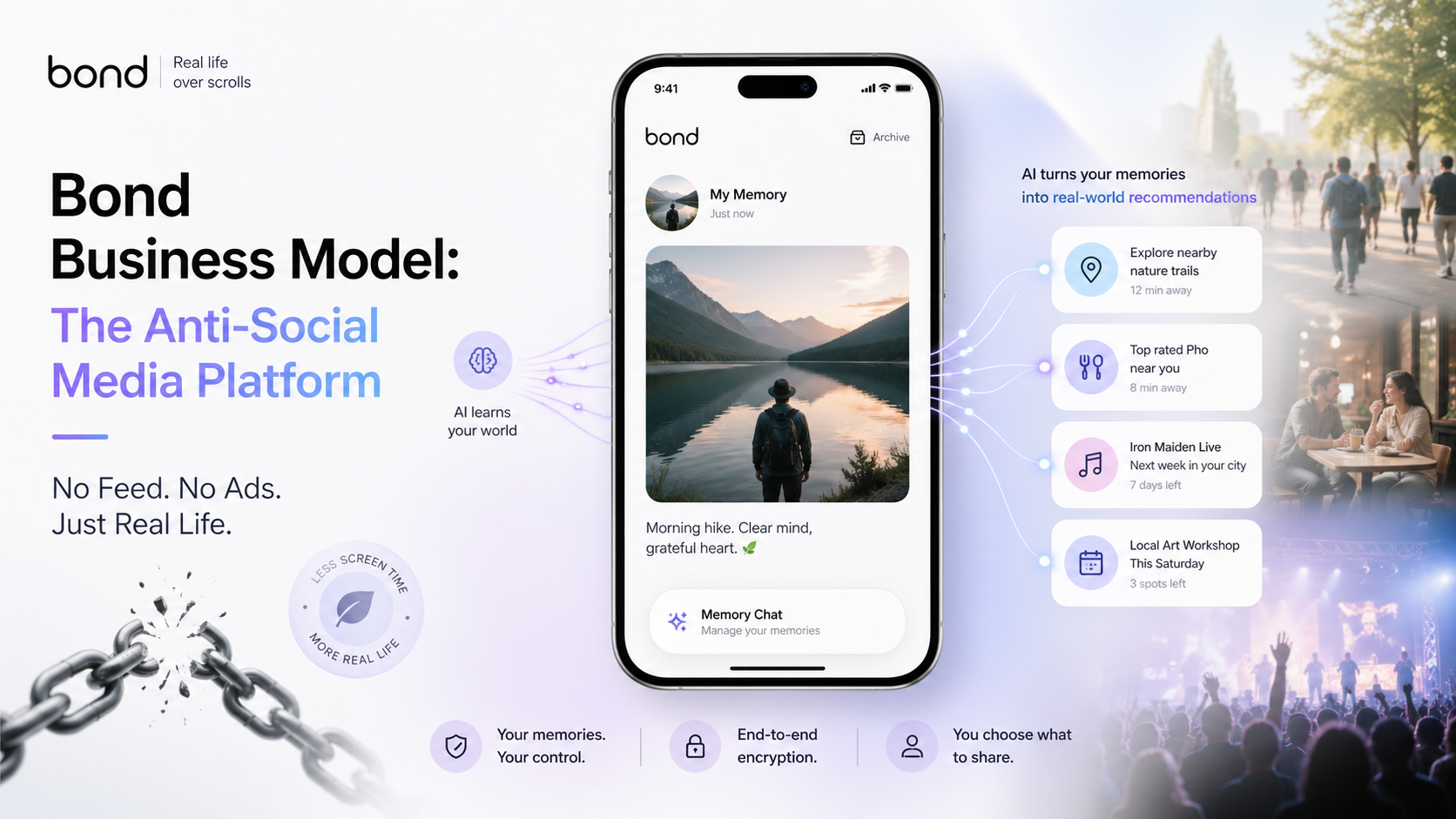
Users post updates about their recent activities through what Bond calls “memories,” shared via pictures, video, and audio files.
The interface visually resembles Instagram, but without an actual feed. User profiles are presented in a cluster formation. Stories disappear from the public-facing profile after 24 hours but are stored in the user’s private archive, accessible at any time.
The AI Recommendation Layer
This is where Bond gets interesting from a product standpoint.
The memories users post train the system on individual preferences, interests, and habits. Bond then generates personalized recommendations for real-world experiences, events, and activities.
For instance, if you’ve been posting about how much you like pho and how you haven’t had it in a while, Bond’s system might recommend a nearby Vietnamese restaurant that’s getting good reviews. Or, if you’re into heavy metal, Bond might point out that Iron Maiden is coming to your city next week.
The goal is clear: the app pushes you toward doing things, not scrolling through things.
The Bond’s Business Model Breakdown
No Ads. So How Does Bond Make Money?
Bond’s CEO Dino Becirovic has been upfront that monetization is not a short-term priority. The initial focus is on creating an application users get more value from the more they capture their memories.
But the long-term plan has two main revenue paths.
Revenue Stream One: AI Data Licensing
The idea behind the licensing model is that users can monetize their own memories. If Bond becomes a platform with the right incentive structure to get billions of people to document their daily lives, it will naturally become an attractive place for companies wanting to train future AI models.
Bond takes a small percentage cut from those licensing deals. Users who opt in get compensated. AI companies get real-world human data at scale.
Revenue Stream Two: E-Commerce Recommendations
In another scenario, Bond would use its accumulated data to act as a product recommendation tool that integrates with e-commerce sites. Users opt into this experience, and Bond captures value from transactions with merchants by enabling a better user experience, driving conversion, and increasing throughput.
Think of it as a personal shopping concierge trained entirely on your own life choices, not on what advertisers paid to show you.
What Makes This Model Different
It Flips the Attention Economy
Legacy platforms monetize your attention. Bond’s pitch is that it monetizes your intent and lived experience instead.
The distinction between selling data for advertising and licensing data for AI training is worth examining. In both cases, personal content, the photos, videos, and audio users post, becomes a monetizable asset. Bond’s differentiator is user consent and compensation, not just data collection.
No Advertising Revenue Dependency
Legacy social media sites have been designed to keep users hooked to their devices, eyes glued to feeds of memes and videos, in order to create more engaged platforms for advertisements. Bond is deliberately stepping away from that cycle entirely.
That’s a significant structural risk and a genuine differentiation at the same time.
The Team Behind Bond
The founding team carries real credibility.
Bond’s team includes people who previously built major social media apps, including TikTok, Twitter, and Facebook. CEO Dino Becirovic previously worked at Kleiner Perkins and Index Ventures, while Bond’s founding researcher, Arthur Bražinskas, co-led integration of user signals at Google Gemini.
That’s a team that knows how addictive platforms are built, and is now building in the opposite direction.
Privacy and Data Controls
What Bond Says About User Data
Becirovic stated that the platform does not intend to sell user data for advertising purposes and that users retain control over their information, including the ability to delete individual memories or their entire profile.
End-to-end encryption is a priority for the near future after launch. In the meantime, Bond stores all user data securely in its database.
Memory Management
Users can delete stored memories through the Memory tab or by using natural language in what Bond calls “Memory chat,” a conversational AI interface for managing stored content.
The Bigger Market Context
Bond is not launching in a vacuum.
A California jury found Meta and Google liable for intentionally building addictive social media platforms in a landmark trial last year, with 1,500 similar cases still pending. A wave of European countries are banning children from social media entirely, with Australia, France, Spain, Austria, and Greece all moving to restrict access for minors.
User fatigue is real. Regulatory pressure is building. The timing for a platform positioning itself as the anti-doomscroll option is strategic.
Key Takeaways for Business Model Watchers
Bond is testing a thesis that most social platforms have never seriously tried: build a platform that gets users to leave it, and monetize the data of what they do when they get back to real life.
The AI data licensing model is genuinely novel. The e-commerce integration play is familiar but reframed around user intent rather than passive ad exposure. Whether it scales depends entirely on whether millions of users trust Bond with their most personal memories.
That trust is the actual product. The business model only works if they earn it.
Discover more from Business Model Hub
Subscribe to get the latest posts sent to your email.