
Tinder nder makes money through subscriptions, in-app purchases, and advertising.
Its main revenue comes from premium plans like Tinder Plus, Gold, and Platinum. The app runs on a freemium model, attracting millions of users for free and then converting a portion of them into paying subscribers.
The formula is simple: give people enough to get hooked, then charge for the features they really want.
Ever Wondered How a Free App Became a Billion-Dollar Business?
Most people download Tinder without spending a single rupee or dollar. They swipe, they match, they chat. And yet, Tinder generates over a billion dollars in annual revenue.
That is not an accident. It is a carefully engineered business model built on psychology, timing, and user behavior.
Online dating has exploded over the last decade. Millions of people across the world now look for relationships, companionship, or casual connections through apps. Tinder did not just enter this space. It redefined it.
With its swipe-based interface and location-based matching, Tinder became the dominant force in mobile dating. It made the whole process fast, visual, and almost game-like.
In this guide, we will break down exactly how the Tinder business model works, how Tinder makes money, and why it continues to scale globally even in 2026.
What Is Tinder?
Tinder is a location-based dating and social discovery app launched in 2012. It introduced the now-iconic swipe mechanic: swipe right to like someone, swipe left to pass.
When two users swipe right on each other, it becomes a match. Only then can they start a conversation. This mutual interest filter removed the awkwardness of one-sided messages and made interactions feel more natural.
Core functionality includes:
- Swipe right to like, swipe left to pass
- Mutual match before messaging
- Location-based profile suggestions
- Photo-first profile layout
Tinder primarily targets Gen Z and millennials, though its user base spans a wide age range globally. It is owned by Match Group, the same parent company behind Hinge, OkCupid, and Match.com.
Tinder Business Model Overview
The Tinder business model is built on a freemium two-sided marketplace.
On one side, you have users looking for connections. On the other, you have Tinder offering tools, visibility, and features that improve those chances, at a price.
The basic flow looks like this:
Users → Engagement → Premium Features → Revenue
Free users keep the platform alive by creating a large, active pool of people to match with. Paid users fund the entire operation by unlocking features that give them an edge.
This is a classic freemium model executed at massive scale. The free version is functional enough to keep people engaged. But it is deliberately limited in ways that push motivated users toward payment.
How Does Tinder Work? A Step-by-Step Breakdown
Understanding the Tinder revenue model starts with understanding how the product itself works.
Step one: Sign up. Users create an account through their phone number, Apple ID, or Google account. The process is fast and frictionless by design.
Step two: Build a profile. Users upload photos, write a short bio, and set basic preferences like age range and distance. First impressions are everything here, so photos matter most.
Step three: The algorithm takes over. Tinder’s system decides which profiles to show you based on your location, preferences, and activity patterns.
Step four: Swipe. This is where the magic (and the addiction) happens. You see one profile at a time and make a split-second decision.
Step five: Match and chat. A mutual right swipe creates a match. A conversation window opens and two strangers can now talk.
The algorithm has evolved significantly over the years. It used to rely on an ELO-style scoring system, similar to chess rankings. Today it focuses more on:
- Activity level (how often you open the app)
- Swipe behavior (who you like and who you pass)
- Profile completeness and photo quality
- Engagement signals like response rates
Tinder Revenue Model: How Tinder Makes Money
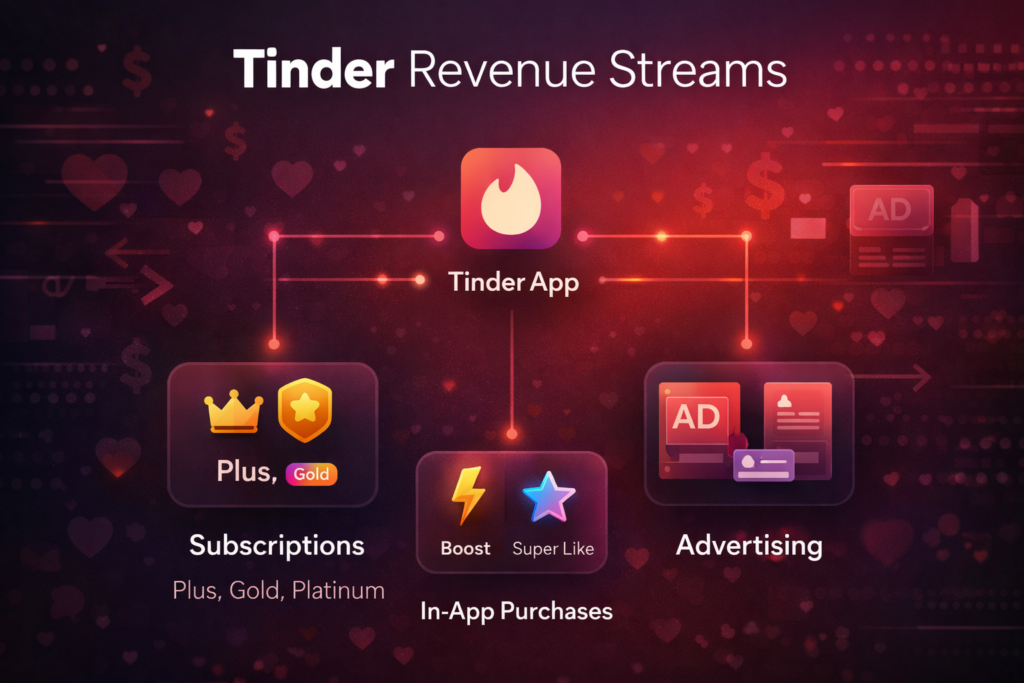
This is the core of the Tinder business model. Let us break it down by each revenue stream.
Subscription Plans: The Biggest Revenue Driver
Subscriptions are where Tinder earns the majority of its money. The platform offers three paid tiers, each unlocking progressively more powerful features.
Tinder Plus
This is the entry-level paid plan. It removes ads and gives users a handful of useful features:
- Unlimited swipes (free users have a daily limit)
- Passport (change your location to anywhere in the world)
- Rewind (undo your last swipe)
- One free Boost per month
It is priced affordably, making it accessible to casual users who just want fewer restrictions.
Tinder Gold
Gold adds one killer feature that makes it extremely popular: you can see who already liked you.
On the free version, you have to swipe through profiles hoping someone you like has also liked you back. Gold removes that guesswork entirely. You open a grid of people who want to match with you and you simply choose.
This single feature has driven enormous Gold subscription numbers because it dramatically improves the experience for serious users.
Tinder Platinum
Platinum is the top tier. It includes everything in Gold plus:
- Priority Likes (your likes are delivered before regular users)
- Message before matching (send a note with your Super Like)
- Top Picks access across global locations
Platinum is aimed at power users who treat Tinder seriously and want every possible advantage in a competitive swiping environment.
Why subscriptions work so well:
Tinder’s subscription model succeeds because the features are genuinely useful, not just cosmetic. Seeing who liked you, swiping without limits, and boosting your visibility all have a direct impact on your results. People pay because they see a return.
In-App Purchases: Boosts and Super Likes
Beyond subscriptions, Tinder sells individual features as one-time purchases. These are called microtransactions and they add a meaningful chunk to the overall revenue.
Boosts
A Boost makes your profile the top result in your area for 30 minutes. During that window, you get dramatically more visibility than normal users.
It works because of simple supply and demand logic. At peak times (Sunday evenings, for example), there are more people actively swiping. A Boost puts you in front of all of them.
The psychology here is powerful: instant visibility = instant gratification. If someone has been on Tinder for weeks without much success, a Boost feels like a shortcut worth paying for.
Super Likes
A Super Like notifies the other person that you have really liked their profile. Your profile appears with a blue star, standing out from the usual stream of anonymous right swipes.
Free users get one Super Like per day. Additional ones can be purchased in packs.
Super Likes tap into the psychology of being noticed. Most people are flattered when someone makes an extra effort, which makes this a high-conversion purchase for users who are genuinely interested in someone.
Why microtransactions matter:
These purchases are impulsive by design. They are priced low enough that the decision feels trivial. But across millions of users, small purchases add up to serious revenue.
Advertising Revenue
The third pillar of the Tinder revenue model is advertising.
Free users see ads as they swipe through profiles. These ads are designed to blend into the native swipe experience, appearing as card-style placements between real profiles.
Tinder also runs brand partnerships, where companies can engage users in more interactive formats. Some campaigns have included swipeable ad experiences tailored specifically to Tinder’s interface.
Advertising is not Tinder’s primary revenue source. Subscriptions and in-app purchases dominate. But with a user base numbering in the tens of millions, even a modest ad revenue per user adds up to significant income.
What Is Tinder’s Pricing Strategy?
Tinder uses a tiered dynamic pricing model that adjusts based on several factors.
Tiered plans give users options at different price points. This ensures that even budget-conscious users can find an entry point, while high-intent users can justify the premium cost of Platinum.
Dynamic pricing means the same subscription may cost different amounts depending on:
- Your age (younger users typically pay less)
- Your country or city
- Your device type (iOS vs Android)
- Promotional offers based on behavior
This pricing approach is controversial but effective. Tinder maximizes revenue from users in high-income markets while keeping the app accessible in emerging markets where dating app spending is lower.
The conversion funnel works like this:
Free users get just enough to see the value. They hit limits (no more swipes, no visibility into who liked them) at moments of high motivation. That friction, felt at exactly the right time, drives upgrades.
Tinder Growth Strategy: Why the App Keeps Growing
The Tinder business model is not just about monetization. It is equally about growth. Here is how Tinder has built and sustained its massive user base.
Network Effects
Tinder benefits enormously from network effects. The more people use the app, the more valuable it becomes for every individual user.
More users means more potential matches. More matches means more engagement. More engagement means longer sessions and higher retention. And higher retention means more opportunities to convert free users into paying ones.
This self-reinforcing loop is the backbone of Tinder’s growth strategy. It is why being the biggest player in the market is such a powerful competitive advantage.
Gamification
Tinder turned dating into a game, and that was not accidental.
The swipe mechanic is fundamentally a game loop. You see a profile, you make a judgment, you get a result (match or no match), and you move on. It is fast. It is unpredictable. And the occasional match acts like a reward that keeps you coming back.
This is the same psychological principle behind slot machines: variable reward schedules are highly addictive. You never know when the next match is coming, so you keep swiping.
Dopamine-driven UX design is central to why people spend so much time on Tinder. The app does not just help you meet people. It makes the act of searching feel rewarding in itself.
Simplicity and Minimal UI
Tinder succeeded in part because it stripped dating down to its most basic form.
No complex questionnaires. No elaborate profile prompts. Just photos, a short bio, and a binary choice.
This simplicity lowers the barrier to entry dramatically. Anyone can create a profile in minutes and start swiping immediately. That frictionless onboarding is a huge driver of user acquisition.
And once someone is in, the clean interface keeps them engaged without overwhelming them.
How Does Tinder’s Algorithm Work?
Tinder’s algorithm has always been a topic of curiosity and speculation.
In its early years, Tinder used a system similar to the ELO rating in chess. Every profile had a hidden desirability score that went up or down based on who swiped right or left on you. High-scoring profiles were shown more often to other high-scoring users.
Tinder later moved away from this system publicly, though the core principles likely remain in some form.
Today, the algorithm is understood to prioritize:
- Activity level: Profiles of active users are shown more often than inactive ones
- Swipe patterns: Whom you swipe right on influences who gets shown to you
- Profile quality: More complete profiles with better photos tend to perform better
- Response behavior: If you match frequently and reply quickly, the algorithm rewards you
Tinder has never fully disclosed how its algorithm works. That mystery, ironically, keeps users more engaged as they try to figure out how to improve their results.
Why Is Tinder So Successful?
Several factors explain why Tinder has dominated the dating app market for over a decade.
First-mover advantage in swipe UX. Tinder invented the swipe-to-match mechanic and competitors have been copying it ever since. Being first meant building brand recognition that is hard to displace.
Strong brand positioning. Tinder is not just an app. It is a cultural reference point. The word “Tinder” has become synonymous with mobile dating across languages and cultures.
Global scalability. The product works the same way in Mumbai, New York, London, or São Paulo. A scalable tech product with universal appeal is a rare thing, and Tinder has it.
High engagement. Users open Tinder multiple times per day. That kind of engagement gives Tinder more advertising inventory, more conversion opportunities, and more data to improve its product.
What Are the Challenges in the Tinder Business Model?
No business model is perfect, and Tinder faces real challenges that affect both its user experience and its growth.
User fatigue. Many long-term users report feeling exhausted by the endless swiping. The gamification that drives engagement early on can start to feel hollow over time.
Fake profiles and scams. Bots and fake accounts are a persistent problem on Tinder. They erode trust and drive away genuine users, particularly women.
Gender imbalance. Tinder has significantly more male users than female users. This means men often see lower match rates, which increases frustration and churn among a large portion of the user base.
Monetization vs user experience. There is a constant tension between making free users frustrated enough to pay and making them frustrated enough to leave. Tinder has to walk this line carefully.
Who Are Tinder’s Main Competitors?
The dating app market is competitive. Tinder’s main rivals each take a different approach.
Bumble flips the dynamic by requiring women to send the first message. This addresses the gender imbalance problem and has attracted a large, loyal female user base.
Hinge markets itself as “the dating app designed to be deleted.” It focuses on more meaningful connections through detailed profiles and prompt-based conversations rather than just photos.
OkCupid takes a data-driven approach with extensive questionnaires. It matches users based on compatibility scores rather than purely visual appeal.
Each competitor targets a slightly different segment of the same market. Tinder remains the dominant player by volume, but its rivals are growing.
Tinder Business Model Canvas
A quick look at the key building blocks behind Tinder’s operation:
Key Partners:
- Payment processors (Apple Pay, Google Pay, Stripe)
- Cloud infrastructure providers
- App stores (Apple App Store, Google Play)
- Advertisers and brand partners
Key Activities:
- App development and maintenance
- Algorithm development and optimization
- User acquisition and retention
- Content moderation and safety
Value Proposition:
- Fast, easy way to meet new people
- Low-commitment browsing experience
- Premium tools for serious daters
Customer Segments:
- Young adults aged 18 to 35
- Urban, mobile-first users
- Global markets across income levels
Revenue Streams:
- Tinder Plus, Gold, and Platinum subscriptions
- Boosts and Super Likes
- In-app advertising
What Is the Future of Tinder?
Tinder is not standing still. The platform is actively evolving to stay relevant in a competitive and changing market.
AI-based matchmaking is the most significant coming shift. Rather than relying purely on user-driven swipes, future versions of Tinder may use AI to predict compatibility more accurately and surface better matches automatically.
Video dating features have already been tested and are expanding. Short video profiles, live video dates, and video-first discovery could change how the platform feels fundamentally.
Safety improvements are a priority. Features like photo verification, background check integrations, and real-time content moderation are becoming table stakes in the dating app industry.
Expansion into social discovery is also on the horizon. Tinder may evolve beyond romantic matching into a broader social platform where people discover friends, events, and communities, not just dates.
Key Takeaways
Here is a quick summary of everything we covered about the Tinder business model:
- Tinder uses a freemium model where the core product is free and premium features are paid
- Subscriptions (Plus, Gold, Platinum) are the largest revenue driver
- In-app purchases like Boosts and Super Likes add significant microtransaction revenue
- Advertising contributes a smaller but meaningful share of total income
- Growth is powered by network effects, gamification, and a simple UI
- The algorithm rewards active, engaged users with better visibility
- Tinder faces challenges including user fatigue, fake accounts, and gender imbalance
- The future of Tinder points toward AI, video, and social discovery features
Frequently Asked Questions
Is Tinder free to use?
Yes, Tinder is free to download and use at a basic level. You can create a profile, swipe, and chat with matches without paying anything. However, premium features like unlimited swipes, seeing who liked you, and location Passport require a paid subscription.
How does Tinder earn the most money?
Tinder earns the most through its subscription plans, particularly Tinder Gold and Platinum. These plans offer high-value features that serious users are willing to pay for on a recurring monthly basis.
What makes Tinder so addictive?
Tinder’s swipe mechanic creates a variable reward loop similar to a slot machine. You never know when the next match is coming, which keeps you swiping. The fast, visual interface and dopamine hit from a match make the app psychologically compelling.
Who owns Tinder?
Tinder is owned by Match Group, a publicly traded company that also owns Hinge, OkCupid, Plenty of Fish, and Match.com. Match Group is one of the largest online dating companies in the world.
How does Tinder use dynamic pricing?
Tinder adjusts its subscription prices based on your age, location, and device. Younger users and users in lower-income countries typically pay less. This allows Tinder to maximize revenue from high-income markets while staying accessible globally.
Can Tinder survive increasing competition?
Tinder’s scale, brand recognition, and network effects give it significant advantages. However, rivals like Hinge and Bumble are growing quickly by targeting users who want more than casual swiping. Tinder will need to continue evolving its product to retain its dominant position.
Discover more from Business Model Hub
Subscribe to get the latest posts sent to your email.

[…] Hornet, and other LGBTQ+-focused apps at the niche level. At a broader level, mainstream apps like Tinder and Hinge have added features that make them appealing to queer users. Grindr must continue to […]
[…] Tinder has brand dominance. Bumble has a strong female-first narrative. Both have significantly larger user bases. For Hinge, competing means staying focused on differentiation rather than trying to out-feature or out-spend either competitor. […]