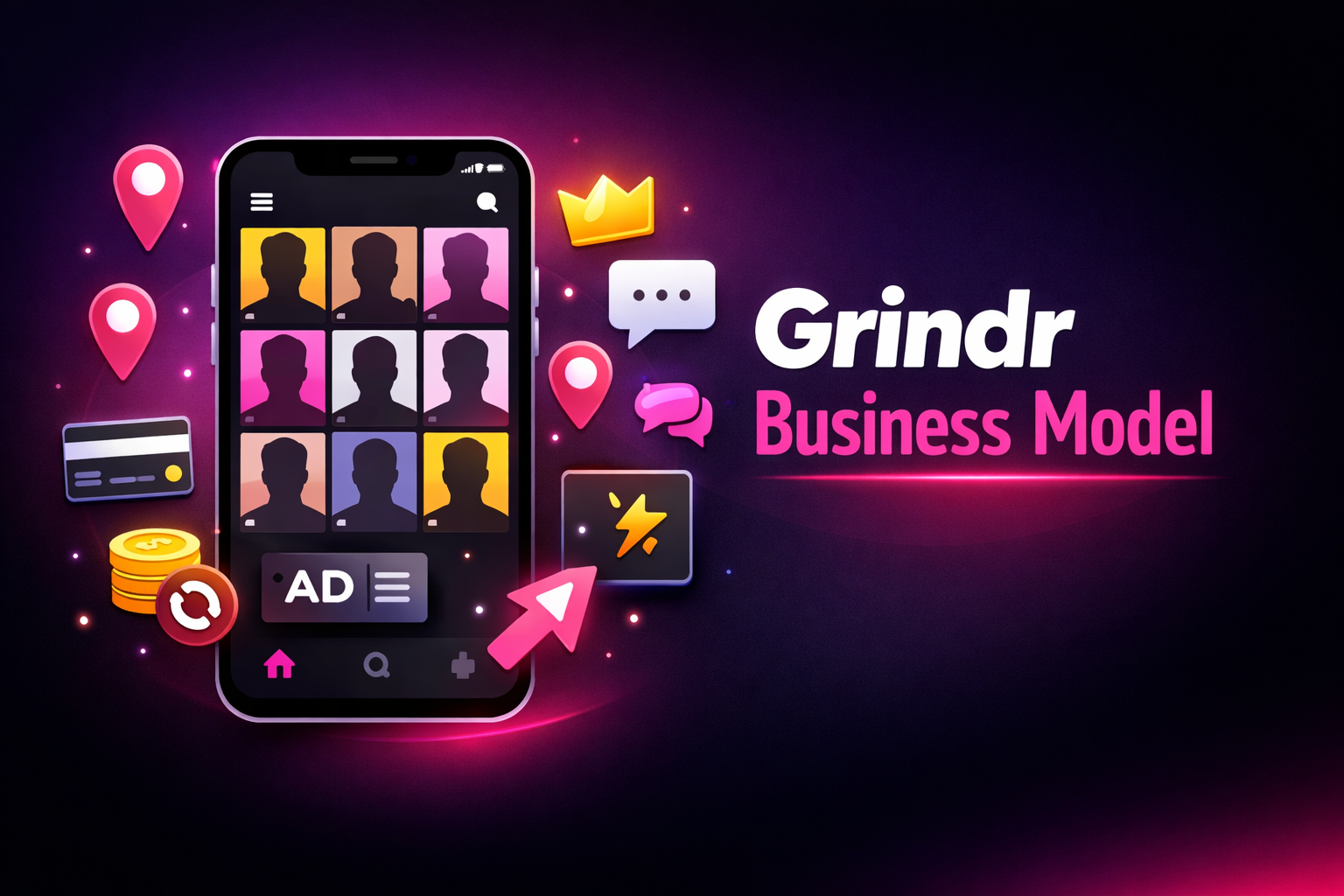

Grindr is more than a dating app. It is a location-based social networking platform built specifically for the LGBTQ+ community. Since its launch in 2009, Grindr has become one of the most recognized names in queer digital spaces, running on a freemium model that blends subscriptions, advertising, and in-app purchases to generate revenue.
This blog breaks down exactly how the Grindr business model works, who it serves, and why it continues to thrive in a competitive market.
What Is Grindr?
Grindr is a mobile app primarily designed for gay, bisexual, transgender, and queer individuals. It uses GPS technology to show nearby users in real time, allowing people to connect based on proximity.
Key features include:
- Profile creation with photos, age, preferences, and bios
- Real-time messaging and photo sharing
- Location-based user grid
- Community-driven interactions
- Privacy and safety controls
The core value proposition is simple: instant connection based on location. Unlike broader dating platforms that try to serve everyone, Grindr was built for a specific community from day one.
Grindr’s Core Business Model
Grindr operates on a freemium platform model. This means the app is free to download and use, but premium features are locked behind paid tiers.
The formula works like this:
Free users create scale. Scale attracts advertisers. Premium users generate recurring revenue.
This three-part cycle produces:
- A massive, engaged user base
- Predictable subscription income
- Advertiser demand driven by audience size
- Network effects that make the platform more valuable as it grows
It is a model used by many successful apps, but Grindr applies it within a focused niche, which strengthens each layer.
Grindr’s Value Proposition
For Free Users
Free users get access to:
- A grid of nearby profiles updated in real time
- Basic messaging and photo sharing
- Standard profile customization
- Global accessibility across countries
The free experience is functional enough to attract and retain a large user base, which is essential for the model to work.
For Premium Subscribers
Paid users unlock features that improve their experience significantly. These include ad-free browsing, advanced search filters, access to more profiles, and privacy tools like incognito mode.
Premium subscribers are willing to pay because the platform already has value at the free tier. Upgrading makes that experience faster and more personalized.
For Advertisers
Brands and organizations get access to a highly targeted demographic. Grindr’s audience is well-defined, engaged, and active daily. That specificity is valuable for advertisers who want efficient reach without wasted impressions.
How Grindr Works
Here is a quick walkthrough of the user experience from start to finish.
Step one: Download the app. Grindr is available on both the App Store and Google Play. Installation takes under a minute.
Step two: Create a profile. Users add a photo, age, bio, and preferences. The onboarding process is fast and low-friction, which reduces drop-off.
Step three: Browse nearby users. The app uses GPS to display a grid of profiles sorted by distance. This is the feature that made Grindr famous.
Step four: Start messaging. Users can chat, send photos, and react to messages. Basic communication is available on the free plan.
Step five: Upgrade. Heavy users who want more features convert to paid plans. This is where the business model starts paying off.
Grindr Revenue Model
This is the most important section. Grindr generates revenue through four main streams.
Subscription Revenue
Subscriptions are Grindr’s largest and most reliable revenue source. The platform currently offers two paid tiers.
Grindr XTRA includes:
- Ad-free experience
- Access to more profiles
- Advanced filtering options
- Faster loading and priority features
Grindr Unlimited includes everything in XTRA, plus:
- Unlimited profile views
- Incognito/invisible mode
- Typing status indicators
- Message recall (unsend feature)
Both tiers are available as monthly or annual plans. Recurring subscriptions create predictable cash flow, which is one of the healthiest revenue structures a digital platform can have.
Advertising Revenue
Users on the free plan see ads. These appear as banner ads, full-screen interstitials, and native placements within the user experience.
Advertisers pay based on:
- Impressions served
- Clicks generated
- Targeted audience access
This stream monetizes every free user who never pays a subscription fee. It is not as valuable per user as subscription revenue, but it scales with the size of the free user base, which is substantial.
In-App Purchases
Beyond subscriptions, Grindr offers one-time purchases that give users temporary advantages. These include profile boosts, which increase visibility in the nearby grid, and other features that improve exposure without requiring a full subscription.
In-app purchases serve users who want occasional upgrades without committing to a monthly plan. They also extend the monetization reach beyond the two standard subscriber tiers.
Data Insights and Partnerships
Grindr has explored brand partnerships, campaign sponsorships, and audience insights as additional revenue channels. This area is handled carefully because of privacy concerns tied to sensitive user data.
Health organizations, LGBTQ+ nonprofits, and event promoters have worked with Grindr to reach its audience in ways that align with community values. This is not a primary revenue driver but adds supplemental income.
Grindr Customer Segments
Grindr serves two distinct groups of customers.
Primary users include:
- LGBTQ+ adults across age groups
- Urban users in cities with dense user grids
- Travelers looking for connections in new locations
- Socially active individuals seeking community
Secondary customers include:
- Advertisers targeting the LGBTQ+ demographic
- Health organizations running awareness campaigns
- Event promoters marketing to queer audiences
Most platforms serve one side of this equation. Grindr serves both, which is what makes it a true two-sided marketplace.
Grindr’s Key Resources
Several assets are essential to Grindr’s ability to operate and compete.
Technology platform. The mobile app, geolocation engine, and messaging infrastructure are the foundation. Without reliable tech, the user experience collapses.
User base. The value of the platform grows with each additional user. A larger network produces more matches, more engagement, and more retention.
Brand trust. Grindr has spent over fifteen years building credibility within the LGBTQ+ community. That trust is not easy to replicate.
Data infrastructure. The platform uses data to drive personalization, content moderation, and advertising targeting.
Grindr’s Key Activities
Running a platform like Grindr requires ongoing work across multiple functions.
The company is constantly involved in app development, user safety, content moderation, customer support, advertising sales, and subscription optimization. Product innovation is also ongoing, as the platform needs to stay competitive with both niche competitors and mainstream dating apps.
Moderation is particularly important. A platform built around sensitive personal information and vulnerable communities has a high duty of care. This is an expensive activity, but skimping on it risks both user safety and brand reputation.
Grindr’s Competitive Advantage
Niche Positioning
Grindr’s biggest advantage is focus. Tinder, Bumble, and Hinge are broad platforms trying to serve everyone. Grindr serves a specific audience with specific needs, and it has optimized for that audience for over a decade.
This focus creates loyalty. Users are not just using a dating app. They are using the app that was built for them.
Network Effects
Network effects are powerful in social platforms. More users produce more nearby profiles, which creates more potential connections, which drives retention, which attracts more users. Once this loop is running at scale, it is very hard for competitors to break in.
First-Mover Advantage
Grindr launched in 2009 and quickly became the dominant app in its category. Being early gave it time to build a user base that competitors still struggle to match, even with better features in some cases.
Business Model Canvas of Grindr
Here is a structured overview of the full Grindr business model canvas.
Key Partners: App stores (Apple, Google), advertisers, payment processors, cloud infrastructure providers, LGBTQ+ safety organizations.
Key Activities: Platform maintenance, user acquisition, subscription management, content moderation, ad sales.
Key Resources: Mobile app technology, brand equity, user data, engineering and safety teams.
Value Proposition: Real-time nearby connections, a safe and inclusive LGBTQ+ platform, privacy tools, premium experience for paying users.
Customer Relationships: Self-service app, personalized recommendations, community features, customer support.
Channels: Mobile app stores, digital marketing, referral and word-of-mouth, app store search.
Customer Segments: LGBTQ+ individuals, premium subscribers, advertisers.
Cost Structure: Server and cloud hosting, app development, marketing and user acquisition, content moderation, legal compliance.
Revenue Streams: Subscription fees, advertising, in-app purchases.
Cost Structure of Grindr
Revenue is only half the picture. Understanding costs explains why Grindr needs multiple revenue streams.
Technology costs include cloud hosting, server infrastructure, app maintenance, and security. Keeping a real-time geolocation platform running at global scale is not cheap.
Staff costs include engineers, product managers, moderators, and support teams. Moderation alone requires significant headcount.
Marketing costs cover user acquisition campaigns and retention efforts. Dating apps have naturally high churn, which means they must constantly spend to replace users who leave.
Compliance costs are significant given the sensitivity of the data Grindr holds. Privacy laws vary by country, and staying compliant across jurisdictions requires legal and technical investment.
Challenges in Grindr’s Business Model
No business model is without friction. Grindr faces several ongoing challenges.
Privacy Concerns
Grindr holds deeply sensitive user information, including location data, sexual orientation, and personal preferences. Past data mishandling incidents have damaged trust and attracted regulatory scrutiny. Protecting this data is both a moral responsibility and a business requirement.
Competition
Grindr competes with Scruff, Hornet, and other LGBTQ+-focused apps at the niche level. At a broader level, mainstream apps like Tinder and Hinge have added features that make them appealing to queer users. Grindr must continue to innovate to stay relevant.
Monetization Balance
Too many ads degrade the free user experience. Too aggressive a push toward subscriptions can alienate users who cannot afford or simply do not want to pay. Finding the right balance is an ongoing product and pricing challenge.
User Safety
Safety is a cost center, not a revenue driver, but neglecting it has real consequences. Platforms that fail to protect users face backlash, regulatory action, and long-term brand damage.
Growth Opportunities
Despite its maturity, Grindr has room to grow in several directions.
Feature expansion could include video calling, community spaces, and premium matchmaking services. These features exist in adjacent apps and would give Grindr users more reasons to stay on the platform longer.
Travel integrations make sense given how many users open Grindr when visiting new cities. A dedicated travel mode or destination-based discovery feature could unlock a new use case.
Creator and wellness partnerships represent an untapped revenue stream. Grindr could host health content, partner with LGBTQ+ creators, or build a marketplace around community services.
Event monetization is another opportunity. Local events, pride activations, and community gatherings could be promoted and ticketed directly through the app.
Lessons Entrepreneurs Can Learn from Grindr
Grindr’s business model contains lessons that apply far beyond dating apps.
Build for a niche. Grindr did not try to compete with every dating app. It picked an underserved audience and built something specifically for them. Niche audiences can become large, loyal businesses.
Freemium works when done right. The free experience has to be good enough to attract users. The paid experience has to be valuable enough to justify the cost. Grindr has found that balance over time.
Community creates retention. Users stay on Grindr not just because the features are good, but because their community is there. Building a sense of belonging is a stronger retention mechanism than any product feature.
Recurring revenue matters. Subscription income is more predictable and more valuable than one-time transactions. Building toward a subscription model gives businesses stability.
Trust is infrastructure. For platforms handling sensitive data, trust is not a soft value. It is a structural requirement. Grindr’s long-term viability depends on users believing their information is safe.
Conclusion
Grindr’s business model works because it combines niche positioning, network effects, subscription revenue, and advertising in a way that reinforces each layer. It turned a simple proximity-based app into a profitable digital platform by deeply understanding a specific audience and building around their needs.
The freemium structure attracts users at scale. The subscriptions convert the most engaged users into reliable revenue. The advertising monetizes everyone else. And the brand trust keeps the whole system from collapsing when competitors show up.
For any business building a platform product, Grindr is a useful case study in what happens when you pick a lane and commit to it completely.
FAQs
Grindr generates revenue through two subscription tiers (XTRA and Unlimited), in-app advertising shown to free users, and one-time in-app purchases like profile boosts.
Grindr earns recurring revenue from premium memberships and advertising. As a publicly traded company, it reports financial results regularly, though profitability has varied by quarter and year.
Its exclusive focus on LGBTQ+ users and its real-time location-based grid set it apart from broad platforms like Tinder and Bumble.
Yes. The core app is free to download and use. Premium plans (XTRA and Unlimited) unlock additional features for subscribers.
Grindr is a publicly traded company listed on the NYSE. It has gone through several ownership changes over the years, including a period of Chinese ownership before being required by US regulators to divest.
Discover more from Business Model Hub
Subscribe to get the latest posts sent to your email.