
Starbucks Corporation stands as a towering presence in the global coffee industry, transforming from a single store in Seattle’s Pike Place Market in 1971 into the world’s largest coffeehouse chain. What began as a modest coffee bean retailer has evolved into a cultural phenomenon, with the iconic green mermaid logo recognized in virtually every corner of the world.
The journey from that original Seattle location to a global empire spanning thousands of stores across more than 80 countries represents one of the most remarkable brand-building stories in modern business history. Starbucks didn’t just sell coffee it sold an experience, a lifestyle, and a “third place” between home and work where communities could gather. Under the leadership of Howard Schultz, who joined in the early 1980s and later acquired the company, Starbucks pioneered the premium coffee shop concept that has since been replicated worldwide.
Today, Starbucks faces a complex landscape of opportunities and challenges. While it maintains its position as the dominant global coffeehouse brand, the company must navigate intense competition, changing consumer preferences, economic uncertainties, and operational challenges. This comprehensive SWOT analysis examines Starbucks’ current strategic position, evaluating its internal strengths and weaknesses alongside external opportunities and threats. Whether you’re an investor analyzing the stock, an entrepreneur studying successful business models, or a marketer examining brand strategy, understanding Starbucks’ competitive position provides valuable insights into retail, hospitality, and consumer brand management.
What is a SWOT Analysis?
SWOT analysis is a strategic planning framework that evaluates four critical dimensions of a business: Strengths, Weaknesses, Opportunities, and Threats. The first two elements—strengths and weaknesses—are internal factors within the company’s control, such as brand equity, operational efficiency, or financial resources. The latter two—opportunities and threats—are external factors in the market environment, including emerging trends, competitive pressures, or regulatory changes.
For investors, a SWOT analysis reveals whether a company is well-positioned to capitalize on market opportunities and defend against competitive threats. It helps assess whether current valuations reflect the company’s true potential and risks. For founders and entrepreneurs, studying a SWOT analysis of industry leaders like Starbucks provides a masterclass in strategic positioning, revealing what drives success and what pitfalls to avoid. Marketers benefit from understanding how companies leverage their strengths to build brand equity and how they respond to market challenges.
When applied to Starbucks, SWOT analysis helps evaluate the coffee giant’s competitive position in an increasingly crowded and dynamic market. It addresses critical questions: Can Starbucks maintain its premium positioning? How vulnerable is it to economic downturns? Where should it focus its growth investments? What strategic risks loom on the horizon? By systematically examining these dimensions, we gain a holistic view of Starbucks’ strategic health and future prospects.
Starbucks Strengths
Strong Global Brand Recognition
Starbucks has achieved something few brands accomplish: true global recognition combined with aspirational appeal. The green siren logo is instantly recognizable from Seattle to Shanghai, representing not just coffee but a lifestyle and status symbol. This brand equity translates into pricing power, customer loyalty, and the ability to enter new markets with lower customer acquisition costs than competitors.
The company’s premium positioning sets it apart from both fast-food chains and local coffee shops. Customers don’t just buy coffee at Starbucks; they buy into an experience characterized by comfortable seating, free Wi-Fi, consistent quality, and friendly baristas who write your name on the cup. This “third place” concept—positioning Starbucks as a welcoming space between home and work—has created emotional connections that transcend the product itself.
Customer loyalty runs deep within the Starbucks ecosystem. The company has cultivated a community of regulars who visit daily, often ordering personalized drinks that baristas memorize. This loyalty translates into predictable revenue streams and valuable word-of-mouth marketing. The brand’s cultural cachet also makes it a frequent setting in movies, television shows, and social media, reinforcing its position in popular culture.
Extensive Global Presence
With tens of thousands of locations spanning every major continent, Starbucks has built an unmatched retail footprint in the coffee industry. This extensive network creates multiple advantages: economies of scale in procurement and operations, brand ubiquity that reinforces customer habits, and the flexibility to test and roll out innovations across diverse markets.
North America remains Starbucks’ stronghold, with dense store coverage in urban and suburban markets alike. However, the company has achieved remarkable success in Asia, particularly in China, where it has become a status symbol for the growing middle class. This geographic diversification provides multiple growth engines and reduces dependence on any single market.
The store network itself varies strategically by location—from high-traffic urban stores focused on speed and efficiency to suburban locations designed for longer stays, from airport kiosks to drive-through formats. This flexibility allows Starbucks to meet customers wherever they are, adapting to local preferences while maintaining brand consistency.
Strong Digital Ecosystem
Starbucks has emerged as a leader in retail digital transformation, building one of the most successful mobile apps and loyalty programs in any industry. The Starbucks Rewards program boasts millions of active members who generate a substantial percentage of company revenue. These digital customers visit more frequently, spend more per visit, and provide valuable data that drives personalized marketing.
The mobile app enables mobile ordering and payment, reducing wait times and friction in the purchase process. During peak hours, mobile orders can represent half or more of transactions at busy locations. This digital infrastructure proved invaluable during the pandemic, allowing Starbucks to maintain sales when in-store dining was restricted.
Beyond transactions, the digital ecosystem provides Starbucks with unprecedented customer insights. The company can track purchase patterns, test promotions with specific segments, and personalize offers to individual customers. This data advantage helps Starbucks optimize everything from menu development to store locations to marketing campaigns, creating a virtuous cycle of improved customer experience and loyalty.
Product Diversification
While coffee remains at the core, Starbucks has successfully diversified its product portfolio across multiple categories. The menu now includes tea, refreshers, smoothies, breakfast items, lunch options, and an extensive selection of baked goods and snacks. This diversification increases average transaction values and attracts customers throughout the day, not just during morning coffee rush hours.
Seasonal and limited-time offerings create excitement and drive repeat visits. The Pumpkin Spice Latte phenomenon has become a cultural marker of autumn, generating significant media attention and sales. By regularly rotating specialty drinks and food items, Starbucks gives customers reasons to return and try something new while maintaining core favorites.
The company has also extended beyond the café into consumer packaged goods, selling bagged coffee, K-Cup pods, and ready-to-drink beverages in grocery stores. This retail presence puts the Starbucks brand in front of consumers daily and creates additional revenue streams with different margin profiles than café operations.
Ethical Sourcing and Sustainability Focus
Starbucks has invested heavily in ethical sourcing programs, working directly with coffee farmers to improve quality and sustainability. The company’s Coffee and Farmer Equity practices aim to ensure fair prices for farmers while promoting environmental stewardship. This commitment resonates with increasingly conscious consumers who care about the impact of their purchases.
Sustainability initiatives extend beyond sourcing to packaging, store design, and operations. Starbucks has announced ambitious goals around renewable energy, waste reduction, and water conservation. While implementation challenges remain, this leadership on environmental, social, and governance issues strengthens brand reputation and appeals to younger consumers who prioritize corporate responsibility.
These efforts also provide practical business benefits. Direct relationships with farmers improve supply chain reliability and quality control. Sustainability investments often reduce long-term operational costs. And the positive brand associations help justify premium pricing while differentiating Starbucks from competitors who may lack similar commitments.
Starbucks Weaknesses
Premium Pricing Strategy
Starbucks’ positioning at the premium end of the coffee market creates vulnerability during economic uncertainty. When consumers face financial pressure, expensive coffee becomes an easy discretionary expense to cut. A five-dollar latte may seem reasonable during prosperous times but extravagant when budgets tighten. This price sensitivity became evident during previous recessions when Starbucks saw traffic declines as customers traded down to lower-priced alternatives.
The premium pricing also limits market penetration in price-sensitive demographics and geographies. While Starbucks appeals to affluent urban professionals, it may struggle to attract budget-conscious consumers or penetrate lower-income markets where local alternatives offer adequate coffee at half the price. This creates a ceiling on addressable market size and makes the brand vulnerable to value-oriented competitors.
Competition has intensified at both ends of the spectrum—fast-food chains have improved coffee quality at lower prices, while independent specialty roasters compete for high-end customers willing to pay even more for single-origin, artisanal experiences. Starbucks occupies the middle of this premium segment, which can be an uncomfortable position when squeezed from both directions.
Heavy Dependence on US Market
Despite global expansion, Starbucks remains significantly dependent on the United States for revenue and profits. This geographic concentration creates risk—economic challenges, competitive pressures, or regulatory changes in the US market disproportionately impact overall company performance. When American consumers pull back spending, Starbucks feels the impact immediately and substantially.
This dependence also means that growth increasingly depends on international expansion into markets where Starbucks must navigate different consumer preferences, regulatory environments, and competitive landscapes. Success in China has been remarkable, but replicating that success in other emerging markets presents challenges, and international operations often carry lower margins than the mature US business.
The concentration in developed Western markets also exposes Starbucks to similar economic cycles, demographic trends, and cultural shifts. Greater geographic diversification into markets with different economic patterns would provide more stability, but achieving meaningful diversification at Starbucks’ scale requires sustained investment and patient capital.
Operational Costs
Operating premium retail locations in high-traffic urban areas requires significant capital and creates ongoing cost pressures. Rent in prime locations—downtown districts, shopping centers, airports—represents a substantial fixed cost that doesn’t decline with sales volatility. During downturns, these expensive leases become anchors on profitability.
Labour costs also run higher than typical fast-food operations due to Starbucks’ positioning and service model. The company invests in barista training and offers benefits more generous than industry norms, which supports quality and morale but increases operating expenses. As minimum wage laws rise in many markets and unionization efforts gain momentum, labour cost pressures may intensify.
The complexity of Starbucks’ operations—customizable drinks, food warming, mobile order management—requires more labour and time than simpler competitors. During peak periods, this complexity can lead to long wait times and service bottlenecks that frustrate customers despite higher staffing levels. Balancing operational efficiency with service quality remains an ongoing challenge.
Overexposure to Coffee-Based Revenue
While Starbucks has diversified its menu, coffee and coffee-based beverages still dominate revenue. This concentration creates vulnerability to shifts in coffee consumption patterns, health concerns about caffeine, or simple changes in consumer tastes. If coffee consumption declines or consumer preferences shift dramatically toward alternatives, Starbucks would face fundamental business model challenges.
The company has tried to expand beyond beverages into food and merchandise, but these efforts haven’t transformed the business model fundamentally. Food quality and variety have improved, but Starbucks isn’t viewed primarily as a food destination, and margins on food are typically lower than beverages. Merchandise sales remain a small percentage of revenue.
This concentration also means Starbucks’ fortunes remain tied to coffee commodity markets, global coffee supply chains, and the agricultural challenges facing coffee production. While the company has worked to secure supply and manage price volatility, it cannot fully escape exposure to climate change impacts on coffee-growing regions or disruptions in global supply chains.
Starbucks Opportunities
Expansion in Emerging Markets
Emerging markets represent Starbucks’ most significant growth opportunity. While the company has achieved remarkable success in China, vast markets in India, Southeast Asia, Africa, and Latin America remain underpenetrated. These regions feature growing middle classes, increasing urbanization, and Western brand aspirations—all favorable trends for Starbucks.
India presents particular promise, with over a billion people, rapidly growing cities, and a emerging café culture among young professionals. While tea traditionally dominates, coffee consumption is rising, and Starbucks’ premium positioning aligns with aspirational consumer behavior. Similar opportunities exist across Southeast Asian markets where economic development is creating new consumer classes.
However, successful emerging market expansion requires cultural adaptation. Starbucks must balance maintaining its core brand identity with accommodating local tastes, price sensitivity, and competitive dynamics. The company has shown this capability in China, incorporating local food items and digital payment systems while maintaining its essential Starbucks experience. Replicating this approach across diverse emerging markets could drive decades of growth.
Product Innovation
Health and wellness trends create opportunities for Starbucks to expand beyond traditional coffee into functional beverages, plant-based options, and better-for-you food items. Younger consumers particularly seek products that align with health goals while providing the taste and experience they enjoy. Starbucks’ brand strength and distribution network position it well to capture this demand.
Plant-based alternatives for milk and food have moved from niche to mainstream. Starbucks already offers oat, almond, soy, and coconut milk alternatives, but could expand plant-based food options more aggressively. Similarly, functional beverages infused with adaptogens, vitamins, or other wellness ingredients represent white space where Starbucks could innovate.
The company could also push further into adjacent categories that complement the core business. Enhanced breakfast and lunch offerings could drive higher average tickets and all-day traffic. Alcoholic beverages, tested in some markets, could make Starbucks relevant for evening occasions. Expanding merchandise beyond mugs and tumblers into apparel or lifestyle products could deepen brand engagement while creating new revenue streams.
Digital and Delivery Expansion
While Starbucks has built a strong digital ecosystem, significant opportunities remain to deepen digital engagement and expand delivery. Subscription models could create even stickier customer relationships—imagine a monthly subscription for unlimited coffee or guaranteed access during peak times. Such programs would provide predictable revenue while increasing visit frequency.
Partnerships with delivery platforms have opened Starbucks to new occasions and customer segments who prefer at-home or office delivery. Expanding delivery coverage, reducing delivery times, and optimizing the delivery experience could significantly grow this channel. As delivery economics improve through scale and technology, this could become a substantial percentage of sales.
The digital platform also enables innovations like virtual baristas powered by AI that help customers discover new drinks, dynamic pricing that manages demand during peak periods, or augmented reality features that enhance the in-store experience. Starbucks’ technology infrastructure and customer data provide advantages in developing these capabilities ahead of competitors.
Retail and Consumer Packaged Goods
Starbucks’ retail presence in grocery stores and supermarkets offers significant growth potential. Many consumers want to recreate the Starbucks experience at home, whether through bagged coffee, K-Cup pods, or ready-to-drink beverages. These products generate margin dollars while reinforcing brand presence and habit formation.
Ready-to-drink beverages represent a particularly attractive opportunity as consumers seek convenient, premium options for on-the-go consumption. Starbucks has built a strong position in this category, but could expand further with new flavors, formats, and distribution. These products reach customers who may never visit a Starbucks café, expanding the addressable market.
The company could also license its brand for additional consumer products beyond beverages—coffee-flavored ice cream, coffee-infused snacks, or even home brewing equipment designed specifically for Starbucks. Each extension reinforces the brand while creating incremental revenue with asset-light business models.
Sustainability Leadership
As consumers and investors increasingly prioritize environmental and social responsibility, Starbucks’ sustainability commitments could become competitive advantages. Leading on issues like renewable energy, waste reduction, regenerative agriculture, and social equity could attract conscious consumers while appealing to ESG-focused investors.
Reusable cup programs could transform customer behavior while reducing waste. Incentivizing customers to bring their own cups or implementing deposit-return systems for branded reusable cups would demonstrate environmental commitment while potentially reducing costs. Such programs also create new touchpoints for customer engagement and loyalty.
Carbon-neutral or even carbon-negative operations would position Starbucks as an environmental leader while future-proofing against potential carbon taxes or regulations. Investments in renewable energy, sustainable store design, and supply chain improvements could pay long-term dividends while generating positive publicity and brand enhancement.
Starbucks Threats
Intense Competition
The coffee shop industry has become intensely competitive at all price points and formats. Global chains like Costa Coffee and Dunkin’ compete directly for market share. Fast-food giants including McDonald’s and Burger King have upgraded coffee offerings, providing acceptable quality at lower prices. Meanwhile, independent specialty roasters attract customers seeking artisanal experiences beyond Starbucks’ standardized approach.
In emerging markets, local competitors understand cultural preferences and price sensitivity better than multinational chains. Regional coffee shop brands can move faster, adapt more readily, and often operate with lower cost structures. Starbucks must compete against these nimble local players while maintaining global brand consistency and operational standards.
The competitive threat extends beyond coffee shops to all beverages and food occasions. Energy drinks, smoothie chains, juice bars, and even convenience stores compete for the same discretionary spending. As consumers face crowded schedules and limited budgets, Starbucks must fight for share-of-wallet against expanding options.
Economic Slowdowns
As a premium-priced discretionary purchase, Starbucks remains vulnerable to economic downturns. During recessions or periods of high inflation, consumers quickly identify expensive coffee as an unnecessary luxury. The company saw this dynamic during the financial crisis, when traffic declined as customers traded down to home brewing or lower-priced alternatives.
Current inflationary pressures create challenges from both demand and cost perspectives. Higher prices for labour, rent, and commodities squeeze margins, while price increases to offset costs risk alienating price-sensitive customers. This squeeze forces difficult decisions about protecting volume versus maintaining profitability.
Economic uncertainty also affects expansion plans and capital allocation. During downturns, opening new stores in unproven markets becomes riskier, and financing expansion becomes more expensive. Starbucks must balance growth ambitions with financial prudence, potentially slowing expansion when opportunities may actually be most attractive.
Commodity Price Fluctuations
Coffee prices fluctuate based on weather, crop yields, geopolitical factors, and currency movements. While Starbucks uses hedging strategies to manage short-term volatility, sustained price increases eventually flow through to costs. The company faces difficult choices between absorbing cost increases, passing them to customers through price hikes, or reducing quality to maintain margins.
Climate change poses long-term risks to coffee production, threatening yields in traditional growing regions and forcing cultivation into new areas. Starbucks’ sourcing programs aim to improve farmer resilience, but cannot fully insulate the company from systemic climate impacts on coffee agriculture. If coffee becomes significantly more expensive or scarce, the entire business model faces pressure.
Beyond coffee, other commodities including dairy, sugar, and packaging materials create additional exposure to input cost volatility. While diversifying the supply base and locking in long-term contracts mitigate some risk, commodity inflation remains an ongoing threat that can surprise even sophisticated operators.
Regulatory and Labour Issues
Unionization efforts have gained momentum at Starbucks locations across the United States, creating potential for increased labour costs and operational constraints. While the company has historically resisted unions, worker organizing has accelerated, particularly among younger employees concerned about wages, scheduling, and working conditions. Widespread unionization could fundamentally change Starbucks’ labour relations and cost structure.
Regulatory changes around minimum wage, scheduling requirements, and employee benefits continue evolving, particularly in progressive jurisdictions. Compliance costs money, and restrictions on scheduling flexibility can make operations less efficient. As these regulations spread, Starbucks must adapt operations while maintaining service quality.
Health and safety regulations, particularly following the pandemic, may create ongoing costs and operational constraints. Requirements around social distancing, sanitation, and employee health could persist or evolve, requiring continued investment and adaptation. Food safety regulations also create compliance burdens, particularly as Starbucks expands food offerings.
Changing Consumer Preferences
Consumer tastes evolve, and Starbucks must continuously adapt to remain relevant. Health consciousness has already driven demand for lower-sugar drinks, plant-based options, and transparency about ingredients. If coffee itself becomes perceived as unhealthy or falls out of fashion, Starbucks would face fundamental challenges.
Younger consumers particularly value authenticity, social responsibility, and unique experiences. They may perceive Starbucks as overly corporate or inauthentic compared to independent coffee shops. While the brand remains strong, maintaining relevance across generations requires constant attention and adaptation.
The shift toward home consumption, accelerated by the pandemic, could permanently reduce café traffic. If consumers become accustomed to quality home brewing or prefer the convenience and cost savings of making coffee at home, foot traffic to Starbucks locations may not fully recover. The company must find ways to remain relevant in an increasingly hybrid world where home and away-from-home consumption coexist.
Starbucks SWOT Summary
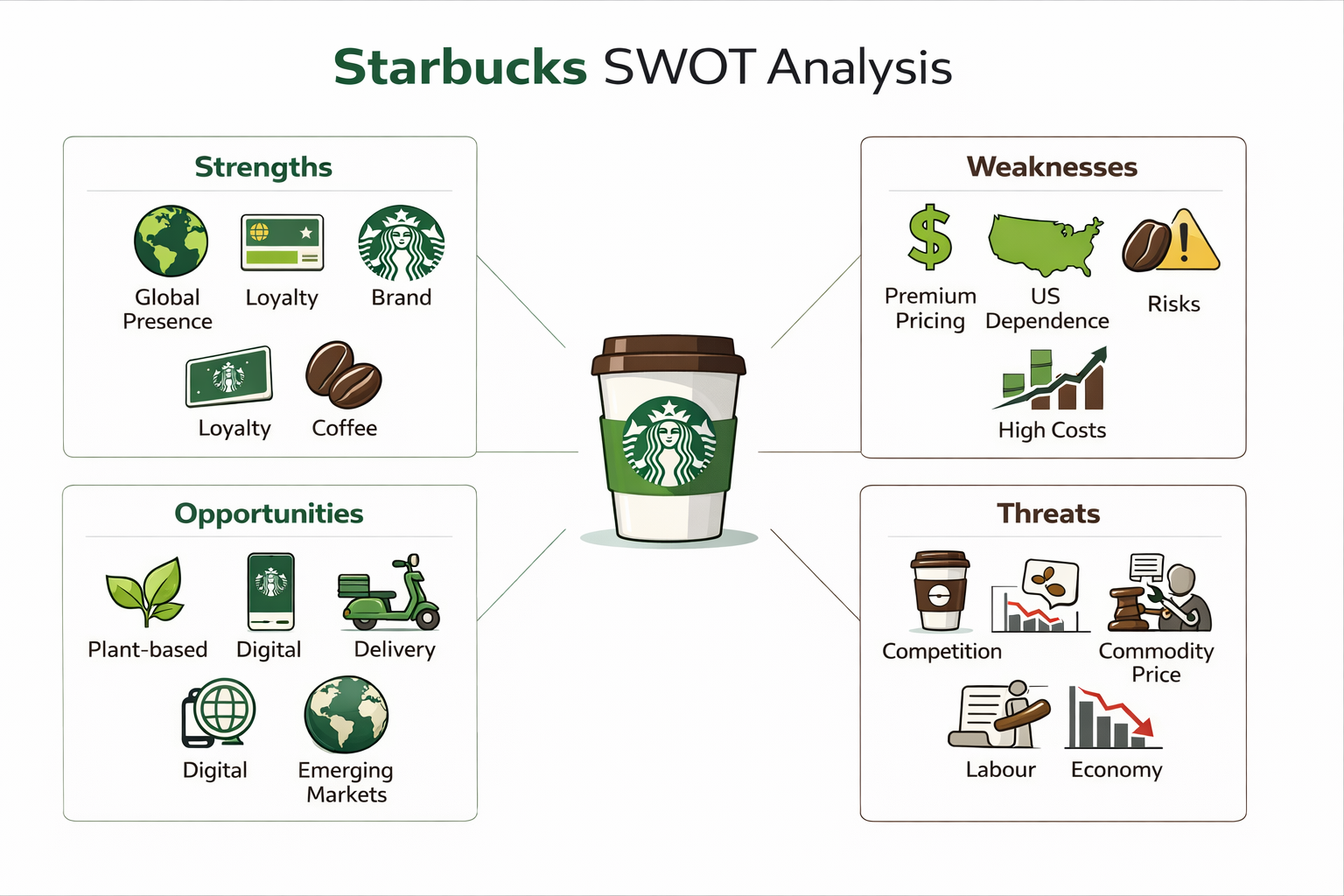
Strengths: Global Brand Recognition, Extensive Store Network, Strong Digital Ecosystem & Loyalty Program, Product Diversification Beyond Coffee, Ethical Sourcing & Sustainability Focus
Weaknesses: Premium Pricing Vulnerability, Heavy US Market Dependence, High Operational Costs (Rent & Labor), Overexposure to Coffee-Based Revenue
Opportunities: Emerging Markets Expansion (India, Southeast Asia, Africa), Health-Focused & Plant-Based Innovation, Digital Subscription & Delivery Growth, Consumer Packaged Goods Expansion, Sustainability Leadership Positioning
Threats: Intense Competition (Chains, Fast Food, Local Cafes), Economic Downturns Affecting Discretionary Spending, Coffee Commodity Price Volatility, Unionization & Labor Regulation, Shifting Consumer Preferences
Strategic Insights from Starbucks SWOT
This SWOT analysis reveals that Starbucks occupies a strong but challenged position. The company’s core strengths—brand equity, global scale, digital infrastructure, and customer loyalty—remain formidable. However, these advantages face increasing pressure from competition, economic uncertainty, and evolving consumer preferences.
Strategically, Starbucks should prioritize three imperatives. First, accelerate profitable growth in emerging markets, particularly India and Southeast Asia, where demographics and economic development favor premium coffee consumption. Success requires cultural adaptation while maintaining brand essence—a balance Starbucks has demonstrated in China. Second, deepen digital engagement through subscriptions, enhanced personalization, and seamless omnichannel experiences that make Starbucks indispensable to daily routines. Third, lead on sustainability and social responsibility, turning commitments into competitive advantages that attract conscious consumers and employees.
The company must also address key tensions. The premium positioning that enables strong margins creates vulnerability during economic stress and limits addressable market size. Starbucks needs strategies that protect premium brand perception while expanding accessibility—perhaps through tiered formats or value-oriented sub-brands. Similarly, maintaining operational efficiency while delivering distinctive experiences requires continued investment in technology and process improvement.
For café startups and founders, Starbucks provides valuable lessons. The “third place” concept demonstrates the power of selling experience beyond product. Digital infrastructure and loyalty programs create sustainable competitive advantages in retail. Ethical sourcing and sustainability commitments resonate with consumers and can justify premium pricing. However, Starbucks’ challenges also offer warnings about overexpansion, operational complexity, and vulnerability to commodity costs and economic cycles.
Investors should view Starbucks as a mature brand with decent growth prospects but meaningful risks. Emerging market expansion offers genuine growth, but success isn’t guaranteed. Digital innovations can drive same-store sales and margin improvement. However, the premium positioning creates cyclical exposure, and competition will remain intense. Valuation should reflect this balanced picture—neither the unstoppable growth story of the past nor a business in terminal decline.
Conclusion
Starbucks remains the dominant global coffeehouse brand, with strengths that competing chains struggle to replicate. The company’s brand recognition, global footprint, loyal customer base, and digital infrastructure create durable competitive advantages. Yet dominance doesn’t equal invincibility. Starbucks faces formidable challenges from competition, economic uncertainty, changing preferences, and operational pressures.
The coffee giant stands at an inflection point. Mature market saturation in North America requires looking elsewhere for growth. Emerging markets offer the most promising opportunities, but success demands cultural sensitivity and operational excellence. Product innovation beyond traditional coffee could expand relevance and reduce commodity dependence. Digital evolution can deepen customer relationships and improve economics. Sustainability leadership might transform costs into competitive advantages.
For investors, Starbucks presents a quality company trading at mature-growth valuations. The stock likely won’t deliver spectacular returns, but should provide steady performance barring major execution failures. For entrepreneurs, Starbucks offers a masterclass in brand building, customer experience, and scaling retail operations globally. The lessons apply far beyond coffee to any business seeking to create beloved consumer brands. For marketers, Starbucks demonstrates the enduring power of consistent branding, emotional connection, and community building.
This SWOT analysis reveals a company navigating the challenges of maturity while pursuing meaningful growth opportunities. Success requires balancing premium positioning with accessibility, global consistency with local relevance, and growth ambitions with operational excellence. Starbucks has proven capable of such balancing acts before. Whether it can continue doing so will determine if the next decade matches the remarkable success of the past.
Discover more from Business Model Hub
Subscribe to get the latest posts sent to your email.